CZ at Davos Talks About the Future: Tokenization, Payments, and AI Are Accelerating Integration

比推Pubblicato 2026-01-23Pubblicato ultima volta 2026-01-23

Introduzione

CZ, founder of Binance, discussed the convergence of tokenization, payments, and AI at Davos. He highlighted that while exchanges and stablecoins are mature sectors, he is particularly excited about three emerging areas: tokenization of real-world assets, the integration of crypto into traditional payment systems, and the use of crypto as the native currency for AI agents. He expressed skepticism about the long-term viability of meme coins and predicted a significant reduction in physical bank branches due to digitalization. CZ also addressed risks, arguing that technological speed amplifies existing systemic flaws rather than creating new ones, using Binance's handling of massive withdrawals as an example of robust system design. He noted the vast differences in global crypto regulation and advocated for a passport system for licenses to foster innovation.

Compiled by: CoolFish

Original Title: Full Transcript of CZ's Davos Dialogue: Bullish on Tokenization, Payments, and Artificial Intelligence


Very Excited About Three New Fields

Moderator: Over the past few days at the forum, I feel like there are almost two completely different conversations happening here. One is about geopolitics and macroeconomics, worrying about the fragmentation of the global trade system, debt, and the role of the US dollar. These conversations are often very depressing and concerning. The other focus is on artificial intelligence, innovation, and technology. These discussions about future possibilities are full of vitality, with many exciting technological breakthroughs happening.

In today's seminar, we will make a bold attempt to merge these different discussions—not only focusing on how innovation happens and what the future might bring, but also thinking about the regulatory and geopolitical context in which these innovations occur, and how this context affects financial innovation.

We have four excellent guests. First, we have Steven van Rijswijk, CEO of the Netherlands' ING Group. Then, Jayee Koffey, Chief Enablement Officer and Global Head of Public Policy at BNY Mellon. Next is Hu Zuliu (Fred Hu), Founder, Chairman, and CEO of China's Primavera Capital Group. Finally, from the UAE, Changpeng Zhao, founder of Binance—we're used to calling him CZ, so I don't have to stumble over the name anymore. CZ is no longer under any restrictions when speaking, so I'm sure he will have some particularly exciting insights to share.

The theme of this discussion is how technology is reshaping the global financial landscape. Those following this field should note that many changes are currently happening. Payment methods and monetary systems are undergoing dramatic changes, and the underlying infrastructure of financial transactions is also iterating rapidly. These changes are overwhelming. To start the discussion, I will ask each of you in the order you are seated: What do you think is the most far-reaching restructuring? What is the most exciting development direction for you? It could be a specific market area—private credit, investment, Bitcoin, stablecoins, digital currencies, etc.; it could be a technological breakthrough—Bitcoin ledger technology; or it could be infrastructure-level innovation. The scope is completely open, please speak freely. Please talk about what exciting new developments you think will have the most profound impact on the financial sector.

CZ: Sure. I focus on a very narrow field in the financial market, mainly cryptocurrencies, blockchain, Web3, whatever you call it. I am convinced that this technology is a game-changer, and I think we have proven over the past 15, 16 years that it is not going away.

Binance is one of the world's largest cryptocurrency exchanges.

Fred Hu: It is actually the largest.

CZ: It is by far the largest, larger than the sum of the top five exchanges. But look at some data—Binance has 300 million users. It's probably larger than any bank I know. The trading volume not only surpasses the Shanghai Stock Exchange but last year also exceeded the New York Stock Exchange. But currently, there are only two truly mature industries in the crypto space: exchanges and stablecoins, both of which are huge business systems.

I am very excited about three other new areas. I think tokenization is a huge field—I am currently discussing asset tokenization solutions with more than ten governments. Governments can use this to achieve financial benefits first, and then promote the upgrading of industries such as mining and trading markets.

We have tried but haven't truly conquered the payment field—to be precise, cryptocurrencies have not truly entered the payment field. We've tried, but no one really uses cryptocurrencies for payments. However, now we see traditional payment methods quietly integrating with encryption technology: when consumers swipe their cards to pay, cryptocurrencies are deducted from their accounts, and merchants receive settlements in fiat currencies such as US dollars or euros. When these bridges are built, the payment field will usher in a major breakthrough.

The third area is artificial intelligence. The native currency for AI agents will be cryptocurrency.

Encrypted blockchains will become the most native technical interface for AI agents. Current AI is far from the level of intelligent agents; they can't buy tickets for you or pay for your meals—but when they have these capabilities, all payments will be made through cryptocurrencies.

Concerns About Some Future Areas

Moderator: The above is the best scenario, the exciting part. Now I want to change the subject a bit. Whenever we go through a period of innovation and experimentation like this, some attempts will succeed, and some will fail. So I want to explore what might not work. Ten years from now, if we are sitting on this panel in Davos, what developments discussed today might not even be mentioned? They might have been abandoned. I'll start by offering a few ideas. You are all excited about AI. But there is also some research from MIT showing that while AI can complete a lot of work quickly, the output is relatively mediocre. They call it "work slop."

You can get about 80% accuracy, and if that's okay with you, then AI is great. But if you really want to pursue excellence and ensure foolproof results, AI might have limitations. Then there are experiments with Bitcoin. El Salvador worked very hard to promote Bitcoin. This was supposed to be a good way—El Salvador relies heavily on remittances and does not have its own stable currency. Bitcoin was supposed to be the ideal choice for the remittance field, reducing transaction costs. But despite a lot of marketing and resources invested, the actual adoption rate is almost zero. These are just a few examples of potential limitations for everyone to think about.

Now let's continue. In the same order. What are the areas that people are excited about today, or at least some people are passionate about—but you think won't even be discussed in ten years? CZ, what areas should we be wary of right now? Or what areas are not worth investing in?

CZ: Sure. I think my three guests are all very measured and politically correct. I will give a more direct answer, which might offend more people, including people in my industry. I do agree with Stephen's point; if you had asked me this question 10 years ago, I might have said Bitcoin payments. But ten years later today, we are still far from that goal. So I am still skeptical about the payment field.

We are working on it. The entire industry is investing in many payment projects. But any innovative field comes with a very high failure rate, and the few successful cases will show exponential growth, right? I also agree with Stephen's view on the metaverse. Well, we saw NFTs were once very hot, but now they have become quite quiet. I have a strong feeling that memes might be similar. I might be wrong.

Many people in the crypto circle will hate me for saying this. But, you know, there is very high risk in new areas where value is highly speculative. It is difficult to build use cases for these areas. Some meme coins have indeed stayed, like Dogecoin, which has been around for about 15 years. So projects with cultural value may survive. But I think most meme coins will not last. Then I also want to add, although this will offend other industries, I think physical banks will significantly decrease in the next 10 years.

Fred Hu: Decrease?

CZ: Yes, decrease. The need for people to go to physical banks will be greatly reduced. I think ING was the first to launch online banking, that was 25 years ago, so it can be seen that replacing traditional industries is a long process. But now we have cryptocurrency and blockchain technology. Electronic identity verification (eKYC) and electronic services (e-everything) can already meet the needs of financial business, and the necessity of physical banks is decreasing.

I don't think banks will disappear. They perform vital functions—actually multiple important functions. But all industries, whether emerging or traditional, have risks. We should regularly and carefully assess market dynamics.

Fred Hu: But you only told us what failed in the past 10 years. You haven't told us what will fail in 10 years.

CZ: Basically saying, it seems memes are high risk. Physical banks are high risk. I could go on, but then I would offend more people.

Guest: Yeah

Views on Risks Generated by AI

Moderator: No, I think your last point is very important. I want you to talk about banks. If macroeconomists were involved in this discussion, they would be highly concerned about the risks banks face. When funds flow through other channels and mechanisms, banks are still a key source of financing for investment and growth—especially for small and medium-sized enterprises, which is particularly significant in Europe, and varies in importance in other parts of the world. But if new financial models emerge, the role of banks may weaken, and funding channels will shift to other mechanisms. So I particularly want to hear your further elaboration on the risks.

Last week I attended a seminar on the risks of AI and algorithmic trading in financial markets. I think the speed of events has indeed increased significantly. For me, even before the many innovations you discussed appeared, the Silicon Valley Bank incident sounded the alarm. In the Silicon Valley Bank incident, we witnessed a bank collapse faster than ever before—even compared to the peak of the 2008 global financial crisis when two major US banks failed (Washington Mutual). At that time, it took about two to three weeks of a bank run for the two banks to finally go bankrupt, while Silicon Valley Bank lost 80% to 90% of its deposits in just one or two days. And that run that lasted two or three weeks only led to about 10%-15% of deposits being lost. But Silicon Valley Bank lost 80%-90% of its deposits in just one or two days. The speed of events was far faster than before. More notably, this was not a crisis triggered by emerging technologies like AI, Bitcoin, etc., but merely by new trends caused by people chatting online.

They didn't all have to go to cafes to exchange news and rumors. And because of new technology, people can withdraw money from online accounts without even having to queue. So in a sense, compared to the things you are talking about, that was outdated technology. Yet, it has fundamentally changed the speed at which bank runs occur. When you consider the impact on the broader financial markets, you find there is more momentum trading. When everyone is using the same algorithm to trade, and AI takes over so that humans don't even have time to press the button, this will cause more severe losses, more violent fluctuations, and a series of risks. How worried should we be about this? Is there any way?

CZ: I want to add a few points. I think it can be broken down into several independent points. I think the first point is that, all else being equal, faster and cheaper is always better. This itself does not create more risk. Existing risks are just more prominent because of the increased speed. But if a bank operates on a fractional reserve system, when there is insufficient funds, people withdrawing money faster only exposes the problem faster. But slowing down the speed does not solve the fundamental problem; it only causes more consumers to be unable to withdraw money when they need it, getting into trouble, so they are trapped. This doesn't solve anything. So all else being equal, technology that reduces costs and improves efficiency is always better.

Regarding the doubts about Silicon Valley Bank, in the crypto industry we felt a completely different rumor atmosphere; the bank may or may not have been in trouble. But our impression is that this bank was very friendly to cryptocurrency. It might have been shut down in 2023 by "Operation Choke Point 2.0".

Let me give the example of Binance: In December 2023, this was after the FTX collapse, after the Luna, UST collapse, and actually also after the Silicon Valley Bank incident. In one day, the maximum withdrawal amount on the Binance platform was $7 billion equivalent in assets. The system ran without a hitch. That week, the withdrawal amounts in the first few days were a few billion, ten billion, ten billion, then 70 billion, then another ten billion, ten billion, ten billion. In that week, a total of $14 billion in assets were withdrawn from the platform, and the system remained stable throughout. In the banking system, I don't know of any bank that can withstand withdrawals of this scale.

So-called "bank runs" essentially stem from the design flaw of banks using a fractional reserve system. When a fractional reserve system is used, liquidity problems follow. This is ultimately a problem of system design, not an AI problem. That's my point.

Of course, AI does have the potential risk of synchronized action. But I think this is just the tip of the iceberg; blaming all problems on this is too one-sided.

Differences in Regulatory Policies Among Countries

Moderator: Okay, so I got some different ideas. So the key lies in settlement, risk management, and regulation including reserve requirements. Some work needs to be done internally by enterprises, but government regulation and national infrastructure construction are also indispensable. We are very fortunate to have such a diverse panel of experts—not only do you operate globally, but your respective companies are also rooted in different countries, like the Netherlands, the US, China, and the UAE. So can you talk about the importance of the regulatory framework? I'll start with Fred. In particular, different countries have adopted different approaches to managing these risks. Fred, can you especially talk about some of the different approaches taken by China and the US? How do the government's approaches affect the opportunities in these countries?

......

CZ: I have a different perspective on this issue because we are in different industries. Personally, I think regulation in the banking and securities industries is already highly developed, highly mature, and highly similar in various countries. Of course, there are differences, which might be a beginner's oversimplification of the problem. But cryptocurrency regulation is completely different—currently, policies vary greatly from country to country. Honestly, Binance holds about 22, 23 licenses around the world, but most countries in the world today do not have a licensing system yet. We also see the US is progressing rapidly, but it is still in progress, right?

In terms of market structure, the FIT21 Bill was passed last year, only six or seven months ago. So this is an ongoing process. We also see many other countries, such as the UAE, which has introduced quite forward-looking regulatory policies, as well as Bahrain, Pakistan, Kenya. We are happy to participate in the consultation process with them so that they can at least have a dialogue with industry participants.

I serve as a private advisor to some governments—although I am neither a cryptocurrency expert nor a regulatory expert. But I just tell them from the perspective of a market participant.

Furthermore, in this process, there are some key differences in policies among countries, especially in terms of capital controls. Many countries restrict the outflow of funds; exceeding the limit constitutes money laundering or a substantive violation (however defined). The US does not have this problem. It does not have such controls. Tax systems also vary greatly from country to country, which directly affects financial regulation—for example, after buying Bitcoin, the price rises, should unrealized gains or realized gains be taxed? Things like that.

Obviously, clearer and more unified rules would greatly improve the current situation. But I think a global regulator is difficult to achieve, although it's not completely impossible at the moment. Different countries have different priorities, different agendas, different considerations, so a global unified regulator would be quite difficult. We would very much like to see it, especially if that global regulator could formulate a proactive, relatively innovation-friendly regulatory framework. That would make the work of industry participants much easier.

But frankly, logically it should be like this—after all, cryptocurrency is essentially the same in every country. We don't want it to change with the country, so there should be a best framework that we can implement. I actually spend a lot of time trying to figure out what that is and how to cooperate with different countries.

Moderator: Glad to hear that, I agree. Now might not be the time to launch a new global international organization or a new global regulatory framework. That would be a tough battle. But that doesn't mean we shouldn't start thinking about what it would look like if the opportunity really arises, especially if we encounter some kind of crisis or major financial collapse. We might want to prepare some ideas and plans so that we can implement some solutions then.

CZ: What is relatively easy to achieve is a regulatory passport system. Like once you get a license in one country, some other countries can also recognize it. This only requires regulatory agencies in different countries to reach some kind of agreement. We have already seen some related discussions. I think this step is most likely to be achieved first. Creating a new regulatory agency or even a forum and other global organizations is both difficult to implement at the execution level and time-consuming.


Twitter:https://twitter.com/BitpushNewsCN

Bitpush TG Discussion Group:https://t.me/BitPushCommunity

Bitpush TG Subscription: https://t.me/bitpush

Original link:https://www.bitpush.news/articles/7605432

Domande pertinenti

QWhat are the three new areas that CZ is particularly excited about in the crypto and blockchain space?

ACZ is excited about tokenization, payments (where traditional payment systems are integrating with crypto technology), and AI (where cryptocurrencies will serve as the native currency for AI agents).

QAccording to CZ, which areas in the crypto industry does he view as high-risk or likely to fail in the future?

ACZ views meme coins as high-risk and believes most will not last, though some with cultural value like Dogecoin may endure. He also predicts a significant reduction in physical bank branches due to digitalization.

QHow does CZ respond to concerns about bank runs accelerated by technology, using the example of Silicon Valley Bank?

ACZ argues that faster technology exposes existing flaws rather than creating new risks. He cites Binance handling $14 billion in withdrawals in a week without issues, attributing bank runs to fractional reserve systems, not technology.

QWhat does CZ say about the current state of global cryptocurrency regulation?

ACZ notes that cryptocurrency regulations vary greatly by country, with many lacking licensing frameworks. He mentions that the UAE, Bahrain, and others have progressive policies, but global regulatory uniformity is challenging due to differing national priorities.

QWhat solution does CZ propose for improving cross-border cryptocurrency regulatory efficiency?

ACZ suggests a regulatory passport system, where a license obtained in one country could be recognized by others, as a more feasible step than creating a global regulatory body.

Letture associate

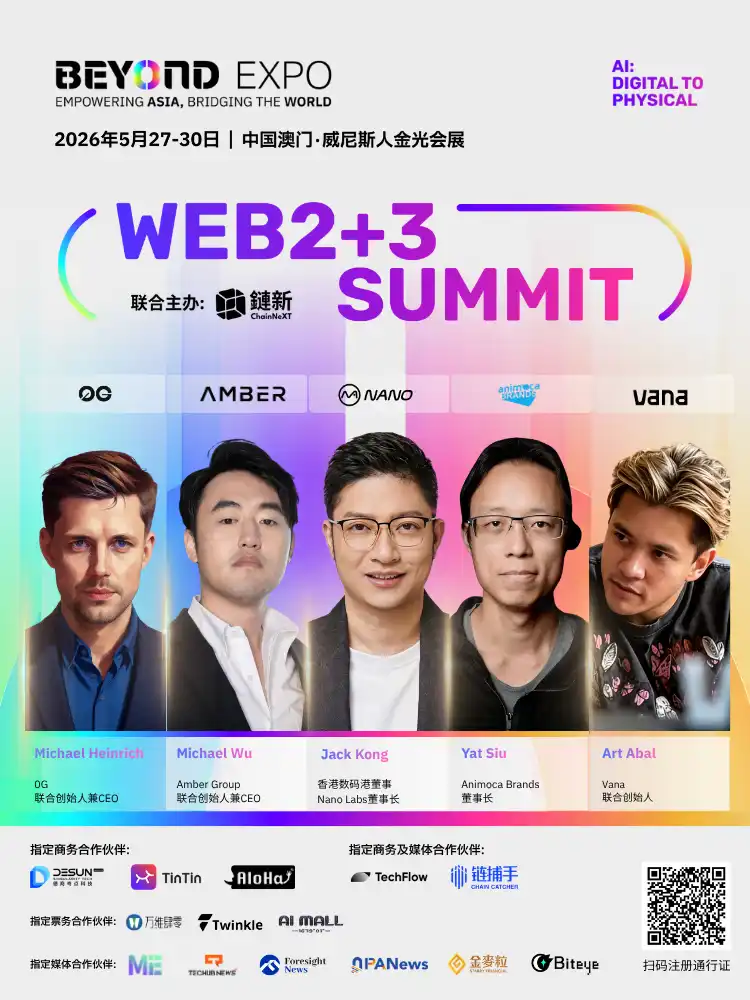
First Batch of Keynote Speakers and Partners Announced! Web2+3 Summit: Defining the Next Generation of Digital Economy

Web2+3 Summit: Defining the Next Generation of Digital Economy The 6th BEYOND International Technology Innovation Expo (BEYOND Expo 2026), Asia's largest tech and ecosystem exhibition, is launching a dedicated Web2+3 stage for the first time. Co-hosted by BEYOND Expo and ChainNeXT Group, the Web3 Summit will take place from May 28–30, 2026. Against the backdrop of accelerating global tech integration, the boundaries between Web2 and Web3 are rapidly blurring. With clearer global regulations for blockchain-driven internet (Web3) and the special issuance of a Hong Kong dollar stable币 license by the Hong Kong SAR government on April 10, 2026, Web3's decentralized principles are quickly merging with traditional industries (Web2) such as e-commerce, finance, and artificial intelligence. Focused on blockchain-driven digital economy elements, the summit will center on three core principles—implementability, commercial viability, and compliance. It will bring together top Web3 experts to discuss key integration areas like stablecoin payment finance (PayFi), real-world asset tokenization (RWA), and decentralized AI (DeAI), unveiling new opportunities for industrial innovation. The first wave of confirmed speakers includes Jack Kong (Director of Hong Kong Cyberport, Chairman of Nano Labs), Yat Siu (Chairman of Animoca Brands), Michael Wu (Co-founder & CEO of Amber Group), Michael Heinrich (Co-founder & CEO of 0G), and Art Abal (Co-founder of Vana). More Web3 ecosystem pioneers, AI, and fintech experts will be announced soon. Core forum topics include: - Web2+DeAI: New AI Paradigms Driven by Decentralized Infrastructure - Web2+RWA: Real-World Asset Tokenization and Global Liquidity - Web2+PayFi: Cross-Border Payments and Financial Innovation Powered by Crypto Infrastructure - Web2+3 AI: Autonomous Agents and the Crypto Economy - Web2+3 Wealth: On-Chain and Off-Chain Integrated Investment Ecosystems - Web2+3 Commerce: A New Landscape for Global Trade Driven by Stablecoins Additional agenda details will be released in the near future.

marsbit4 h fa

First Batch of Keynote Speakers and Partners Announced! Web2+3 Summit: Defining the Next Generation of Digital Economy

marsbit4 h fa

Trading

Spot
Futures

Articoli Popolari

Cosa è GROK AI

Grok AI: Rivoluzionare la Tecnologia Conversazionale nell'Era Web3 Introduzione Nel panorama in rapida evoluzione dell'intelligenza artificiale, Grok AI si distingue come un progetto notevole che collega i domini della tecnologia avanzata e dell'interazione con l'utente. Sviluppato da xAI, un'azienda guidata dal rinomato imprenditore Elon Musk, Grok AI cerca di ridefinire il modo in cui interagiamo con l'intelligenza artificiale. Mentre il movimento Web3 continua a prosperare, Grok AI mira a sfruttare il potere dell'IA conversazionale per rispondere a query complesse, offrendo agli utenti un'esperienza che è non solo informativa ma anche divertente. Cos'è Grok AI? Grok AI è un sofisticato chatbot di intelligenza artificiale conversazionale progettato per interagire dinamicamente con gli utenti. A differenza di molti sistemi di intelligenza artificiale tradizionali, Grok AI abbraccia un'ampia gamma di domande, comprese quelle tipicamente considerate inappropriate o al di fuori delle risposte standard. Gli obiettivi principali del progetto includono: Ragionamento Affidabile: Grok AI enfatizza il ragionamento di buon senso per fornire risposte logiche basate sulla comprensione contestuale. Supervisione Scalabile: L'integrazione dell'assistenza degli strumenti garantisce che le interazioni degli utenti siano sia monitorate che ottimizzate per la qualità. Verifica Formale: La sicurezza è fondamentale; Grok AI incorpora metodi di verifica formale per migliorare l'affidabilità delle sue uscite. Comprensione del Lungo Contesto: Il modello di IA eccelle nel trattenere e richiamare una vasta storia di conversazione, facilitando discussioni significative e consapevoli del contesto. Robustezza Adversariale: Concentrandosi sul miglioramento delle sue difese contro input manipolati o malevoli, Grok AI mira a mantenere l'integrità delle interazioni degli utenti. In sostanza, Grok AI non è solo un dispositivo di recupero informazioni; è un partner conversazionale immersivo che incoraggia un dialogo dinamico. Creatore di Grok AI Il cervello dietro Grok AI non è altri che Elon Musk, un individuo sinonimo di innovazione in vari campi, tra cui automotive, viaggi spaziali e tecnologia. Sotto l'egida di xAI, un'azienda focalizzata sull'avanzamento della tecnologia AI in modi benefici, la visione di Musk mira a rimodellare la comprensione delle interazioni con l'IA. La leadership e l'etica fondamentale sono profondamente influenzate dall'impegno di Musk nel superare i confini tecnologici. Investitori di Grok AI Sebbene i dettagli specifici riguardanti gli investitori che sostengono Grok AI rimangano limitati, è pubblicamente riconosciuto che xAI, l'incubatore del progetto, è fondato e supportato principalmente dallo stesso Elon Musk. Le precedenti imprese e partecipazioni di Musk forniscono un robusto sostegno, rafforzando ulteriormente la credibilità e il potenziale di crescita di Grok AI. Tuttavia, al momento, le informazioni riguardanti ulteriori fondazioni di investimento o organizzazioni che supportano Grok AI non sono facilmente accessibili, segnando un'area per potenziali esplorazioni future. Come Funziona Grok AI? Le meccaniche operative di Grok AI sono innovative quanto il suo framework concettuale. Il progetto integra diverse tecnologie all'avanguardia che facilitano le sue funzionalità uniche: Infrastruttura Robusta: Grok AI è costruito utilizzando Kubernetes per l'orchestrazione dei container, Rust per prestazioni e sicurezza, e JAX per il calcolo numerico ad alte prestazioni. Questo trio garantisce che il chatbot operi in modo efficiente, si scaldi efficacemente e serva gli utenti prontamente. Accesso alla Conoscenza in Tempo Reale: Una delle caratteristiche distintive di Grok AI è la sua capacità di attingere a dati in tempo reale attraverso la piattaforma X—precedentemente nota come Twitter. Questa capacità consente all'IA di accedere alle informazioni più recenti, permettendole di fornire risposte e raccomandazioni tempestive che altri modelli di IA potrebbero perdere. Due Modalità di Interazione: Grok AI offre agli utenti la scelta tra “Modalità Divertente” e “Modalità Normale”. La Modalità Divertente consente uno stile di interazione più giocoso e umoristico, mentre la Modalità Normale si concentra sulla fornitura di risposte precise e accurate. Questa versatilità garantisce un'esperienza su misura che soddisfa varie preferenze degli utenti. In sostanza, Grok AI sposa prestazioni con coinvolgimento, creando un'esperienza che è sia arricchente che divertente. Cronologia di Grok AI Il viaggio di Grok AI è segnato da traguardi fondamentali che riflettono le sue fasi di sviluppo e distribuzione: Sviluppo Iniziale: La fase fondamentale di Grok AI si è svolta in circa due mesi, durante i quali sono stati condotti l'addestramento iniziale e il perfezionamento del modello. Rilascio Beta di Grok-2: In un significativo avanzamento, è stata annunciata la beta di Grok-2. Questo rilascio ha introdotto due versioni del chatbot—Grok-2 e Grok-2 mini—ognuna dotata delle capacità per chattare, programmare e ragionare. Accesso Pubblico: Dopo lo sviluppo beta, Grok AI è diventato disponibile per gli utenti della piattaforma X. Coloro che hanno account verificati tramite un numero di telefono e attivi per almeno sette giorni possono accedere a una versione limitata, rendendo la tecnologia disponibile a un pubblico più ampio. Questa cronologia racchiude la crescita sistematica di Grok AI dall'inizio all'impegno pubblico, enfatizzando il suo impegno per il miglioramento continuo e l'interazione con gli utenti. Caratteristiche Chiave di Grok AI Grok AI comprende diverse caratteristiche chiave che contribuiscono alla sua identità innovativa: Integrazione della Conoscenza in Tempo Reale: L'accesso a informazioni attuali e rilevanti differenzia Grok AI da molti modelli statici, consentendo un'esperienza utente coinvolgente e accurata. Stili di Interazione Versatili: Offrendo modalità di interazione distinte, Grok AI soddisfa varie preferenze degli utenti, invitando alla creatività e alla personalizzazione nella conversazione con l'IA. Avanzata Struttura Tecnologica: L'utilizzo di Kubernetes, Rust e JAX fornisce al progetto un solido framework per garantire affidabilità e prestazioni ottimali. Considerazione del Discorso Etico: L'inclusione di una funzione di generazione di immagini mette in mostra lo spirito innovativo del progetto. Tuttavia, solleva anche considerazioni etiche riguardanti il copyright e la rappresentazione rispettosa di figure riconoscibili—una discussione in corso all'interno della comunità AI. Conclusione Come entità pionieristica nel campo dell'IA conversazionale, Grok AI incarna il potenziale per esperienze utente trasformative nell'era digitale. Sviluppato da xAI e guidato dall'approccio visionario di Elon Musk, Grok AI integra conoscenze in tempo reale con capacità di interazione avanzate. Si sforza di spingere i confini di ciò che l'intelligenza artificiale può realizzare, mantenendo un focus su considerazioni etiche e sicurezza degli utenti. Grok AI non solo incarna il progresso tecnologico, ma rappresenta anche un nuovo paradigma conversazionale nel panorama Web3, promettendo di coinvolgere gli utenti con sia conoscenze esperte che interazioni giocose. Man mano che il progetto continua a evolversi, si erge come testimonianza di ciò che l'incrocio tra tecnologia, creatività e interazione simile a quella umana può realizzare.

350 Totale visualizzazioniPubblicato il 2024.12.26Aggiornato il 2024.12.26

Cosa è GROK AI

Cosa è ERC AI

Euruka Tech: Una Panoramica di $erc ai e delle sue Ambizioni in Web3 Introduzione Nel panorama in rapida evoluzione della tecnologia blockchain e delle applicazioni decentralizzate, nuovi progetti emergono frequentemente, ciascuno con obiettivi e metodologie uniche. Uno di questi progetti è Euruka Tech, che opera nel vasto dominio delle criptovalute e del Web3. L'obiettivo principale di Euruka Tech, in particolare del suo token $erc ai, è presentare soluzioni innovative progettate per sfruttare le crescenti capacità della tecnologia decentralizzata. Questo articolo si propone di fornire una panoramica completa di Euruka Tech, un'esplorazione dei suoi obiettivi, della funzionalità, dell'identità del suo creatore, dei potenziali investitori e della sua importanza nel contesto più ampio del Web3. Cos'è Euruka Tech, $erc ai? Euruka Tech è caratterizzato come un progetto che sfrutta gli strumenti e le funzionalità offerte dall'ambiente Web3, concentrandosi sull'integrazione dell'intelligenza artificiale nelle sue operazioni. Sebbene i dettagli specifici sul framework del progetto siano piuttosto sfuggenti, è progettato per migliorare l'engagement degli utenti e automatizzare i processi nello spazio crypto. Il progetto mira a creare un ecosistema decentralizzato che non solo faciliti le transazioni, ma incorpori anche funzionalità predittive attraverso l'intelligenza artificiale, da cui il nome del suo token, $erc ai. L'obiettivo è fornire una piattaforma intuitiva che faciliti interazioni più intelligenti e un'elaborazione delle transazioni più efficiente all'interno della crescente sfera del Web3. Chi è il Creatore di Euruka Tech, $erc ai? Attualmente, le informazioni riguardanti il creatore o il team fondatore di Euruka Tech rimangono non specificate e piuttosto opache. Questa assenza di dati solleva preoccupazioni, poiché la conoscenza del background del team è spesso essenziale per stabilire credibilità nel settore blockchain. Pertanto, abbiamo classificato queste informazioni come sconosciute fino a quando dettagli concreti non saranno resi disponibili nel dominio pubblico. Chi sono gli Investitori di Euruka Tech, $erc ai? Allo stesso modo, l'identificazione degli investitori o delle organizzazioni di supporto per il progetto Euruka Tech non è prontamente fornita attraverso la ricerca disponibile. Un aspetto cruciale per i potenziali stakeholder o utenti che considerano di impegnarsi con Euruka Tech è la garanzia che deriva da partnership finanziarie consolidate o dal supporto di società di investimento rispettabili. Senza divulgazioni sulle affiliazioni di investimento, è difficile trarre conclusioni complete sulla sicurezza finanziaria o sulla longevità del progetto. In linea con le informazioni trovate, anche questa sezione rimane allo stato di sconosciuto. Come funziona Euruka Tech, $erc ai? Nonostante la mancanza di specifiche tecniche dettagliate per Euruka Tech, è essenziale considerare le sue ambizioni innovative. Il progetto cerca di sfruttare la potenza computazionale dell'intelligenza artificiale per automatizzare e migliorare l'esperienza dell'utente all'interno dell'ambiente delle criptovalute. Integrando l'IA con la tecnologia blockchain, Euruka Tech mira a fornire funzionalità come operazioni automatizzate, valutazioni del rischio e interfacce utente personalizzate. L'essenza innovativa di Euruka Tech risiede nel suo obiettivo di creare una connessione fluida tra gli utenti e le vaste possibilità presentate dalle reti decentralizzate. Attraverso l'utilizzo di algoritmi di apprendimento automatico e IA, mira a ridurre le sfide degli utenti alle prime armi e semplificare le esperienze transazionali all'interno del framework Web3. Questa simbiosi tra IA e blockchain sottolinea l'importanza del token $erc ai, fungendo da ponte tra le interfacce utente tradizionali e le avanzate capacità delle tecnologie decentralizzate. Cronologia di Euruka Tech, $erc ai Sfortunatamente, a causa delle limitate informazioni disponibili riguardo a Euruka Tech, non siamo in grado di presentare una cronologia dettagliata dei principali sviluppi o traguardi nel percorso del progetto. Questa cronologia, tipicamente preziosa per tracciare l'evoluzione di un progetto e comprendere la sua traiettoria di crescita, non è attualmente disponibile. Man mano che le informazioni su eventi notevoli, partnership o aggiunte funzionali diventano evidenti, gli aggiornamenti miglioreranno sicuramente la visibilità di Euruka Tech nella sfera crypto. Chiarimento su Altri Progetti “Eureka” È importante sottolineare che più progetti e aziende condividono una nomenclatura simile con “Eureka.” La ricerca ha identificato iniziative come un agente IA della NVIDIA Research, che si concentra sull'insegnamento ai robot di compiti complessi utilizzando metodi generativi, così come Eureka Labs ed Eureka AI, che migliorano l'esperienza utente nell'istruzione e nell'analisi del servizio clienti, rispettivamente. Tuttavia, questi progetti sono distinti da Euruka Tech e non dovrebbero essere confusi con i suoi obiettivi o funzionalità. Conclusione Euruka Tech, insieme al suo token $erc ai, rappresenta un attore promettente ma attualmente oscuro nel panorama del Web3. Sebbene i dettagli sul suo creatore e sugli investitori rimangano non divulgati, l'ambizione centrale di combinare intelligenza artificiale e tecnologia blockchain si erge come un punto focale di interesse. Gli approcci unici del progetto nel promuovere l'engagement degli utenti attraverso l'automazione avanzata potrebbero distinguerlo mentre l'ecosistema Web3 progredisce. Con l'evoluzione continua del mercato crypto, gli stakeholder dovrebbero tenere d'occhio gli sviluppi riguardanti Euruka Tech, poiché lo sviluppo di innovazioni documentate, partnership o una roadmap definita potrebbe presentare opportunità significative nel prossimo futuro. Così com'è, attendiamo ulteriori approfondimenti sostanziali che potrebbero svelare il potenziale di Euruka Tech e la sua posizione nel competitivo panorama crypto.

359 Totale visualizzazioniPubblicato il 2025.01.02Aggiornato il 2025.01.02

Cosa è ERC AI

Cosa è DUOLINGO AI

DUOLINGO AI: Integrare l'apprendimento delle lingue con Web3 e innovazione AI In un'era in cui la tecnologia rimodella l'istruzione, l'integrazione dell'intelligenza artificiale (AI) e delle reti blockchain annuncia una nuova frontiera per l'apprendimento delle lingue. Entra in scena DUOLINGO AI e la sua criptovaluta associata, $DUOLINGO AI. Questo progetto aspira a fondere la potenza educativa delle principali piattaforme di apprendimento delle lingue con i benefici della tecnologia decentralizzata Web3. Questo articolo esplora gli aspetti chiave di DUOLINGO AI, esaminando i suoi obiettivi, il framework tecnologico, lo sviluppo storico e il potenziale futuro, mantenendo chiarezza tra la risorsa educativa originale e questa iniziativa indipendente di criptovaluta. Panoramica di DUOLINGO AI Alla sua base, DUOLINGO AI cerca di stabilire un ambiente decentralizzato in cui gli studenti possono guadagnare ricompense crittografiche per il raggiungimento di traguardi educativi nella competenza linguistica. Applicando smart contracts, il progetto mira ad automatizzare i processi di verifica delle competenze e le allocazioni di token, aderendo ai principi di Web3 che enfatizzano la trasparenza e la proprietà da parte degli utenti. Il modello si discosta dagli approcci tradizionali all'acquisizione linguistica, facendo forte affidamento su una struttura di governance guidata dalla comunità, che consente ai detentori di token di suggerire miglioramenti ai contenuti dei corsi e alle distribuzioni delle ricompense. Alcuni degli obiettivi notevoli di DUOLINGO AI includono: Apprendimento Gamificato: Il progetto integra traguardi blockchain e token non fungibili (NFT) per rappresentare i livelli di competenza linguistica, promuovendo la motivazione attraverso ricompense digitali coinvolgenti. Creazione di Contenuti Decentralizzati: Apre opportunità per educatori e appassionati di lingue di contribuire con i propri corsi, facilitando un modello di condivisione dei ricavi che beneficia tutti i collaboratori. Personalizzazione Guidata dall'AI: Utilizzando modelli avanzati di machine learning, DUOLINGO AI personalizza le lezioni per adattarsi ai progressi individuali, simile alle funzionalità adattive presenti nelle piattaforme consolidate. Creatori del Progetto e Governance A partire da aprile 2025, il team dietro $DUOLINGO AI rimane pseudonimo, una pratica comune nel panorama decentralizzato delle criptovalute. Questa anonimato è inteso a promuovere la crescita collettiva e il coinvolgimento degli stakeholder piuttosto che concentrarsi su sviluppatori individuali. Lo smart contract distribuito sulla blockchain di Solana annota l'indirizzo del wallet dello sviluppatore, che segna l'impegno verso la trasparenza riguardo alle transazioni, nonostante l'identità dei creatori sia sconosciuta. Secondo la sua roadmap, DUOLINGO AI mira a evolversi in un'Organizzazione Autonoma Decentralizzata (DAO). Questa struttura di governance consente ai detentori di token di votare su questioni critiche come l'implementazione di funzionalità e le allocazioni del tesoro. Questo modello si allinea con l'etica dell'empowerment della comunità presente in varie applicazioni decentralizzate, enfatizzando l'importanza del processo decisionale collettivo. Investitori e Partnership Strategiche Attualmente, non ci sono investitori istituzionali o capitalisti di rischio identificabili pubblicamente legati a $DUOLINGO AI. Invece, la liquidità del progetto proviene principalmente da scambi decentralizzati (DEX), segnando un netto contrasto con le strategie di finanziamento delle aziende tradizionali di tecnologia educativa. Questo modello di base indica un approccio guidato dalla comunità, riflettendo l'impegno del progetto verso la decentralizzazione. Nel suo whitepaper, DUOLINGO AI menziona la formazione di collaborazioni con “piattaforme educative blockchain” non specificate, mirate ad arricchire la sua offerta di corsi. Sebbene partnership specifiche non siano ancora state divulgate, questi sforzi collaborativi suggeriscono una strategia per mescolare innovazione blockchain con iniziative educative, ampliando l'accesso e il coinvolgimento degli utenti attraverso diverse vie di apprendimento. Architettura Tecnologica Integrazione AI DUOLINGO AI incorpora due componenti principali guidate dall'AI per migliorare la sua offerta educativa: Motore di Apprendimento Adattivo: Questo sofisticato motore apprende dalle interazioni degli utenti, simile ai modelli proprietari delle principali piattaforme educative. Regola dinamicamente la difficoltà delle lezioni per affrontare le sfide specifiche degli studenti, rinforzando le aree deboli attraverso esercizi mirati. Agenti Conversazionali: Utilizzando chatbot alimentati da GPT-4, DUOLINGO AI offre una piattaforma per gli utenti per impegnarsi in conversazioni simulate, promuovendo un'esperienza di apprendimento linguistico più interattiva e pratica. Infrastruttura Blockchain Costruito sulla blockchain di Solana, $DUOLINGO AI utilizza un framework tecnologico completo che include: Smart Contracts per la Verifica delle Competenze: Questa funzionalità assegna automaticamente token agli utenti che superano con successo i test di competenza, rinforzando la struttura di incentivi per risultati di apprendimento genuini. Badge NFT: Questi token digitali significano vari traguardi che gli studenti raggiungono, come completare una sezione del loro corso o padroneggiare competenze specifiche, consentendo loro di scambiare o mostrare digitalmente i loro successi. Governance DAO: I membri della comunità dotati di token possono partecipare alla governance votando su proposte chiave, facilitando una cultura partecipativa che incoraggia l'innovazione nell'offerta di corsi e nelle funzionalità della piattaforma. Cronologia Storica 2022–2023: Concettualizzazione I lavori per DUOLINGO AI iniziano con la creazione di un whitepaper, evidenziando la sinergia tra i progressi dell'AI nell'apprendimento delle lingue e il potenziale decentralizzato della tecnologia blockchain. 2024: Lancio Beta Un lancio beta limitato introduce offerte in lingue popolari, premiando i primi utenti con incentivi in token come parte della strategia di coinvolgimento della comunità del progetto. 2025: Transizione DAO Ad aprile, avviene un lancio completo della mainnet con la circolazione di token, stimolando discussioni nella comunità riguardo a possibili espansioni nelle lingue asiatiche e ad altri sviluppi dei corsi. Sfide e Direzioni Future Ostacoli Tecnici Nonostante i suoi obiettivi ambiziosi, DUOLINGO AI affronta sfide significative. La scalabilità rimane una preoccupazione costante, in particolare nel bilanciare i costi associati all'elaborazione dell'AI e nel mantenere una rete decentralizzata reattiva. Inoltre, garantire la creazione e la moderazione di contenuti di qualità in un'offerta decentralizzata presenta complessità nel mantenere standard educativi. Opportunità Strategiche Guardando al futuro, DUOLINGO AI ha il potenziale per sfruttare partnership di micro-credentialing con istituzioni accademiche, fornendo validazioni verificate dalla blockchain delle competenze linguistiche. Inoltre, l'espansione cross-chain potrebbe consentire al progetto di attingere a basi utenti più ampie e a ulteriori ecosistemi blockchain, migliorando la sua interoperabilità e portata. Conclusione DUOLINGO AI rappresenta una fusione innovativa di intelligenza artificiale e tecnologia blockchain, presentando un'alternativa focalizzata sulla comunità ai sistemi tradizionali di apprendimento delle lingue. Sebbene il suo sviluppo pseudonimo e il modello economico emergente comportino alcuni rischi, l'impegno del progetto verso l'apprendimento gamificato, l'istruzione personalizzata e la governance decentralizzata illumina un percorso per la tecnologia educativa nel regno di Web3. Man mano che l'AI continua a progredire e l'ecosistema blockchain evolve, iniziative come DUOLINGO AI potrebbero ridefinire il modo in cui gli utenti interagiscono con l'istruzione linguistica, potenziando le comunità e premiando il coinvolgimento attraverso meccanismi di apprendimento innovativi.

330 Totale visualizzazioniPubblicato il 2025.04.11Aggiornato il 2025.04.11

Cosa è DUOLINGO AI

Discussioni

Benvenuto nella Community HTX. Qui puoi rimanere informato sugli ultimi sviluppi della piattaforma e accedere ad approfondimenti esperti sul mercato. Le opinioni degli utenti sul prezzo di AI AI sono presentate come di seguito.

活动图片