Cypherpunk values are dying, but they’re not dead yet

cointelegraphPubblicato 2025-12-18Pubblicato ultima volta 2025-12-18

Introduzione

The author reflects on their grandfather's distrust of banks and preference for hiding cash, which initially seemed paranoid but later revealed deeper wisdom about privacy and financial sovereignty. Growing up in wartime London, his generation valued privacy as a fundamental right, contrasting sharply with today’s pervasive surveillance and data exploitation. The article critiques modern attitudes that equate privacy with secrecy, citing examples like Vitalik Buterin’s criticized use of a mixer and the erosion of self-sovereignty. It emphasizes that privacy is normal and essential for an open society, echoing Eric Hughes' "Cypherpunk Manifesto." Despite the decline of cypherpunk values—privacy, self-sovereignty, and decentralization—the piece argues they are not yet dead, calling for renewed focus on these principles.

Not long before he died, Grandad said something that I thought was a little silly, a little old-fashioned.

He declared that he didn’t trust the banks, and he didn’t want them to know what he did with his money. I scoffed at the time, paranoid old fella! But of course, it turns out I owe him an apology.

As we were walking around his house, he motioned toward an off-white wall with an off-comfortable sofa in front of it. This piece of singularly ugly furniture hadn’t left its spot in more than a decade.

The wall had a small square door that, when pushed in, revealed a crawl space. Inside was packaging from the 1970s, partially gnawed board games and unimportant documents, squirreled as if they would one day stave off a harsh winter.

My Grandad guided my flashlight to a brown padded envelope hidden near what I was truly hoping wasn’t exposed asbestos. I retrieved the envelope and handed it over. He took the opportunity to deliver a short speech. He was proud I was doing my Master’s, and he knew it was a financial burden, so he wanted to help. Inside the envelope was a musty wad of cash fastened with a mostly decayed rubber band.

His speech was meaningful, but what came after was wisdom that took more than 10 years to land. I asked why he hid cash in the wall, and he explained that most of his savings were hidden around the house; in books, in wardrobes, under mattresses. In fact, he joked that when he died, I must tear the house apart before it’s sold.

Well, he did die, and we did examine every crack and cavity, and we did indeed find most of his savings. Some of the cash was so old that we worried the bank may not even agree to exchange it for modern legal tender, though inflation had robbed the piles of most of their purchasing power anyway, two scams of fiat that I’ll save for another article.

My Grandad grew up poor in wartime London, and it meant a fierce caution with currency was woven into his DNA; money was scarce. Still, his philosophy was sound, and it has played on my mind for years now.

The people of my grandparents’ era were highly protective of their privacy, back when it was a basic human right. I know, how quaint.

In 1950, a motorist named Harry Willcock was stopped in London, and the police officer demanded to see his identity card, an unfortunate requirement introduced at the outbreak of World War II.

Harry refused to brandish his papers and was arrested. According to the lord chief justice in charge of the subsequent legal battle, the ID cards were now being used for purposes beyond their original scope. And so, they were scrapped.

Back in the 1950s, privacy was the baseline for most, and it led to suspicion of anything like surveillance, despite there not being much of it. Just 70 years ago, surveillance was rare, labor-intensive and expensive, typically involving someone physically following you, possibly in a trench coat.

Conversations, cash payments and public transport; no permanent record was left. Any records created were mainly on paper and, importantly, siloed. You couldn’t easily cross-reference records; it’s what lawyers call “practical obscurity.”

Today, our data is farmed, sold and cross-referenced en masse as surveillance has become the new baseline.

My Grandad would have loathed the modern way. He was unknowingly a cypherpunk, and those values are eroding with increasing speed.
Source: Cointelegraph

Privacy, self-sovereignty, decentralization: Before it’s too late

The privacy narrative that has arisen of late could be chalked up to numerous causes, but it feels like a desperate and inevitable last stand.

Society is somehow so downtrodden that tools to assist with privacy are demonized. Vitalik Buterin used a mixer to donate money and was criticized with winks and nods, suggesting he was shady for doing so. Buterin replied with the simple yet iconic, “Privacy is normal.”

There is a sense that a desire for privacy must mean you have something to hide, but as Susie Violet Ward, CEO of Bitcoin Policy UK, once replied: “You have curtains in your house, don’t you?”

Eric Hughes wrote in “A Cypherpunk Manifesto” in 1993 that “privacy is necessary for an open society in the electronic age. Privacy is not secrecy. A private matter is something one doesn’t want the whole world to know, but a secret matter is something one doesn’t want anybody to know. Privacy is the power to selectively reveal oneself to the world.”

Self-sovereignty has followed the downward trajectory of privacy. Control over one’s identity, data and even property has been steadily stripped away, year after year. We must offer up identification, in nearly a “papers, please” kind of way, to most centralized authorities with which we wish to interact.

With data, extensive legal battles have carved us a sliver of control with the “right to be forgotten,” but even that still requires each person to manually request the erasure of their data from each holder.

Likewise, with property, the “right to repair” was necessary as manufacturers of everything from cars to phones raised the walls of their gardens.

These issues are not the concern of the unscrupulous, and we need not whisper. Privacy is normal, as is agency over the many threads of our lives and the right to a fair, pragmatically decentralized playing field.

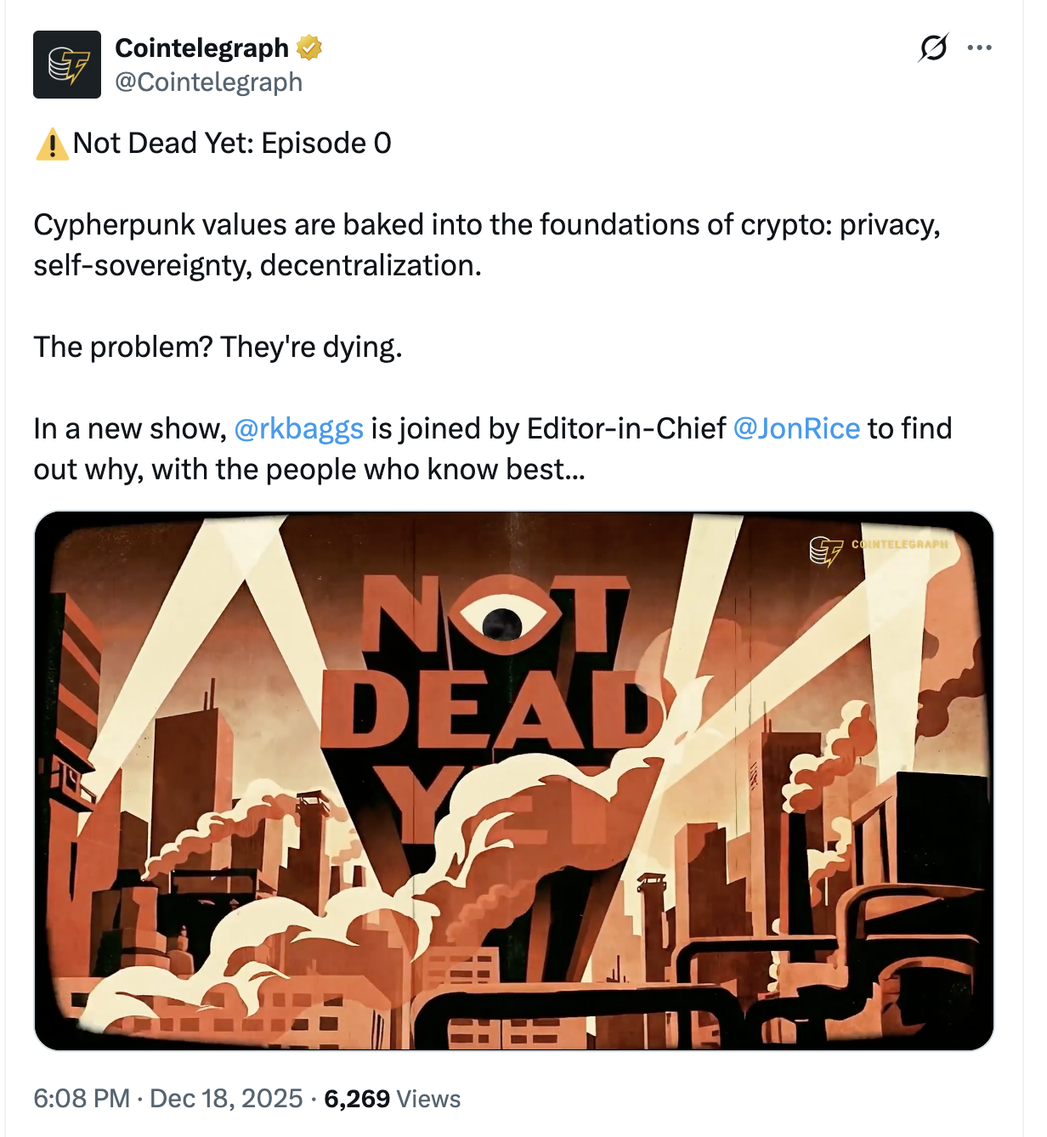
That is why Cointelegraph is launching a show dedicated to conversations on the erosion of these basic human rights, with bona fide experts, visionaries and those building the tools of a free and private future. It is a show for the digital dissidents who believe in civil liberties.

Because cypherpunk values are dying.

But they’re Not Dead Yet.


Crypto di tendenza

Domande pertinenti

QWhat core values does the article associate with the cypherpunk movement?

AThe article associates privacy, self-sovereignty, and decentralization as the core values of the cypherpunk movement.

QWhy did the author's grandfather hide cash around his house?

AHe didn't trust the banks and wanted to keep his financial transactions private, a philosophy born from growing up poor in wartime London where money was scarce.

QAccording to the article, how has the public perception of privacy changed from the last century to today?

AIn the past, privacy was considered a baseline human right and the public was suspicious of surveillance. Today, mass surveillance and data farming have become the new baseline, and the desire for privacy is often wrongly equated with having something to hide.

QWhat historical example is given to illustrate the public's past defense of privacy?

AThe case of Harry Willcock in 1950s London, who was arrested for refusing to show his identity card to a police officer, leading to the eventual scrapping of the ID card system as it was being used beyond its original purpose.

QWhat is the main argument the article makes against the notion that wanting privacy means you have something to hide?

AThe article argues that privacy is not secrecy. It quotes Eric Hughes's 'A Cypherpunk Manifesto,' stating that 'privacy is the power to selectively reveal oneself to the world,' and uses the analogy of having curtains in one's house to show that the desire for privacy is normal and not nefarious.

Letture associate

After Aave's Exit and TVL's Sharp Fluctuation, Where Does MegaETH's Valuation Anchor Lie?

Following the withdrawal of Aave and a sharp drop in its Total Value Locked (TVL), the valuation of the high-performance DeFi blockchain MegaETH faces scrutiny. Once a highly anticipated project with a fully diluted valuation (FDV) reaching around $2 billion, MegaETH saw its TVL plummet from a May peak of $245 million to just over $30 million in July, a roughly 70% decline. Its native token, MEGA, currently trades around $0.048 with a market cap of approximately $54 million and an FDV of about $480 million. The report identifies a core vulnerability: MegaETH's TVL was heavily dependent on a single protocol, Aave V3, which at its peak contributed around 90% of the chain's TVL. A significant portion of this capital is attributed to leveraged yield-farming strategies involving stablecoins like USDe. When the profitability of these strategies diminished, capital rapidly exited, exposing the lack of diversified, sustainable activity. Three key mismatches between MegaETH's valuation and its fundamentals are highlighted: 1. **Valuation vs. Real Usage:** With an FDV of ~$4.8B but only ~$1M in annualized protocol revenue and ~2,600 daily active addresses, the valuation appears disconnected from current economic activity. 2. **Token Narrative vs. Ecosystem Reality:** Despite its DeFi narrative, nearly 80% of the chain's recent protocol revenue comes from a trading card game, Monster, not from core DeFi applications like Aave. The chain's native stablecoin, USDM, also shows low trading volume and a declining market cap. 3. **Short-Term Hype vs. Long-Term Delivery:** Initial hype from token generation, blue-chip integrations, and influencer support has faded. Major protocols like Uniswap now hold minimal TVL on the chain, indicating that early capital was largely transient and driven by incentives rather than organic demand. The situation reflects a broader market trend where investors are becoming less tolerant of valuations based on inflated TVL and narrative, demanding clearer evidence of sustainable transactions, revenue, and ecosystem development. While MEGA's price may experience short-term rebounds from market sentiment, a fundamental re-rating likely depends on the team's ability to convert its remaining resources into tangible, user-retaining applications and genuine ecosystem growth.

链捕手1 h fa

After Aave's Exit and TVL's Sharp Fluctuation, Where Does MegaETH's Valuation Anchor Lie?

链捕手1 h fa

Goldman Sachs In-Depth Report: Who Will Be the Long-Term Winners in China's AI Large Model Industry?

Goldman Sachs Report: China's AI Models at an Inflection Point China's open-source/open-weight large language models (LLMs) have reached performance parity with top global proprietary models, according to a Goldman Sachs report. This is driven by architectural innovations and higher parameter efficiency, allowing Chinese models to achieve comparable capabilities at 2%-10% the parameter size and significantly lower cost. The market is evolving into a two-tiered structure: a high-end segment (e.g., GLM5.2, Qwen3.7 Max) with premium pricing and a low-end, price-sensitive segment for global SMEs and individual users. Key points: * **Cost & Performance:** Innovations like Mixture of Experts (MoE) enable high performance with smaller models. Projects like Meituan's LongCat 2.0, trained on domestic hardware, highlight progress in tech self-sufficiency. * **Open-Source Strategy:** Most Chinese players use open-source/open-weight models for flexibility and ecosystem growth. However, Goldman notes this may underreport actual deployment and revenue. A shift toward "open-weight + community license" models with revenue sharing (e.g., MiniMax) could improve monetization. * **Market Shift & Global Expansion:** Enterprise AI adoption is shifting from "token maximization" to "ROI-first." International expansion, especially in non-US markets, is a major growth driver. Chinese models are increasingly available on global platforms like AWS Bedrock and Microsoft Copilot. * **Competitive Landscape:** Using a framework based on pricing power, cost advantage, and financial strength, Goldman identifies **Zhipu AI and DeepSeek** as the strongest in foundational text models, and **ByteDance** as the leader in multimodal/video generation. The report maintains Buy ratings on MiniMax and Kuaishou. * **Market Growth:** China's AI model API and subscription revenue is projected to grow from an estimated ¥35 billion in 2026 to ¥879 billion by 2030.

marsbit1 h fa

Goldman Sachs In-Depth Report: Who Will Be the Long-Term Winners in China's AI Large Model Industry?

marsbit1 h fa

Goldman Sachs Deep Dive Report: Who Will Become the Long-Term Winners in China's AI Large Model Industry?

Goldman Sachs Report: Who Will Be the Long-Term Winners in China's AI Large Model Industry? China's AI large model sector is at a historic inflection point. Goldman Sachs argues that the intelligence of Chinese open-source/open-weight models is approaching top global proprietary models. Rapid adoption by domestic enterprises and global SMEs is creating a data flywheel effect that will further drive model iteration. The evolution is summarized as moving from "DeepSeek's cost-efficiency moment last year to GLM's model-intelligence moment this year." Chinese models achieve near-state-of-the-art performance at significantly lower cost, primarily due to architectural innovations like Mixture of Experts (MoE) and higher parameter efficiency. Models like DeepSeek V4 Pro (1.6T params), GLM5.2 (0.7T), and MiniMax M3 (0.4T) are much smaller than global leaders. Recent advancements in coding capability are attributed to better data curation and RLHF. Landmarks like Meituan's LongCat 2.0, trained fully on domestic AI chips, demonstrate progress in hardware stack independence. The market is forming a "two-tiered structure." The high-end tier (e.g., GLM5.2, Alibaba's Qwen3.7 Max) prices around $1 per million tokens, about 10-25% of US top models, with estimated inference gross margins of 10-20%. The low-end tier (priced as low as $0.06-$0.2 per million tokens) targets price-sensitive global SMEs and individuals. MiniMax derives 60-70% of revenue overseas. Goldman forecasts China's AI model API/subscription revenue to grow from an estimated RMB 35bn in 2026 to RMB 879bn by 2030. Most Chinese players adopt open-source/open-weight strategies for deployment flexibility and community feedback, though this limits monetization as deployments on third-party platforms (e.g., Alibaba Cloud) may not generate direct revenue. A shift towards "open-weight + community license" models with revenue-sharing agreements (like MiniMax's approach) could improve unit economics. International expansion, particularly in non-US markets, is the key growth driver. The global enterprise AI paradigm is shifting from "token maximization" to "ROI prioritization." Chinese models are already hosted on major global platforms like AWS Bedrock and are under consideration for integration into Microsoft Copilot. Using a competitive framework based on pricing power, cost advantage, and financial strength, Goldman identifies the strongest players: In foundational text models, Zhipu AI (initiated coverage) and DeepSeek lead. In multimodal/video generation, ByteDance's Seed is the frontrunner, with Kuaishou's Kling and MiniMax's Hailuo also well-positioned. Goldman maintains a Buy rating on MiniMax, citing its attractive valuation.

链捕手1 h fa

Goldman Sachs Deep Dive Report: Who Will Become the Long-Term Winners in China's AI Large Model Industry?

链捕手1 h fa

Trading

Spot

Articoli Popolari

Come comprare O

Benvenuto in HTX.com! Abbiamo reso l'acquisto di O1 exchange (O) semplice e conveniente. Segui la nostra guida passo passo per intraprendere il tuo viaggio nel mondo delle criptovalute.Step 1: Crea il tuo Account HTXUsa la tua email o numero di telefono per registrarti il tuo account gratuito su HTX. Vivi un'esperienza facile e sblocca tutte le funzionalità,Crea il mio accountStep 2: Vai in Acquista crypto e seleziona il tuo metodo di pagamentoCarta di credito/debito: utilizza la tua Visa o Mastercard per acquistare immediatamente O1 exchangeO.Bilancio: Usa i fondi dal bilancio del tuo account HTX per fare trading senza problemi.Terze parti: abbiamo aggiunto metodi di pagamento molto utilizzati come Google Pay e Apple Pay per maggiore comodità.P2P: Fai trading direttamente con altri utenti HTX.Over-the-Counter (OTC): Offriamo servizi su misura e tassi di cambio competitivi per i trader.Step 3: Conserva O1 exchange (O)Dopo aver acquistato O1 exchange (O), conserva nel tuo account HTX. In alternativa, puoi inviare tramite trasferimento blockchain o scambiare per altre criptovalute.Step 4: Scambia O1 exchange (O)Scambia facilmente O1 exchange (O) nel mercato spot di HTX. Accedi al tuo account, seleziona la tua coppia di trading, esegui le tue operazioni e monitora in tempo reale. Offriamo un'esperienza user-friendly sia per chi ha appena iniziato che per i trader più esperti.

70 Totale visualizzazioniPubblicato il 2026.06.19Aggiornato il 2026.06.29

Come comprare O

Come comprare PROS

Benvenuto in HTX.com! Abbiamo reso l'acquisto di Pharos (PROS) semplice e conveniente. Segui la nostra guida passo passo per intraprendere il tuo viaggio nel mondo delle criptovalute.Step 1: Crea il tuo Account HTXUsa la tua email o numero di telefono per registrarti il tuo account gratuito su HTX. Vivi un'esperienza facile e sblocca tutte le funzionalità,Crea il mio accountStep 2: Vai in Acquista crypto e seleziona il tuo metodo di pagamentoCarta di credito/debito: utilizza la tua Visa o Mastercard per acquistare immediatamente PharosPROS.Bilancio: Usa i fondi dal bilancio del tuo account HTX per fare trading senza problemi.Terze parti: abbiamo aggiunto metodi di pagamento molto utilizzati come Google Pay e Apple Pay per maggiore comodità.P2P: Fai trading direttamente con altri utenti HTX.Over-the-Counter (OTC): Offriamo servizi su misura e tassi di cambio competitivi per i trader.Step 3: Conserva Pharos (PROS)Dopo aver acquistato Pharos (PROS), conserva nel tuo account HTX. In alternativa, puoi inviare tramite trasferimento blockchain o scambiare per altre criptovalute.Step 4: Scambia Pharos (PROS)Scambia facilmente Pharos (PROS) nel mercato spot di HTX. Accedi al tuo account, seleziona la tua coppia di trading, esegui le tue operazioni e monitora in tempo reale. Offriamo un'esperienza user-friendly sia per chi ha appena iniziato che per i trader più esperti.

69 Totale visualizzazioniPubblicato il 2026.06.22Aggiornato il 2026.06.29

Come comprare PROS

Cosa è VERONA

I. Introduzione al Progetto VERONA è una blockchain costruita per tutti, ovunque attraverso l'astrazione della catena. Utilizzando il suo livello di astrazione generalizzato, VERONA si distingue integrando funzionalità blockchain complesse, come conti, firme e interoperabilità, direttamente a livello di protocollo. Questo approccio consente di interagire con le applicazioni blockchain senza la necessità di comprendere le tecnologie sottostanti.1) Informazioni di Base Nome:VERONA(VERONA)III. Link Correlati Link al sito ufficiale:https://xion.burnt.com/ Whitepaper:https://xion.burnt.com/whitepaper.pdf Esploratori:https://explorer.burnt.com/ Social Media: https://x.com/burnt_xion Nota: L'introduzione al progetto proviene dai materiali pubblicati o forniti dal team ufficiale del progetto, che è solo a scopo di riferimento e non costituisce consulenza per investimenti. HTX non si assume responsabilità per eventuali perdite dirette o indirette risultanti.

95 Totale visualizzazioniPubblicato il 2026.06.22Aggiornato il 2026.06.22

Cosa è VERONA

Discussioni

Benvenuto nella Community HTX. Qui puoi rimanere informato sugli ultimi sviluppi della piattaforma e accedere ad approfondimenti esperti sul mercato. Le opinioni degli utenti sul prezzo di A A sono presentate come di seguito.

活动图片