Cutting Off OpenAI, Anthropic Acquires the Tool Provider Used by a Quarter of Global Developers

marsbitPubblicato 2026-05-21Pubblicato ultima volta 2026-05-21

Introduzione

Anthropic has acquired Stainless, a developer tool company that automatically generated official SDKs (Software Development Kits) for AI giants including OpenAI, Anthropic, Meta, and Cloudflare. The deal, reportedly valued at around $300 million, marks a strategic shift for Anthropic as it builds its "AI agent" infrastructure. Stainless acted as a "translator," converting complex API specifications into ready-to-use code libraries for developers. Its tools indirectly reached about a quarter of professional software developers globally. Following the acquisition, Stainless will shut down its public products and its team will join Anthropic to focus on internal platform development, notably for the Claude Platform. Existing SDKs remain with their respective client companies but will no longer receive updates from Stainless. This move is part of Anthropic's broader 18-month strategy to assemble a complete "agent stack." The stack consists of the Claude model at its core, the newly acquired Stainless for standardized API interfaces, and the Model Context Protocol (MCP), an open standard for connecting agents to external tools and data. This contrasts with OpenAI's focus on model generations and consumer-scale compute. Anthropic believes an agent's ultimate utility depends on its ability to connect to external systems. By internalizing the SDK layer and promoting MCP as a connection standard, Anthropic aims to lock in long-term ecosystem advantages and create path dependency, m...

You may not have heard of Stainless, but if you've used the official SDKs of Claude, OpenAI, or Cloudflare, you've likely indirectly used code it generated.

Beyond OpenAI and Anthropic, Stainless's client list includes Meta, Groq, Runway, Cerebras, and others, covering nearly all the top players in AI infrastructure.

It acts as a "translator" between large models and developers: converting obscure API specifications into ready-to-use code libraries for developers.

Now, Anthropic has acquired Stainless, with both companies announcing the completion of the acquisition.

The Stainless founding team will join Anthropic, and Stainless will begin sunsetting its managed products, including the SDK generator.

This is not a simple tool company acquisition.

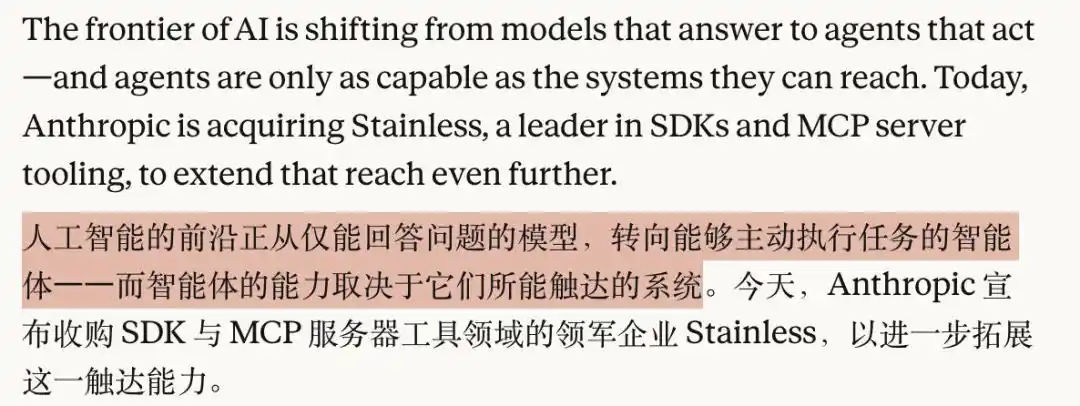
In its official blog post about acquiring Stainless, Anthropic mentioned that the upper limit of an agent's capabilities depends on how many external systems it can connect to: acquiring Stainless is about strengthening the agent's interfaces.
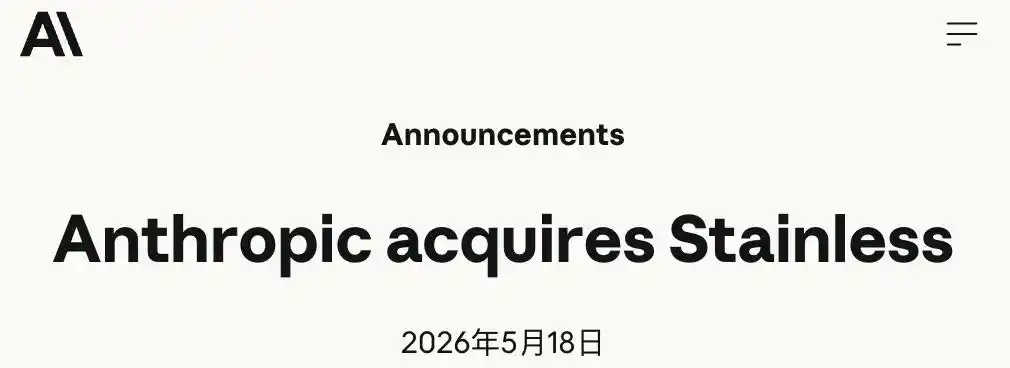
The AI frontier is shifting from models that can only answer questions to agents that can proactively execute tasks—and an agent's capabilities depend on the systems it can reach. Acquiring Stainless is precisely to expand this reach further.
If we place this acquisition within the context of Anthropic's actions over the past 18 months, the three-piece agent suite is now complete: Claude is the model, Stainless is the interface, and MCP is the connection.

The Company That Wrote SDKs for Multiple AI Giants Has Been Bought by Anthropic

Stainless was founded in New York in 2022 by Alex Rattray, who came from Stripe, where he led the redesign of the API documentation and personally built Stripe's SDK code generation system.

During user research, he discovered that developers never directly call API endpoints: for them, the SDK is the API itself.

This insight directly led him to later found Stainless, turning that capability into a product.

Stainless founder Alex Rattray

Developers feed it an OpenAPI specification, and it outputs official SDKs in Python, TypeScript, Go, Java, Ruby, and other languages.

The model company only needs to maintain one API description; Stainless handles all language versions, error handling, retry logic, documentation generation, and more.

OpenAI, Anthropic, Meta, Cloudflare, DocuSign, Square—these AI giants or software vendors are all Stainless clients.

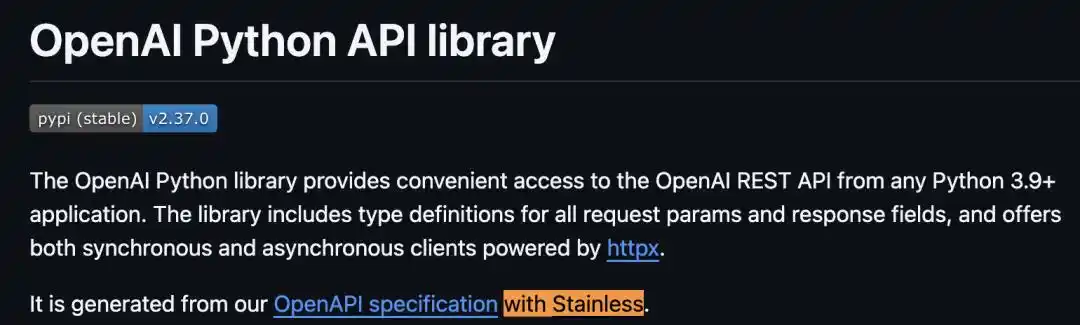
Open the GitHub repository for OpenAI's official Python SDK, and the README states: "Generated by Stainless based on the OpenAPI specification."
Similarly, the header of any source file in the Anthropic SDK also states: "Automatically generated by Stainless from the OpenAPI specification."
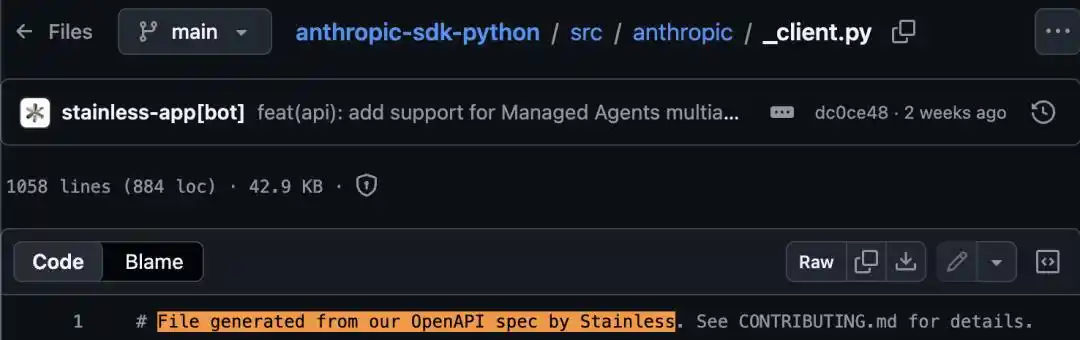
This means that over the past few years, OpenAI and Anthropic, as rivals, have long used the same developer tool platform for their official SDK generation.

After the acquisition, Stainless founder Alex Rattray informed existing clients that all previously generated SDKs fully belong to the clients, who can modify and extend them independently, but Stainless will no longer provide subsequent support.

The Stainless team will continue working as an internal organization within Anthropic, focusing on building out Claude Platform capabilities and connecting agents to APIs.
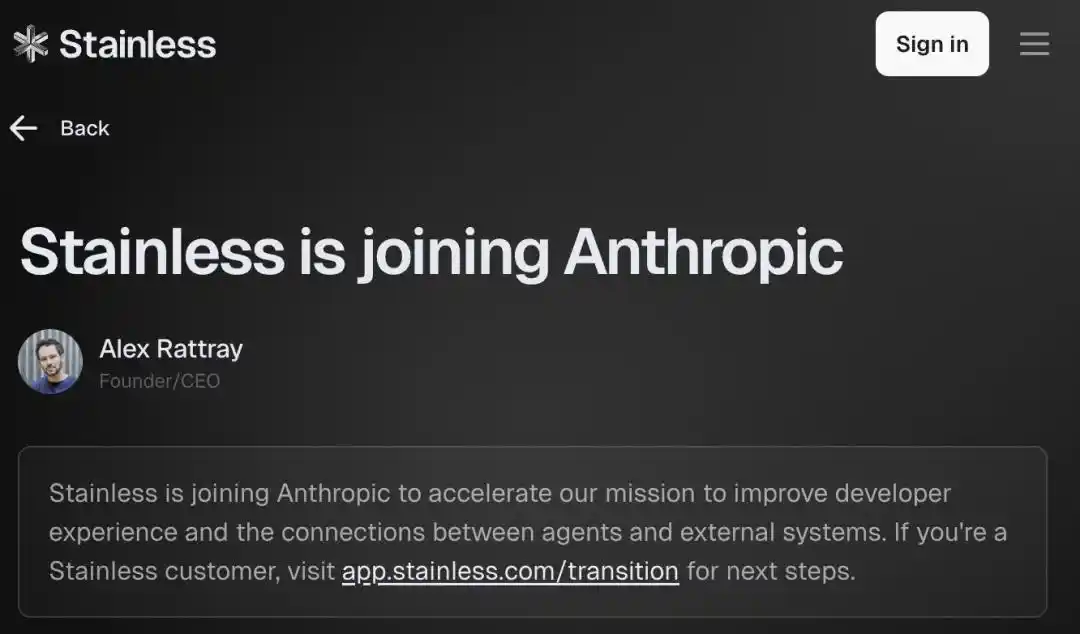
https://www.stainless.com/blog/stainless-is-joining-anthropic/
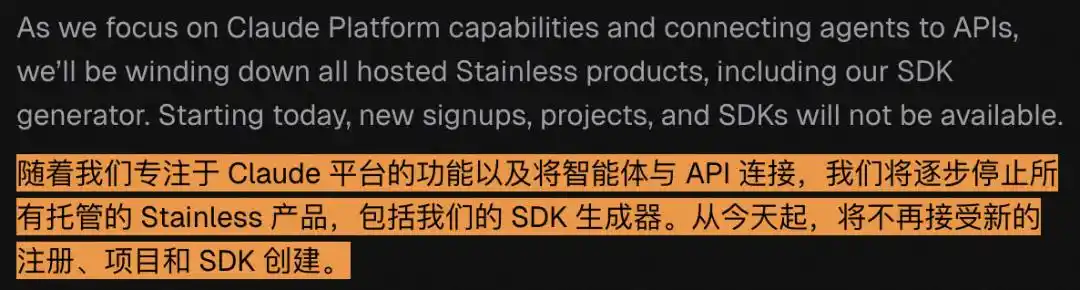
This tool company's products indirectly reached about a quarter of professional software developers worldwide. On its first day joining Anthropic, it closed its doors to the entire industry: from a shared infrastructure to an internal department of Anthropic.

The Agent Three-Piece Suite Is Complete: Model, Interface, Connection

This acquisition is not an isolated event.

Placing the Stainless acquisition back on the strategic path Anthropic has taken over the past 18 months reveals a completed three-piece suite.
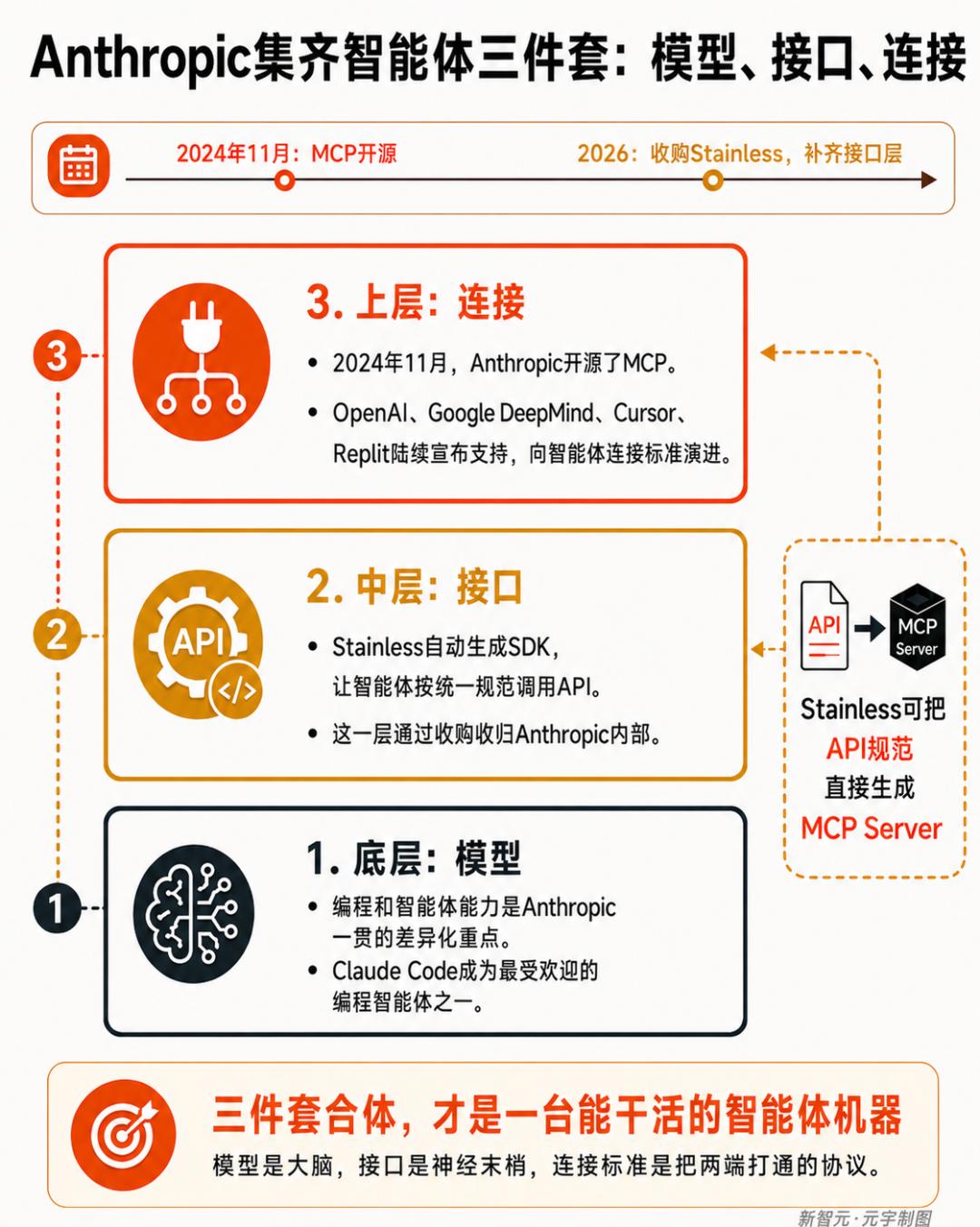
The foundational layer is the model.

From Claude 3.5 Sonnet all the way to Claude 4.7, programming and agent capabilities have been consistent differentiators for Anthropic. Claude Code has also become one of the most popular programming agents among developers this past year.

The middle layer is the interface.

Stainless's SDK auto-generation capability makes it possible for agents to call various APIs using a unified specification. This layer was previously outsourced; now it's brought in-house at Anthropic.

The top layer is the connection.

In November 2024, Anthropic open-sourced MCP (Model Context Protocol), standardizing how models connect to external data sources, tools, and file systems, so agents don't need to write separate adapters for every external service.

After MCP was open-sourced, OpenAI, Google DeepMind, Cursor, and Replit announced support. MCP is evolving into an agent connectivity standard.

And Stainless can directly generate an MCP server from an API specification. The model is the brain, the interface is the nerve endings, and the connection standard is the protocol that links them. Combined, these three pieces form a functional agent machine.

Katelyn Lesse, Head of Platform Engineering at Anthropic, stated plainly: "How useful an agent is depends on what it can connect to."

Stainless founder and CEO Alex Rattray said that Anthropic was one of the earliest teams to bet on Stainless, and "bringing the two teams together was an easy decision."

This acquisition is the final move in a strategic game that began 18 months ago.

Why Is an "SDK Translation Company" Worth $300 Million?

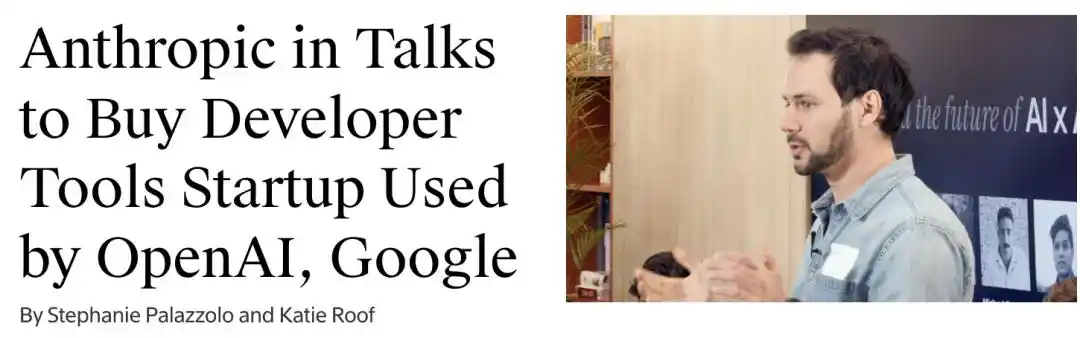
According to a previous report by The Information, the negotiation amount for this acquisition was at least $300 million. Anthropic has not disclosed the specific figure officially, but even this magnitude is enough to make people reevaluate the value of the SDK layer.
In the past, SDKs were an insignificant engineering problem.

The API was the model company's business; the SDK was just a "wrapper layer" translating the API into various programming languages. Model companies could write it themselves or outsource it to Stainless; no one cared.

But the agent era is different. When Claude or GPT acts as an agent to call third-party services, the SDK is no longer a "tool for humans to read" but an "interface for agents to use."

Whether an agent task succeeds largely depends on whether every API's SDK it calls is robust: is error handling complete? Is retry logic reasonable? Are parameter definitions strict? Are types inferable?

Any non-standard SDK can cause an agent to get stuck mid-task.

If the reported $300 million negotiation amount is accurate, what Anthropic sees is clearly not just an SDK generator, but the developer interface infrastructure layer between APIs and agents.

There's a subtler point: The official SDKs of companies like OpenAI, Meta, and Cloudflare were all previously generated by Stainless.

On the first day after the acquisition, with Stainless closing its doors externally, these companies face a practical problem: will they take over SDK maintenance themselves, or find another supplier?

So far, none have responded to this question.

OpenAI Doubles Down on Models, Anthropic Secures the Foundation

Looking back at the final ASI showdown between the two giants, OpenAI and Anthropic have distinct strategic focuses.

OpenAI's focus is on model generations and compute investment.

From GPT-5, GPT-5.4 to GPT-5.5 incremental updates, the Stargate project's massive compute procurement, ChatGPT's weekly active users growing from 400 million a year ago to 900 million—it concentrates resources on the consumer-facing entry point and the model itself.

Anthropic is taking a different path: enterprise agent infrastructure. Strengthening developer tools with Claude Code, standardizing the connection protocol with MCP, and now bringing the SDK layer in-house with Stainless.

The underlying logic of these two paths is completely different.

The model layer follows a logic of generational disruption: when the next generation arrives, the previous generation's advantages can vanish instantly. The gaps between generations are shrinking, windows are getting shorter, and can only be achieved through compute and data.

The infrastructure layer's logic is the opposite. Once established as a de facto standard, the compounding returns are long-term. With MCP now adopted industry-wide, each new adopter adds switching costs. Once the SDK layer is internalized within Anthropic, the entire agent ecosystem could develop a path dependency on Anthropic's interface specifications.
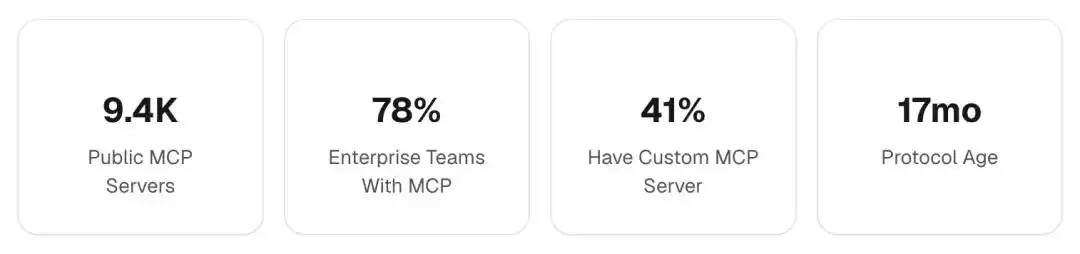
According to Digital Applied statistics, the number of public MCP servers grew from 1,200 in Q1 2025 to over 9,400 by April 2026, with 78% of enterprise AI teams deploying at least one MCP agent in production.

The gap in model capabilities is becoming easier to close.

Once this connection layer gateway is locked, it becomes very hard to bypass.

References:

https://www.anthropic.com/news/anthropic-acquires-stainless

https://www.stainless.com/blog/stainless-is-joining-anthropic/

https://www.digitalapplied.com/blog/mcp-adoption-statistics-2026-model-context-protocol

This article is from the WeChat public account "AI Era", author: ASI Revelation

Domande pertinenti

QWhat is the main purpose of Stainless as described in the article, and why was it significant for AI companies?

AStainless acts as a 'translator' between complex API specifications and developers, automatically generating official SDKs in multiple programming languages. It was significant for AI companies like OpenAI and Anthropic because it allowed them to maintain just one API description while Stainless handled all language versions, error handling, retry logic, and documentation, greatly simplifying developer integration.

QWhy did Anthropic acquire Stainless, according to the article's analysis of their strategic roadmap?

AAnthropic acquired Stainless to strengthen its 'agent' infrastructure. The article states that an agent's usefulness depends on what it can connect to. By bringing Stainless in-house, Anthropic gains control over the 'interface' layer—the SDKs that agents use to call APIs—completing its 'agent trifecta' of model (Claude), interface (Stainless), and connection protocol (MCP).

QWhat immediate impact does the acquisition have on Stainless's existing clients, such as OpenAI and Meta?

AThe acquisition means Stainless will begin winding down its hosted products, including the SDK generator. While existing clients retain full ownership of previously generated SDKs and can modify them, Stainless will no longer provide future support or updates. These companies must now decide whether to maintain the SDKs themselves or find an alternative supplier.

QHow does the article contrast the strategic focuses of OpenAI and Anthropic in the AI race?

AThe article contrasts their strategies: OpenAI focuses on model generation leaps and massive compute investment (e.g., GPT-5 series, Stargate project) to dominate the consumer-facing market. Anthropic focuses on building enterprise-grade agent infrastructure, strengthening developer tools (Claude Code), standardizing the connection protocol (MCP), and now internalizing the SDK layer (Stainless) to create long-term ecosystem lock-in.

QWhat is MCP, and why is its growth cited as important for Anthropic's strategy?

AMCP (Model Context Protocol) is an open-source protocol standardized by Anthropic for connecting AI models to external data sources, tools, and file systems. Its growth is important because it's becoming a de facto standard for agent connectivity. With a reported increase from 1,200 to over 9,400 public servers and widespread enterprise adoption, it creates network effects and switching costs, solidifying Anthropic's position in the agent infrastructure layer.

Letture associate

Must-Watch Events Next Week|CLARITY Act Could Face Senate Vote; SpaceX, Circle to Report Earnings (8.3-8.9)

**Summary: Key Events and Developments to Watch (August 3-9)** The upcoming week is marked by significant financial disclosures, key legislative deadlines, and notable product updates. **Major Financial Events:** Several companies are scheduled to release their Q2 2026 earnings. American Bitcoin (ABTC) will report on August 3, followed by SpaceX and Hut 8 Mining Corp. on August 4, and Circle on August 5. Notably, a significant portion of SpaceX shares (up to 12% of total shares) will be unlocked on August 6 following their earnings release. **Key Legislative Deadline:** The U.S. Senate faces an August 7 deadline to secure 60 votes for the CLARITY Act, a bipartisan bill aiming to establish a federal regulatory framework for cryptocurrencies. The Senate may hold a full vote on the bill during the week. **Economic Data:** The U.S. July Non-Farm Payrolls report will be released on August 7, providing crucial labor market data. **Technology & Product Updates:** * **Shutdowns:** DeFi portfolio tracker Zapper and wallet app Ctrl Wallet will cease operations on August 3. * **Upgrades:** LayerZero will deprecate its v1 relayers on August 3. XRP Ledger's new version 3.3.0, featuring five new functions, is expected next week. * **AI:** Elon Musk announced that the advanced Grok 4.6 AI model is set for release around August 7. * **Bitcoin:** The BIP-110 forced signaling for a potential Bitcoin network change is scheduled to begin around August 8. **Other Notable Events:** Chinese robotics firm Unitree Tech has set its preliminary price inquiry for its IPO for August 5. South Korean exchange Upbit will delist AQT and AERGO tokens on August 3.

marsbit10 min fa

Must-Watch Events Next Week|CLARITY Act Could Face Senate Vote; SpaceX, Circle to Report Earnings (8.3-8.9)

marsbit10 min fa

Stocks Are Plummeting More Sharply Than Cryptocurrencies. Where Has the Money Gone?

Stock Markets Plunge Deeper Than Cryptocurrencies: Where Did the Money Go? In late July, Seoul's Kospi index triggered circuit breakers for two consecutive days, plummeting over 40% from its June high. The collapse was led by heavyweight stocks like SK Hynix, whose record profits still disappointed investors, and devastating leveraged ETFs, with one major product losing over 83% of its value. This signaled a global, forced deleveraging targeting the most crowded trades. Interestingly, while stocks exhibited extreme volatility akin to crypto markets, Bitcoin rose nearly 15% in July after a prior steep drop. Analysis shows the money fleeing equities did not flow into Bitcoin. Instead, Bitcoin had already absorbed its sell-off in May-June, when U.S. spot Bitcoin ETFs saw historic outflows. The true safe-haven beneficiary was gold, whose price rose over 20% year-on-year, highlighting a decoupling between Bitcoin and gold as "digital gold." The sell-off was a targeted unwinding of leveraged positions in tech and semiconductors, accelerated by broker-dealer risk management and shifts in the AI narrative, including new competition from Chinese memory chipmakers. The retreat path was clear: from high-valuation tech stocks to cash and U.S. Treasuries, then to gold. For Bitcoin to attract sustained institutional inflows, conditions like eased global liquidity pressure, a "soft-landing" Fed rate cut, and U.S. regulatory clarity via legislation like the stalled CLARITY Act are needed. Currently, Bitcoin is not a safe haven but an already-cleared asset. Its low correlation with tech stocks, however, makes it a potential diversification play for institutional portfolios once the storm passes. The money isn't here yet, but the positioning is underway.

marsbit10 min fa

Stocks Are Plummeting More Sharply Than Cryptocurrencies. Where Has the Money Gone?

marsbit10 min fa

In Conversation with Ray Dalio: We Are Currently in an AI Bubble, with 1% of My Portfolio in Bitcoin

Ray Dalio, founder of Bridgewater Associates, warns in an interview that the current AI boom shows classic bubble characteristics, which could lead to significant economic downturns as seen in past cycles like 1929 or 2000. He explains that speculative enthusiasm, fueled by debt and overvaluation, often precedes a crash when rising rates or taxation force asset sales, causing widespread losses and recession. Dalio also outlines his "Big Cycle" theory, describing an approximate 80-year pattern where widening wealth gaps, massive government deficits, and shifting geopolitical power (like China's rise) create internal conflict and global instability. He emphasizes that we are in a late-cycle, transitional phase where traditional powers like the US and UK face decline. For personal wealth protection, Dalio advises diversification beyond cash into assets like stocks, bonds, real estate, and particularly gold, which he prefers over Bitcoin. While he holds about 1% of his portfolio in Bitcoin as a non-printable hard asset, he views gold as more secure from technological or governmental threats. Regarding AI's impact, Dalio believes it will disproportionately benefit capital owners, worsening inequality by replacing both physical and cognitive labor. He suggests that human intuition and emotional intelligence, combined with AI, will be key for future workers. On taxation, Dalio argues that wealth taxes are impractical and risk triggering asset sell-offs, reducing productive investment. He points to the UK as a cautionary example of debt, low productivity, and political strife. Geopolitically, Dalio foresees a more regionalized world, with the US showing weakness in prolonged conflicts like with Iran, akin to past imperial declines. The ideal outcome, he suggests, is coexisting powerful blocs (e.g., Americas, China-Asia Pacific) without major war.

marsbit4 h fa

In Conversation with Ray Dalio: We Are Currently in an AI Bubble, with 1% of My Portfolio in Bitcoin

marsbit4 h fa

Daily 7.2 Trillion KRW: Foreign Capital's Record Net Buying on Friday! Wall Street Says Headwinds for Korean Stock Fund Flows Have Subsided

South Korean stock market sees a dramatic shift in fund flows. On July 31, foreign investors made a record net purchase of approximately KRW 7.2 trillion in KOSPI stocks, marking a fundamental reversal from the persistent large-scale net outflows seen in previous months. This contributed to a significant narrowing of foreign net selling in July to KRW 9.8 trillion, down sharply from KRW 48.4 trillion in June and KRW 44.5 trillion in May. Simultaneously, domestic institutional pressure eased. South Korean pension funds and asset managers turned to a net buying position in July, purchasing KRW 1.0 trillion worth of KOSPI shares, contrasting with net sales in May and June. Market volatility is expected to be dampened by new financial regulations. Effective July 31, the Financial Services Commission tightened access for retail investors to single-stock leveraged ETFs by raising the minimum cash deposit requirement. Trading volumes for these products subsequently dropped to about 50% of their monthly average. Citigroup Research maintains its year-end KOSPI target of 10,000 points. The firm cites several supportive factors: the substantial easing of headwinds from capital outflows, a robust fundamental outlook for the semiconductor sector, historically low market valuations, strong economic fundamentals, and the potential for policy support from financial authorities if needed.

marsbit4 h fa

Daily 7.2 Trillion KRW: Foreign Capital's Record Net Buying on Friday! Wall Street Says Headwinds for Korean Stock Fund Flows Have Subsided

marsbit4 h fa

Trading

Spot
活动图片





