Currency and Stock Barometer丨 Strategy invested $90 million last week to purchase 1,142 Bitcoins; Bitmine increased its holdings by 40,613 ETH last week (February 10)

marsbitPubblicato 2026-02-10Pubblicato ultima volta 2026-02-10

Introduzione

Crypto Market Weekly Roundup: Strategy Invests $90M in 1,142 BTC; Bitmine Adds 40,613 ETH (Feb 10) Despite a bearish start to 2026 for crypto, mining stocks showed strength in January, outperforming Bitcoin with a 23% sector cap increase to $60B, though still 15% below late-2025 highs. JPMorgan noted reduced network competition and pivot to AI/HPC data centers as key drivers. Morgan Stanley analysts highlighted Terawulf and Cipher Mining, projecting ~150% upside due to their AI power agreements. Strategy purchased 1,142 BTC ($90M), bringing its total to 714,644 BTC. Global public companies net bought $92.83M in BTC, though overall DATs (crypto treasury firms) face selling pressure, declining 62% since October highs. Bitmine increased its ETH holdings by 40,613, totaling 4.33M ETH. ETHZilla launched an aviation engine RWA token and expanded into real estate tokenization. FG Nexus announced a 1:5 reverse stock split. Solana treasury firm Forward Industries, holding 7M SOL, hinted at potential industry consolidation, while Upexi raised $7.4M to expand its SOL strategy. Jupiter Lend added DFDV’s staking token dfdvSOL as collateral, enhancing DeFi-TradFi liquidity integration.

Editor's Note: For the cryptocurrency industry, the market performance in the first month of 2026 is nothing short of an industry winter, which is particularly evident in the price performance of crypto concept stocks. Strategy, Bitmine, Sharplink, Forward, and other BTC and ETH treasury companies have all experienced significant pullbacks; in contrast, thanks to AI/HPC computing power demand and large orders, many mining concept stocks have shown bright price performance, but they are still some distance from last year's price highs. Considering the current market conditions, mining stocks may continue their upward trend, with Terawulf and Cipher Mining particularly favored by well-known investment bank analysts. Meanwhile, Jupiter Lend has listed company DFDV's liquid staking token dfdvSOL as collateral, which may indicate a further deepening of the integration between DeFi and TradFi liquidity.

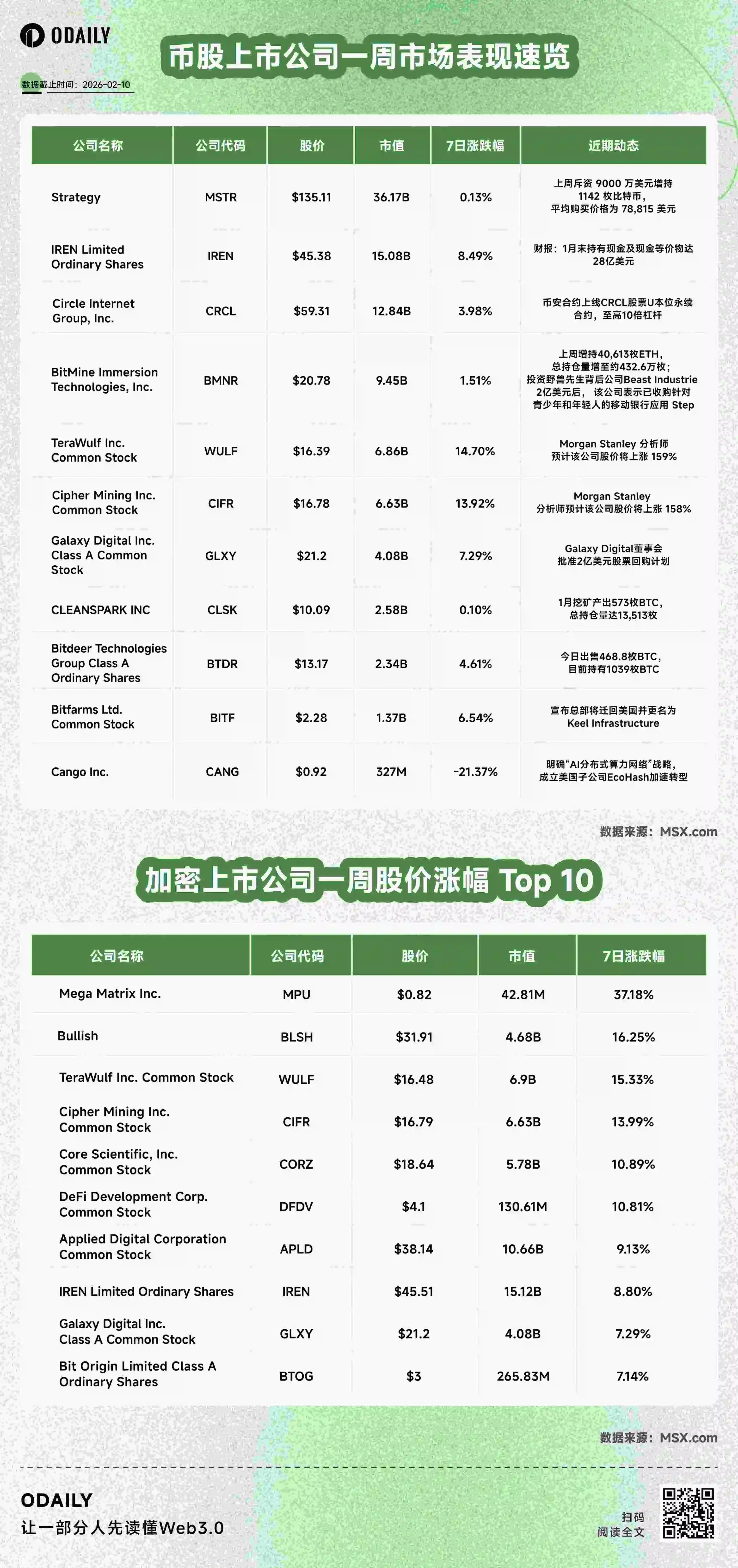
The following is a summary of last week's currency and stock market information compiled by Odaily Planet Daily, all U.S. stock data are frommsx.com.
Crypto Concept Stocks Review: Mining Stocks Showed Strong Gains in January, But Still 15% Below Last Year's Highs

JPMorgan: Mining Stocks Significantly Outperformed BTC in January, Short-Term Prospects Supported but Valuation Gap Widens

JPMorgan stated in a report that Bitcoin miners performed strongly at the beginning of 2026, benefiting from reduced network competition and new enthusiasm for high-performance computing (HPC). The bank noted that the total market capitalization of the 14 U.S.-listed Bitcoin miners and data center operators it tracks reached $60 billion at the end of last month, a 23% increase month-on-month, far exceeding the S&P 500's 1% gain. This rise was partly fueled by news of Riot Platforms signing an HPC agreement with AMD, highlighting miners' efforts to diversify beyond Bitcoin. Facing record-low profit margins after the 2024 halving, Bitcoin miners are repositioning themselves as digital infrastructure providers, converting power-intensive mining sites into data centers usable for AI to seek more stable, long-term revenue.

The report pointed out that winter storms across the U.S. in January caused the average network hash rate to drop 6% month-on-month to 981 EH/s, and mining difficulty decreased 5% compared to December. The reduction in competition helped offset the weakness in Bitcoin prices. Analysts estimate that miners' daily block reward revenue in January was about $42,350 per EH/s, slightly higher than in December, while gross profit rose 24% to about $21,200 per EH/s. Among the 14 mining companies tracked by JPMorgan, 12 outperformed Bitcoin's 4% decline in January, with IREN up 42% and Cango down 18%. The group's total valuation is still about 15% below the October 2025 high.

Bloomberg: Selling Pressure Rises on Crypto Treasury Listed Companies, May Trigger Chain Reaction Risks in the Market

Crypto asset treasury listed companies (DATs), which drove the market rise last year, are now facing the problem of triggering chain reaction risks in the market due to increased selling pressure. Data shows that since Bitcoin fell nearly half from its October high of $126,000, the median stock price of the 150 largest DATs has fallen 62%, even more than Bitcoin's decline. Hayden Hughes, managing partner of Tokenize Capital, analyzed that DATs without operating revenue, relying solely on hoarding crypto assets, will be forced to sell their holdings to maintain operations, which may shake investors' confidence in their "long-term firm holding" narrative, thereby triggering broader market sentiment contagion.

Morgan Stanley Analyst: Two Mining Companies Expected to Rise Over 150% Within a Year

Morgan Stanley analyst Stephen Byrd stated that although the Bitcoin price has fallen 44% since October, Bitcoin miners have been reborn as AI data centers. Stephen Byrd initiated coverage of Terawulf and Cipher Mining on Monday, expecting the share prices of the two companies to rise 159% and 158%, respectively. Stephen Byrd pointed out that the core asset of mining companies is power access rights, and AI companies are willing to pay a premium for power access, and the economics of AI business are better than cryptocurrency mining. Currently, Terawulf has signed a 510-megawatt power agreement with Google, and Cipher Mining has reached similar cooperation with companies like Amazon. In addition, Stephen Byrd gave MARA Holdings an underweight rating, believing its AI strategy is not focused enough.

Weekly Updates on Currency and Stock Listed Companies

Representative BTC Treasury Listed Companies

Last week, global listed companies had a net purchase of BTC worth $92.83 million. Strategy invested $90 million to purchase 1,142 Bitcoins, a 19.5% increase in purchase amount compared to last week.

According to SoSoValue data, as of 8:30 AM Eastern Time on February 9, 2026, the total net purchase of Bitcoin by global listed companies (excluding mining companies) last week was $92.83 million, a decrease of 24.5% compared to the previous week.

Strategy (formerly MicroStrategy) announced on February 9 that it invested $90 million (a 19.5% increase compared to last week's purchase amount) to acquire 1,142 Bitcoins at a price of $78,815, bringing its total holdings to 714,644.

Japanese listed company Metaplanet did not purchase Bitcoin last week, marking the fourth consecutive week without a purchase.

Additionally, 5 other companies purchased Bitcoin last week. Japanese food brand DayDayCook announced on February 5 that it invested $9.12 million to purchase 105 Bitcoins at a price of $86,868, bringing its total holdings to 1,888; entrepreneurial education learning platform company Genius Group Limited announced on February 6 that it sold 96 Bitcoins at a price of $73,238, generating a total income of $7.03 million, reducing its total holdings to 84.15; Swedish health tech company H100 invested $3 million on February 6 to purchase 4.39 Bitcoins at a price of $66,620, bringing its total holdings to 1,051.05; UK Bitcoin company BHODL announced on February 6 that it spent $70,000 to purchase 1 Bitcoin at a price of $66,950, bringing its total holdings to 161.388; French Bitcoin reserve company Capital B announced on February 9 that it invested $370,000 to purchase 5 Bitcoins at a price of $73,893, bringing its total holdings to 2,828.

Canadian Bitcoin ecosystem company Metador Technologies announced the initiation of an ATM equity offering procedure, aiming to raise approximately $21.98 million to purchase Bitcoin. Metadoor Technologies plans to hold 1,000 Bitcoins by the end of 2026.

As of press time, the total Bitcoin holdings of the global listed companies (excluding mining companies) in the statistics amounted to 974,480, an increase of 0.035% compared to last week, with a current market value of approximately $67.36 billion, accounting for 4.9% of Bitcoin's circulating market capitalization.

Bitcoin treasury company ProCap repurchased approximately $135 million in convertible bonds

On February 9, Nasdaq-listed Bitcoin treasury company ProCap Financial disclosed that it repurchased convertible bonds worth approximately $135 million today. The company has repurchased about 2% of its outstanding common shares since December 2025. Additionally, the company disclosed that its current Bitcoin holdings are approximately 5,007, with a cash balance of $72 million and outstanding convertible bonds of approximately $100 million.

UK's largest Bitcoin treasury company listed on the London Stock Exchange main board last week

The UK's largest Bitcoin treasury company, Smarter Web Company, officially listed on the main market of the London Stock Exchange on February 3, with the stock code SWC. On its first day of listing, the stock price was reported at 43 pence, corresponding to a market capitalization of approximately £118 million. Public information shows that Smarter Web Company currently holds 2,674 Bitcoins, with an average purchase price of approximately $111,000, making it the largest Bitcoin treasury-type listed company in the UK by holding size.

Representative ETH Treasury Listed Companies

BitMine: Increased holdings by 40,613 ETH last week, total holdings increased to approximately 4.326 million

Ethereum treasury company BitMine Immersion Technologies disclosed that it increased its holdings by 40,613 ETH last week. The company's current crypto asset holdings include 4,325,738 ETH, 192 BTC, $19 million worth of Eightco Holdings equity, $200 million worth of Beast Industries shares, and $595 million in cash.

ETHZilla launches RWA token for aircraft engine cash flow

Nasdaq-listed company ETHZilla (ETHZ) announced that it will launch Eurus Aero Token I this week, splitting the monthly cash flow generated from leasing aircraft engines through tokenization to provide investors with on-chain yield exposure.

The token is issued by subsidiary ETHZilla Aerospace, with the underlying assets being two commercial aircraft engines leased to a "leading U.S. airline." Token holders will receive monthly cash flow distributions from basic rent and usage fees through ERC-20 tokens.

ETHZilla is supported by Peter Thiel's Founders Fund. The company was previously known for its Ethereum reserve strategy but has gradually shifted towards real-world asset (RWA) tokenization since last year. Previously, the company completed a tokenization trial involving 95 housing loans.

As the blockchain industry accelerates the onboarding of traditional assets, RWA is seen as one of the fastest-growing sectors. Ark Invest estimates that the tokenized asset size could reach $11 trillion by 2030, while the current market size is approximately $22 billion.

ETHZilla shifts to real estate tokenization, reaches $4.7 million housing loan agreement

Ethereum treasury company ETHZilla (ETHZ) is accelerating its asset tokenization layout, spending $4.7 million to acquire a portfolio of 95 manufactured housing and modular housing loans, and plans to tokenize these loans on the Ethereum Layer-2 network, issuing cash-flow type digital tokens to investors through the regulated trading platform Liquidity.io. The loan portfolio is secured by first-lien mortgages, with an expected annualized return of about 10%. ETHZilla Chairman and CEO McAndrew Rudisill stated that this transaction is a natural extension of the company's tokenization strategy, and manufactured housing loans have stable cash flow and strong collateral assets, making them very suitable for tokenization within a regulated, transparent framework.

Ethereum treasury company FG Nexus announces 1:5 reverse stock split

Nasdaq-listed Ethereum treasury company FG Nexus announced that it will implement a 1:5 reverse stock split, meaning every 5 shares of common stock will be automatically combined into 1 share. The company expects it to take effect officially at 9:30 AM Eastern Time on February 13, 2026. It will also adopt a new CUSIP number 30329Y403. After the split, its stock will continue to trade on Nasdaq under the code "FGNX". It is reported that based on the current outstanding shares of approximately 32.7762 million, the number of outstanding shares is expected to drop to approximately 6.5552 million after the split; the number of authorized common shares will decrease from 900 billion to 180 billion.

Bit Digital discloses holding 155,239.4 ETH as of the end of January, worth over $380 million

On February 6, Nasdaq-listed Ethereum treasury company Bit Digital released a holdings update report. As of January 31, 2026, the company held 155,239.4 ETH, worth approximately $380.2 million, with an average purchase price of $3045. Additionally, the company disclosed that as of the end of January, it had staked a total of 138,266 ETH, generating approximately 344 ETH in staking rewards.

Representative SOL Treasury Listed Companies

Forward Industries says it will adopt an offensive strategy and consolidate other SOL treasury companies if industry funding is under pressure

Solana treasury company Forward Industries (FWDI) Chief Information Officer Ryan Navi stated that there is mispricing in the current market, creating potential opportunities for the company. Ryan Navi pointed out that Forward Industries currently has no debt. If the industry faces funding constraints, the company will adopt an offensive strategy to promote the consolidation of other SOL treasury companies.

He disclosed that Forward Industries currently holds nearly 7 million SOL, with a holding size exceeding the sum of its top three competitors. Ryan Navi further stated that a leverage-free, debt-free balance sheet is considered its core advantage in the crypto treasury market. The company will continue to configure Solana as a long-term strategic infrastructure without using leverage or debt, rather than as a short-term speculative tool.

Solana treasury company Upexi to raise $7.4 million through placement

On February 6, Nasdaq-listed Solana treasury company Upexi announced that it had reached a final agreement with an institutional investor to sell and issue 6,337,000 shares of the company's common stock and warrants at a price of $1.17 per share to raise $7.4 million. The net proceeds from this offering will be used for working capital, general corporate purposes, and expanding its SOL token investment strategy. AGP/Alliance Global Partners acted as the sole placement agent for this offering of common stock and warrants.

Jupiter Lend lists DFDV's liquid staking token dfdvSOL as collateral

On February 5, Jupiter's lending platform Jupiter Lend announced that it has listed the liquid staking token dfdvSOL, issued by Solana treasury company DeFi Development (DFDV), as collateral, allowing users to directly borrow assets on-chain and release the liquidity of their staked SOL.


Domande pertinenti

QHow much did Strategy invest in Bitcoin last week and how many coins did they purchase?

AStrategy invested $90 million to purchase 1,142 Bitcoin last week.

QWhich two mining companies did Morgan Stanley analyst Stephen Byrd cover, and what potential upside did he forecast for their stock prices?

AStephen Byrd initiated coverage on Terawulf and Cipher Mining, forecasting potential stock price increases of 159% and 158%, respectively.

QWhat was the new asset class that ETHZilla tokenized, and on which blockchain network was it issued?

AETHZilla tokenized cash flows from leased aircraft engines, issuing the Eurus Aero Token I as an ERC-20 token on the Ethereum Layer-2 network.

QWhat action did the Solana treasury company Forward Industries (FWDI) say it would take if the industry faces funding pressure?

AForward Industries stated it would adopt an offensive strategy to consolidate other SOL treasury companies if the industry faces funding pressure.

QWhat significant corporate action did FG Nexus, an Ethereum treasury company, announce?

AFG Nexus announced a 1-for-5 reverse stock split, which is scheduled to take effect on February 13, 2026.

Letture associate

Three Months, 35 Billion Yuan: Investors Rush to Grab the OpenAI of the Physical World

Investors flock to a physical AI startup as the race for the "OpenAI of the physical world" heats up. Ji Jia Shi Jie (GigaWorld), a company dedicated to developing Artificial General Intelligence (AGI) for the physical world, has raised 3.5 billion RMB (approximately $490 million) in just three months, according to a report from investment media outlet Touzijie. The latest B2 funding round of 1 billion RMB attracted a wide range of top-tier investors, including sovereign wealth funds, industrial capital, and financial institutions. This brings the total funding for the young company, now valued over 10 billion RMB, to 3.5 billion RMB across three recent rounds. The company is led by Huang Guan, a post-90s Tsinghua University PhD with extensive experience in AI, autonomous driving, and entrepreneurship. Its core innovation is a "dual-pyramid" system comprising a five-layer data pyramid (from internet videos to real-world robot data) and a three-layer algorithm pyramid focused on world simulation, action alignment, and reinforcement learning. This system underpins its key models: the "World Action Model" (e.g., GigaBrain series for robot control) and the "World Generation Model" (e.g., GigaWorld series for simulating and understanding the physical world). Its models have reportedly achieved top rankings in global robotics benchmarks. Ji Jia Shi Jie argues that while current digital AGI excels in information processing, the next frontier is physical AGI—systems that can understand and interact with the real world. The company believes the field is approaching its "GPT-3 moment," a key inflection point in capability scaling. To achieve this, the company is pursuing a dual-market strategy. For the consumer (C) market, it launched the "SeeLight" brand and its S1 general-purpose humanoid robot, which has secured initial orders for deployment in real homes. For the business (B) market, it focuses on industrial automation with its Maker series robots, having signed agreements for large-scale deployment in factories, and its DriveDreamer world model for autonomous driving, which is already in use with over 30 automakers and tech companies. The report concludes that by bridging the gap between digital intelligence and physical action, Ji Jia Shi Jie aims to unlock a new wave of productivity, ultimately bringing physical AGI into everyday life.

marsbit13 min fa

Three Months, 35 Billion Yuan: Investors Rush to Grab the OpenAI of the Physical World

marsbit13 min fa

What's the Connection Between Pinduoduo's Huang Zheng and Blockchain?

This text explores the unexpected connection between Pinduoduo founder Colin Huang and blockchain, as suggested in his article *Turning Capitalism Upside Down*. Huang argues Pinduoduo's core business is about managing "uncertainty." He posits that wealth flows to the rich because they absorb life's uncertainties (e.g., illness, job loss) that devastate the poor, who pay a premium for certainty through insurance or stable prices. Pinduoduo's model attempts a "reverse insurance": by aggregating consumer demand via group-buying and flash sales, it creates a large, predictable order for manufacturers. This certainty allows factories to remove risk premiums, passing savings back as lower prices, thus partially reversing the wealth flow. The key obstacle, Huang notes, is that an individual's buying intent is an unreliable promise. He then asks if blockchain is the natural solution for this "reverse insurance." The text elaborates that blockchain, through smart contracts with binding deposits, could transform casual intent into a costly-to-break, enforceable commitment. This replaces interpersonal trust with coded rules, making promises credible, pricable, and resistant to fraud. Finally, the author draws a parallel to Bitcoin, framing two paths to creating certainty: the "Pinduoduo path" of aggregating decentralized will into scale, and the "Bitcoin path" of locking rules into immutable code. Both sacrifice something—personal freedom or system flexibility—to manufacture trust and predictability.

链捕手1 h fa

What's the Connection Between Pinduoduo's Huang Zheng and Blockchain?

链捕手1 h fa

The Storage Magnate Who Conquered a Trillion-Dollar Kingdom, Yet Ultimately Could Not Become the Richest

**Summary:** "The Memory Magnate Who Built a Trillion-Dollar Empire, Yet Never Became the Richest" explores the journey of Zhu Yiming, founder of GigaDevice (603986) and co-founder of the soon-to-IPO ChangXin Memory Technologies (CXMT). The article positions GigaDevice, a fabless chip designer now valued at ~¥340 billion, as a prequel to the massive IDM (Integrated Device Manufacturer) venture, CXMT. Starting in 2005 with minimal capital, Zhu strategically "picked up the pieces" by focusing on niche markets like NOR Flash and microcontrollers (MCUs), areas major players were exiting. This allowed GigaDevice to grow into a diversified semiconductor company, maintaining robust profitability even during industry downturns by controlling costs. However, the piece argues that in the highly cyclical and capital-intensive memory chip industry, the fabless model has limits. True resilience and scale require the ability for "counter-cyclical expansion" – investing heavily during downturns – a tactic only possible for IDMs like Samsung or SK Hynix. This insight led Zhu to partner with the Hefei city government in 2016 to establish CXMT, an IDM focused on DRAM. Zhu's symbolic moves, like forfeiting salary and diluting his equity, were crucial in securing the massive state and bank funding needed. CXMT's equipment base is now valued even higher than that of BYD's vast auto manufacturing empire. Despite the potential for CXMT to reach a market cap of ¥1-2 trillion upon its IPO, Zhu's indirect stake in both companies is estimated below 3%, placing his personal wealth far below that of China's top billionaires. The article concludes that his strategic vision built a trillion-yuan memory landscape, but the capital structure necessary to achieve it precluded a personal fortune of similar scale.

marsbit1 h fa

The Storage Magnate Who Conquered a Trillion-Dollar Kingdom, Yet Ultimately Could Not Become the Richest

marsbit1 h fa

XRP Ledger Daily Fees Drop Below $400 As Network Activity Question Returns

The XRP Ledger is drawing attention as daily network fees have fallen below $400. While low fees align with XRPL's design for affordable transactions and are often seen as a strength, the metric can also serve as an indicator of network demand and paid transaction volume. This data point of around $3,100 in weekly fee burn highlights the stark contrast with higher-fee chains like Ethereum and Bitcoin. The development fuels an ongoing debate. Proponents view low fees as a sign of efficiency and accessibility, while critics may question if the network is generating sufficient high-value activity relative to its market cap and payments-focused narrative. The article cautions against overstating the finding, noting a single low-fee day does not signify network failure. It instead adds context to discussions about XRPL's usage, especially alongside Ripple's broader initiatives in stablecoins (RLUSD), AI payments, and enterprise infrastructure. The report recommends monitoring for a fee rebound, checking transaction counts for a fuller picture, and confirming the trend via native explorers like Bithomp. It frames the story within a larger market shift where on-chain data, protocol updates, and infrastructure developments are becoming crucial alongside price action. The editorial stance is to present the verified data, explain its significance for assessing network activity, and avoid hype, positioning it as part of the daily crypto conversation.

bitcoinist6 h fa

XRP Ledger Daily Fees Drop Below $400 As Network Activity Question Returns

bitcoinist6 h fa

Trading

Spot
Futures

Articoli Popolari

Cosa è BITCOIN

Comprendere HarryPotterObamaSonic10Inu (ERC-20) e la sua posizione nel mondo delle criptovalute Negli ultimi anni, il mercato delle criptovalute ha assistito a un aumento della popolarità delle meme coin, catturando l'interesse non solo dei trader, ma anche di coloro che cercano coinvolgimento comunitario e valore di intrattenimento. Tra questi token unici c'è HarryPotterObamaSonic10Inu (ERC-20), un progetto intrigante che mescola riferimenti culturali nel tessuto delle criptovalute. Questo articolo esplora gli aspetti chiave di HarryPotterObamaSonic10Inu, analizzando i suoi meccanismi, l'etica guidata dalla comunità e il suo coinvolgimento con il panorama crittografico più ampio. Che cos'è HarryPotterObamaSonic10Inu (ERC-20)? Come suggerisce il suo nome, HarryPotterObamaSonic10Inu è una meme coin costruita sulla blockchain di Ethereum, classificata secondo lo standard ERC-20. A differenza delle criptovalute tradizionali che possono enfatizzare l'utilità pratica o il potenziale investimento, questo token prospera grazie al valore di intrattenimento e alla forza della sua comunità. Il progetto mira a creare un ambiente in cui gli utenti coinvolti possono riunirsi, condividere idee e partecipare ad attività ispirate a diversi fenomeni culturali. Una caratteristica notevole di HarryPotterObamaSonic10Inu è la zero tassa sulle transazioni. Questo elemento allettante tende a incoraggiare il trading e il coinvolgimento della comunità, privo di costi aggiuntivi che possono scoraggiare i trader di piccole dimensioni. L'offerta totale della moneta è fissata a un miliardo di token, un numero che segna la sua intenzione di mantenere una circolazione sostanziale all'interno della comunità. Creatore di HarryPotterObamaSonic10Inu (ERC-20) Le origini di HarryPotterObamaSonic10Inu sono avvolte in un certo mistero; i dettagli sul creatore rimangono sconosciuti. Lo sviluppo di questo token non presenta un team identificabile o un piano esplicito, cosa non rara nel settore delle meme coin. Invece, il progetto è emerso organicamente, con il suo progresso fortemente dipendente dall'entusiasmo e dalla partecipazione della sua comunità. Investitori di HarryPotterObamaSonic10Inu (ERC-20) Per quanto riguarda investimenti esterni e finanziamenti, HarryPotterObamaSonic10Inu rimane ambiguo. Il token non elenca alcuna fondazione di investimento conosciuta o un sostegno organizzativo significativo. Invece, la linfa vitale del progetto è la sua comunità di base, che informa la sua crescita e sostenibilità attraverso azioni collettive e coinvolgimento nello spazio crittografico. Come funziona HarryPotterObamaSonic10Inu (ERC-20)? In quanto meme coin, HarryPotterObamaSonic10Inu opera principalmente al di fuori delle strutture tradizionali che governano spesso il valore degli asset. Ci sono diversi aspetti distintivi che definiscono il funzionamento del progetto: Transazioni senza tasse: Senza costi fiscali sulle transazioni, gli utenti possono comprare e vendere liberamente il token senza preoccuparsi di costi nascosti. Coinvolgimento della comunità: Il progetto prospera sull'interazione della comunità, sfruttando le piattaforme social per creare entusiasmo e facilitare il coinvolgimento. Discussioni, condivisione di contenuti e coinvolgimento sono elementi cruciali che aiutano ad espandere la sua portata e a favorire la lealtà tra i sostenitori. Nessuna utilità pratica: Va notato che HarryPotterObamaSonic10Inu non offre un'utilità concreta all'interno dell'ecosistema finanziario. Piuttosto, è classificato come un token principalmente per attività di intrattenimento e comunitarie. Riferimento culturale: Il token incorpora astutamente elementi della cultura pop per attirare interesse, collegandosi a appassionati di meme e seguaci delle criptovalute. HarryPotterObamaSonic10Inu esemplifica come le meme coin operino in modo diverso rispetto ai progetti di criptovalute più tradizionali, entrando nel mercato come costrutti sociali innovativi piuttosto che come asset utilitari. Cronologia di HarryPotterObamaSonic10Inu (ERC-20) La storia di HarryPotterObamaSonic10Inu è segnata da diversi traguardi notevoli: Creazione: Il token è emerso da un meme virale, catturando l'immaginazione di molti appassionati di criptovalute. Le date di creazione specifiche non sono disponibili, sottolineando la sua crescita organica. Inserimento negli scambi: HarryPotterObamaSonic10Inu ha fatto il suo ingresso in vari scambi, consentendo un accesso e un trading più facili da parte della comunità. Iniziative di coinvolgimento della comunità: Attività in corso volte a migliorare l'interazione della comunità, comprese gare, campagne sui social media e generazione di contenuti da parte di fan e sostenitori. Piani di espansione futura: La tabella di marcia del progetto include il lancio di una collezione NFT, merchandising e un sito di eCommerce relativo ai suoi temi culturali, coinvolgendo ulteriormente la comunità e cercando di aggiungere più dimensioni al suo ecosistema. Punti chiave su HarryPotterObamaSonic10Inu (ERC-20) Natura guidata dalla comunità: Il progetto dà priorità al contributo collettivo e alla creatività, garantendo che il coinvolgimento degli utenti sia al centro del suo sviluppo. Classificazione come meme coin: Rappresenta l'epitome delle criptovalute basate sull'intrattenimento, distinguendosi dai veicoli d'investimento tradizionali. Nessuna affiliazione diretta con Bitcoin: Nonostante la somiglianza nel nome del ticker, HarryPotterObamaSonic10Inu è distintivo e non ha alcuna relazione con Bitcoin o altre criptovalute consolidate. Focus sulla collaborazione: HarryPotterObamaSonic10Inu è progettato per creare uno spazio per la collaborazione e la condivisione di storie tra i suoi detentori, fornendo un canale per la creatività e il legame comunitario. Prospettive future: L'ambizione di espandersi oltre il suo presupposto iniziale verso NFT e merchandising delinea un percorso per il progetto per potenzialmente entrare in strade più mainstream all'interno della cultura digitale. Poiché le meme coin continuano a catturare l'immaginazione della comunità crittografica, HarryPotterObamaSonic10Inu (ERC-20) si distingue per i suoi legami culturali e il suo approccio centrato sulla comunità. Anche se potrebbe non adattarsi al modello tipico di un token orientato all'utilità, la sua essenza risiede nella gioia e nella camaraderia coltivate tra i suoi sostenitori, evidenziando la natura in evoluzione delle criptovalute in un'epoca sempre più digitale. Con la continuazione dello sviluppo del progetto, sarà importante osservare come le dinamiche della comunità influenzano la sua traiettoria nel panorama in continuo cambiamento della tecnologia blockchain.

1.7k Totale visualizzazioniPubblicato il 2024.04.01Aggiornato il 2024.12.03

Cosa è BITCOIN

Come comprare BTC

Benvenuto in HTX.com! Abbiamo reso l'acquisto di Bitcoin (BTC) semplice e conveniente. Segui la nostra guida passo passo per intraprendere il tuo viaggio nel mondo delle criptovalute.Step 1: Crea il tuo Account HTXUsa la tua email o numero di telefono per registrarti il tuo account gratuito su HTX. Vivi un'esperienza facile e sblocca tutte le funzionalità,Crea il mio accountStep 2: Vai in Acquista crypto e seleziona il tuo metodo di pagamentoCarta di credito/debito: utilizza la tua Visa o Mastercard per acquistare immediatamente BitcoinBTC.Bilancio: Usa i fondi dal bilancio del tuo account HTX per fare trading senza problemi.Terze parti: abbiamo aggiunto metodi di pagamento molto utilizzati come Google Pay e Apple Pay per maggiore comodità.P2P: Fai trading direttamente con altri utenti HTX.Over-the-Counter (OTC): Offriamo servizi su misura e tassi di cambio competitivi per i trader.Step 3: Conserva Bitcoin (BTC)Dopo aver acquistato Bitcoin (BTC), conserva nel tuo account HTX. In alternativa, puoi inviare tramite trasferimento blockchain o scambiare per altre criptovalute.Step 4: Scambia Bitcoin (BTC)Scambia facilmente Bitcoin (BTC) nel mercato spot di HTX. Accedi al tuo account, seleziona la tua coppia di trading, esegui le tue operazioni e monitora in tempo reale. Offriamo un'esperienza user-friendly sia per chi ha appena iniziato che per i trader più esperti.

4.0k Totale visualizzazioniPubblicato il 2024.12.12Aggiornato il 2026.06.02

Come comprare BTC

Cosa è $BITCOIN

ORO DIGITALE ($BITCOIN): Un'Analisi Completa Introduzione all'ORO DIGITALE ($BITCOIN) L'ORO DIGITALE ($BITCOIN) è un progetto basato su blockchain che opera sulla rete Solana, con l'obiettivo di combinare le caratteristiche dei metalli preziosi tradizionali con l'innovazione delle tecnologie decentralizzate. Sebbene condivida un nome con Bitcoin, spesso definito “oro digitale” a causa della sua percezione come riserva di valore, l'ORO DIGITALE è un token separato progettato per creare un ecosistema unico all'interno del panorama Web3. Il suo obiettivo è posizionarsi come un asset digitale alternativo valido, anche se i dettagli riguardanti le sue applicazioni e funzionalità sono ancora in fase di sviluppo. Cos'è l'ORO DIGITALE ($BITCOIN)? L'ORO DIGITALE ($BITCOIN) è un token di criptovaluta esplicitamente progettato per l'uso sulla blockchain di Solana. A differenza di Bitcoin, che fornisce un ruolo di stoccaggio di valore ampiamente riconosciuto, questo token sembra concentrarsi su applicazioni e caratteristiche più ampie. Aspetti notevoli includono: Infrastruttura Blockchain: Il token è costruito sulla blockchain di Solana, nota per la sua capacità di gestire transazioni ad alta velocità e a basso costo. Dinamiche di Offerta: L'ORO DIGITALE ha un'offerta massima fissata a 100 quadrilioni di token (100P $BITCOIN), sebbene i dettagli riguardanti la sua offerta circolante siano attualmente non divulgati. Utilità: Sebbene le funzionalità precise non siano esplicitamente delineate, ci sono indicazioni che il token potrebbe essere utilizzato per varie applicazioni, potenzialmente coinvolgendo applicazioni decentralizzate (dApp) o strategie di tokenizzazione degli asset. Chi è il Creatore dell'ORO DIGITALE ($BITCOIN)? Attualmente, l'identità dei creatori e del team di sviluppo dietro l'ORO DIGITALE ($BITCOIN) rimane sconosciuta. Questa situazione è tipica tra molti progetti innovativi nel settore blockchain, in particolare quelli allineati con la finanza decentralizzata e i fenomeni delle meme coin. Sebbene tale anonimato possa favorire una cultura guidata dalla comunità, intensifica le preoccupazioni riguardo alla governance e alla responsabilità. Chi sono gli Investitori dell'ORO DIGITALE ($BITCOIN)? Le informazioni disponibili indicano che l'ORO DIGITALE ($BITCOIN) non ha alcun sostenitore istituzionale noto o investimenti di venture capital prominenti. Il progetto sembra operare su un modello peer-to-peer incentrato sul supporto e sull'adozione della comunità piuttosto che su percorsi di finanziamento tradizionali. La sua attività e liquidità si trovano principalmente su exchange decentralizzati (DEX), come PumpSwap, piuttosto che su piattaforme di trading centralizzate consolidate, evidenziando ulteriormente il suo approccio di base. Come Funziona l'ORO DIGITALE ($BITCOIN) Le meccaniche operative dell'ORO DIGITALE ($BITCOIN) possono essere elaborate in base al suo design blockchain e alle caratteristiche della rete: Meccanismo di Consenso: Sfruttando il proof-of-history (PoH) unico di Solana combinato con un modello di proof-of-stake (PoS), il progetto garantisce una validazione efficiente delle transazioni contribuendo all'alta performance della rete. Tokenomics: Sebbene meccanismi deflazionistici specifici non siano stati dettagliati ampiamente, l'ampia offerta massima di token implica che potrebbe soddisfare microtransazioni o casi d'uso di nicchia che devono ancora essere definiti. Interoperabilità: Esiste il potenziale per l'integrazione con l'ecosistema più ampio di Solana, inclusi vari piattaforme di finanza decentralizzata (DeFi). Tuttavia, i dettagli riguardanti integrazioni specifiche rimangono non specificati. Cronologia degli Eventi Chiave Ecco una cronologia che evidenzia traguardi significativi riguardanti l'ORO DIGITALE ($BITCOIN): 2023: Il dispiegamento iniziale del token avviene sulla blockchain di Solana, contrassegnato dal suo indirizzo di contratto. 2024: L'ORO DIGITALE guadagna visibilità poiché diventa disponibile per il trading su exchange decentralizzati come PumpSwap, consentendo agli utenti di scambiarlo contro SOL. 2025: Il progetto assiste a un'attività di trading sporadica e a un potenziale interesse per impegni guidati dalla comunità, sebbene non siano state documentate partnership significative o avanzamenti tecnici fino ad ora. Analisi Critica Punti di Forza Scalabilità: L'infrastruttura sottostante di Solana supporta alti volumi di transazioni, il che potrebbe migliorare l'utilità di $BITCOIN in vari scenari di transazione. Accessibilità: Il potenziale basso prezzo di trading per token potrebbe attrarre investitori al dettaglio, facilitando una partecipazione più ampia grazie a opportunità di proprietà frazionata. Rischi Mancanza di Trasparenza: L'assenza di sostenitori, sviluppatori o di un processo di audit pubblicamente noti potrebbe generare scetticismo riguardo alla sostenibilità e all'affidabilità del progetto. Volatilità del Mercato: L'attività di trading è fortemente dipendente dal comportamento speculativo, il che può comportare una significativa volatilità dei prezzi e incertezze per gli investitori. Conclusione L'ORO DIGITALE ($BITCOIN) emerge come un progetto intrigante ma ambiguo all'interno dell'evolvente ecosistema di Solana. Sebbene tenti di sfruttare la narrativa dell'“oro digitale”, la sua partenza dal ruolo consolidato di Bitcoin come riserva di valore sottolinea la necessità di una chiara differenziazione della sua utilità e struttura di governance. L'accettazione e l'adozione future dipenderanno probabilmente dall'affrontare l'attuale opacità e dalla definizione più esplicita delle sue strategie operative ed economiche. Nota: Questo rapporto comprende informazioni sintetizzate disponibili a ottobre 2023, e potrebbero essersi verificati sviluppi oltre il periodo di ricerca.

99 Totale visualizzazioniPubblicato il 2025.05.13Aggiornato il 2025.05.13

Cosa è $BITCOIN

Discussioni

Benvenuto nella Community HTX. Qui puoi rimanere informato sugli ultimi sviluppi della piattaforma e accedere ad approfondimenti esperti sul mercato. Le opinioni degli utenti sul prezzo di BTC BTC sono presentate come di seguito.

活动图片













