Crypto’s Slide May Not Be Fear — It’s A US Liquidity Crunch, CEO Says

bitcoinistPubblicato 2026-02-02Pubblicato ultima volta 2026-02-02

Introduzione

A sharp sell-off in crypto markets wiped out approximately $250 billion in value over the weekend, with Bitcoin falling below $80,000—down 40% from its 2025 high. Analysts note weakening retail interest, large ETF outflows, and a loss of momentum. Support around $73,000–$75,000 is now critical. According to Raoul Pal, CEO of Global Macro Investor, the decline is not crypto-specific but stems from a broader U.S. dollar liquidity crunch. Factors include Treasury General Account rebuilds, higher funding costs, and a reduced Reverse Repo Facility buffer. Pal stated that gold’s rally absorbed marginal liquidity that might have flowed into risk assets like Bitcoin and SaaS stocks, leaving the most exposed positions vulnerable. The nomination of Kevin Warsh as Fed Chair added uncertainty, with some fearing slower rate cuts. While markets remain fragile, some expect liquidity conditions to improve, potentially allowing a recovery if dollar flow normalizes.

A sharp hit to risk markets left crypto with heavy losses over the weekend. Reports say roughly $250 billion was wiped from combined market value as investors pulled back. Some of the selling hit Bitcoin hard. Others said it spread to tech stocks at the same time.

Bitcoin Faces A Confidence Test

Bitcoin has been searching for a base. As of today, it slipped below $80,000 and is down about 40% from the 2025 high above $126,000.

Traders and on-chain trackers show weaker buying pressure. Retail interest has cooled. Large outflows from spot ETFs have been recorded, and momentum has been lost across several indicators.

Support near $73,000–$75,000 is now the zone many are watching, while some market participants expect more stops to be run before calm returns.

BTCUSD now trading at $76,822. Chart: TradingView

Markets Are Moving Together

Analysts note that Software-as-a-Service stocks and Bitcoin fell in tandem. That matters because both depend a lot on hopes about future growth; they tend to be hurt first when money gets tight.

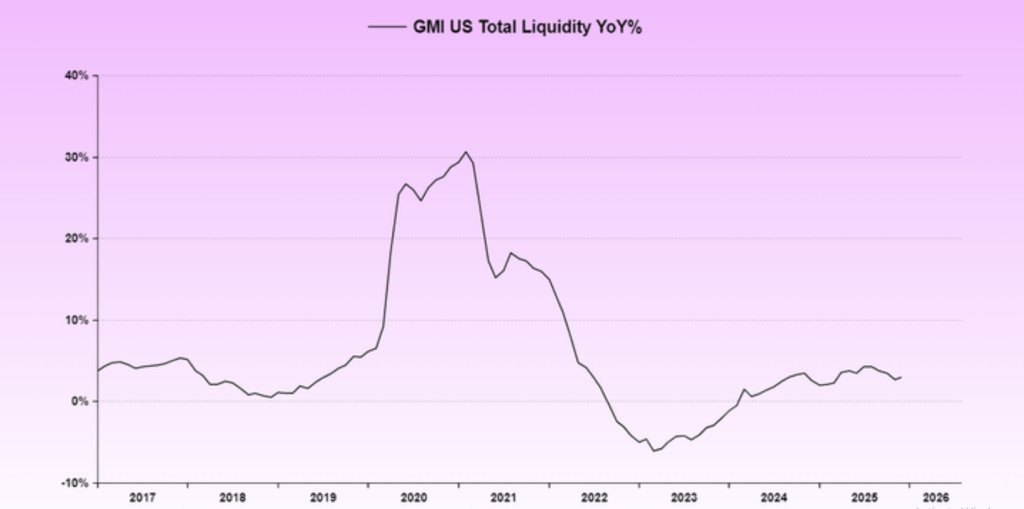
Gold was rising at the same time, and some traders argued that the move into bullion drew marginal cash away from riskier bets. When fewer dollars are freely moving between banks, hedge funds trim leverage fast and the riskiest positions suffer most.

Source: LSEG Datastream/Global Macro Investor

Macro Liquidity, Not A Crypto-Only Issue

According to Raoul Pal, founder and CEO of Global Macro Investor. the squeeze came from a narrower pool of US dollar liquidity rather than a problem unique to crypto.

The mechanics he points to are technical: Treasury General Account rebuilds, higher funding costs, and a smaller buffer in the Reverse Repo Facility that used to soak up extra cash.

“The rally in gold sucked all marginal liquidity out of the system that would have flowed into BTC and SaaS,” Pal said.

“There was not enough liquidity to support all these assets, so the riskiest got hit,” he added.

Those shifts can quietly remove liquidity even when no single headline screams crisis. Government funding hiccups were also blamed for adding friction to the system. When liquidity is chased away, assets tied to future cash flows get hit hard.
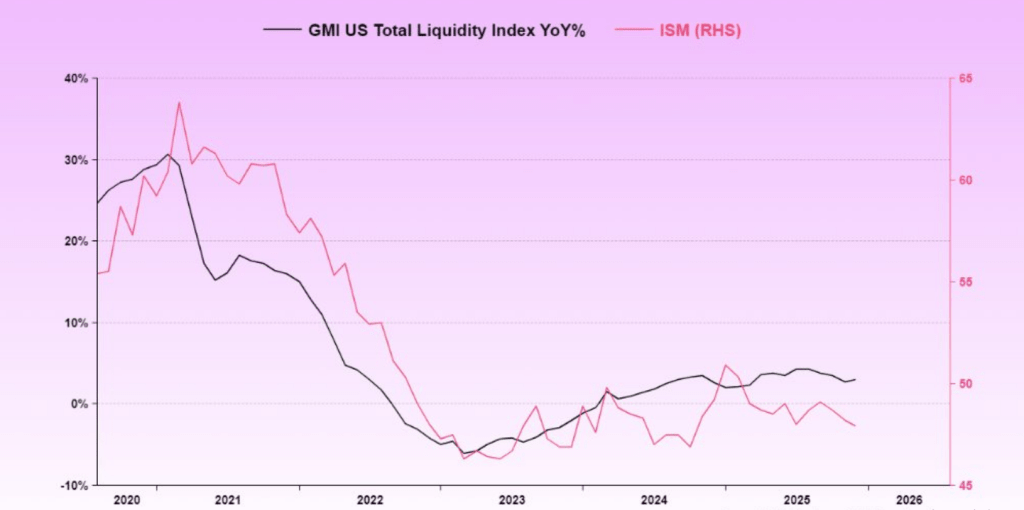
Source: LSEG Datastream/Global Macro Investor

Different Voices On The Fed Nomination

Reports say the nomination of Kevin Warsh to run the Federal Reserve has added to the nervous mood. Some market pros worry he won’t cut rates as quickly as hoped.

Some analysts said that sentiment swung on the idea that rate relief might be delayed. But Raoul Pal pushed back, arguing that US President Donald Trump’s team will steer policy toward easier rates and that Warsh will follow that playbook.

Views differ. That uncertainty has left many traders unwilling to put fresh money into stretched trades.

A Cautious But Not Despairing Close

At the time of writing, price action looks fragile and rallies have been short-lived. Yet some analysts expect the liquidity drain to ease and for capital to trickle back once funding conditions normalize.

The coming weeks will show whether buyers return around the low-$70k area or if selling finds a deeper level. Reports note that risk appetite often returns before headlines change, but only when dollars are flowing again.

Featured image from Unsplash, chart from TradingView

Domande pertinenti

QWhat is the main reason for the recent sharp decline in crypto markets according to Raoul Pal?

AThe main reason is a US dollar liquidity crunch, caused by factors like Treasury General Account rebuilds, higher funding costs, and a reduced buffer in the Reverse Repo Facility, rather than a problem unique to crypto.

QHow much has Bitcoin fallen from its 2025 high, and what is the key support level being watched?

ABitcoin has fallen about 40% from its 2025 high above $126,000. The key support level many are watching is near $73,000–$75,000.

QAccording to the article, what two asset classes fell in tandem, indicating a broader risk-off sentiment?

ASoftware-as-a-Service (SaaS) stocks and Bitcoin fell in tandem, as both are growth-dependent assets that are often the first to be sold when liquidity gets tight.

QWhat role did the rally in gold play in the market dynamics described?

AThe rally in gold sucked marginal liquidity out of the system that would have otherwise flowed into riskier assets like Bitcoin and SaaS stocks, exacerbating their decline.

QWhat event added to market nervousness regarding future Federal Reserve policy?

AThe nomination of Kevin Warsh to run the Federal Reserve added to the nervous mood, as some market professionals worry he will not cut interest rates as quickly as hoped.

Letture associate

KOL's Perspective: Why Is SOL Set to Rise from This Point?

**Summary: Why SOL is Positioned for Growth at This Level** The article argues that SOL is poised for an upward move from its current price point, citing several key factors. Primarily, SOL has just broken out of a 4-month consolidation phase. This breakout signals a return of risk appetite to the broader crypto market, as SOL is seen as a key indicator of overall crypto health. The token's ownership has reportedly shifted from short-term traders and tourists to long-term accumulators, leading to low volume. Any meaningful increase in trading activity could thus trigger significant upward momentum. Fundamental strengths include strong institutional adoption, integration with DeFi and RWAs (Real-World Assets), and the potential benefits from the Clarity Act. Despite its high volatility—having dropped 70% from its all-time high but still up 12x from its bear market low—SOL is highlighted as one of the few tokens from the last cycle to reach new highs. It boasts a robust ecosystem of applications, users, and protocols. Future catalysts include the expected influx of AI developers following the Miami Accelerate conference, which focused on AI on Solana. Furthermore, Solana is positioned as the premier chain for memecoin activity, a trend expected to continue and drive network usage and fees. The article concludes that recent price action reflects a healthy transfer to long-term holders, setting the stage for growth.

marsbit27 min fa

KOL's Perspective: Why Is SOL Set to Rise from This Point?

marsbit27 min fa

Those Pre-Bitcoin PoW Protocols Have Recently Been Reimplemented

This article details a recent surge in replicating pre-Bitcoin Proof-of-Work (PoW) protocols, specifically focusing on Hal Finney's 2004 RPOW (Reusable Proofs of Work). Within five days in May 2026, multiple independent builders in the Bitcoin/cypherpunk community launched projects inspired by this early electronic cash proposal. The initiative began with Fred Krueger's `rpow2.com`, a centralized but auditable system that replaced RPOW's original IBM 4758 hardware with Ed25519 signatures. Initially a faithful replica, it later adopted Bitcoin-like features (21M supply cap, difficulty adjustment) and a controversial 5.24% founder allocation. This sparked rapid forks, including `rpow4.com` which incorporated full Bitcoin parameters, a prediction market (`rpowmarket.com`), and a DEX (`rpow2swap.com`). Concurrently, Mike In Space created a prototype of Wei Dai's 1998 b-money proposal (`b-money.replit.app`), pushing the historical exploration even further back. The article contrasts these centralized, server-dependent experiments with Bitcoin's core innovation of decentralized, trustless consensus. It also highlights a parallel development: the `HASH` project on Ethereum, which uses smart contract hooks to enable a purely fair-launch, browser-mineable PoW token with 0% allocations to team or VCs. The collective activity is framed as a meme-driven, educational exploration of cypherpunk history rather than a serious financial movement, with all projects heavily disclaiming any investment value.

marsbit32 min fa

Those Pre-Bitcoin PoW Protocols Have Recently Been Reimplemented

marsbit32 min fa

South Korean Exchanges 'Battle' Regulators, Challenging the Boundaries of Enforcement and Legislation

South Korea's cryptocurrency industry is engaged in a rare, direct confrontation with regulators. The Financial Intelligence Unit (FIU), the primary anti-money laundering (AML) watchdog, has recently imposed heavy penalties on major exchanges like Upbit and Bithumb for alleged violations involving unregistered overseas VASPs and AML procedures. However, exchanges are now actively challenging these actions in court and through industry associations. In a significant shift, the Seoul Administrative Court ruled in favor of Upbit's operator, Dunamu, overturning part of an FIU-ordered business suspension. The court found the FIU's penalty criteria and justification insufficiently clear. Similarly, the court suspended the enforcement of a six-month business suspension against Bithumb pending a final ruling, citing potential irreversible harm to the exchange. Beyond legal battles, the industry is contesting proposed legislative amendments. The Digital Asset eXchange Alliance (DAXA) strongly opposes a draft rule that would mandate Suspicious Transaction Reports (STRs) for all crypto transfers over 10 million KRW (~$6,800). DAXA argues this "poison pill" clause violates legal principles and would overwhelm the STR system, increasing reports from 63,000 to an estimated 5.45 million annually for major exchanges, thereby crippling effective AML monitoring. This conflict highlights a structural tension in South Korea's crypto governance: comprehensive digital asset laws are still developing, while regulators rely heavily on AML enforcement. The industry's move from passive compliance to active legal and legislative challenges signifies a new phase, pressing for clearer rules and more proportionate enforcement. While short-term disputes may intensify, this clash could ultimately lead to a more mature and sustainable regulatory framework for South Korea's vibrant crypto market.

marsbit1 h fa

South Korean Exchanges 'Battle' Regulators, Challenging the Boundaries of Enforcement and Legislation

marsbit1 h fa

After 50x Storage Surge, Justin Sun Always Looks to the Next Decade

Sun Yuchen, known for his controversial stunts like a $30 million lunch with Warren Buffett (canceled due to a kidney stone) and eating a $6.2 million duct-taped banana, is often overshadowed by a significant fact: his decade-long track record of spotting major investment trends. In 2016, he famously advised young people to invest in Bitcoin, Nvidia, Tesla, and Tencent instead of buying property. A hypothetical $20,000 investment in Nvidia and Tesla from that list would now be worth over 50 million RMB. His latest major call was on November 6, 2025, predicting a "50x storage opportunity" tied to the AI boom, which materialized with Sandisk's stock surging nearly 50-fold by 2026. Looking ahead, Sun now focuses on the next frontier: Physical AI. He identifies four key areas: 1. **Embodied AI/Robotics**: He sees this reaching its "iPhone moment," with companies like UBTech and Galaxy General leading in commercialization. 2. **Drones**: Viewed as the first commercially viable form of Physical AI, revolutionizing sectors from warfare (e.g., AeroVironment's Switchblade) to logistics. 3. **Spatial Computing**: Beyond VR, it's about AI understanding physical space, a foundational technology for robotics and autonomous systems, exemplified by Apple's Vision Pro. 4. **Space Exploration**: After a 2025 suborbital flight with Blue Origin, Sun advocates for space as the ultimate frontier, discussing blockchain's potential role in space asset management and data transactions. His investment philosophy involves betting on entire, inevitable trends rather than single companies. For robotics, he sees Tesla (the body/manufacturer) and Nvidia (the brain/AI platform) as complementary plays. In defense drones, he highlights companies making tanks obsolete (AeroVironment) and those augmenting fighter jets (Kratos). For space, he participated in Blue Origin's flight and anticipates SpaceX's potential IPO to redefine the sector's valuation. Sun Yuchen's vision frames the next two decades not as a revolution in information flow (like the internet), but in the fundamental operation of the physical world through AI-powered robots, autonomous systems, and spatial intelligence, ultimately extending human and AI activity into space. While many still focus on conventional assets, he continues to look toward the next technological horizon.

marsbit2 h fa

After 50x Storage Surge, Justin Sun Always Looks to the Next Decade

marsbit2 h fa

Trading

Spot
Futures
活动图片