Crypto.com and Trump Media "Break Up": $6.42 Billion Vault Plan Fails, CRO Loses Its Largest Backstop Buyer

marsbitPubblicato 2026-08-13Pubblicato ultima volta 2026-08-13

Introduzione

Crypto.com, Trump Media (DJT), and Yorkville Acquisition Corp. have officially terminated their planned $64.2 billion merger to create the "Trump Media Group CRO Strategy," a publicly-listed CRO treasury company. Announced in August 2025 during the peak of Digital Asset Treasury (DAT) hype, the deal was promoted as a massive vote of confidence, with Crypto.com's CEO Kris Marszalek once stating the entity would "forever" buy CRO. The termination, citing changing market conditions and business priorities, also ends related plans for ETF services and integrating a prediction market into Truth Social. Following the news, CRO's price fell below $0.05, hitting its lowest point since October 2023. The token is down approximately 95% from its 2021 all-time high. The collapse of this high-profile deal raises critical questions about the DAT model, suggesting it creates artificial, unsustainable demand rather than being driven by genuine token utility or adoption. This sentiment is reinforced by recent reports that Strategy, the largest Bitcoin treasury company, has been selling BTC, breaking its "never sell" narrative. For CRO holders, the failed merger adds to existing concerns, including recent reductions in Crypto.com card benefits and executive departures, forcing a broader reassessment of the exchange's fundamentals beyond a single abandoned transaction.

Author: Claude, Shencha TechFlow

Shencha TechFlow Insights: Last weekend, Crypto.com, Trump Media, and Yorkville officially announced the termination of the $6.42 billion CRO vault company plan. The buyer that once promised to "buy forever" has formally exited, causing CRO to drop below $0.05, hitting a new low since October 2023. For holders of CRO or similar "vault concept tokens," this failed deal answers a crucial question: when artificial demand withdraws, what remains for the token?
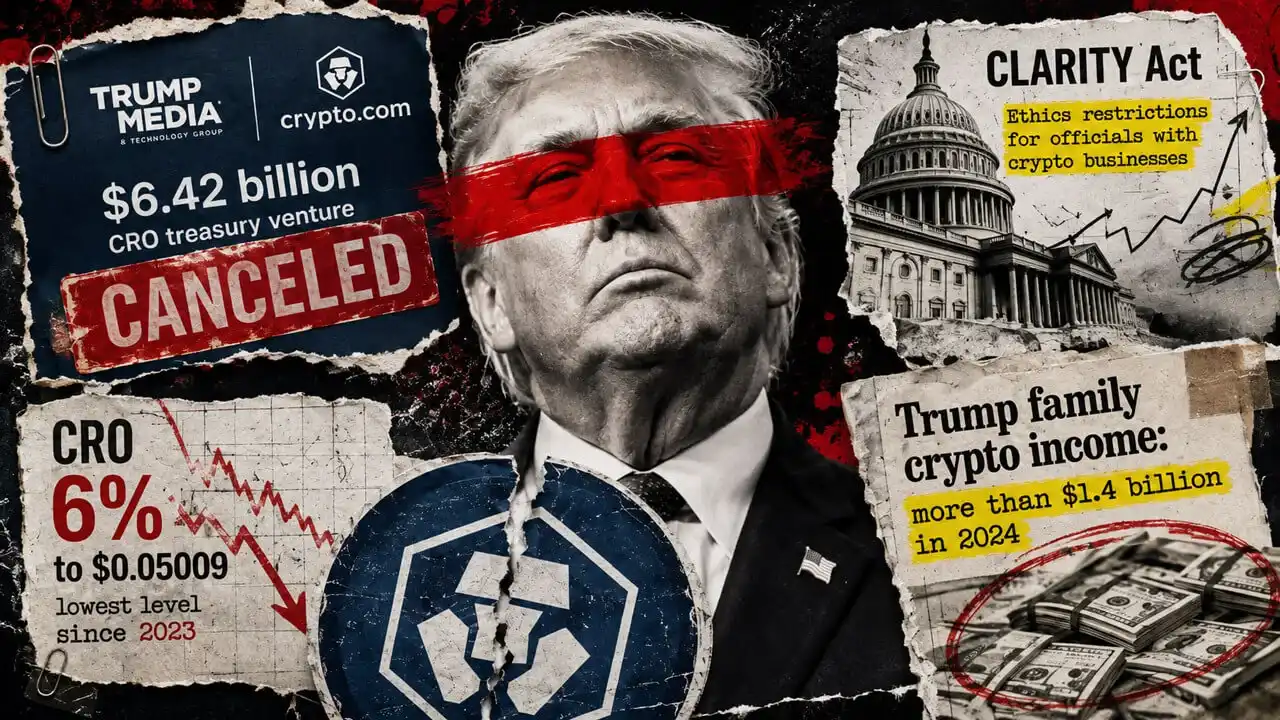
On August 7, Crypto.com, Trump Media & Technology Group (DJT), and Yorkville Acquisition Corp. filed documents with the SEC, jointly announcing the termination of the merger plan to form the "Trump Media Group CRO Strategy" vault company. The parties cited "current market conditions, as well as changes in business and stakeholder priorities" in a joint statement, marking the official end of all preliminary work regarding the merger and the digital asset vault structure.

Background: This was the most aggressive deal in the 2025 vault frenzy

This deal was officially announced in August 2025, during the peak of the "Digital Asset Treasury" (DAT) trend. The model was pioneered by the Bitcoin vault company Strategy: a publicly listed company continuously buys a certain token through financing, turning its own stock into a "proxy asset" for that token, while the premise of "having a big company to backstop the buying" was itself touted as a bullish signal for the token.

According to the initial plan, the three parties intended to form the Trump Media Group CRO Strategy through a SPAC merger, positioning it as the first and largest publicly listed CRO vault company. The funding plan included $1 billion in CRO, $200 million in cash, $220 million in mandatory exercisable warrants, plus a $5 billion equity credit line provided by Yorkville's affiliates, totaling $6.42 billion. If realized, it would have become the world's largest public holder of CRO, marketed as a "huge vote of confidence" in the token.

Looking back a year later, this vote of confidence has not materialized.

The deal wasn't locked in, but the stock ticker changed from YORK to MCGA first

The high profile of this deal is evident in the details. In anticipation of the merger, Yorkville's stock ticker was prematurely changed from YORK to MCGA, a clear nod to Trump's iconic slogan MAGA, interpreted by many as "Make CRO Great Again." Changing the ticker long before the deal was finalized appears, in hindsight, as an awkward false start.

More awkward were the initial promises. Crypto.com CEO Kris Marszalek had publicly stated that this vault company would become the world's largest holder of CRO, with a market cap potentially exceeding that of CRO itself, and would "forever" continue buying. Now, all these expectations have evaporated. Regarding the termination decision, Marszalek's statement was reduced to: "Proceeding with the transaction in the current market environment is not justified."

More than just the vault: ETF services and Truth Social prediction markets also severed

Two other collaborations were scrapped on the same day. Crypto.com will no longer provide services for Yorkville America's planned ETF products, with the latter stating its existing and future ETF business remains unaffected. Additionally, according to Axios, Trump Media also abandoned its plan to directly embed a prediction market into Truth Social (the Truth Predict initiative announced in October 2025), downgrading it to directing users to Crypto.com's prediction market product.

Trump Media's interim CEO Kevin McGurn explained the reasons to Axios: the digital asset vault sector has become saturated, and the significance of staking these assets has diminished for Crypto.com; the decision was driven by competitive dynamics, not regulatory concerns. He is refocusing the company on its media and data licensing business. Notably, Trump Media is not exiting crypto entirely: it remains the 14th largest publicly traded company holder of Bitcoin, holding over $600 million in BTC, and recently transferred 2,628 BTC to Crypto.com (the company stated it was a transfer, not a sale).

CRO's ledger after the buyer exits: Falls below $0.05, down ~95% from 2021 peak

Following the announcement, CRO broke below $0.05, touching a low of approximately $0.047, the first time since October 2023. Market data shows CRO is down nearly 40% year-to-date, around 70% over the past year, and has fallen about 95% from its all-time high of around $0.89 in November 2021, with a current market cap of approximately $2.2 billion.

These numbers illustrate one thing: the vault news once brought a pulse of "confidence premium" to CRO, but that premium required the buyer's continuous, real-money purchases to sustain. With the buyer gone, the premium vanished.

Takeaway for holders: Vault narratives create artificial demand, not real utility

On Reddit's r/CryptoCurrency, the post discussing this news raised a more pointed question: Is this DAT vault model essentially just a mechanism to create artificial demand and prop up token prices, with no real underlying utility? Every time such a deal falls through, the underlying token plummets, because the entire investment thesis was simply "a company will buy and hold," not that the token itself has utility or adoption.

This skepticism is not an isolated case. Just last week, the largest Bitcoin vault company, Strategy, was revealed to have sold Bitcoin multiple times this year, loosening its "never sell" narrative. From Strategy to MCGA, the 2025 wave of "public companies buying crypto as a bullish signal" vault mania is entering its ebb tide.

For CRO holders, there's an added layer of practical concern. Crypto.com recently also downgraded benefits for card users (Ruby card cashback reduced from 2% to 1.5%, unlimited 4% cashback for Icy White card eliminated), and several executives have departed. With the vault failure, benefit reductions, and executive exits piled together, what the market needs to reassess is not just one transaction, but the fundamentals of the exchange itself.


Domande pertinenti

QWhat was the value of the proposed 'Trump Media Group CRO Strategy' vault company plan, and which parties were involved?

AThe proposed plan was valued at $64.2 billion. The involved parties were Crypto.com, Trump Media & Technology Group (DJT), and Yorkville Acquisition Corp.

QWhat reason was given in the joint SEC filing for terminating the CRO vault company merger plan?

AThe reason given was 'current market conditions, as well as changes in business and stakeholder priorities.'

QWhat was the immediate impact on CRO's price following the announcement of the deal's termination?

AFollowing the announcement, CRO's price fell below $0.05, hitting a low of approximately $0.047, marking its lowest point since October 2023.

QAccording to the article, what fundamental problem does the collapse of this deal highlight for tokens like CRO that rely on 'vault' narratives?

AIt highlights that vault narratives create artificial, unsustainable demand based on the promise of a single buyer, rather than genuine utility or adoption of the token itself. When that buyer disappears, the price support collapses.

QBesides the vault deal, what other two collaborations between the mentioned companies were reportedly cut or downgraded?

A1. Crypto.com will no longer provide services for Yorkville America's planned ETF products. 2. Trump Media abandoned its plan to directly embed a prediction market into Truth Social (Truth Predict), downgrading it to merely redirecting users to Crypto.com's prediction market product.

Letture associate

Arca Chief Investment Officer: How Should Tokens Be Valued Once Protocols Start Earning Money?

Title: Arca CIO: How Should Tokens Be Valued When Protocols Start Making Money? Summary: For over a decade, Arca has argued that digital assets should be valued based on fundamentals and future cash flows, just like traditional investments. While tokens are not stocks, basic investment principles still apply. Many decentralized protocols (e.g., Hyperliquid, Aave) are now generating significant, real revenue with high margins. However, protocol revenue alone does not automatically translate to token value. Unlike equity holders who have a legal claim on company assets and future cash flows (via dividends, buybacks, or acquisitions), token holders often lack a clear, enforceable path to receive value from protocol profits. Therefore, the critical link between protocol economics and token economics is even more important. A credible mechanism must exist for value to eventually flow to token holders, with token buybacks being one clear, direct method. Capital allocation is now a key issue for profitable protocols. Like growing companies, protocols should reinvest profits when returns on investment are high. However, this reinvestment only delays value capture; it cannot replace it indefinitely. Investors must believe that eventually, surplus capital will be returned. For example, two protocols with identical revenues should not trade at the same valuation multiple if one has a credible buyback mechanism and the other does not. As the market increasingly accepts this valuation framework, a major opportunity exists. Protocols with strong fundamentals and value-capture mechanisms may see their valuation multiples expand significantly as the historical discount for token-based assets narrows. Crypto investment is finally maturing into fundamental analysis, focusing on revenue growth, margins, competitive advantages, reinvestment returns, and credible paths for profit distribution to token holders.

marsbit25 min fa

Arca Chief Investment Officer: How Should Tokens Be Valued Once Protocols Start Earning Money?

marsbit25 min fa

SEC Proposal a ‘Significant’ Step Forward From ‘Ill-Suited’ Crypto Rules: Commissioner Peirce

A U.S. Securities and Exchange Commission (SEC) commissioner, Hester M. Peirce, has called a new SEC proposal a significant improvement over what she termed a "misfit" set of crypto rules. Peirce stated that a whole generation has struggled due to the SEC's insistence on applying unsuitable regulations to cryptocurrencies, but the new proposal moves toward "clear, sensible, and enforceable rules for crypto offerings." SEC Chairman Paul S. Atkins also welcomed the initiative, noting in a separate statement that the agency's previous enforcement-heavy approach had driven investment overseas, limiting investor protections domestically. The proposal, announced on Tuesday, outlines new rules aimed at creating a clear and purposeful framework for certain investment contracts involving crypto assets, designed to allow organizations to raise capital while protecting investors. This move comes shortly after the U.S. Senate failed to advance the comprehensive Digital Asset Market Clarity (CLARITY) Act. Atkins had previously stated the SEC was prepared to develop rules for digital assets if the Senate could not pass the CLARITY Act. Meanwhile, Galaxy Digital has lowered its estimated odds of the CLARITY Act passing by 2026 to just 10%, citing numerous unresolved policy questions and the Senate's limited time—only about two to three weeks after reconvening on September 14—to pass it.

cryptonews.ru57 min fa

SEC Proposal a ‘Significant’ Step Forward From ‘Ill-Suited’ Crypto Rules: Commissioner Peirce

cryptonews.ru57 min fa

Trading

Spot
活动图片