Crypto Watchlist: 5 Things To Monitor This Week

bitcoinistPubblicato 2026-03-02Pubblicato ultima volta 2026-03-02

Introduzione

Crypto markets face a mix of geopolitical and product catalysts this week. Bitcoin remains the key macro watch, rebounding after an initial dip from U.S.-Iran tensions, with traders assess whether the conflict will escalate or fade. Oil price movements are being monitored for inflation and rate implications. On the product side, Starknet is launching strkBTC, a privacy-optional wrapped Bitcoin. Polygon’s March 4 upgrade will recycle gas fees to subsidize machine-to-machine payments. Avalanche begins its Retro9000 incentive round on March 2, shifting focus to rewarding most-used projects. The week concludes with the U.S. jobs report on March 6, which could reset interest rate expectations. Overall, macro factors like geopolitical risk and economic data may drive sharp market swings. The total crypto market cap stood at $2.25 trillion.

Crypto heads into the week of March 2 with five clear catalysts on deck: a worsening US-Iran conflict under President Donald Trump, a privacy-focused Bitcoin wrapper from Starknet, Polygon’s March 4 agentic-payments gas upgrade, Avalanche’s new incentive round, and Friday’s US jobs report.

Crypto Watchlist For This Week

Bitcoin is still the biggest macro watch this week, but the setup has already changed. The initial war shock over the weekend pushed BTC down toward $63,000, yet that move did not hold. The token rebounded as high as $68,196 on Sunday and was back around $65,807 by European Monday morning, while broader reporting showed traders were already reassessing whether the conflict would become a lasting macro shock or a violent but temporary headline event.

Oil followed a similar pattern: Brent briefly surged to $82.37 before giving back part of the move and easing back into the upper-$70s, which matters because crypto traders are now watching inflation risk and rate expectations more than the initial geopolitical headline itself.

What matters now is not simply that Washington and Tehran are in open conflict, but that the political signals are mixed. Trump has said he is willing to talk to Iran’s “new leadership,” while the White House has also made clear that military operations are continuing.

At the same time, AP’s live coverage says Iranian leaders are publicly rejecting negotiations. For markets, that creates a more nuanced watch item than a straight risk-off story: if diplomacy starts to look credible and oil keeps fading from its highs, Bitcoin’s rebound may hold; if the war widens and energy markets tighten again, crypto is likely to trade under macro pressure first and narrative second.

On the product side, Starknet is preparing to roll out strkBTC, a wrapped Bitcoin asset issued on Starknet and redeemable for native BTC, with optional shielding for balances and transfers. The design matters because Starknet is not pitching privacy as mandatory. In its own words, “Privacy is available when needed. Transparency remains available when required for compliance.”

Polygon’s catalyst lands on March 4, when the Lisovo/LisovoPro hardfork is scheduled around block 83,756,500, with implementation of PIP-82 included in the release. The proposal would recycle up to $1 million in gas base fees spent on agentic-commerce transactions, a direct subsidy aimed at machine-to-machine payments. Polygon’s own proposal says the chain has attracted 20.3% of x402 transactions and 10.4% of total volume since the start of the year.

Avalanche’s watch item is the Retro9000 C-Chain Round, which starts on March 2 and draws from the Foundation’s $40 million Retro9000 funding pool. The key shift is methodological. Avalanche says the program is moving from rewarding who built to rewarding what gets used, with projects ranked by AVAX burned through smart-contract activity and the top 40 becoming eligible for rewards.

The cleanest scheduled macro event arrives on Friday, March 6, when the Bureau of Labor Statistics releases the February US employment report at 8:30 a.m. ET. Reuters expects payroll growth of 60,000 after January’s 130,000 gain, making the release an important test of whether the prior month was a false signal or the start of a firmer labor backdrop. For crypto, that report matters because it can quickly reset rate-cut expectations just as markets are trying to price geopolitical stress.

This leaves crypto focused mainly on macro. If Middle East risk keeps oil, the dollar and broader risk sentiment in motion, Bitcoin and the wider altcoin market could remain exposed to sharp headline-driven swings. But if US-Iran tensions cool, Friday’s jobs report may become the next major trigger, with markets likely to judge it through one question above all: whether it strengthens or weakens the case for Fed easing.

At press time, the total crypto market cap stood at $2.25 trillion.
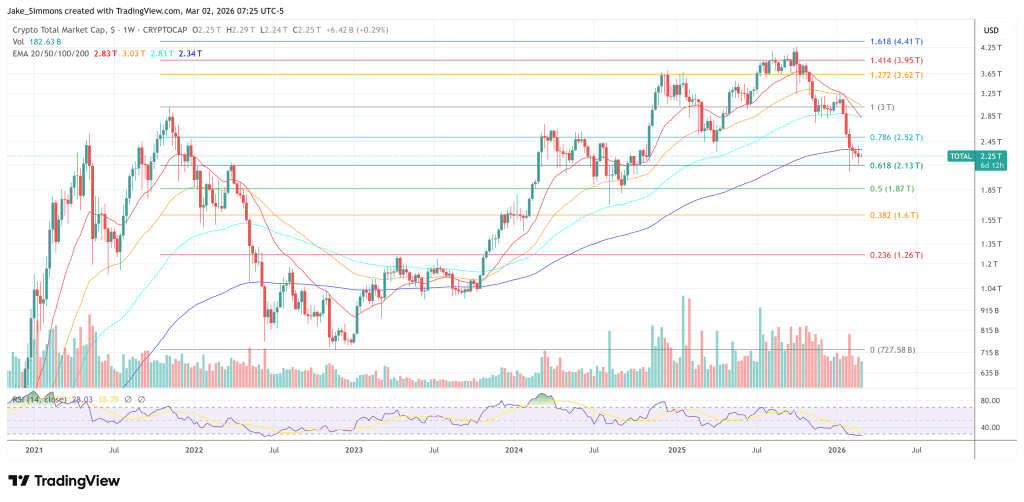
Total crypto market cap remains above the 0.618 Fib, 1-week chart | Source: TOTAL on TradingView.com

Domande pertinenti

QWhat are the five key catalysts for the crypto market this week as mentioned in the article?

AThe five catalysts are: a worsening US-Iran conflict, the launch of Starknet's strkBTC, Polygon's gas upgrade on March 4, Avalanche's new incentive round, and the US jobs report on Friday.

QHow did Bitcoin initially react to the US-Iran conflict over the weekend, and what was its price by European Monday morning?

AThe initial war shock pushed Bitcoin down toward $63,000, but it rebounded to as high as $68,196 on Sunday and was trading around $65,807 by European Monday morning.

QWhat is the key feature of Starknet's new strkBTC product?

AstrkBTC is a wrapped Bitcoin asset issued on Starknet that is redeemable for native BTC, with optional privacy shielding for balances and transfers, meaning privacy is available when needed but transparency remains for compliance.

QWhat is the purpose of Polygon's March 4 upgrade, and what specific feature does it implement?

AThe purpose of the upgrade is to implement agentic-payments through the Lisovo hardfork, which includes PIP-82. This proposal recycles up to $1 million in gas base fees spent on agentic-commerce transactions to directly subsidize machine-to-machine payments.

QHow does the Avalanche Retro9000 C-Chain Round differ from previous incentive programs?

AThe key methodological shift is that it moves from rewarding 'who built' to rewarding 'what gets used.' Projects are ranked by the amount of AVAX burned through smart-contract activity, with the top 40 becoming eligible for rewards from the $40 million funding pool.

Letture associate

Anthropic Starts Poaching Scientists? $27K Weekly Onsite Stipend to Fix Claude's Expert-Level Errors

Anthropic has launched a new STEM Fellow program, offering $3,800 per week for a three-month, in-person residency in San Francisco. The role targets experts from science, technology, engineering, and mathematics (STEM) fields—machine learning experience is helpful but not required. Instead, Anthropic values scientific judgment and a willingness to learn quickly. Fellows will work with Claude models and internal tools under the guidance of an Anthropic researcher. Example projects include a materials scientist identifying errors in Claude’s reasoning or a climate scientist integrating atmospheric modeling software with Claude. The goal is to have experts "tell Claude where it's wrong" and improve its scientific capabilities. This initiative is part of Anthropic’s broader strategy to strengthen its scientific ecosystem, following earlier programs like the AI Safety Fellows and AI for Science programs. The company acknowledges that current AI models, while powerful, still produce high-confidence errors and lack end-to-end research autonomy. The program aims to embed domain expertise directly into model development, turning scientists into "high-level reviewers" for AI. Anthropic CEO Dario Amodei has previously emphasized AI’s potential to accelerate scientific breakthroughs, particularly in biology and healthcare. The company believes that the next phase of AI competition will depend not on scaling parameters, but on integrating human expertise to refine model accuracy and reliability.

marsbit26 min fa

Anthropic Starts Poaching Scientists? $27K Weekly Onsite Stipend to Fix Claude's Expert-Level Errors

marsbit26 min fa

On the Eve of X Money's Launch, Musk Dismantles the Referee First

"X Money Launches After Dismantling Regulator: Musk's 9-Day Power Play" In February 2025, a team from the "Department of Government Efficiency" (DOGE), led by Elon Musk, entered the Consumer Financial Protection Bureau (CFPB) headquarters. Shortly after, the CFPB was effectively dismantled—its funding frozen, activities suspended, and nearly 90% of staff laid off. This move came just nine days after X announced a partnership with Visa and as X Money prepared to launch. The article contrasts this with the decade-long regulatory battles faced by companies like Coinbase and PayPal. Coinbase spent over $75 million in political contributions and endured a major SEC lawsuit to operate legally. PayPal complied with strict state and federal rules for its stablecoin PYUSD, including 100% reserve requirements and monthly audits. However, Musk’s approach was different. After the CFPB introduced a rule placing large digital payment apps under federal oversight, Musk tweeted "Delete CFPB." Within months, the rule was revoked by Congress. Meanwhile, DOGE operatives gained "god-tier" access to CFPB databases, potentially obtaining sensitive competitive information from rivals like Apple, Google, and PayPal. The article also highlights a "suspicious exemption clause" in the GENIUS Act, which allows private companies like X to issue stablecoins with fewer restrictions. Senator Elizabeth Warren questioned whether Musk, who was a senior presidential advisor during the Act’s drafting, influenced this clause. X Money offers a 6% APY on deposits, despite FDIC warnings that stablecoin users are not insured. As X Money launches to 600 million monthly users, the article questions the fairness of a system where Musk can bypass regulations that others spent years and millions to comply with. The dismantling of the CFPB and the alleged regulatory advantages raise concerns about the future of equitable rule-making in the U.S. financial system.

marsbit34 min fa

On the Eve of X Money's Launch, Musk Dismantles the Referee First

marsbit34 min fa

Trading

Spot
Futures
活动图片