Crypto Users Hit By 1,400% Surge In Impersonation Scams, Research Shows

bitcoinistPubblicato 2026-01-14Pubblicato ultima volta 2026-01-14

Introduzione

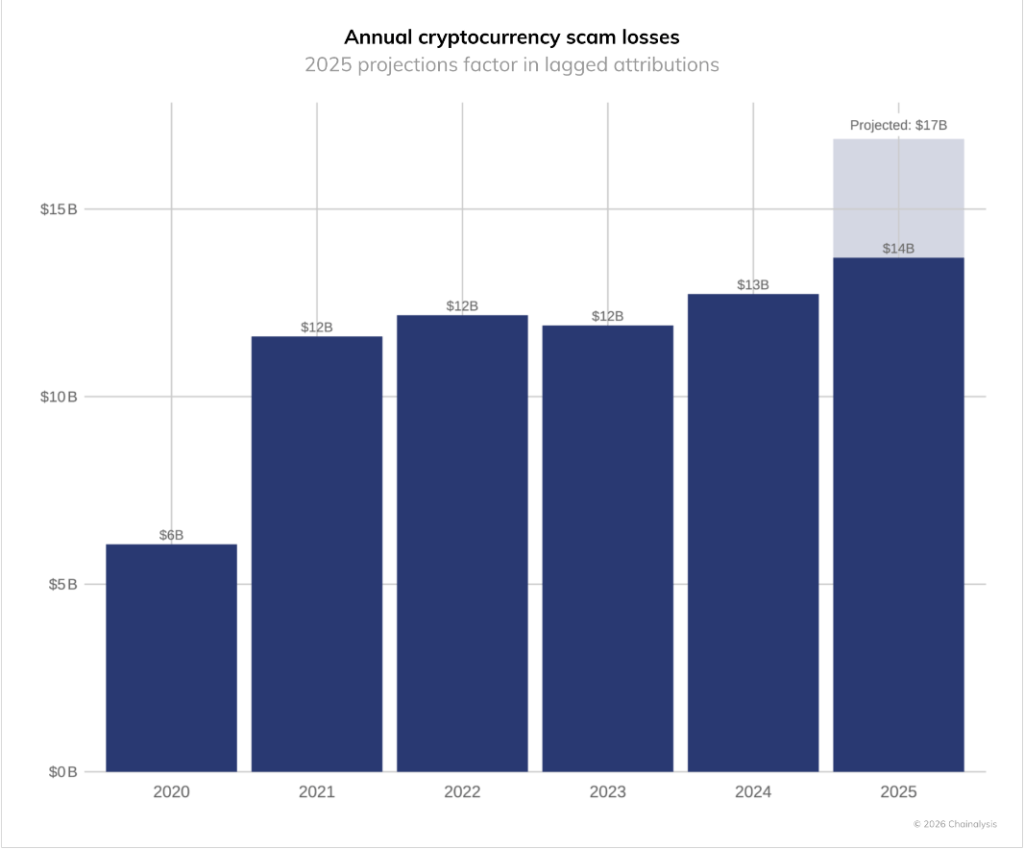
Impersonation scams surged by 1,400% in 2025, causing billions in losses as criminals used AI tools, voice cloning, and fake customer-support schemes. The average scam amount increased by over 600%, with AI-enabled methods proving several times more profitable. Scammers impersonated exchange staff and celebrities using deepfakes and sophisticated social engineering, making operations more efficient and harder to trace. One high-profile case stole nearly $16 million. Total on-chain crypto scam losses for 2025 are estimated between $14 billion and $17 billion.

Impersonation scams exploded in 2025, growing by about 1,400% and driving some of the biggest losses seen in crypto fraud to date. According to analysis by Chainalysis, scammers used AI tools, voice cloning and fake customer-support schemes to scale up attacks, pushing total scam losses on chain into the low-double-digit billions.

Impersonation Scams Jump Dramatically

Reports have disclosed that the rise was not just in the number of cases but in how much each case cost victims. The average amount taken in impersonation schemes rose by over 600% compared with the prior year, a jump that turned many small cons into large heists. Chainalysis highlights the role of automated tooling and commercially available phishing services that let scammers run scams like factories.
Source: Chainalysis

Criminals Used AI And Deepfakes

Fraudsters leaned heavily on AI techniques in 2025. Based on reports, AI-generated voice and face clones, paired with very believable messages, helped criminals impersonate exchange staff, celebrities or close contacts. These methods increased both reach and success rates. Industry writeups and analysts show that AI-enabled scams were several times more profitable than older approaches.

BTCUSD currently trading at $94,929. Chart: TradingView

A High-Profile Example Shows The Risk

One public example involved scammers posing as a major exchange and clearing nearly $16 million from victims in a single operation. That case became a headline because it showed how quickly an impersonation scam can turn into a mass theft when it uses polished fake identities and coordinated social engineering. Financial news outlets and industry trackers used that case to illustrate the shift in tactics.

Operations Became Industrialized

Based on Chainalysis data, scam groups now resemble small businesses. They outsource parts of the fraud chain — writing scripts, buying deepfake clips, and hiring money movers. This setup made fraud more efficient and harder to disrupt. One analysis found AI-assisted schemes were about 4.5 times more profitable than traditional scams, a gap that attackers exploited to level up operations quickly.

Estimates of total crypto scam losses for 2025 vary by outlet, but multiple sources put the number well into the billions. Some trackers reported $14 billion in funds stolen on chain, while Chainalysis noted the figure could be as high as $17 billion once more data is tallied. The difference reflects how quickly new incidents were discovered and how some thefts moved off public rails.

Featured image from Unsplash, chart from TradingView

Domande pertinenti

QWhat was the percentage increase in impersonation scams in 2025 according to the research?

AImpersonation scams grew by about 1,400% in 2025.

QWhich company provided the analysis on the surge in crypto impersonation scams?

AThe analysis was provided by Chainalysis.

QWhat technologies did scammers heavily rely on to scale up their attacks in 2025?

AScammers heavily relied on AI tools, voice cloning, and fake customer-support schemes to scale up their attacks.

QHow much more profitable were AI-enabled scams compared to traditional approaches according to one analysis?

AOne analysis found that AI-assisted schemes were about 4.5 times more profitable than traditional scams.

QWhat is the estimated range of total crypto scam losses for 2025 as mentioned in the article?

AEstimates vary, with some sources reporting $14 billion and Chainalysis noting the figure could be as high as $17 billion once more data is tallied.

Letture associate

2026 New Policy Interpretation: The "Mutual Pursuit" of Intelligent Agents and AI Terminals, and the Three Major Value Reconstructions in the AIoT Industry

In May 2026, China's national ministries released two pivotal policy documents that jointly establish a strategic "dual-track" framework for the AIoT industry. The "Intelligent Agent Standardized Application and Innovation Development Implementation Opinions" defines the "soul"—positioning intelligent agents as core AI products. The "Artificial Intelligence Terminal Intelligence Grading" national standard defines the "body"—establishing a four-tier capability ladder (L1 to L4) for AI hardware. This synchronized policy approach is globally unique, moving beyond market-led (US) or risk-focused (EU) models. It frames AIoT as a new type of "intelligent infrastructure," comparable to electricity or the internet in historical significance. The core analysis identifies a value evolution from IoT 1.0 (connection) to AIoT 4.0 (collaboration, represented by the forward-looking L4 level). This "L4" signifies a paradigm shift: from users operating tools to delegating tasks to agent-like devices ("Intelligent Action of All Things"). The article outlines three strategic paths for companies: becoming Standard Definers, Scenario Integrators (focusing on 19 specified application areas), or Infrastructure Builders. A critical 18-24 month window is identified for strategic positioning. A "Four Levers" strategy is proposed: leveraging Standards (L-level certification), leveraging Scenarios (deep vertical focus), leveraging Open Source (for cost reduction and ecosystem influence), and leveraging Momentum (engaging in global protocol ecosystems). In conclusion, these policies are a starting gun for a decade-long industrial transformation, shifting the industry narrative from "Intelligent Connection of All Things" to "Intelligent Action of All Things," with companies needing to choose their赛道and execution strategy decisively.

marsbit39 min fa

2026 New Policy Interpretation: The "Mutual Pursuit" of Intelligent Agents and AI Terminals, and the Three Major Value Reconstructions in the AIoT Industry

marsbit39 min fa

Splashing Out 27 Billion Yuan, OpenAI Establishes New Company to Accelerate AI Deployment

On May 11th, OpenAI announced the formation of a new company, "OpenAI Deployment Company," with an initial investment of over $4 billion (approximately 27.2 billion RMB). This venture aims to help businesses build and deploy AI solutions. OpenAI is also acquiring the AI consulting firm Toromo to rapidly scale the deployment company's capabilities. This new entity, majority-owned by OpenAI, brings together 19 investment, consulting, and system integration partners, led by TPG with co-lead founding partners including Advent International, Bain Capital, and Brookfield. OpenAI's Chief Revenue Officer, Denise Dresser, stated that while AI is becoming increasingly capable, the current challenge lies in integrating these systems into core business infrastructure and workflows. The deployment company is designed to bridge this gap and translate AI capabilities into operational impact. This move comes as OpenAI emphasizes the next competitive phase will depend on the efficiency of deploying AI in real business scenarios. The company reports over 1 million businesses already use its products and APIs. OpenAI is significantly increasing its investments in computing power, with co-founder Greg Brockman stating the company expects to spend $50 billion on compute this year, a dramatic increase from $3 million in 2017. The announcement follows OpenAI's recent completion of a record $122 billion funding round in late March, led by Amazon, Nvidia, and SoftBank, valuing the company at $852 billion post-money. Major strategic investors committed $110 billion as a base for this round. Concurrently, OpenAI is advancing its core model development. It has shifted focus from its Sora video generator to developing advanced robotics and AI models that interact with the physical world. It has also begun allowing select users access to a new model specialized in identifying software vulnerabilities and is reportedly preparing to launch an enhanced image generation model in the coming weeks. According to reports citing founder Sam Altman, OpenAI is considering an IPO as early as 2027, with a potential valuation around $1 trillion.

marsbit55 min fa

Splashing Out 27 Billion Yuan, OpenAI Establishes New Company to Accelerate AI Deployment

marsbit55 min fa

Trading

Spot
Futures
活动图片