Crypto Traders On Edge As Korea Stalls Key Law — Is The “Kimchi Premium” At Risk Next?

bitcoinistPubblicato 2026-04-03Pubblicato ultima volta 2026-04-03

Introduzione

The National Policy Committee of Korea has delayed the debate on the "second-phase" crypto framework until after the June local elections, creating uncertainty in the industry. The proposed Digital Asset Basic Act was excluded from the legislative agenda, despite its importance in regulating stablecoins and exchange ownership. Two major conflicts are stalling progress: first, a dispute between the Bank of Korea and the Financial Services Commission (FSC) over whether banks must hold a 51% stake in won-denominated stablecoin issuers. The FSC opposes this, arguing it would exclude tech firms and exchanges. Second, there is disagreement over equity caps for crypto exchanges, with proposals to limit major shareholders to 20%, affecting giants like Upbit and Bithumb. The delay leaves KRW stablecoin issuers in a gray zone and increases operational costs. Post-election, a bank-heavy stablecoin framework and tighter rules could favor large incumbents, reshaping market liquidity and altcoin listings. Weakening these rules could signal greater openness for crypto in Korea.

The National Policy Committee of Korea pushed the “second‐phase” crypto act debate until after the June 3 local elections.

Crypto Framework Postponed In A Time Of Need

The Korean outlet Maeil Business Newspaper reported uncertainty in the crypto industry deepening after the National Policy Committee excluded the Framework Act on Digital Assets from the 31st of March agenda.

Lawmakers sent five finance-related bills to the subcommittee that day: the Framework Act on Administrative Regulation, the Credit Information Protection Act, the Microfinance Support Act, the Insurance Business Act, and the Capital Markets Act. Not a single bill related to crypto was included, but the Political Affairs Committee’s plenary session received Representative Kim Nam-geun’s “Partial Amendment to the Act on the Protection of Virtual Asset Users, etc.” and forwarded it to the Bill Review Subcommittee.

Lawmakers opted to park the second‐phase bill during a sensitive election window rather than ram through divisive provisions on banks and exchange tycoons, which have become “core landmines” in the legislative process. Speculation in Korean political coverage suggest that the presidential office and the Financial Services Commission (FSC) are not fully aligned on how far to push ownership caps and how tightly to ring‐fence stablecoin issuance, adding to the deadlock narrative.

The proposed crypto framework comes at a time of major importance, as the aforementioned political disagreements also happen to be the two key fights occurring between major players in the Korean cryptocurrency and financial industry.

The Stablecoins Fight

South Korea has recently seen a tug‐of‐war between The Bank of Korea and the FSC over who gets to issue won‐denominated stablecoins.

The BOK is pushing for a bank‐led consortium model where commercial banks must hold at least 51% of any issuer of won‐denominated stablecoins. Bitcoinist reported this on October last year.

The FSC, however, accepts that stablecoins need strict safeguards but opposes a hard 51% bank‐ownership rule, warning it would lock out tech platforms, fintechs and exchanges that actually build the user‐facing products.

These stablecoin-issuers rules are to be hard‐wired under the Digital Asset Basic Act, so every month of delay leaves existing and would‐be KRW stablecoin issuers operating in a gray zone or stuck on the sidelines. According to local outlet Aju Economy, this is a real and concerning issue for the industry. They reported on and industry insider lament:

We need the bill to be finalized quickly to determine our business direction, but currently, we are keeping all possibilities open, which is only increasing the cost burden.

The Equity-Cap Fight

The FSC has been backing proposals to treat big crypto exchanges more like securities or ATS‐style markets, where no single “same person” can own beyond roughly 15–20% in principle. After heavy pushback, regulators and the ruling party have coalesced around a 20% ceiling for “major shareholders”, with a narrow exception that allows stakes up to 34% for new entrants, mirroring the 33.3% veto line in Korea’s Commercial Act. Bitcoinist covered the story at the beginning of the past month.

For existing giants like Upbit and Bithumb, this is a post‐facto rule. Founders and early backers already hold stakes well above 20%, so a hard cap would force them to sell down significant portions of their equity over a three‐year transition (six years for some smaller exchanges). This could potentially disrupt ongoing M&A and reshape control of the local market.

What This Means For The Market

South Korea seems ready to move from ad‐hoc crackdowns to a comprehensive crypto regime. This delay comes on top of recent moves from Seoul to step up oversight with strategies such as AI surveillance, manipulation probes and tax tracking, and to loosen some restrictions, like easing earlier exchange‐stake proposals and reconsidering corporate crypto trading.

Near term, rule uncertainty around KRW stablecoins and exchange ownership could keep Korean venues’ risk premia high and make local listing or market‐making plans harder to model. Post‐election, a bank‐heavy stablecoin framework plus tighter governance rules could favor well‐capitalized incumbents and banks over smaller, high‐beta platforms. This could reshape liquidity and altcoin listings.

Lawmakers watering down ownership caps or opening up stablecoin issuance beyond banks would be a clear risk‐on signal for KRW‐denominated products and for global firms eyeing Korea’s retail base.
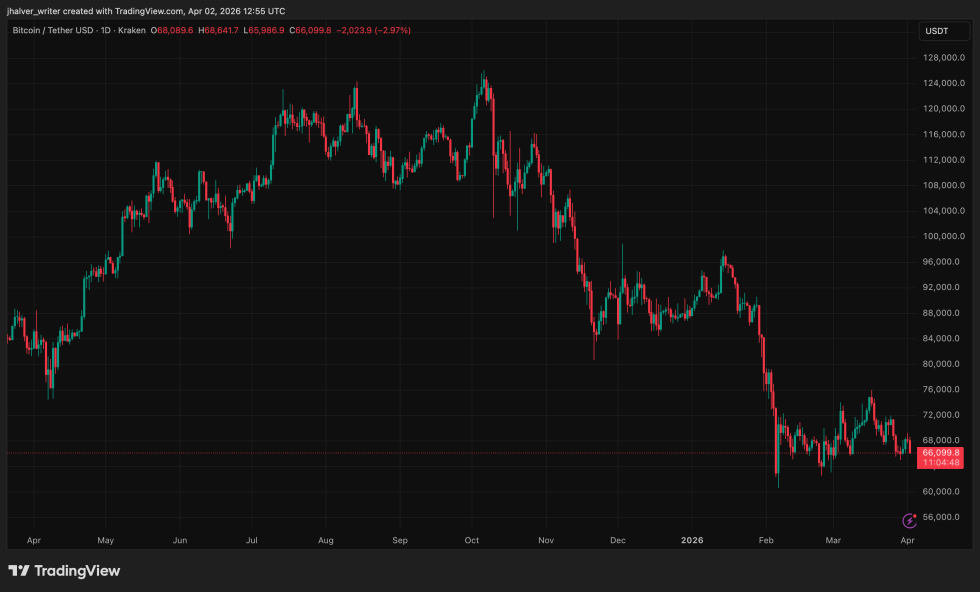
At the moment of writing, BTC trades for exactly $66k on the daily chart. Source: BTCUSDT on Tradingview.

Cover image from Perplexity. BTCUSDT chart from Tradingview.

Domande pertinenti

QWhy was the debate on the 'second-phase' crypto act in Korea postponed?

AThe National Policy Committee of Korea postponed the debate until after the June 3 local elections to avoid pushing through divisive provisions on banks and exchange tycoons during a sensitive election window.

QWhat are the two key disagreements causing a deadlock in the Korean crypto framework legislation?

AThe two key disagreements are over ownership caps for major shareholders of crypto exchanges and the regulatory approach for won-denominated stablecoin issuance, particularly between the Bank of Korea and the Financial Services Commission (FSC).

QHow does the Bank of Korea propose to regulate won-denominated stablecoin issuance?

AThe Bank of Korea is pushing for a bank-led consortium model where commercial banks must hold at least 51% of any issuer of won-denominated stablecoins.

QWhat ownership cap is being proposed for major shareholders of crypto exchanges in Korea?

ARegulators and the ruling party have coalesced around a 20% ceiling for major shareholders, with a narrow exception allowing stakes up to 34% for new entrants.

QWhat are the potential market implications of the delayed crypto legislation in Korea?

AThe delay could keep risk premia high for Korean venues, make local listing or market-making plans harder to model, and potentially reshape liquidity and altcoin listings depending on the final rules for stablecoins and exchange ownership.

Letture associate

Google and Amazon Simultaneously Invest Heavily in a Competitor: The Most Absurd Business Logic of the AI Era Is Becoming Reality

In a span of four days, Amazon announced an additional $25 billion investment, and Google pledged up to $40 billion—both direct competitors pouring over $65 billion into the same AI startup, Anthropic. Rather than a typical venture capital move, this signals the latest escalation in the cloud wars. The core of the deal is not equity but compute pre-orders: Anthropic must spend the majority of these funds on AWS and Google Cloud services and chips, effectively locking in massive future compute consumption. This reflects a shift in cloud market dynamics—enterprises now choose cloud providers based on which hosts the best AI models, not just price or stability. With OpenAI deeply tied to Microsoft, Anthropic’s Claude has become the only viable strategic asset for Google and Amazon to remain competitive. Anthropic’s annualized revenue has surged to $30 billion, and it is expanding into verticals like biotech, positioning itself as a cross-industry AI infrastructure layer. However, this funding comes with constraints: Anthropic’s independence is challenged as it balances two rival investors, its safety-first narrative faces pressure from regulatory scrutiny, and its path to IPO introduces new financial pressures. Globally, this accelerates a "tri-polar" closed-loop structure in AI infrastructure, with Microsoft-OpenAI, Google-Anthropic, and Amazon-Anthropic forming exclusive model-cloud alliances. In contrast, China’s landscape differs—investments like Alibaba and Tencent backing open-source model firm DeepSeek reflect a more decoupled approach, though closed-source models from major cloud providers still dominate. The $65 billion bet is ultimately about securing a seat at the table in an AI-defined future—where missing the model layer means losing the cloud war.

marsbit1 h fa

Google and Amazon Simultaneously Invest Heavily in a Competitor: The Most Absurd Business Logic of the AI Era Is Becoming Reality

marsbit1 h fa

Computing Power Constrained, Why Did DeepSeek-V4 Open Source?

DeepSeek-V4 has been released as a preview open-source model, featuring 1 million tokens of context length as a baseline capability—previously a premium feature locked behind enterprise paywalls by major overseas AI firms. The official announcement, however, openly acknowledges computational constraints, particularly limited service throughput for the high-end DeepSeek-V4-Pro version due to restricted high-end computing power. Rather than competing on pure scale, DeepSeek adopts a pragmatic approach that balances algorithmic innovation with hardware realities in China’s AI ecosystem. The V4-Pro model uses a highly sparse architecture with 1.6T total parameters but only activates 49B during inference. It performs strongly in agentic coding, knowledge-intensive tasks, and STEM reasoning, competing closely with top-tier closed models like Gemini Pro 3.1 and Claude Opus 4.6 in certain scenarios. A key strategic product is the Flash edition, with 284B total parameters but only 13B activated—making it cost-effective and accessible for mid- and low-tier hardware, including domestic AI chips from Huawei (Ascend), Cambricon, and Hygon. This design supports broader adoption across developers and SMEs while stimulating China's domestic semiconductor ecosystem. Despite facing talent outflow and intense competition in user traffic—with rivals like Doubao and Qianwen leading in monthly active users—DeepSeek has maintained technical momentum. The release also comes amid reports of a new funding round targeting a valuation exceeding $10 billion, potentially setting a new record in China’s LLM sector. Ultimately, DeepSeek-V4 represents a shift toward open yet realistic infrastructure development in the constrained compute landscape of Chinese AI, emphasizing engineering efficiency and domestic hardware compatibility over pure model scale.

marsbit1 h fa

Computing Power Constrained, Why Did DeepSeek-V4 Open Source?

marsbit1 h fa

Trading

Spot
Futures

Articoli Popolari

Come comprare EDGE

Benvenuto in HTX.com! Abbiamo reso l'acquisto di edgeX (EDGE) semplice e conveniente. Segui la nostra guida passo passo per intraprendere il tuo viaggio nel mondo delle criptovalute.Step 1: Crea il tuo Account HTXUsa la tua email o numero di telefono per registrarti il tuo account gratuito su HTX. Vivi un'esperienza facile e sblocca tutte le funzionalità,Crea il mio accountStep 2: Vai in Acquista crypto e seleziona il tuo metodo di pagamentoCarta di credito/debito: utilizza la tua Visa o Mastercard per acquistare immediatamente edgeXEDGE.Bilancio: Usa i fondi dal bilancio del tuo account HTX per fare trading senza problemi.Terze parti: abbiamo aggiunto metodi di pagamento molto utilizzati come Google Pay e Apple Pay per maggiore comodità.P2P: Fai trading direttamente con altri utenti HTX.Over-the-Counter (OTC): Offriamo servizi su misura e tassi di cambio competitivi per i trader.Step 3: Conserva edgeX (EDGE)Dopo aver acquistato edgeX (EDGE), conserva nel tuo account HTX. In alternativa, puoi inviare tramite trasferimento blockchain o scambiare per altre criptovalute.Step 4: Scambia edgeX (EDGE)Scambia facilmente edgeX (EDGE) nel mercato spot di HTX. Accedi al tuo account, seleziona la tua coppia di trading, esegui le tue operazioni e monitora in tempo reale. Offriamo un'esperienza user-friendly sia per chi ha appena iniziato che per i trader più esperti.

524 Totale visualizzazioniPubblicato il 2026.03.31Aggiornato il 2026.03.31

Come comprare EDGE

Discussioni

Benvenuto nella Community HTX. Qui puoi rimanere informato sugli ultimi sviluppi della piattaforma e accedere ad approfondimenti esperti sul mercato. Le opinioni degli utenti sul prezzo di EDGE EDGE sono presentate come di seguito.

活动图片