Crypto saw capital exit in Q1 – Can $10B stablecoin surge drive Q2 rebound?

ambcryptoPubblicato 2026-04-07Pubblicato ultima volta 2026-04-07

Introduzione

The crypto market experienced a significant bearish trend in Q1 2026, marked by a 20.8% drop in total market capitalization and capital outflows, as evidenced by a 1.6% decline in USDT's market cap. However, recent data suggests a potential reversal in Q2. Stablecoin activity has surged, with USDT issuance on Ethereum increasing by nearly 2.6% monthly and Circle minting $3.25 billion USDC on Solana in just one week—the largest weekly issuance of 2026. Ethereum’s stablecoin supply change reached $10.3 billion, the highest among L1 networks. These inflows indicate investors are redeploying capital, possibly due to Ethereum’s relative undervaluation (down 57% from its 2025 peak) and growing institutional involvement in DeFi. This stablecoin momentum may lay the foundation for a Q2 rally.

So far, the 2026 cycle has been a bear market.

Notably, one clear signal is when stablecoin market caps drop alongside crypto prices. In Q1, USDT fell 1.6%, showing that money was leaving crypto instead of sitting on the sidelines like it would in a bull market, where investors hold dry powder for the next risk-on move.

The result? The total crypto market dropped 20.8% over the same period, confirming the bearish trend.

Investors weren’t chasing dips. Instead, they were exiting. TOTAL2 (market cap ex-BTC) fell 19.17%, meaning capital didn’t rotate into altcoins either, which only adds to the bearish picture.
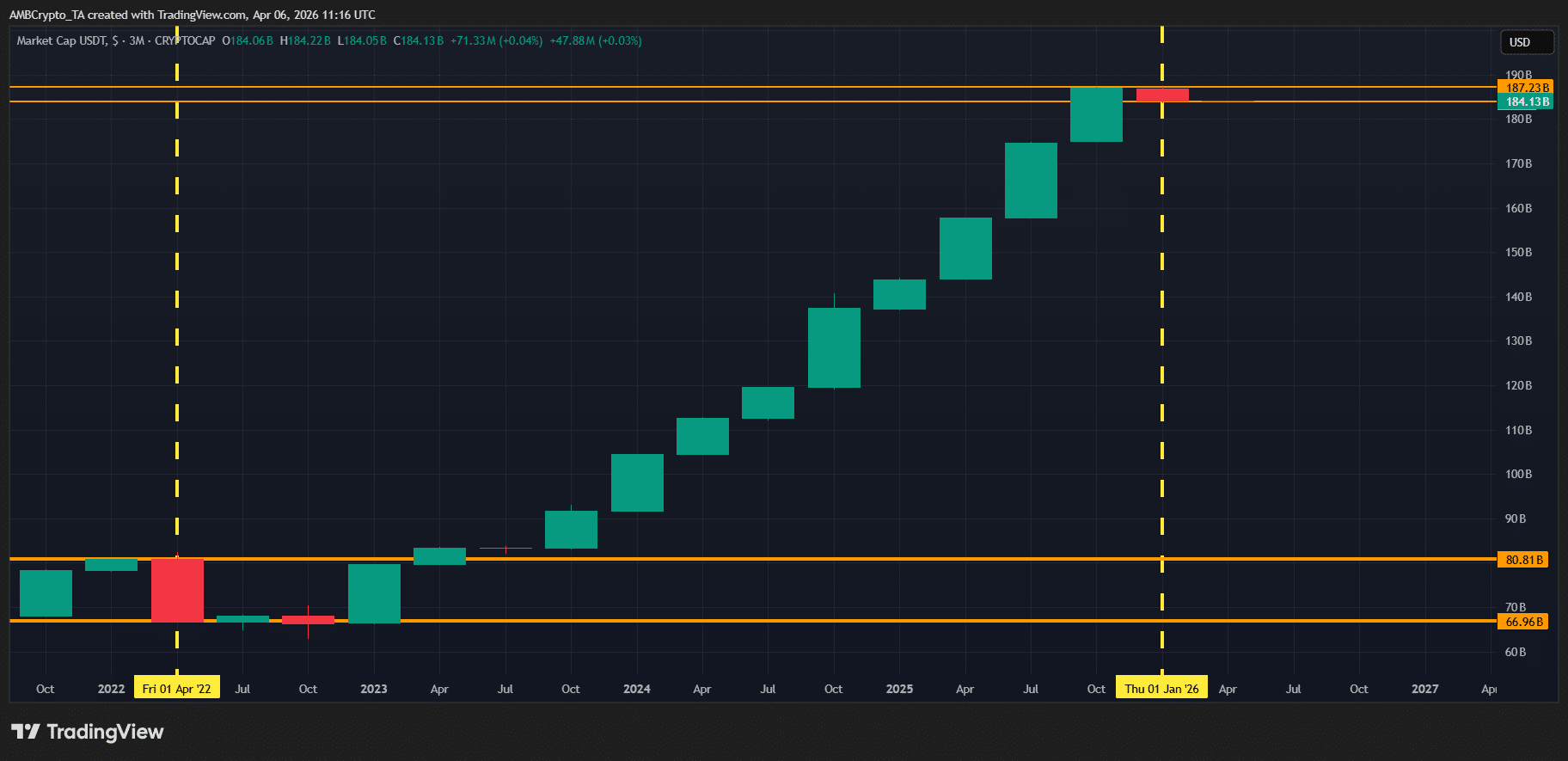
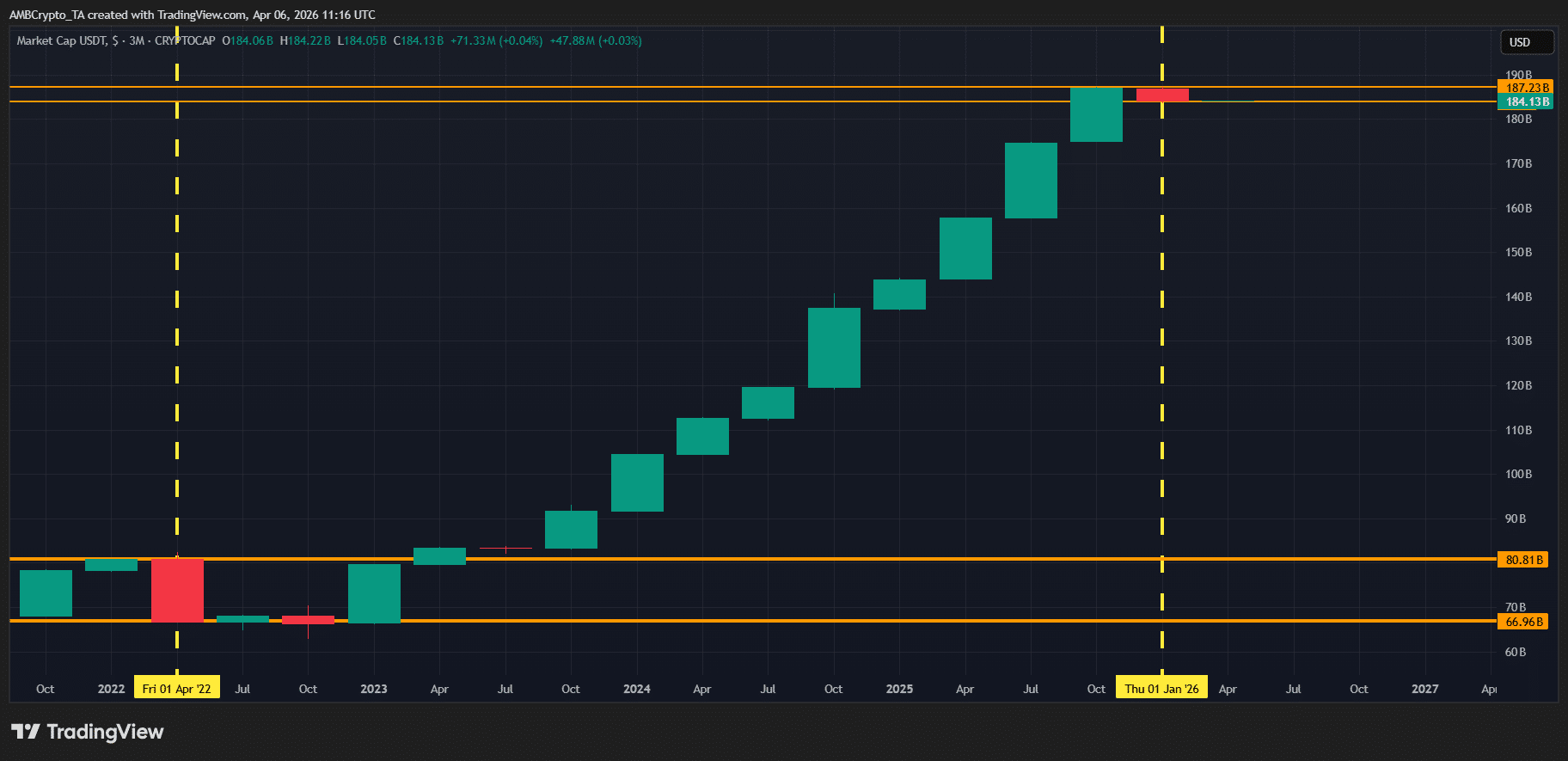
Source: TradingView (USDT)

In essence, stablecoins played a central role in defining crypto’s Q1 trend.

According to AMBCrypto, this is where the recent 10x Research report becomes relevant.

It highlights that USDT issuance on Ethereum [ETH] has recently outpaced Tron [TRX], with a near 2.6% monthly jump in volume on ETH. That closes the gap with TRX, which is now just 1% higher, signaling that liquidity is starting to flow into high-cap networks, consistent with the total crypto market cap rising 1.6% so far in April.

From a technical standpoint, this combination of rising market cap and stablecoin inflows is significant.

When stablecoins move back into major networks, it suggests that investors are redeploying capital. This kind of flow often forms a base for price support, and we’re already seeing it in action.

ETH has rallied 1.87% from its $2.1k open, reinforcing that this setup is gaining traction.

Naturally, the question arises: With stablecoins back in play, could this momentum be laying the foundation for a broader Q2 rally, potentially reversing the bearish trend from Q1?

Stablecoin flows hit major networks, market eyes potential rally base

Apart from serving as a hedge or a bridge, stablecoins often act as an early signal for market activity.

A striking example is the recent activity around Solana [SOL].

Circle minted $3.25 billion USDC on Solana in just 7 days, the largest weekly issuance of 2026. This sudden influx of liquidity into the network naturally raises questions about investor intent and market positioning.

But it doesn’t stop there.

According to Artemis Terminal, monthly stablecoin supply changes on Ethereum have reached a staggering $10.3 billion, the largest among all L1 networks. This “coordinated” increase in stablecoin supply across major networks suggests that investors are actively redeploying capital.
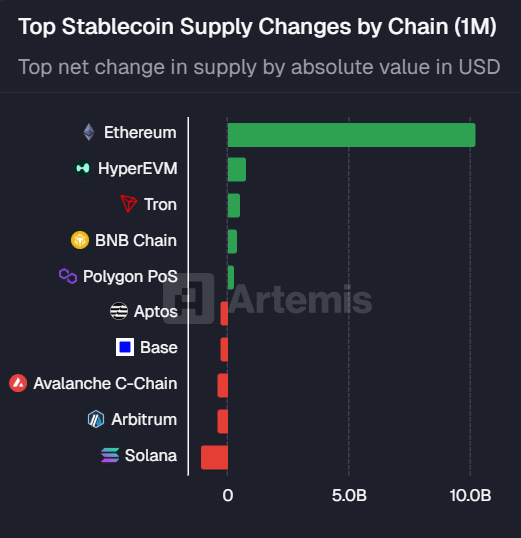
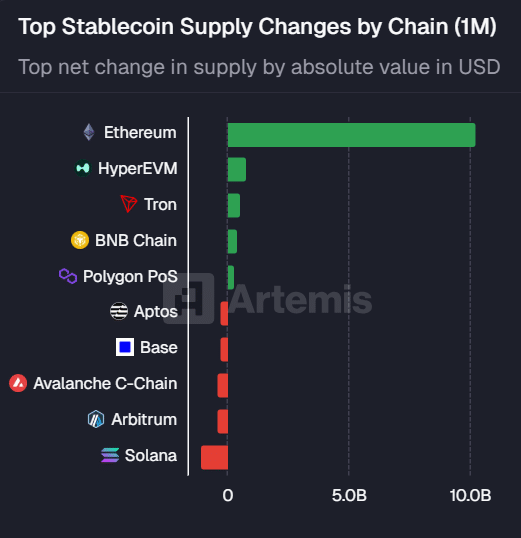
Source: Artemis Terminal

Consequently, the critical question now becomes: Do these issuers have insight into opportunities or risks that the broader market hasn’t priced in yet?

According to the 10x Research report, Ethereum’s relative undervaluation appears to be driving much of this influx.

From a technical standpoint, Ethereum has dropped 57% from its August 2025 peak, making it look relatively cheap, especially when compared to Bitcoin, which is down roughly 42% over the same period.

This is particularly significant given that BTC dominance continues to face resistance around 60%.

Adding to this, Wall Street’s integration into DeFi is gaining momentum, bringing institutional capital to the market.

Taken together, these factors suggest that Ethereum and other high-cap L1s may be positioning for early Q2 momentum, with stablecoin flows acting as a leading indicator of where capital may move next.


Final Summary

  • Rising USDT issuance on ETH and large USDC minting on SOL indicate capital is redeploying.
  • With ETH down 57%, BTC dominance under pressure, and Wall Street entering DeFi, stablecoin inflows may act as a leading indicator for Q2 momentum.


Domande pertinenti

QWhat was the overall trend of the crypto market in Q1 2026, and what key metric confirmed this trend?

AThe crypto market was in a bear market in Q1 2026. This trend was confirmed by a 20.8% drop in the total crypto market cap over the period.

QHow did the behavior of stablecoins, specifically USDT, differ in the Q1 bear market compared to a typical bull market?

AIn the Q1 bear market, the stablecoin USDT's market cap fell by 1.6%, indicating that money was leaving the crypto ecosystem. In a bull market, investors typically hold stablecoins as 'dry powder' on the sidelines, waiting to deploy it for the next risk-on move.

QWhat recent development in stablecoin issuance on Ethereum suggests a potential shift in market sentiment?

ARecent data shows that USDT issuance on Ethereum has recently outpaced Tron, with a near 2.6% monthly jump in volume on ETH. This signals that liquidity is starting to flow back into high-cap networks.

QWhat was the significant USDC activity on the Solana network, and why is it notable?

ACircle minted $3.25 billion USDC on Solana in just 7 days, which was the largest weekly issuance of 2026. This massive and sudden influx of liquidity raises questions about investor intent and is a significant signal of market activity.

QAccording to the article, what are the three main factors suggesting Ethereum may be positioning for early Q2 momentum?

AThe three factors are: 1) Ethereum's relative undervaluation, being down 57% from its peak. 2) Bitcoin dominance facing resistance around 60%. 3) Wall Street's integration into DeFi, which is bringing institutional capital to the market.

Letture associate

a16z: From Companies to DAOs, DUNA May Become the Next Generation Organizational Form

This article, "From Companies to DAOs: How DUNA Could Become the Next Organizational Form," traces the 500-year evolution of business collaboration. It begins with medieval structures like the *commenda* and Florentine *compagnia*, which exposed partners to personal risk. The modern corporation, exemplified by the Dutch East India Company (VOC), was a revolutionary leap, enabling large-scale, capital-intensive ventures by offering limited liability and reducing coordination costs. However, corporations introduced new challenges like principal-agent problems and bureaucratic overhead. The piece argues that software and internet-native protocols are now reducing these traditional overheads. Decentralized Autonomous Organizations (DAOs) emerged as a new model for coordination without centralized management. Yet, DAOs face a significant legal vacuum: they lack legal recognition, leaving members exposed to unlimited personal liability, and their tokens are vulnerable to being classified as securities under unclear regulations (e.g., the Howey Test). This has forced projects into suboptimal workarounds like offshore foundations. The article identifies the Decentralized Unincorporated Nonprofit Association (DUNA) as a potential solution. Recently legalized in states like Wyoming, the DUNA provides a legal wrapper for decentralized networks. It grants key protections—legal personality, limited liability, and perpetual existence—to a group without imposing a traditional hierarchical management structure. This allows token-holder communities to govern, hold assets, and contract as a single legal entity, aligning with their decentralized nature. While DUNA doesn't solve all governance challenges or magically resolve securities law questions, it represents a crucial step. It fills the legal recognition gap, offering a native legal form for internet-scale, decentralized collaboration and extending the separation of personal risk from organizational venture into a new domain.

marsbit5 min fa

a16z: From Companies to DAOs, DUNA May Become the Next Generation Organizational Form

marsbit5 min fa

2026 Mid-Year Report On-Chain RWA: Tokenized Stock Market Cap Doubles in a Year, But 90% of Rights Are Hollow Shells

The 2026 Mid-Year Report on On-Chain RWA highlights a significant growth in tokenized stock market capitalization, which nearly doubled from $951 million in March to $1.89 billion by July. However, the report reveals a fundamental contradiction in this "layer 2.5" ecosystem: products with the strongest legal foundation (like regulated U.S. infrastructure) lack liquidity and distribution, while freely tradable offshored wrapper products often lack substantive ownership rights. The increase is driven largely by a few products (SECZ, FGRS, STRCx) and platforms (Ondo, xStocks, Securitize collectively hold over 85% share). While distributed value across networks like Ethereum, Solana, and BNB Chain has grown, the market remains fragmented. Products referencing the same underlying asset (e.g., Apple stock) are distinct legal liabilities with different intermediaries and jurisdictional rules, offering varying degrees of legal claim. The report cautions that headline numbers are misleading, as they reflect changes in distributed token value—driven by issuance, conversions, and price movements—not pure investor inflows. True "canonical shares" with legal ownership, wide wallet distribution, institutional liquidity, and independent on-chain price discovery do not yet exist at scale. Tokenized treasuries show stronger product-market fit, and ETFs may be easier to scale than single stocks. The core takeaway is a trade-off: legal certainty versus liquidity and composability.

marsbit54 min fa

2026 Mid-Year Report On-Chain RWA: Tokenized Stock Market Cap Doubles in a Year, But 90% of Rights Are Hollow Shells

marsbit54 min fa

Coldcard Hardware Wallet Hacked: 594 Bitcoin Withdrawn in 25 Minutes

The Coldcard hardware wallet has been compromised, with hackers stealing approximately 594.5 Bitcoin (~$40 million) from 500 addresses in just 25 minutes. The root cause was a critical software bug, undetected for five years, which disabled the device's secure chip for generating true random numbers. This led to the creation of private keys based on predictable data like the processor's serial number, drastically reducing cryptographic security. The attackers exploited this offline by brute-forcing possible seed phrases, finding active addresses on the public ledger, and signing transactions. Initially, Coinkite (Coldcard's maker) claimed only older models were at risk but later admitted all devices running the compromised firmware were vulnerable. CEO Rodolphe Novak (NVK) apologized but ruled out financial compensation for affected users. To secure funds, owners must urgently update their firmware to specific safe versions, generate a completely new seed phrase on the updated device, and transfer all assets to new addresses created with that new seed. While a BIP-39 passphrase can help, it does not replace this migration process. Other Coinkite products like TAPSIGNER were not affected. This incident underscores that even specialized hardware requires rigorous, independent code audits, especially for cryptographic functions. It parallels past failures, like a 2006 OpenSSL bug in Debian, and raises questions about whether automated code analysis can ever fully replace human scrutiny in critical security areas.

cryptonews.ru3 h fa

Coldcard Hardware Wallet Hacked: 594 Bitcoin Withdrawn in 25 Minutes

cryptonews.ru3 h fa

Trading

Spot
活动图片




