Crypto Prices Drop On The Weekend As Iran Shuts Strait Of Hormuz Again

bitcoinistPubblicato 2026-04-20Pubblicato ultima volta 2026-04-20

Introduzione

Cryptocurrency prices declined over the weekend following Iran's decision to reclose the Strait of Hormuz, reversing the positive market reaction to its brief reopening. Bitcoin fell below $76,000 after reaching a 10-week high of $77,500, while Ethereum dropped to around $2,350. The global crypto market cap decreased by more than 2%, with major altcoins like XRP and Solana also experiencing losses. The renewed geopolitical tension has reintroduced volatility and uncertainty, casting doubt on earlier optimism about a market recovery. Further price fluctuations are expected if diplomatic tensions between the U.S. and Iran continue.

The crypto market suffered a slight dip on Saturday, April 18th, after the tensions in the Middle East took an interesting turn over the weekend. On Friday, United States President Donald Trump announced that Iran fully reopened the Strait of Hormuz (for the first time since March) for the free passage of oil vessels, with the global financial markets and crypto reacting positively to the news. However, Iran announced on Saturday that it has closed the Strait again, with digital asset prices dropping on the back of the fresh development.

Bitcoin Falls Below $76k As Iran Closes Strait Again

On Saturday, Iran’s military announced the closure of the Strait of Hormuz again, with reports suggesting at least three attacks on commercial ships along the waterway. After President Trump’s several announcements going into the weekend, the Iranian Speaker of the Parliament, Mohammad Ghalibaf, said the US president made “seven claims in one hour, all seven of which were false.”

What’s interesting is that the crypto and global financial markets have been seeing a return of bullish momentum after a ceasefire agreement was reached between the United States and Iran in recent weeks. However, with the ceasefire agreement set to expire in a couple of days and negotiations looking broken down, volatility and uncertainty seem set to return to the markets in the coming days.

According to data from CoinGecko, the global cryptocurrency market capitalization is down by more than 2%, with the Bitcoin and Ethereum prices showing dips of 2% and 3%, respectively. Specifically, the premier cryptocurrency, which ran up to a 10-week high of around $77,500 on Friday, is now back below $76,000.
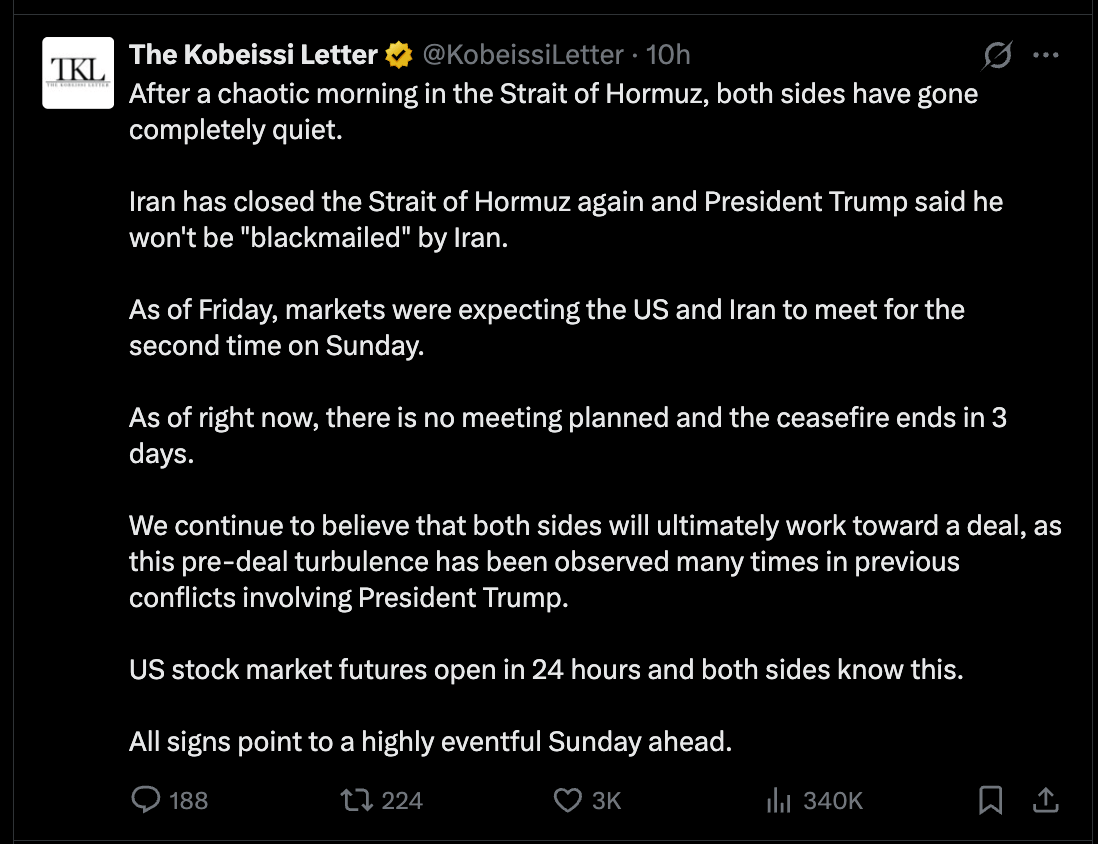
Source: @KobeissiLetter on X

Despite the crypto market gaining notoriety for slow price actions during the weekends, it’s interesting to see asset prices move in line with the latest developments in the Gulf. With no clear resolution in sight, the next few days could come with some degree of volatility.

Crypto Market Back To Point Zero?

Following these recent developments in the Middle East, conversations around the potential formation of a bottom in this current bear market now appear premature. Bitcoin, for instance, seems to have formed a local top around $77,500, with its current value at around $75,760.

Meanwhile, Ethereum, the second-largest cryptocurrency by market cap, sits at around $2,350, as of this writing. Other large-cap cryptocurrencies that have faced significant declines over the weekend include XRP and Solana, each falling by at leaast 3% in the past 24 hours.

The total crypto market cap on the daily timeframe | Source: TOTAL chart on TradingView


Domande pertinenti

QWhat event triggered the drop in cryptocurrency prices over the weekend?

AIran's announcement that it has closed the Strait of Hormuz again, with reports of attacks on commercial ships.

QHow did the global cryptocurrency market capitalization and the prices of Bitcoin and Ethereum change according to CoinGecko?

AThe global cryptocurrency market capitalization dropped by more than 2%, with Bitcoin and Ethereum prices falling by 2% and 3%, respectively.

QWhat had initially caused a positive reaction in the global financial and crypto markets on Friday?

AUnited States President Donald Trump's announcement that Iran fully reopened the Strait of Hormuz for the free passage of oil vessels.

QWhat is the current status of the ceasefire agreement between the United States and Iran mentioned in the article?

AThe ceasefire agreement is set to expire in a couple of days, and negotiations appear to have broken down, leading to increased volatility and uncertainty.

QWhat price levels did Bitcoin reach on Friday and where did it fall to after the news on Saturday?

ABitcoin reached a 10-week high of around $77,500 on Friday and fell back below $76,000 after the news on Saturday.

Letture associate

SpaceX, OpenAI, Anthropic: The Three AI Giants Racing for IPO, Which One Is Worth Betting On?

SpaceX, OpenAI, and Anthropic are poised for historic IPOs within weeks, potentially raising a combined $180 billion—a sum exceeding the entire internet bubble's fundraising. The hosts of the Limitless Podcast argue this isn't just individual company financing but an unprecedented capital concentration for AI infrastructure, driven by an insatiable need for compute, data centers, power, and chips. SpaceX's IPO is notable for reportedly changing market index rules to allow faster inclusion, potentially funneling trillions in passive retirement funds into its stock, despite its unproven space-based data center business model. In contrast, Anthropic demonstrates explosive growth, with ARR reportedly hitting $45 billion and approaching profitability, fueled by strong enterprise adoption of products like Claude Code. Google's separate $80 billion raise highlights the immense capital pressure, even for giants. The discussion acknowledges bubble risks but leans optimistic. The hosts contend the massive spending is building essential physical infrastructure for the next technological era. A key bottleneck isn't capital but the real-world limits of chip manufacturing and construction speed. As long as demand for AI compute outstrips supply, this investment cycle represents a foundational build-out rather than a purely financial bubble. All three companies are seen as foundational bets on the future, with Anthropic often cited as the most immediately compelling due to its proven revenue trajectory.

marsbit2 h fa

SpaceX, OpenAI, Anthropic: The Three AI Giants Racing for IPO, Which One Is Worth Betting On?

marsbit2 h fa

From 'Old Guys' to 'New Favorites': How AI Is Revaluing Old Infrastructure from Dell to Nokia?

From "Vintage Tech" to "New AI Darlings": How AI Revalues Old Infrastructure One year ago, tech giants like Dell, Nokia, Cisco, and Western Data were seen as slow-growth, low-valuation stories, far from the AI spotlight dominated by players like Nvidia. Now, these legacy tech stocks are gaining market attention, sparking debate on whether this is genuine industry revaluation or a temporary narrative. As AI moves from model parameters to real-world data centers, the market is recognizing companies with proven delivery and infrastructure capabilities. This shift marks a change in the AI investment thesis: from pure model and GPU focus to the complex systems engineering required for deployment. Companies like Dell, HPE, and Corning are being revalued not for being "sexy" AI innovators, but for their decades of accumulated expertise in supply chains, enterprise delivery, and infrastructure—assets that have become critical in the AI buildout phase. The revaluation is unfolding across three key infrastructure lines: 1. **Servers & System Integration:** Dell and HPE are emerging as crucial system integrators or "general contractors" for AI data centers, translating GPU orders into complete, deployable server racks integrated with power, cooling, and networking. 2. **Networking & Connectivity:** AI's scale demands robust high-speed connections. Corning (fiber optics), Nokia (AI-RAN, 6G), and Cisco (data center switches) are gaining importance for enabling efficient data transfer within and between AI clusters. 3. **Storage:** Beyond high-speed memory (HBM/DRAM), the AI data explosion is driving demand for high-capacity hard drives (HDDs) from companies like Western Digital and Seagate to handle training data, logs, and cold storage cost-effectively. For this revaluation to be substantive and not just a narrative, three criteria are key: 1) Concrete AI-related order and revenue growth (e.g., Dell's AI server sales), 2) Upward revisions to company financial guidance, and 3) Sustainable improvements in profit quality, not just top-line revenue spikes. In essence, AI's transition to a real construction phase is re-pricing "old assets" against "new demand." The opportunity, however, is selective. Only those legacy firms that are demonstrably integrated into the capital expenditure chains of data center and enterprise AI deployment are likely to experience a true "logic re-rating" rather than just a temporary valuation bounce.

marsbit2 h fa

From 'Old Guys' to 'New Favorites': How AI Is Revaluing Old Infrastructure from Dell to Nokia?

marsbit2 h fa

Trading

Spot
Futures
活动图片




