Crypto Phishing Losses Crash By 83% In 2025 – Details

bitcoinistPubblicato 2026-01-04Pubblicato ultima volta 2026-01-04

Introduzione

Crypto phishing losses plummeted by 83% in 2025, falling from $494 million to $83.85 million, with victim count dropping 68% to 106,106. Despite the decline, Web3 security firm Scam Sniffer warns this does not indicate reduced threat levels, as losses correlated with market activity—peaking in Q3 during high user engagement. A new threat emerged with EIP-7702 exploits, enabling bundled malicious transactions via account abstraction. Permit/Permit2 signatures remained the leading attack method, responsible for 38% of large-case losses. Major incidents included a $1.46 billion breach by the Lazarus group. While reported losses fell, attackers may be shifting to harder-to-track methods like private key theft or targeted social engineering.

Phishing losses fell drastically in 2025 by over 83% compared to the previous year. However, the underlying data show that reduced figures do not translate to a decline in security threats.

Crypto Phishing Losses Down From $494M To $84M In 2025

A phishing attack occurs when an unsuspecting user is tricked into giving up sensitive information or signing off on malicious transactions. In the crypto space, signature phishing attacks are a major security concern and are facilitated using wallet drainers.

According to Web3 security outfit Scam Sniffer, total phishing losses in 2025 were valued at $83.85 million across 106,106 victims, representing respective drops of 83% and 68% from 2024. There were also 11 large cases of theft over $1 million compared to 30 in 2024. Meanwhile, the single largest theft was a $6.5 million loss via a permit signature attack in September, which was 8x lower than that of 2024.
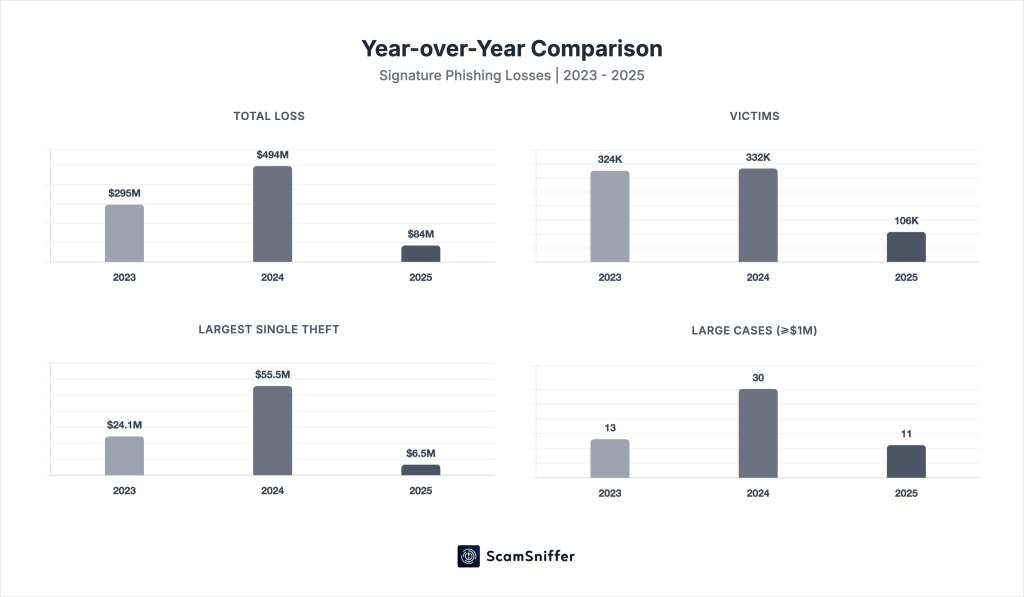
Source: Scam Sniffer

While the latest figures represent a significant decline from the previous year, Scam Sniffer analysts state there is no direct translation to decreased market threat as losses moved in parallel with the market cycle. Therefore, losses increased or decreased in relation to the global crypto user activity.

Notably, monthly losses varied from $2.04 million in December to $12.17 million in August. However, Q3, which was the busiest market period, accounted for the largest portion (29% i.e $31 million) of the yearly losses. However, figures dropped to $13 million in Q4, as user activity cooled off.

Related Reading: Aave Founder Responds To Governance Tension With Strategic Plan – Details

EIP-7702 Emerges As Latest Phishing Signature Type

According to Scam Sniffer’s report, EIP-7702 exploitation emerged as a new threat in the signature-based wallet-drainer ecosystem. Leveraging account abstraction introduced in the Pectra upgrade in May 2025, attackers can bundle multiple malicious operations into a single signature.

Notably, the largest EIP-7702 losses, with two incidents culminating in $2.54 million, were recorded in August. Meanwhile, Permit/ Permit2 signature types lead the space, accounting for $8.72 million in losses across three major incidents, I.e. 38% of all large-case losses.

Beyond signature phishing types, Scam Sniffer also highlighted other phishing attack types that threaten the crypto space. The Bybit incident in February stands out, after the Lazarus group breached a Safe (Wallet) developer machine and launched a program that imitated the multi-sig interface, resulting in losses of $1.46 billion.

In conclusion, while reported signature phishing losses have declined, the threat landscape remains active. Moreover, the fall in trackable losses may suggest attackers are employing harder-to-track vectors such as private key breaches or targeted social engineering.

Total crypto market cap valued at $3.08 trillion on the daily chart | Source: TOTAL chart on Tradingview.com

Domande pertinenti

QWhat was the percentage decrease in crypto phishing losses from 2024 to 2025 according to Scam Sniffer?

AThere was an 83% decrease in crypto phishing losses from 2024 to 2025.

QWhat new type of phishing signature emerged as a threat in 2025, and which Ethereum upgrade did it leverage?

AEIP-7702 exploitation emerged as a new threat, leveraging the account abstraction introduced in the Pectra upgrade in May 2025.

QDespite the drop in losses, why do analysts caution that this does not mean the market threat has declined?

AAnalysts state that losses moved in parallel with the market cycle, meaning they increased or decreased in relation to global crypto user activity, not because the underlying security improved.

QWhich quarter of 2025 accounted for the largest portion of the yearly phishing losses, and how much was it?

AQ3 of 2025 accounted for the largest portion of the yearly losses at 29%, which was $31 million.

QWhat was the single largest theft via a permit signature attack in 2025, and how did it compare to 2024?

AThe single largest theft was a $6.5 million loss via a permit signature attack in September, which was 8 times lower than the largest theft in 2024.

Letture associate

Five Counterparty Risk Architectures: A Settlement-Layer Methodology for Classifying TradFi Models in Crypto Exchanges

**Summary:** This companion piece reframes the five TradFi-on-crypto exchange architectures, previously classified by "architectural fingerprint," through the lens of counterparty risk. The core question is: whose balance sheet bears the loss first in a stress scenario, and has it historically done so? Each of the five models corresponds to a distinct risk holder with its own documented failure modes. * **Model 1 (Stablecoin-Settled CEX Perpetuals):** Risk is held by the stablecoin issuer (e.g., reserve composition, bank connectivity) and the CEX's own book. History includes Tether's banking disconnections (2017) and reserve misrepresentations (CFTC 2021 Order). * **Model 2 (CFD Brokers):** Risk resides on the broker's balance sheet (B-book model). Regulatory differences (e.g., ESMA's mandatory negative balance protection vs. Mauritius FSC's lack thereof) define loss allocation rules, as seen in the 2015 SNB event (Alpari UK insolvency). * **Model 3 (Off-Chain Custody & Transfer Agent Chain):** Risk lies with the off-chain custodian/platform. User asset recovery depends on Terms of Use and corporate structure, exemplified by the Celsius bankruptcy ruling (2023) where Earn Account assets were deemed property of the estate. * **Model 4 (DEX Perpetual Protocols):** No single balance sheet bears risk. Loss absorption relies on a protocol's insurance fund and Auto-Deleveraging (ADL) mechanism, as demonstrated in the GMX V1 (2022) and dYdX v3 YFI (2023) incidents. * **Model 5 (Regulated CCP - DCM-DCO-FCM):** The most institutionalized model concentrates risk in the Central Counterparty (CCP). However, history shows CCPs can employ non-standard tools under extreme stress, such as mass trade cancellation (LME Nickel, 2022) or enabling negative price settlements (CME WTI, 2020). The report argues that regulatory choices and counterparty risk structures are co-extensive, not in an upstream-downstream relationship. It concludes with five separate observation checklists (not predictions) for monitoring the structural vulnerabilities of each risk model.

marsbit16 min fa

Five Counterparty Risk Architectures: A Settlement-Layer Methodology for Classifying TradFi Models in Crypto Exchanges

marsbit16 min fa

Trading

Spot
Futures
活动图片