Crypto nears its ‘Netscape moment’ as industry approaches inflection point

cointelegraphPubblicato 2025-12-09Pubblicato ultima volta 2025-12-09

Introduzione

The cryptocurrency industry is approaching its "Netscape moment," driven by advancements in blockchain infrastructure and the rise of regulated investment products, according to Paradigm co-founder Matt Huang. This inflection point mirrors the early internet's mass adoption phase, where ease of use and institutional accessibility became key catalysts. Onchain systems enable open, programmable finance, while regulated products like ETFs attract traditional investors by offering familiar, compliant access. Analysts note over 200 crypto ETPs may launch soon, broadening participation. Despite concerns about speculation and memecoin dominance on some networks, experts argue that centralized platforms and ETFs expand the onchain economy rather than threaten it. The true risk lies in slowed technological progress; continued innovation in functionality and market structures is essential for long-term value creation.

The cryptocurrency industry is approaching its “Netscape moment,” as steady progress in blockchain infrastructure and the rise of regulated investment products drive a new wave of institutional adoption, according to Paradigm co-founder Matt Huang.

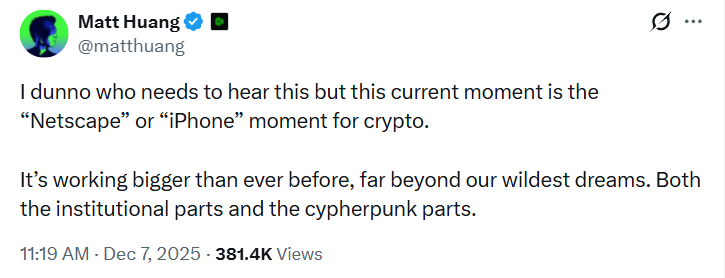
The crypto sector is “facing its ‘Netscape’ or ‘iPhone’ moment,” Huang wrote Sunday in a post on X. “It’s working bigger than ever before, far beyond our wildest dreams. Both the institutional parts and the cypherpunk parts.”

Netscape launched the first easy-to-use web browser for mainstream users in 1994 before going public with a successful initial public offering (IPO) in August 1995, marking the first building block that triggered the internet’s mass adoption.

However, Microsoft saw the large-scale interest and capitalized on it on it by freely bundling Internet Explorer as a pre-installed component of the Windows operating system, outcompeting Netscape to become the most widely used internet browser.
Source: Matt Huang

Onchain usability meets regulated access

In the crypto world, Bitcoin’s (BTC) peer-to-peer model and decentralized finance (DeFi) have enabled a new vision of an open, programmable financial system that cuts out intermediaries.

At the same time, centralized platforms and traditional investment vehicles are attracting a growing share of new capital because they are easier to use and fit within familiar regulatory frameworks.

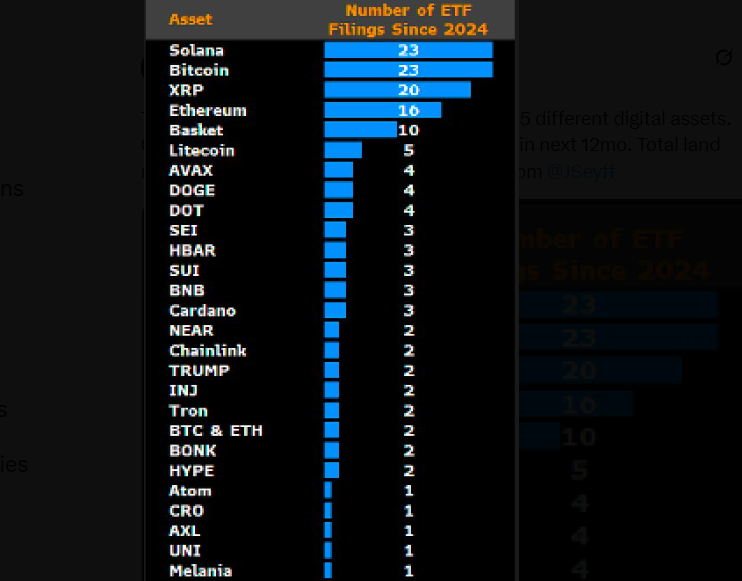
About 200 crypto-based exchange-traded products (ETPs) could launch on the market in the next year, with 155 awaiting approval as of Oct. 22, according to Bloomberg’s senior ETF analyst, Eric Balchunas.

Crypto ETPs provide easier access to altcoins for traditional investors on brokerage platforms that don’t have an account on a centralized cryptocurrency exchange.
Source: Eric Balchunas

Related: Prediction markets emerge as speculative ‘arbitrage arena’ for crypto traders

Onchain products are becoming easier to use, while “regulated” investment vehicles are making crypto more accessible, signaling that the industry may be at the tipping point ahead of mass adoption, Lacie Zhang, market analyst at Bitget Wallet, told Cointelegraph.

“ETFs and similar products legitimize digital assets but don’t replace what onchain systems uniquely offer, such as direct ownership, programmable settlement, and real-time transfers.”

She added that regulated access points tend to pull more liquidity onto underlying networks by drawing in institutional capital and new participants, rather than “displacing onchain activity.”

Related: Bitcoin now settles Visa-scale volumes, but most is for wholesale, not coffee

Despite some concerns about centralization, the rise of centralized finance (CeFi) platforms and ETFs is an “expansion of the onchain economy,” not an inherent threat, according to Marcin Kazmierczak, co-founder of RedStone, a blockchain oracle solutions provider.

“The Netscape moment isn’t about onchain versus CeFi. It’s about the broader crypto ecosystem finally attracting capital that actually stays around long-term,” he told Cointelegraph, adding that the two ecosystems are “not adversarial.”

Netscape moment or dot-com bubble repeat?

However, the crypto industry may still risk a market crash akin to the dot-com bubble, considering that the majority of revenue is derived from speculative memecoin trading for some blockchain networks.

On Solana, memecoin trading accounted for 62% of the network’s decentralized app revenue in June, and the majority of its $1.6 billion in revenue for the first half of 2025.

To reach its true potential, the developers need to focus on advancing the industry’s real-world utility, as the only “real risk” to the industry is a “slowdown in technological development,” according to Edwin Mata, lawyer, co-founder and CEO of tokenization platform Brickken.

“What matters is that onchain environments continue creating functionality, automation, and new market structures, because that is where fundamental value is produced,” he told Cointelegraph.

Magazine: Solana vs Ethereum ETFs, Facebook’s influence on Bitwise — Hunter Horsley

Letture associate

Bank of America Quietly Positions: Could $6 Trillion in Bank Deposits Flow into Stablecoins?

Bank of America has quietly made leadership appointments to accelerate its digital asset strategy, sparking discussion about a potential large-scale migration of bank deposits to stablecoins. Reports highlighted the bank naming Sonali Theisen, Kevin Milsom, and Adam Dixon to lead its global digital asset and AI platform, focusing on stablecoins, tokenized deposits, custody, and crypto settlement. This move revived a claim that $6 trillion in bank deposits could flow into stablecoins, a figure originally cited by Bank of America's CEO Brian Moynihan in January. However, he conditioned this shift on stablecoins being allowed to pay interest—a feature not permitted under the current GENIUS Act. The legislation's final rules are delayed, pushing its effective date to January 2027. Major banks are not waiting. JPMorgan and Citigroup are already piloting tokenized deposit services, and a consortium including Bank of America is building a shared tokenized deposit network targeting a 2027 launch. While some, like Pacemakers.io's Alessandro Hatami, remain skeptical of rapid bank collaboration, data shows significant institutional adoption. Stablecoin settlement volume hit $33 trillion in 2025, and analysts project the market could surpass $1 trillion by 2026. Despite a recent dip in crypto prices and stablecoin supply, the institutional push for real-world use cases continues. The race is on for January 2027, when the GENIUS Act takes effect, potentially reshaping the competition between traditional finance and digital assets.

Foresight News11 min fa

Bank of America Quietly Positions: Could $6 Trillion in Bank Deposits Flow into Stablecoins?

Foresight News11 min fa

US Treasury Secretary Bement Claims: The US Will Soon Control 80% of Global Computing Power

U.S. Treasury Secretary Ben Sent proclaimed that America is poised to control 80% of the world's computing power, positioning compute dominance as a core pillar of U.S. economic strategy. Speaking on the Mike Rowe show, he stated the U.S. currently holds 50-60% of global compute share, with expectations to reach 80% soon. He framed this as a strategic competition the U.S. "cannot afford to lose," warning that a rival's lead would grant "unacceptable" strategic leverage, while asserting a current one-year AI lead. This high-level policy endorsement is seen as a direct boost for AI infrastructure investment, benefiting chipmakers like NVIDIA and cloud providers' capex cycles. Sent positioned AI compute, semiconductors, and quantum computing as three pillars of national economic strength and security. He defended AI's societal impact, citing historical tech shifts, and argued AI empowers small businesses without causing net job loss so far. He highlighted government efforts to deepen public-private AI cybersecurity cooperation. For investors, the statement signals sustained U.S. policy support for AI infrastructure. However, analysts urge caution, noting "compute share" lacks a standard public metric; the 80% figure is a forecast, not audited data. They recommend focusing on tangible indicators like physical capacity expansion and power infrastructure, with future semiconductor and cloud reports providing key verification data.

marsbit23 min fa

US Treasury Secretary Bement Claims: The US Will Soon Control 80% of Global Computing Power

marsbit23 min fa

Trading

Spot
活动图片