Crypto moves on as banks push back – What Brazil and Venezuela reveal

ambcryptoPubblicato 2025-12-14Pubblicato ultima volta 2025-12-14

Introduzione

U.S. banking groups are challenging the OCC's approval of national trust charters for crypto firms, arguing it creates regulatory gray areas and risks financial instability. Meanwhile, regulatory and financial systems worldwide are advancing crypto integration. The CFTC is testing systems to include crypto in cross-margining with U.S. Treasuries. Brazil’s largest bank, Itaú Unibanco, advises clients to allocate up to 3% of their portfolio to Bitcoin as a long-term hedge. In Venezuela, stablecoins like USDT have become essential for daily transactions, remittances, and payroll due to hyperinflation and unreliable banking. Despite traditional resistance, crypto adoption continues to grow, signaling its irreversible integration into the global financial system.

U.S. banking groups are pushing back against the OCC’s approval of crypto trust charters. Elsewhere, the conversation has already moved on.

Brazil’s largest bank is advising Bitcoin [BTC] exposure. U.S. regulators are integrating crypto into treasury market plumbing. In Venezuela, stablecoins have become a necessity.

Traditional banks may still be arguing the case. The financial system, meanwhile, is getting on with it.

To be, or not to be…a bank?

Trade groups representing traditional banks challenged the Office of the Comptroller of the Currency’s (OCC) decision to approve national trust charters for crypto firms.

At the center of the dispute are conditional approvals granted to a handful of digital asset players. This is a move the OCC insists followed the same review process applied to any bank charter.

Banking groups disagreed.

They argued the move created a gray zone. These firms resembled banks, gained federal status, yet lacked deposit insurance and full bank-level oversight.

On behalf of the American Banking Association, Rob Nichols, President and CEO, said,

“We are concerned that expanding the trust charter in this way… could blur the lines of what it means to be a bank and create opportunities for regulatory arbitrage.”

The ICBA went further. In their statement, President and CEO Rebeca Romero Rainey noted,

“The OCC’s dramatic policy change… allows for an inconsistent regulatory framework that threatens financial instability.”

And while this chatter goes back and forth, crypto is gaining steam on higher levels.

Regulation takes over on the other side

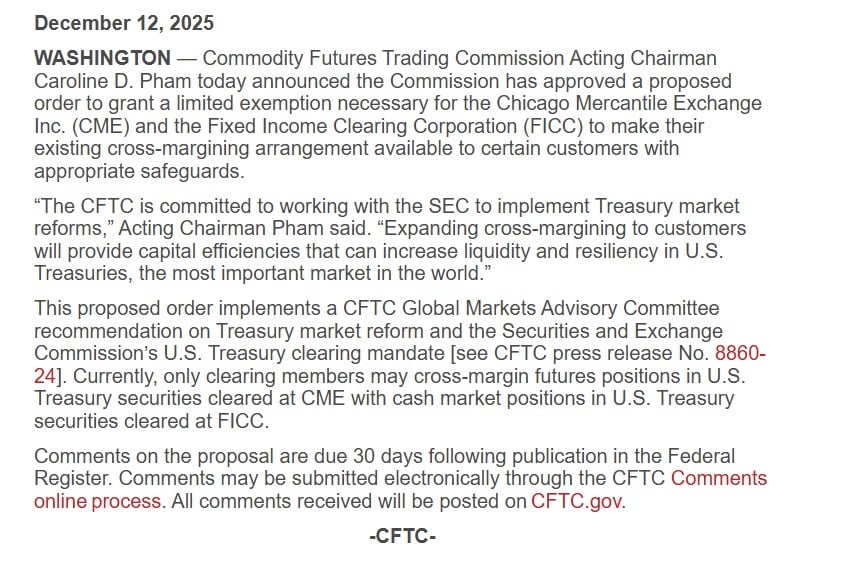
The CFTC’s recent move to expand cross-margining for U.S. Treasuries may sound technical, but the intent is pretty straightforward.

By letting Treasuries be netted alongside futures, regulators are testing systems that could eventually hold crypto and tokenized assets in the same portfolio. The idea is to increase efficiency and risk control.

In the press release, CFTC Acting Chairman Caroline Pham said,

“Expanding cross-margining to customers will provide capital efficiencies that can increase liquidity and resiliency in U.S. Treasuries, the most important market in the world.”

And whatever the industry debate looks like on the surface, the groundwork for integration is already being laid.

Source: cftc.gov

Brazil isn’t going to wait!

The country’s largest private bank is already treating Bitcoin like a portfolio tool.

Itaú Unibanco has recently advised clients to allocate a small slice (up to 3%) to Bitcoin. Not as a trade, but as protection!

Source: Itau

The logic is simple. Bitcoin doesn’t move like local stocks or bonds, and it offers some shelter when the real weakens. Itaú is clear this isn’t about chasing price swings or making crypto a core holding.

It’s meant to be limited, long-term, and disciplined.

For Venezuelans, crypto is non-negotiable

In Venezuela, stablecoins replaced traditional banking functions for many households and businesses.

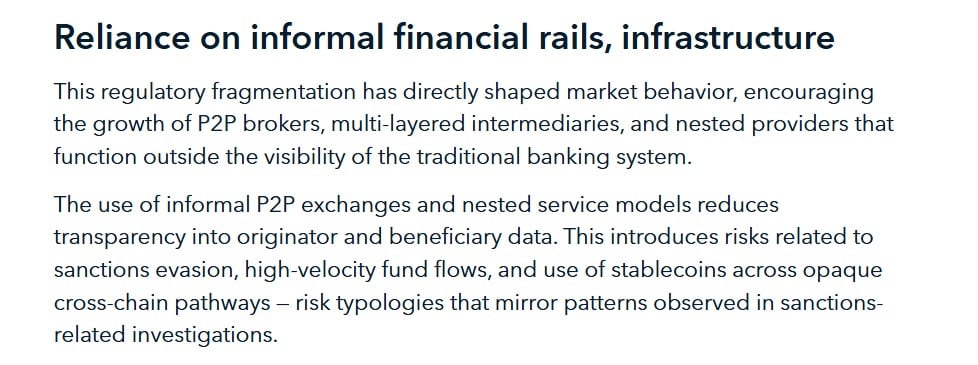
USDT supported payroll, remittances, vendor payments, and cross-border purchases. Peer-to-peer platforms played a central role.

More than 38% of local crypto traffic flowed through a single P2P service enabling crypto-to-fiat conversions.

Source: TRM Labs

A report from TRM Labs noted that, absent major economic or regulatory changes, demand for stablecoins will likely keep growing.

For Venezuelans, crypto means survival. It is a reliable medium of exchange where the bolívar continues to lose value and traditional banking remains unreliable.

A gap that keeps growing

The clash between banks and crypto-forward regulators brings to mind a fundamental gap in priorities. Traditional banks worry about rules, parity, and systemic risk.

Regulators, global institutions, and forward-looking banks are focused on efficiency, resilience, and meeting real market demand.

What happens next could will define crypto’s global role.

National charters, market-structure reforms, institutional allocations, and widespread adoption internationally all point to the same trend: digital assets are becoming part of the financial system, whether legacy banks like it or not.

Resistance from traditional players may slow the pace, but it can’t stop the integration.


Final thoughts

  • While US banks resist crypto charters, regulators and global institutions are already moving ahead.
  • Crypto adoption is advancing beyond regulatory debate.
Next: Bitcoin stuck below $94K: Demand fails to kickstart a recovery
Share
  • Share
  • Tweet

Letture associate

How Many Tokens Away Is Yang Zhilin from the 'Moon Chasing the Light'?

The article explores the intense competition between two leading Chinese AI companies, DeepSeek and Kimi (Moon Dark Side), and the mounting pressure on Yang Zhilin, the founder of Kimi. While DeepSeek re-emerged after 15 months of silence with its powerful V4 model—boasting 1.6 trillion parameters and low-cost, long-context capabilities—Kimi has been focusing on long-context processing and multi-agent systems with its K2.6 model. Yang faces a threefold challenge: technological rivalry, commercialization pressure, and investor expectations. Despite Kimi’s high valuation (reaching $18 billion), its revenue heavily relies on a single product with low paid conversion rates, while DeepSeek’s strategic silence and open-source influence have strengthened its market position and valuation prospects, now targeting over $20 billion. Both companies reflect broader trends in China’s AI ecosystem: Kimi aims for global influence through open-source contributions and agent-based advancements, while DeepSeek prioritizes foundational innovation and hardware independence, notably shifting to Huawei’s chips. Their competition is seen as vital for China’s AI progress, with the gap between top Chinese and U.S. models narrowing to just 2.7% on the Elo rating scale. Ultimately, the article argues that this rivalry, though anxiety-inducing for leaders like Zhilin, is essential for driving innovation and solidifying China’s role in the global AI landscape.

marsbit7 h fa

How Many Tokens Away Is Yang Zhilin from the 'Moon Chasing the Light'?

marsbit7 h fa

Trading

Spot
Futures

Articoli Popolari

Come comprare PUSH

Benvenuto in HTX.com! Abbiamo reso l'acquisto di Push Protocol (PUSH) semplice e conveniente. Segui la nostra guida passo passo per intraprendere il tuo viaggio nel mondo delle criptovalute.Step 1: Crea il tuo Account HTXUsa la tua email o numero di telefono per registrarti il tuo account gratuito su HTX. Vivi un'esperienza facile e sblocca tutte le funzionalità,Crea il mio accountStep 2: Vai in Acquista crypto e seleziona il tuo metodo di pagamentoCarta di credito/debito: utilizza la tua Visa o Mastercard per acquistare immediatamente Push ProtocolPUSH.Bilancio: Usa i fondi dal bilancio del tuo account HTX per fare trading senza problemi.Terze parti: abbiamo aggiunto metodi di pagamento molto utilizzati come Google Pay e Apple Pay per maggiore comodità.P2P: Fai trading direttamente con altri utenti HTX.Over-the-Counter (OTC): Offriamo servizi su misura e tassi di cambio competitivi per i trader.Step 3: Conserva Push Protocol (PUSH)Dopo aver acquistato Push Protocol (PUSH), conserva nel tuo account HTX. In alternativa, puoi inviare tramite trasferimento blockchain o scambiare per altre criptovalute.Step 4: Scambia Push Protocol (PUSH)Scambia facilmente Push Protocol (PUSH) nel mercato spot di HTX. Accedi al tuo account, seleziona la tua coppia di trading, esegui le tue operazioni e monitora in tempo reale. Offriamo un'esperienza user-friendly sia per chi ha appena iniziato che per i trader più esperti.

520 Totale visualizzazioniPubblicato il 2024.12.13Aggiornato il 2025.03.21

Come comprare PUSH

Discussioni

Benvenuto nella Community HTX. Qui puoi rimanere informato sugli ultimi sviluppi della piattaforma e accedere ad approfondimenti esperti sul mercato. Le opinioni degli utenti sul prezzo di PUSH PUSH sono presentate come di seguito.

活动图片