Crypto Morning Report: Crypto Market Bloodbath, Strategy Releases Q4 Earnings

marsbitPubblicato 2026-02-06Pubblicato ultima volta 2026-02-06

Introduzione

Crypto Market Bloodbath: Key Updates & Strategy's Q4 Report The crypto market experienced significant turmoil, with Bitcoin dropping below $73,000. Major developments include: U.S. economic data showed higher-than-expected weekly jobless claims. The CFTC withdrew a proposal to ban political prediction markets. Treasury Secretary Scott Bessent testified that the U.S. will not "bail out" Bitcoin or direct banks to buy crypto, though the government holds over $15B in seized BTC. Policy moves included Virginia proposing a bill to create a state cryptocurrency reserve fund. The House launched an investigation into a $500M deal between a Trump-linked crypto project and an UAE entity. Company news featured Espresso releasing its ESP tokenomics with a 10% airdrop. Binance denied sending legal threats to a user who alleged insolvency. A wallet labeled Trend Research moved 8,000 ETH to Binance. Strategy Inc. reported a massive Q4 net loss of $12.4B, citing digital asset depreciation. It holds 713,502 BTC at an average cost of ~$76,052. Tether announced a $100M strategic investment in Anchorage Digital. The report also covered broader themes like AI's need for crypto-based trust systems and crypto's evolving role as a settlement layer for the internet economy.

Author: Deep Tide TechFlow

Yesterday's Market Dynamics

US Initial Jobless Claims for the Week Ending Jan 31: 231K, Expected 212K

US Initial Jobless Claims for the week ending January 31 were 231,000, compared to an expectation of 212,000 and a previous reading of 209,000.

US CFTC Withdraws Biden-Era Proposal to Ban Political Prediction Markets

According to The Block, the US Commodity Futures Trading Commission (CFTC) has formally withdrawn a 2024 proposed rule on "event contracts" that would have banned political prediction market contracts. CFTC Chairman Michael S. Selig called the initial proposal "policy overreach" and announced the Commission will develop a new framework to support "legitimate innovation".

Bessent: US Will Not "Bail Out" Bitcoin, Has No Authority to Direct Private Banks to Buy Bitcoin or TRUMP Coin

According to Cointelegraph, US Treasury Secretary Scott Bessent testified before Congress on Wednesday, stating that the US will retain Bitcoin obtained through asset forfeiture but will not direct private banks to buy more Bitcoin during a market downturn.

In an exchange with California Representative Brad Sherman, Bessent made clear that he, as Treasury Secretary and Chairman of the Financial Stability Oversight Council (FSOC), does not have the authority to direct private banks to buy more Bitcoin or "TRUMP coin" by altering bank reserve requirements.

Bessent added that the value of Bitcoin seized and held by the US government has grown to over $15 billion. According to an executive order signed by Trump in March 2025, the US can only acquire more Bitcoin through asset forfeiture cases or budget-neutral strategies, not through open market operations.

Virginia Proposes SB557 Bill to Establish State-Level Cryptocurrency Reserve Fund

According to Virginia Senate Bill No. 557, submitted on January 14, 2026, the state plans to amend the Code of Virginia by adding Article 6 to Chapter 18 of Title 2.2, establishing the "Commonwealth Strategic Cryptocurrency Reserve Fund".

The bill was introduced by Senator Reeves and has been referred to the Committee on General Laws and Technology for consideration.

US House Launches Investigation into $500M Deal Between Trump-Linked Crypto Project and UAE

According to The Block, Senior Democrat Rep. Ro Khanna of the House Select Committee on the Strategic Competition Between the United States and the Chinese Communist Party has launched an investigation into the Trump-linked crypto project World Liberty Financial (WLFI) over its reported acceptance of a $500 million investment from Aryam Investment 1, an entity linked to the UAE royal family. The investigation letter notes that the deal was signed four days before Trump's inauguration, with an initial payment of $250 million, of which $187 million flowed to Trump family entities.

Rep. Khanna questioned whether this investment may have influenced US policy on advanced AI chip exports to the UAE and whether there is a temporal correlation with Binance founder Changpeng Zhao receiving a presidential pardon. The representative requested that World Liberty Financial respond to 16 specific questions and submit relevant documents by March 1, 2026.

Previous market news: A member of the UAE royal family secretly acquired a 49% stake in World Liberty Financial for $500 million.

Espresso Reveals ESP Tokenomics Model, Initial Supply of 3.59 Billion Tokens, Airdrop Allocation 10%

Blockchain infrastructure Espresso has revealed the economics model for its ESP token. ESP is an Ethereum ERC-20 token with an initial total supply of 3.59 billion tokens and no fixed maximum supply.

The ESP token allocation includes:

Contributors: 27.36%;

Investors: 14.32%;

Airdrop: 10%;

Community Launchpad: 1%;

Staking Rewards: 3.01%;

Future Airdrops & Incentives: 24.81%;

Foundation Operations: 15%;

Liquidity Provision: 4.5%.

ESP tokens will be used to support the network's Proof-of-Stake consensus. Holders can participate in network operation by running validator nodes or delegating tokens. Espresso uses a staking reward formula similar to Ethereum's, providing higher incentives when the staking ratio is low and gradually decreasing the reward rate as staking participation increases to ensure network security and stable operation.

Previous news: Espresso completed a $28 million Series B funding round led by a16z in 2024.

Binance Denies Sending Legal Threat Letter to User Who Alleged Insolvency

According to The Block, cryptocurrency exchange Binance has clarified that a cease-and-desist notice widely circulated online is a forgery. The notice was purportedly issued against an individual alleging the exchange was insolvent.

Social media user Lewsiphur claimed on platform X on Wednesday that Binance was insolvent, warning it would have a "catastrophic" impact on the market. The user later claimed to have received a cease-and-desist from Binance, attaching an image of a document. The official Binance Customer Support account responded: "This letter is not from Binance, it is an imaginative forgery."

Rumors about Binance's insolvency have been circulating in recent weeks, often linked to the cryptocurrency market crash in October 2025. Binance co-founder He Yi stated that despite user-initiated withdrawal campaigns, assets on Binance addresses have actually increased.

Trend Research Transfers Another 8,000 ETH to Binance, Worth Approximately $14.8 Million

According to on-chain analyst EmberCN (@EmberCN) monitoring, Trend Research transferred another 8,000 ETH to Binance, worth approximately $14.8 million.

Strategy Releases Q4 Earnings Early This Morning: Average Bitcoin Holding ~$76,052, Q4 Net Loss $12.4 Billion

According to an official announcement, Bitcoin treasury company Strategy Inc. released financial data for the fourth quarter and full year 2025. As of February 1, 2026, it holds 713,502 BTC with a total cost of $54.26 billion, averaging approximately $76,052 per bitcoin. The company raised $25.3 billion in financing for the full fiscal year 2025.

Fourth-quarter financial data shows the company had a loss of $17.4 billion and a net loss of $12.4 billion, primarily affected by the decline in digital assets. As of December 31, 2025, the company held $2.3 billion in cash and cash equivalents. Strategy has built a $2.25 billion US dollar reserve, which can cover approximately 2.5 years of dividend and interest expenses.

Market News: Polymarket Parent Company Blockratize Files $POLY Trademark Application

According to market news, prediction market platform Polymarket's parent company, Blockratize, has filed a trademark application for $POLY.

Tether Announces $100 Million Strategic Investment in Anchorage Digital

According to an official Tether message, Tether Investments announced on February 5, 2026, a $100 million strategic equity investment in Anchorage Digital, the first federally chartered digital asset bank in the US. Anchorage Digital provides staking, custody, governance, settlement, and stablecoin issuance services for global institutions and innovators.

Market Trends
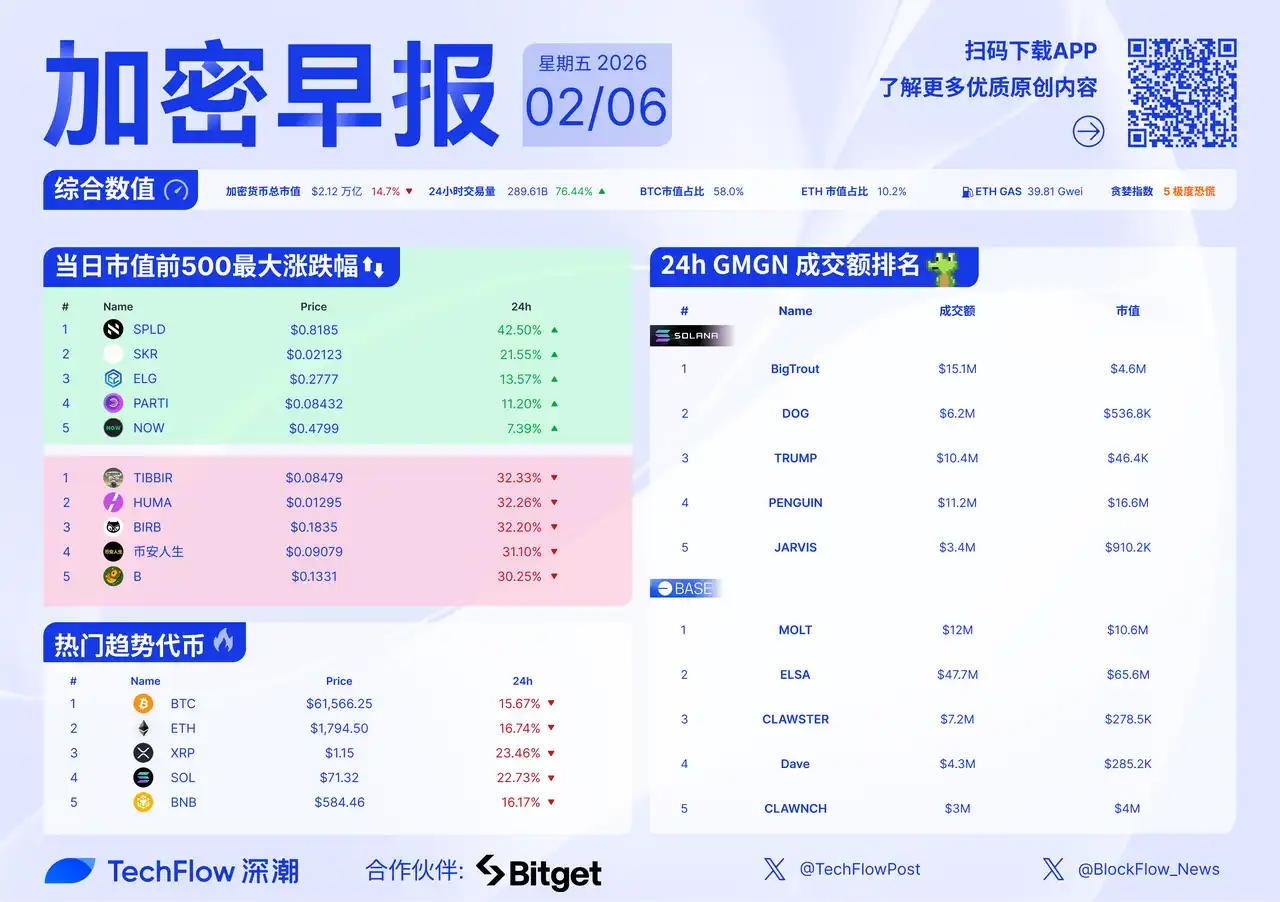
Recommended Reading

Using Claude to Scrape 260,000 Records, I Uncovered Epstein's Crypto Connections

This article analyzes Epstein's connections to the crypto industry, revealing his behavioral patterns in the field, including funding academic research, direct communication with crypto technology developers, and attempts to influence industry development. Through database records and auxiliary analysis, the article shows Epstein's deep penetration into the crypto space and offers speculation about his actions.

Kyle Left the Crypto Industry, and I'm a Bit Sad

This article discusses知名VC Kyle Samani's announcement of leaving the crypto industry to focus on AI, longevity technology, and robotics. His departure is seen as a shake in confidence in the crypto industry. Nonetheless, the author remains hopeful about the prospects of Crypto's financial applications, believing it still holds value in areas like stablecoins and DeFi, and expresses willingness to continue exploring the industry's possibilities. The crypto industry may be undergoing a transition from "faith" to "rationality," which might be a necessary path in its development.

February 5 Market Summary: AMD Plunge Triggers Chip Stock Crash, Bitcoin Falls Below $73K

This article analyzes recent market dynamics, including the performance of tech stocks, cryptocurrencies, and precious metals markets, revealing concerns about the AI bubble bursting and the impact of cost失控 on tech company profitability. Additionally, the article mentions the strong rebound in gold prices and the reasons behind it.

Wintermute Ventures: In 2026, Crypto Gradually Becomes the Clearing Layer for the Internet Economy

This article explores the trend of crypto technology gradually becoming a clearing and settlement layer for the internet economy and analyzes the future development directions in related fields. The article focuses on five themes: everything becomes tradable, stablecoin interoperability, tokenomics returning to fundamentals, DeFi and TradFi convergence, and privacy becoming a regulatory driver.

a16z: Why Does AI Urgently Need Crypto Technology?

This article analyzes how artificial intelligence lowers the cost of large-scale operations but makes trust difficult to establish, while blockchain technology can重塑 the trust system. AI systems can forge identities on a large scale at low cost; blockchain can effectively limit forgery through decentralized proof-of-humanity systems. Blockchain serves as the infrastructure for an AI-native internet, restoring trust and protecting human-scale interaction.

Domande pertinenti

QWhat was the main reason for Strategy Inc.'s $12.4 billion net loss in Q4 2025?

AThe net loss was primarily due to the decline in the value of its digital asset holdings.

QWhat action did the U.S. CFTC take regarding political prediction markets, and what was the reason given by its chairman?

AThe CFTC withdrew a 2024 rule proposal that would have banned political prediction market contracts. Chairman Michael S. Selig called the initial proposal 'policy overreach' and announced the committee would develop a new framework to support 'legitimate innovation'.

QWhat is the purpose of Virginia's proposed Senate Bill No. 557?

AThe bill proposes to establish a 'Commonwealth Strategic Cryptocurrency Reserve Fund' to create a state-level cryptocurrency reserve.

QWhat was the significant transaction involving Trump-associated crypto project World Liberty Financial that prompted a U.S. House committee investigation?

AThe investigation was prompted by a reported $500 million investment from the UAE王室-related entity Aryam Investment 1. The deal was signed four days before Trump's inauguration, with an initial payment of $250 million, of which $187 million flowed to Trump family entities.

QWhat is the total initial supply of Espresso's ESP token and what percentage is allocated for the airdrop?

AThe initial total supply of ESP tokens is 3.59 billion, and 10% of that supply is allocated for the airdrop.

Letture associate

The Essence of AI Layoffs: Why More AI Adoption Leads to More Corporate Anxiety?

The author, awaiting potential inclusion on an 8000-person layoff list, analyzes the true nature of recent "AI-driven" layoffs. They argue that while AI use, particularly tools like Claude for code generation, has skyrocketed and boosted developer output (e.g., 2-5x more code commits), this has not translated into proportional business growth or revenue. The core issue is a misalignment between increased "Input" (code) and tangible "Outcomes" (user value, revenue). AI acts as a costly B2B SaaS, inflating operational expenses without guaranteed returns. Two key problems emerge: 1) The friction that once filtered out bad ideas is gone, as AI allows cheap pursuit of even weak concepts. 2) Organizational "alignment tax"—the difficulty of coordinating across teams—becomes crippling when development velocity outpaces consensus-building. Thus, layoffs serve two immediate purposes: 1) To offset ballooning AI costs (Token consumption) and maintain cash flow, as rising input costs without outcome growth destroys unit economics. 2) To reduce organizational bloat and alignment friction by simply removing teams, thereby speeding up execution in the short term. Therefore, these layoffs are fundamentally caused by AI, even if AI doesn't directly replace roles. They represent a painful correction until companies learn to convert AI-driven productivity into real business outcomes and streamline organizational coordination to match the new pace of work. The cycle will continue until this learning curve is mastered.

marsbit4 min fa

The Essence of AI Layoffs: Why More AI Adoption Leads to More Corporate Anxiety?

marsbit4 min fa

Can the Solana Foundation and Google's Collaboration on Pay.sh Bridge the Payment Link Between Web2 and Web3 in the Agent Economy?

Solana Foundation, in collaboration with Google Cloud, has launched Pay.sh, a payment gateway designed to bridge the gap between AI agents and enterprise-grade service infrastructure. The initiative aims to solve a key bottleneck in the "agent economy": existing payment systems are ill-suited for autonomous AI agents. Traditional methods like credit cards require human verification, while newer on-chain protocols like x402 and MPP create a separate, Web3-native system that raises barriers for service providers. Pay.sh functions as a universal payment layer. It allows users to fund a Solana wallet via credit card or stablecoin, which then acts as an identity and payment proxy for AI agents. When an agent needs to access a paid API service (e.g., Google Cloud, Alibaba Cloud), Pay.sh handles the transaction seamlessly. It leverages the HTTP 402 status code ("Payment Required") to initiate payments, intelligently choosing between one-time transfers (x402-style) or session-based authorizations (MPC-style) based on the service's billing model. This spares agents from manual account registration and API key management. A key feature for service providers is low integration effort. They can adopt Pay.sh by providing a declarative configuration file, enabling features like tiered pricing, free tiers, and automatic revenue splitting to multiple addresses (e.g., for royalties, cloud costs). Providers can also list their APIs in a central Pay Skill Registry for agent discovery. The collaboration with Google Cloud provides crucial infrastructure for API proxying, traffic routing, and compliance logging, aiming to keep agent activities within regulated boundaries. By connecting Web2 services with Web3 payment rails, Pay.sh positions the Solana wallet as a foundational identity and payment tool for AI agents, potentially driving more transaction volume to the Solana ecosystem. However, the report notes challenges. The service registry currently lacks robust vetting, risking exposure to unauthorized or malicious third-party APIs. Pay.sh also inherits security and compatibility risks from its underlying payment protocols (x402, MPC). Furthermore, adoption may be hindered by varying regional data privacy and payment compliance regulations among API providers. Despite these hurdles, Pay.sh represents a significant step towards integrating Web2 and Web3 for autonomous agent commerce.

marsbit11 min fa

Can the Solana Foundation and Google's Collaboration on Pay.sh Bridge the Payment Link Between Web2 and Web3 in the Agent Economy?

marsbit11 min fa

Bitcoin's Bull-Bear Cycle Indicator Turns Positive for the First Time in 7 Months: End of Bear Market or False Breakout?

Bitcoin's "Bull-Bear Market Cycle Indicator" from CryptoQuant has turned positive for the first time since October 2025. This gauge, based on the P&L Index relative to its 365-day moving average, suggests a potential shift from a bear market phase. Concurrently, the Bull Score Index rose to a neutral reading of 50 in late April. The indicator's move into positive territory follows a roughly 35% price rebound from a low near $60,000 in February to above $81,000. The recovery over approximately three months was faster than the 12-month period observed during the 2022 bear market. However, analysts caution against premature optimism, citing a historical precedent from March 2022. Back then, the Bull Score Index briefly hit 50, but it proved to be a false signal as Bitcoin's price subsequently plunged further. Structural differences exist in the current cycle, including consistent inflows into spot Bitcoin ETFs and an increase in large holder addresses. Yet, some models, referencing the four-year halving cycle, suggest a potential deeper bottom near $50,000 might still be possible around late 2026. In summary, while on-chain data shows marked improvement and the worst panic may be over, market participants remain cautious. A convincing trend reversal confirmation likely requires Bitcoin to sustainably break above key resistance, such as the 200-day moving average near $82,000.

marsbit18 min fa

Bitcoin's Bull-Bear Cycle Indicator Turns Positive for the First Time in 7 Months: End of Bear Market or False Breakout?

marsbit18 min fa

How to Automate Any Workflow with Claude Skills (Complete Tutorial)

This is a comprehensive guide to mastering Claude Skills, a feature for creating permanent, reusable instruction sets that automate specific workflows. Unlike simple saved prompts, Skills function like trained employees, delivering consistent, high-quality outputs by defining the entire task process, standards, error handling, and output format. The guide is structured in four phases: **Phase 1: Installation (5 minutes).** Skills are folders containing a `SKILL.md` file. The user is instructed to find a relevant Skill online, install it, test it on a real task, and compare its performance to one-off prompts. **Phase 2: Building Your First Custom Skill.** Start by rigorously defining the Skill's purpose, trigger phrases, and providing a concrete example of perfect output. The `SKILL.md` file has two parts: a YAML frontmatter with a specific name/description/triggers, and a detailed, step-by-step workflow written in natural language with examples and quality standards. **Phase 3: Testing & Optimization for Production.** Test the Skill in three scenarios: 1) a standard, common task; 2) edge cases with missing or conflicting data; and 3) a pressure test with maximum complexity. Any failure indicates a needed instruction. Implement a weekly optimization cycle to continuously refine the Skill based on real usage. **Phase 4: Building a Complete Skill Library.** The goal is to create a team of Skills for all repetitive tasks. Examples are given for industries like real estate, marketing, finance, consulting, and e-commerce. The user should list their tasks, prioritize them, and build one new Skill per week, maintaining a master document to track their library. The conclusion emphasizes the compounding time savings: ten Skills saving 30 minutes each per week reclaims over 260 hours (6.5 work weeks) per year, fundamentally transforming one's work system.

marsbit42 min fa

How to Automate Any Workflow with Claude Skills (Complete Tutorial)

marsbit42 min fa

Trading

Spot
Futures
活动图片

