Crypto Morning Brief: TRUMP Team to Host Banquet for Holders, Backpack Plans TGE This Month

marsbitPubblicato 2026-03-13Pubblicato ultima volta 2026-03-13

Introduzione

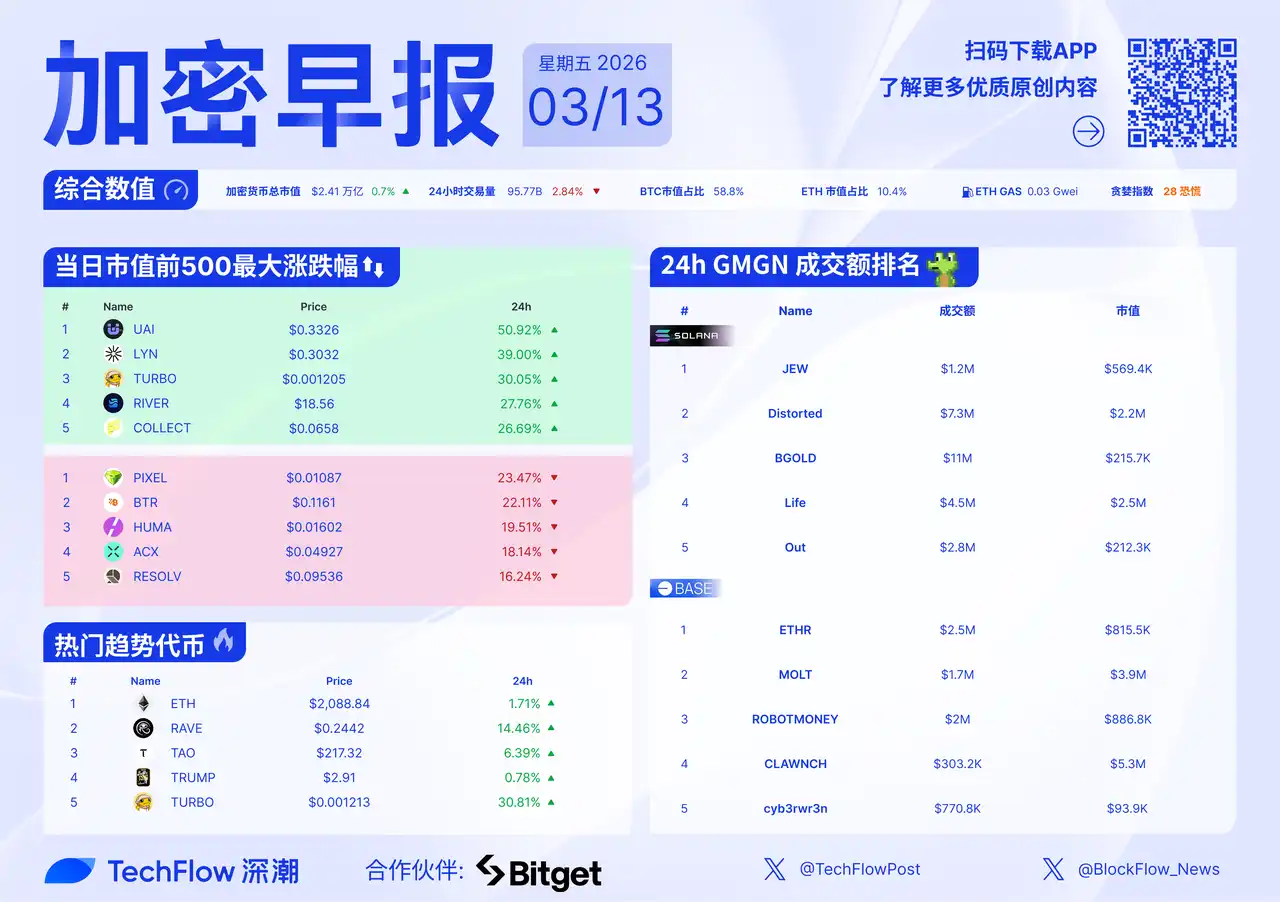
Crypto Morning Brief: Key updates from March 13 include a speech by SEC Commissioner Atkins advocating for streamlined regulation and innovation exemptions for tokenized equities. BlackRock launched its first staked Ethereum ETF (ETHB), offering both ETH exposure and staking rewards. The TRUMP token team announced a summit and banquet for top token holders in April 2026. Backpack confirmed its TGE is scheduled for March 23. Avantis introduced a token buyback and burn program using 30% of daily trading fees. In AI and tech, Perplexity unveiled "Personal Computer," an AI-integrated Mac mini, while Tencent responded to data scraping allegations related to ClawHub. Funding highlights include Cryptio raising $45M for crypto accounting software, Oro Labs securing $100M for AI procurement automation, and Eightco Holdings completing a $125M round with investments in OpenAI and Beast Industries. Market analysis and opinion pieces covered topics like AI narrative arbitrage, the evolution of crypto exchanges, Bitcoin treasury strategies, and talent polarization in AI.

Author: Deep Tide TechFlow

Yesterday's Market Dynamics

US Initial Jobless Claims for the Week Ending March 7: 213K, Expected 215K

US initial jobless claims for the week ending March 7 were 213,000, compared to an expectation of 215,000; the previous figure was revised from 213,000 to 214,000.

SEC Commissioner Atkins Speaks: Advocates for Regulatory Slimdown, Supports Innovation Exemption for Equity Tokenization

According to the SEC website, US Securities and Exchange Commission (SEC) Commissioner Paul S. Atkins delivered a speech at the Investor Advisory Committee's annual meeting on March 12, focusing on three key issues.

First, reducing unnecessary disclosure burdens, promoting the "minimum effective dose regulation" principle, emphasizing that rules should be materiality-focused and flexibly adjusted based on company size; also suggesting extending the applicability period of the "IPO on-ramp" provision in the JOBS Act to encourage more small and medium-sized enterprises to go public.

Second, opposing the SEC's indirect intervention in corporate governance through "comply or explain" disclosure requirements, deeming such "shame-based regulation" beyond the SEC's authority, and asserting that governance decisions should be made by shareholders and directors themselves.

Third, commenting on equity security tokenization, stating that tokenization can improve settlement efficiency, reduce settlement risk, and cut intermediary layers, and revealing that the SEC will consider introducing an innovation exemption mechanism to support limited trading of specific tokenized securities and gather experience for formulating a long-term regulatory framework.

BlackRock Launches First Ethereum ETF with Staking Functionality

According to CoinDesk, BlackRock's iShares Staked Ethereum Trust ETF (ETHB) officially began trading on Nasdaq on March 13, Beijing time. This is BlackRock's third crypto ETF and the first product to incorporate Ethereum staking functionality. ETHB will hold spot ETH and stake a portion of its holdings, allowing investors to gain exposure to ETH price movements while earning staking rewards. The fund's management fee is 0.25%, with an introductory preferential rate of 0.12% for the first $2.5 billion in assets. BlackRock's total assets under management for crypto-related products currently stand at approximately $130 billion.

TRUMP Token Team to Host Banquet on April 25 for Top 297 TRUMP Token Holders

According to the GetTrumpMemes website, the TRUMP token team will host a Crypto & Business Summit and Banquet at Mar-a-Lago in Palm Beach, Florida, on April 25, 2026. US President Donald Trump will attend and deliver the keynote speech.

The event uses a holdings ranking mechanism. The top 297 qualified participants based on holding points will be eligible to attend. Among them, the top 29 VIP users will additionally receive exclusive access to a private reception with Trump and other guests, along with VIP front-row seating.

Backpack Announces TGE on March 23

According to an official announcement, Backpack announced its Token Generation Event (TGE) will be on March 23.

Avantis Announces Launch of AVNT Token Buyback and Burn Program

According to an official announcement on platform X, Avantis announced the launch of the AVNT token buyback and burn program. 30% of daily trading revenue (including opening fees, closing fees, and profit fees) will be used to repurchase and burn AVNT tokens on the open market. This mechanism is now officially active. The official statement indicated that the percentage of fees allocated for buybacks is expected to increase to over 50% following future protocol efficiency upgrades, anticipated to be implemented by the end of Q2 2026.

Tencent Responds to "Mass Scraping of ClawHub" Allegations: Only Pulled 1GB of Data from Official Source with Non-Concurrent Requests

Tencent's AI X account, Tencent AI (@TencentAI_News), responded to community allegations regarding "mass scraping of ClawHub," stating: "Hello Peter, we understand your concerns. SkillHub is a localized skills platform built by Tencent based on the OpenClaw ecosystem, aiming to provide better skill availability and speed for Chinese users.

We are transparently stating that we operate as a local mirror site and always attribute ClawHub as the data source. In the first week of launch, we handled 180GB of traffic for users (870k downloads), while only pulling 1GB of data from the official source (via non-concurrent requests).

Many members of our team are active contributors (code and PRs), and we are eager to support the ecosystem and become better sponsors."

Previous reports indicated that the community accused Tencent's platform SkillHub of mass scraping all skill data from OpenClaw's official skill marketplace, ClawHub, and importing it into its own platform. Peter Steinberger called on Tencent to provide some support rather than unilaterally consuming resources.

Perplexity Launches New Product 'Personal Computer,' Enabling 24/7 Cross-File, Cross-Application, and Cross-Session Operations

According to an official disclosure by AI search startup Perplexity, the company has formally announced the launch of 'Personal Computer.' This product, based on a continuously running Mac mini, deeply integrates Perplexity's AI capabilities with local devices, enabling 24/7 operation and supporting cross-file, cross-application, and cross-session operations.

Perplexity has now opened a waitlist application for the first batch of users and will provide corresponding support and resources to early users.

Crypto Accounting Startup Cryptio Completes $45 Million Series B Funding Round Led by BlackFin Capital Partners

According to a Fortune report, crypto accounting startup Cryptio announced the completion of a $45 million Series B funding round led by BlackFin Capital Partners and Sentinel Global, with participation from 1kx, BlueYard Capital, and Ledger Cathay Capital. Cryptio provides software for enterprise digital asset tracking, crypto loan management, and blockchain asset monitoring. It currently has 110 employees and over 450 clients, including stablecoin issuer Circle and the blockchain subsidiary of Société Générale.

AI Procurement Automation Startup Oro Labs Completes $100 Million Series C Funding Round Led by Goldman Sachs

According to a Fortune report, Silicon Valley AI procurement automation startup Oro Labs announced the completion of a $100 million Series C funding round led by Goldman Sachs Growth Equity and Brighton Park Capital, with participation from existing investors Norwest Venture Partners, B Capital, XYZ Capital, and Felicis. This brings the company's total funding to $160 million. Oro Labs' "procurement orchestration platform" uses AI technology layered on top of enterprises' existing ERP and procurement systems, providing compliance review and process automation services for Fortune 500 clients like Coca-Cola, Pfizer, and Novartis.

Eightco Holdings Announces Completion of $125 Million Funding Round Led by Bitmine

According to PR Newswire, Eightco Holdings (NASDAQ: ORBS) announced the completion of a $125 million funding round. Bitmine (NYSE: BMNR) led with $75 million, with ARK Invest and Payward (Kraken's parent company) each committing $25 million. Other investors include Pantera, Coinfund, GSR, and other institutions. The company simultaneously disclosed a completed $50 million strategic investment in OpenAI and a $25 million investment in MrBeast's Beast Industries, while maintaining holdings in Worldcoin and Ethereum. Bitmine Chairman Tom Lee joined the ORBS board, and ARK Invest Chief Futurist Brett Winton joined as a board advisor.

Market Trends
Recommended Reading

Meta Acquires Moltbook: 42 Days, A Perfect Narrative Arbitrage

This article details the journey of an AI platform called Moltbook from its launch to its acquisition by Meta within 42 days, revealing the phenomenon of "narrative arbitrage" in the AI industry. Moltbook was an experimental platform generating code via AI assistants, specifically designed for AI agents. The article explores how narratives are excessively hyped in tech circles, how valuations are driven, and how retail investors often become the ultimate "bag holders" in this process.

Conversation with Bitget CEO & Dragonfly Partner: BTC at $60-70K is a Good DCA Opportunity, CEX is Moving Towards an "All-in-One" Endgame

This article primarily discusses the trend of cryptocurrency exchanges transforming into "Universal Exchanges" (UEX), along with the current state and future direction of the cryptocurrency market. Through a dialogue with Bitget CEO Gracy Chen and Dragonfly Capital partner Rob Hadick, it provides an in-depth analysis of tokenized assets, the application of AI technology in crypto trading, and the impact of geopolitics and macroeconomics on the market.

Strive Buys Strategy Stock: Bitcoin Treasury Companies Begin Interlocking Investments

This article describes how a company named Strive raised funds by issuing preferred shares (SATA) to purchase Bitcoin and preferred shares (STRC) issued by another Bitcoin-holding company, Strategy. This model of mutual investment is termed "interlocking" (套娃), and its core logic relies on the continuous rise of Bitcoin's price; otherwise, the entire chain could be at risk. Strive currently holds 13,311 Bitcoin, worth approximately $930 million, but its stock price has plummeted 97% from its high. Both companies are doubling down on Bitcoin investments, but this strategy carries significant market volatility risks.

3 Million to Snag a PhD, Post-95s Are Already "Old": AI Recruitment is "Burying" the Middle Layer

This article explores the current state of the job market in the artificial intelligence (AI) field, revealing that while the rapid development of the AI industry creates high-salary opportunities, it also leads to talent polarization and the squeezing out of the middle layer. The article analyzes the talent demand, hiring trends in AI sector, and the resulting social issues.

You're Still Installing OpenClaw, This Company Has Already Built an AI Computer

This article primarily introduces a company named Perplexity and its latest product, "Personal Computer"—a system that deeply integrates AI functionality into a Mac mini, designed to automatically complete user tasks through AI models rather than merely providing answers. The article also discusses the current state of the AI industry and the challenges faced by Perplexity.


Domande pertinenti

QWhat is the key feature of BlackRock's new iShares Staked Ethereum Trust ETF (ETHB)?

AIt is BlackRock's first Ethereum ETF to incorporate a staking function, allowing investors to gain exposure to ETH's price and earn staking rewards.

QWhat event is the TRUMP token team hosting for its top holders, and who is the special guest?

AThe TRUMP token team is hosting a Crypto & Business Summit and Banquet on April 25, 2026, at Mar-a-Lago in Palm Beach, Florida, with former President Donald Trump as the keynote speaker.

QWhat did SEC Commissioner Paul S. Atkins propose regarding equity security tokenization?

AHe stated that tokenization can improve settlement efficiency, reduce settlement risk, and cut out intermediaries. He also revealed the SEC is considering an innovation waiver to support limited trading of certain tokenized securities to gather experience for a long-term regulatory framework.

QWhat is the main purpose of the new product 'Personal Computer' launched by Perplexity?

AIt is a Mac mini-based system that deeply integrates Perplexity's AI capabilities with local devices, enabling it to run 24/7 and perform cross-file, cross-application, and cross-session operations to automate user tasks.

QHow much funding did the crypto accounting startup Cryptio raise in its Series B round and who were the lead investors?

ACryptio raised $45 million in a Series B funding round led by BlackFin Capital Partners and Sentinel Global.

Letture associate

TechFlow Intelligence Bureau: Chip Stocks Lose Trillions in a Single Day, Bitcoin Falls Below $60,000, US-Iran Conflict Escalates

**Daily Tech & Markets Roundup: AI Advances, Market Turmoil, and Geopolitical Tensions** **AI / LLMs**: Anthropic's internal report on AI self-improvement sparked serious discussions about Recursive Self-Improvement (RSI). Meanwhile, debate continues on AI coding tools after Claude was accused of introducing bugs into the rsync codebase. In positive news, DeepSeek V4 Flash impressed in local deployment tests, and GitHub Copilot now supports custom endpoints for local models. A surprising research turn suggests removing chain-of-thought prompting can sometimes improve LLM performance. **Crypto / Web3**: Bitcoin plunged below $60,000, with its RSI hitting levels last seen during the COVID-19 crash, driven by strong U.S. jobs data reviving interest rate hike fears. Discussions highlight Ethereum DeFi's continued lack of a smooth consumer payment layer. **Chips / Hardware**: Chip stocks suffered a massive sell-off, with the Philadelphia Semiconductor Index posting its worst single-day drop in six years, erasing over a trillion dollars in value. Marvell, Micron, AMD, and Intel were among the biggest losers. **Tech Companies**: A leaked Microsoft document revealing goals to make Copilot "addictive" drew criticism. LinkedIn founder Reid Hoffman left Microsoft's board to focus full-time on his AI agent startup, Manus. Google was revealed to be paying SpaceX $920 million monthly for AI training compute. **Markets & Macro**: A blowout U.S. jobs report (172k vs. 80k expected) crushed hopes for near-term rate cuts, sending Treasury yields soaring and triggering a broad market sell-off. CEOs from Kraft, McDonald's, and Whirlpool simultaneously warned U.S. consumers are exhausting their savings. **Geopolitics**: U.S.-Iran tensions escalated with missile/drone interceptions and U.S. strikes on Iranian radar sites, keeping the critical Strait of Hormuz largely closed since late February and posing ongoing oil supply risks. **The Bottom Line**: The strong jobs data acted as a single trigger for correlated sell-offs across equities, crypto, and chips. Underlying the volatility is a stark contradiction between robust employment data and warnings of consumer weakness, alongside geopolitical risks that could reignite inflation, leaving markets to price in a fraught macro outlook with no clear "soft landing" path.

marsbit16 min fa

TechFlow Intelligence Bureau: Chip Stocks Lose Trillions in a Single Day, Bitcoin Falls Below $60,000, US-Iran Conflict Escalates

marsbit16 min fa

It Took Me a Year to See the Bitter Truth About Agent Payments

After a year building infrastructure for the Agent economy, engaging with major players like Stripe, Visa, and Coinbase, the author shares a sobering analysis of the current state of Agent payments. The core finding is a stark lack of genuine, immediate demand across most envisioned use cases. The article breaks down four key market segments: 1. **Agent-to-Merchant (Consumer Shopping):** For most product categories (e.g., clothing, electronics), conversational AI shopping is a step backwards from visual e-commerce interfaces. While agents excel at understanding needs, they can't replace side-by-side product comparison. Real merchant interest is defensive "Agent Engine Optimization," not driven by current customer demand. Potential exists for high-frequency, low-decision purchases (like food delivery) or navigating complex store UIs, but these require massive B2C distribution channels dominated by giants like Amazon. 2. **Agent-to-API (Developer Services):** Developers already have subscriptions and billing relationships for APIs (compute, data). Prepaid balances solve micro-payment issues for low transaction volumes. A deeper structural problem is that major SaaS vendors' business models rely on enterprise contracts, resisting granular pay-per-call pricing. While protocols like MPP and x402 serve the long tail of niche services, this market is small and developers are historically low-willingness-to-pay. 3. **Agent-to-Agent:** This remains largely theoretical with minimal transaction volume. While it represents a long-term bet on a fundamentally new transaction infrastructure (sub-second, micro-penny to million-dollar, multi-party settlements), it does not constitute a present market. 4. **Agent-to-Finance:** This is the only category with existing, paying demand. Integrating AI into financial workflows (trading, portfolio management) is a natural evolution and enables new capabilities like autonomous rebalancing. However, competition favors established, regulated institutions. The "real problem" is not moving money between agents, but the broader challenge of **coordination**—orchestrating work between agents and humans, verifying outcomes, and settling results. Payment is just one component of settlement, which is itself part of coordination. Companies that solve the coordination layer will subsume payment, not the other way around. While well-funded incumbents build defensively for a long-term future, startups must find where the market is today—which, for the author's team, lies outside these four categories in an area of real, growing, and underserved activity.

marsbit59 min fa

It Took Me a Year to See the Bitter Truth About Agent Payments

marsbit59 min fa

It Took Me a Year to See the Hard Truth About Agent Payments

**Title: It Took Me a Year to See the Hard Truth About Agent Payments** Over the past year, I've worked on infrastructure for the Agent economy, engaging with major players like Stripe, Visa, Coinbase, and numerous startups. The findings reveal a stark reality: genuine, widespread demand for Agent-based payments does not yet exist. **Key Observations:** * **Agent-to-Merchant (Shopping):** The user experience for AI shopping often falls short, especially for visual product discovery. While AI excels at understanding needs, conversational interfaces can't yet replace browsing and comparing multiple products visually. Current merchant interest is largely defensive ("Agent Engine Optimization") for a future that hasn't arrived. High-frequency, low-friction purchases (like food delivery) are potential fits, but lack open APIs and face high AI inference costs. Simpler, more affordable, or cross-language interactions for complex UIs are a niche opportunity but require massive consumer distribution to scale. * **Agent-to-API (Developer Tools):** Developer payment needs for APIs (computing, data, models) are already met through subscriptions and prepaid credits. The core challenge is not payment friction but supplier economics: most large SaaS providers prefer enterprise contracts over micropayments for API calls. Protocols like MPP and x402 suit the long-tail of smaller services but cater to a developer market historically reluctant to pay for these tools. Major infrastructure needs at the top of the stack are already being addressed. * **Agent-to-Agent (Machine Commerce):** This is a long-term vision with almost no current transaction volume. While a future with high-speed, high-frequency, multi-party machine-to-machine transactions would require novel infrastructure, it remains theoretical. The market is not here yet. * **Agent-to-Finance:** This is the only category with clear, present demand. Financial professionals and DeFi users already pay for tools, and AI augmentation is a natural evolution. Autonomous AI agents can enable entirely new financial strategies. However, competition is fierce from established, regulated incumbents who can more easily layer AI onto their existing products. **The Core Insight:** Companies, especially giants with long time horizons, are building defensively for a potential future of mass machine commerce. For them, early investment is a low-cost hedge. For startups, the current market reality is different. The primary challenge isn't just moving money between agents (payments). The larger, unsolved problem is **orchestration** – coordinating work between agents and humans, verifying outcomes, and then settling. Payment is just a part of settlement, which is just a part of orchestration. Companies that solve the orchestration problem will subsume payments, not the other way around. After a year of building, we see the real, growing, and underserved market opportunity lies in this broader domain of orchestration.

链捕手1 h fa

It Took Me a Year to See the Hard Truth About Agent Payments

链捕手1 h fa

Claude Opus 4.8 Finds a $4.5 Billion Bug: The AI Era is Mass-Producing Hackers

A researcher discovered a critical "infinite mint" vulnerability in the Zcash cryptocurrency's Orchard protocol using Claude Opus 4.8, leading to a swift fix but also a 50% market drop, erasing billions in value. This incident highlights a new era where powerful, accessible AI models are dramatically lowering the barrier to finding software vulnerabilities. Previously, the security community feared specialized models like Claude Mythos Preview, capable of finding decades-old zero-day exploits. The Zcash case, however, involved a publicly available, general-purpose model. This shift makes advanced security auditing—and attack capabilities—accessible to far more people, not just experts. The mass democratization of vulnerability discovery brings a dual challenge: a flood of low-quality, AI-generated false reports that overwhelm maintainers, and the real, rapid uncovering of deep, dangerous bugs. Open-source projects, often understaffed and unfunded, are particularly vulnerable to this "attention DDoS." The article cites examples like curl shutting down its bug bounty program due to the unsustainable workload. Our perceived digital safety has often been luck, relying on the high cost and effort required to find deeply hidden flaws in complex systems, as seen with historical vulnerabilities like Heartbleed or Baron Samedit. AI changes this cost structure, effectively "mass-producing flashlights" to illuminate every corner of our codebase. While large companies operate extensive security chains involving external white-hat hackers and massive defensive operations, the global cybersecurity workforce faces a severe shortage, especially of experienced personnel capable of analyzing complex threats and coordinating fixes. The core dilemma emerges: AI makes *finding* bugs cheap and scalable, but *fixing* them remains a slow, expensive, and human-intensive process. The article concludes that AI won't destroy the internet but acts as a bright light, revealing that our digital existence is not inherently secure but is precariously maintained by ongoing human effort. The true cost in the AI era may not be discovery, but whether there will be enough people left willing and able to do the hard work of repair.

marsbit1 h fa

Claude Opus 4.8 Finds a $4.5 Billion Bug: The AI Era is Mass-Producing Hackers

marsbit1 h fa

Trading

Spot
Futures
活动图片




