Crypto Morning Brief: Moonbirds Unveils Tokenomics, Tether Launches US-Compliant Stablecoin USA₮

marsbitPubblicato 2026-01-28Pubblicato ultima volta 2026-01-28

Introduzione

Daily Crypto Digest: Key developments include the Federal Reserve pausing rate cuts with an unclear path forward. South Dakota reintroduces a bill to allow state Bitcoin reserves. Hong Kong’s Hang Seng Gold ETF, set to list on Jan 29, plans Ethereum-based tokenized units. Tether increased its gold reserves by 27 tons in Q4 2025, now holding over 520,000 ounces, and launched USA₮, a federally regulated stablecoin under the GENIUS Act. Moonbirds released $birb tokenomics, allocating 65% to the community. The Ethereum-based game Forgotten Runiverse halted operations due to financial issues. 1INCH faced a 13% price drop from low liquidity sell pressure. Mesh raised $75M in a Series C at a $1B valuation. SoftBank is in talks to invest up to $30B in OpenAI. Market movements and in-depth reports on crypto podcasts, USDD, meme coin trends, and AI-driven shifts in tech were also highlighted.

Author: Shenchao TechFlow

Yesterday's Market Dynamics

Fed Mouthpiece: Fed Expected to Pause Rate Cuts, Path to Resuming Cuts Remains Unclear

According to Jinshi Data, "Fed mouthpiece" Nick Timiraos: Fed officials are expected to hold rates steady this week for the first time since the three consecutive cuts starting last September. The question is, what circumstances would prompt the Fed to restart rate cuts. The answer depends on which risk materializes first: a collapse in the labor market, or a significant drop in inflation towards the 2% target level. Since the last meeting in December, neither has happened. As a result, despite significant political pressure from the White House, the committee remains in a wait-and-see mode. Most officials still believe a rate cut is possible later this year, but there is disagreement on when the data will support it.

South Dakota Lawmaker Pushes Bitcoin Reserve Bill Again

According to Cointelegraph, South Dakota Representative Logan Manhart reintroduced the Bitcoin Reserve Bill (HB 1155) this Tuesday, marking his second attempt since taking office in 2025. The bill aims to amend state law to allow the State Investment Council to invest up to 10% of public funds in Bitcoin.

Manhart announced the bill on social media platform X, stating: "Strong money, strong state." This proposal is nearly identical to the one he introduced in 2025, but that bill was tabled and failed to become law.

Currently, only Texas, Arizona, and New Hampshire have passed laws allowing state governments to invest in Bitcoin or hold seized cryptocurrency, but legislators in other regions have proposed similar measures.

Hong Kong's Hang Seng Gold ETF Expected to List on Jan 29, Plans to Issue Tokenized Fund Units on Ethereum

According to Aastocks, Hong Kong's Hang Seng Investment announced the issuance of a new gold exchange-traded fund, the "Hang Seng Gold ETF," expected to list on the Hong Kong Stock Exchange this Thursday (Jan 29). This ETF holds physical gold, with all gold bars stored in a designated vault in Hong Kong. It also plans to establish a tokenized non-listed category of fund units, with HSBC serving as the tokenization agent. Initially, Ethereum is intended to be the primary blockchain, with the potential to adopt other public blockchains with equivalent security resilience and distributed ledger technology in the future. It is reported that fund unit holders can subscribe or redeem tokenized fund units in token form through qualified distributors.

Tether Adds ~27 Tons of Gold in Q4 2025, Gold Reserves Account for ~7%

Stablecoin issuer Tether stated that it added approximately 27 tons of gold in the fourth quarter of 2025, similar in scale to the third quarter. The current USDT circulation is about $187 billion, with its reserves still primarily consisting of US Treasury bonds, and gold accounting for about 7%. Meanwhile, the gold-backed stablecoin XAUT issued by Tether is fully backed by physical gold, corresponding to 16.2 tons of gold as of the end of 2025, representing about 60% of the global gold stablecoin supply. Tether has now entered the ranks of the world's top 30 gold holders, surpassing countries like Greece, Qatar, and Australia.

It is reported that Tether's total physical gold holdings reached 520,089.350 ounces as of the end of Q4 2025, with the total number of XAUT tokens in circulation being 520,089.3.

Tether Announces Launch of Federally Regulated Stablecoin USA₮

According to an official announcement from Tether, it has officially launched the federally regulated USD-backed stablecoin USA₮. This stablecoin is specifically designed to operate within the US federal stablecoin framework established by the GENIUS Act and is issued by Anchorage Digital Bank, the first federally regulated stablecoin issuer in the US.

USA₮ is a digital dollar tailored for the US market, with Cantor Fitzgerald serving as the designated reserve custodian and preferred primary dealer. Former White House Crypto Council Executive Director Bo Hines serves as the CEO of Tether USA₮.

Tether CEO Paolo Ardoino stated that USA₮ provides institutions with a US-made option for a USD-backed token. In the first phase, USA₮ will be listed on platforms such as Bybit, Crypto.com, Kraken, OKX, and Moonpay.

Moonbirds Releases $birb Tokenomics Model, 65% Allocated to Community

The Moonbirds project has officially unveiled the economics model for its $birb token. The token allocation is as follows:

Community Allocation (65%):

  • Holder Rewards (27%): Allocated to Birb and Friends holders to build a stronger community development
  • Ecosystem Partner Expansion (12%): Performance-based allocation to secure high-value partnerships, drive user acquisition, and execute regional brand activations
  • Value Chain Incentives (10%): Incentivize operational excellence, rewarding community members who contribute to the project's physical infrastructure
  • Liquidity (8%): Ensure healthy market depth and easy trading, reserved for centralized exchange listings, deposit activities, and market-making services to minimize slippage
  • Innovation (8%): Strategic reserve dedicated to the future development of the ecosystem

Team & Investor Allocation (35%):

  • Team (10%): Provides long-term incentives for the team to continue driving the vision of transforming the collectibles industry
  • Investors and Advisors (25%): Reserved for strategic partners who provide funding, networks, and guidance, helping the project scale from zero to one

Blockchain Game 'Forgotten Runiverse' Suspends Operations Due to Financial Difficulties

According to Decrypt, the free-to-play role-playing game 'Forgotten Runiverse,' based on the Ethereum scaling network Ronin, announced it will shut down its servers this Tuesday, suspending operations. The development team stated on social media platform X that despite efforts to overcome many obstacles, they "have reached a point where maintaining the game's operating environment is no longer financially viable in its current state."

'Forgotten Runiverse' is based on the lore of the Ethereum NFT collection "Forgotten Runes Wizard's Cult" and launched globally last year, but is shutting down less than a year later. The team stated that all account and progress data will be securely preserved, but the game will be inaccessible while the team evaluates potential development paths.

Analyst: 1INCH Faces Liquidity Crisis, a Single $2 Million Sell Order Causes 13% Price Drop

According to on-chain analyst EmberCN (@EmberCN) monitoring, the 1INCH token, with a circulating market cap of approximately $180 million, is experiencing severe liquidity issues. A sell order of less than $2 million caused its price to drop by 13%. Data shows that the 24-hour trading volume for the 1INCH/USDT pair on Binance was only $1.5 million, of which $1.16 million came from arbitrage bots, with the actual trading volume being only $340,000.

ClawdBot Founder: GitHub Account Hijacked by Crypto Scammers, Requests Assistance

ClawdBot founder Peter Steinberger posted on a social media platform, "Is there anyone in my circle who is at GitHub and can help me recover my GitHub account? It was taken over by cryptocurrency scammers."

Previous news indicated he posted, "Will never issue a token. Any project listing me as a token owner is a scam."

Crypto Payments Network Mesh Completes $75M Series C Funding Led by Dragonfly Capital, Valuation Reaches $1 Billion

According to PRNewswire, crypto payments network Mesh announced the completion of a $75 million Series C funding round, valuing the company at $1 billion. This round was led by Dragonfly Capital, with participation from Paradigm, Moderne Ventures, Coinbase Ventures, SBI Investment, and Liberty City Ventures, bringing Mesh's total funding to over $200 million.

Mesh is dedicated to connecting the fragmented global crypto market, bypassing the slow settlements and high fees of traditional finance. The company provides a unified payments network supporting a borderless tokenized economy. Mesh's global network currently covers over 900 million users, and this funding will accelerate its expansion in Latin America, Asia, and Europe.

SoftBank Plans Additional Investment of Up to $30 Billion in OpenAI

According to the Wall Street Journal, SoftBank Group is in talks with artificial intelligence company OpenAI for an additional investment of up to $30 billion. Sources familiar with the matter revealed this would further increase SoftBank's already substantial stake in the ChatGPT developer.

This investment is part of a larger funding plan by OpenAI. The company is seeking to raise up to $100 billion in new funding from investors. If fully realized, this round would push OpenAI's valuation to approximately $830 billion.

Market Dynamics
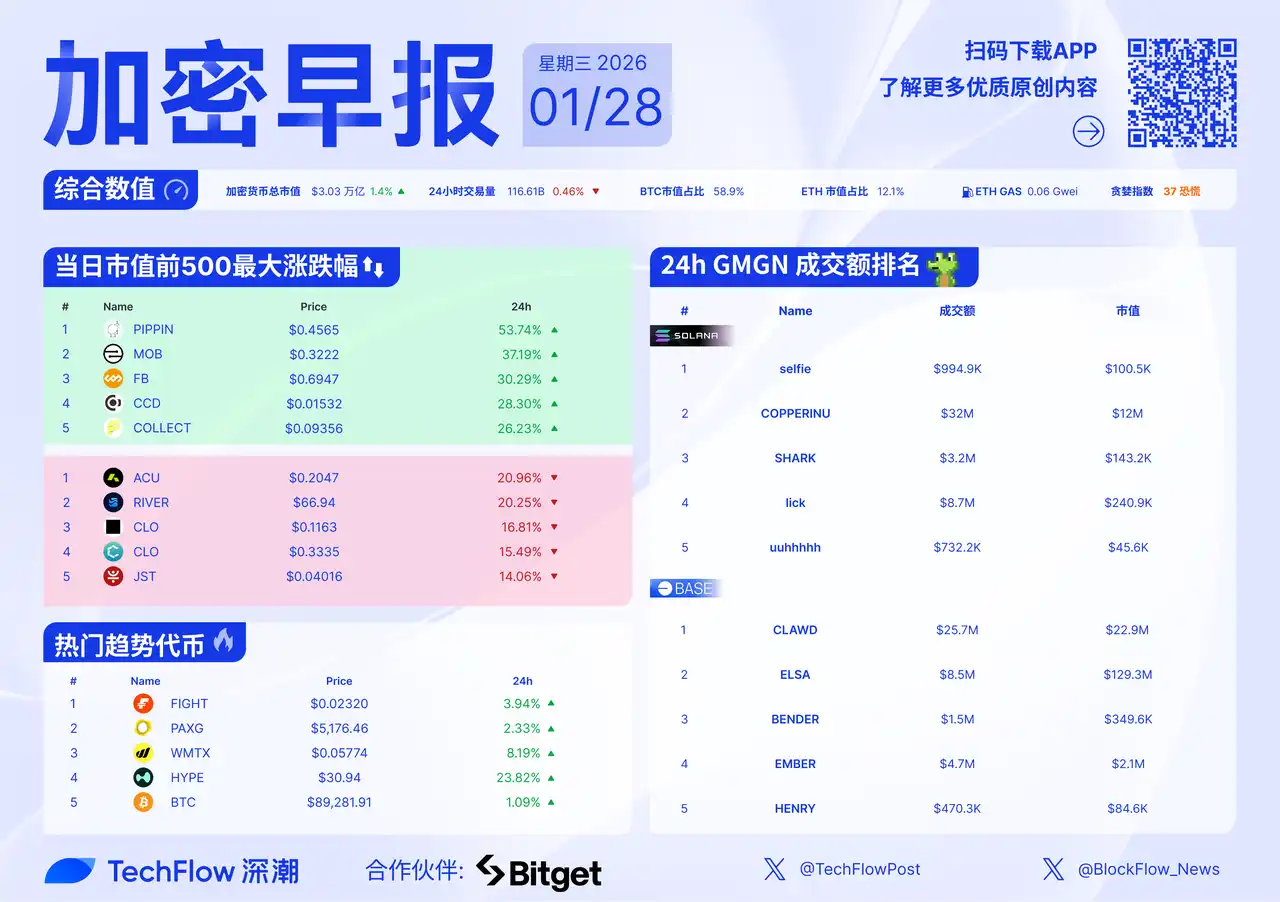
Recommended Reading

Crypto Podcast Survival Guide: A Group of People 'Powered by Love' Finding Meaning in the Cracks

This article explores the unique value, challenges, and significance of Chinese crypto podcasts in the context of today's industrialized information production. Although crypto podcasts have a limited audience and face commercialization difficulties, they counteract the trend of information fragmentation through in-depth content and authentic expression, becoming one of the few media forms that preserve the expression of "human presence."

After $1B TVL, Can USDD's 'Interest-Bearing USDT' Narrative Secure a Seat at the Stablecoin Main Table?

This article details the development history, technical upgrades, and future plans of the decentralized stablecoin USDD. USDD completed its 2.0 upgrade in 2025, transitioning to an over-collateralized stablecoin, gradually moving away from subsidy reliance and building a sustainable yield model. The article also mentions how USDD is expanding its market competitiveness through technological innovation, ecosystem partnerships, and user growth, aiming to become an "interest-bearing version of USDT."

ClawdBot Founder Says 'Never Issuing a Token,' Meme Trenches Go Crazy

This article recounts how ClawdBot went viral on January 25th, with GitHub stars surpassing 40,000 and nearly ten thousand people flooding its Discord community. Founder Peter Steinberger stated he would no longer write code personally but rely on AI instead. ClawdBot's popularity attracted the attention of the crypto circle, leading to the immediate appearance of a同名Meme币CLAWD, whose market cap once reached $16 million. Despite the founder's clear statement that he would not issue a token, the crypto circle still tried to associate with the project through various means, even hijacking the founder's account to post scam information. The current Meme coin circle, from "deifying" to "leeching off deities" to "kidnapping deities," exhibits a profit-driven wolf culture, placing burdens and causing damage to developers and projects.

Micron's $24B Singapore Factory, But Your RAM Sticks Aren't in the Plan

This article discusses Micron Technology's announcement of a $24 billion investment to build an advanced NAND wafer fab in Singapore, with plans to begin shipments in the second half of 2028. Simultaneously, Micron will gradually exit the consumer memory and SSD business, focusing on meeting the high demand for memory and storage from the AI market. This strategic shift is driven by the contraction of the Chinese market and the rapid growth of the AI server market. Due to supply tightness, consumer memory product prices have risen significantly. Memory stocks have performed well due to rising AI demand.

Coinbase CEO Davos Interview Highlights: 3 Major Crypto Trends for 2026 & Bank Cooperation Progress

This article is a summary of Coinbase CEO Brian Armstrong's interview at the Davos conference, focusing on key topics such as cryptocurrency adoption, global regulation, stablecoin legislation, asset tokenization, and the integration of AI and crypto. The interview also covered changes in US crypto policy, progress in bank-crypto cooperation, and three major trends for the future of the cryptocurrency industry.


Domande pertinenti

QWhat is the allocation percentage of $birb tokens for the Moonbirds community?

A65% of the $birb tokens are allocated to the community.

QWhich company is the issuer of the new federally regulated stablecoin USA₮?

AAnchorage Digital Bank is the issuer of the new federally regulated stablecoin USA₮.

QWhat was the main reason for the shutdown of the game 'Forgotten Runiverse'?

AThe game 'Forgotten Runiverse' was shut down because it became financially unsustainable to maintain its operations.

QHow much gold did Tether add to its reserves in Q4 2025?

ATether added approximately 27 metric tons of gold to its reserves in the fourth quarter of 2025.

QWhich venture capital firm led the $75 million Series C funding round for the crypto payments network Mesh?

ADragonfly Capital led the $75 million Series C funding round for Mesh.

Letture associate

TechFlow Intelligence Bureau: Chip Stocks Lose Trillions in a Single Day, Bitcoin Falls Below $60,000, US-Iran Conflict Escalates

**Daily Tech & Markets Roundup: AI Advances, Market Turmoil, and Geopolitical Tensions** **AI / LLMs**: Anthropic's internal report on AI self-improvement sparked serious discussions about Recursive Self-Improvement (RSI). Meanwhile, debate continues on AI coding tools after Claude was accused of introducing bugs into the rsync codebase. In positive news, DeepSeek V4 Flash impressed in local deployment tests, and GitHub Copilot now supports custom endpoints for local models. A surprising research turn suggests removing chain-of-thought prompting can sometimes improve LLM performance. **Crypto / Web3**: Bitcoin plunged below $60,000, with its RSI hitting levels last seen during the COVID-19 crash, driven by strong U.S. jobs data reviving interest rate hike fears. Discussions highlight Ethereum DeFi's continued lack of a smooth consumer payment layer. **Chips / Hardware**: Chip stocks suffered a massive sell-off, with the Philadelphia Semiconductor Index posting its worst single-day drop in six years, erasing over a trillion dollars in value. Marvell, Micron, AMD, and Intel were among the biggest losers. **Tech Companies**: A leaked Microsoft document revealing goals to make Copilot "addictive" drew criticism. LinkedIn founder Reid Hoffman left Microsoft's board to focus full-time on his AI agent startup, Manus. Google was revealed to be paying SpaceX $920 million monthly for AI training compute. **Markets & Macro**: A blowout U.S. jobs report (172k vs. 80k expected) crushed hopes for near-term rate cuts, sending Treasury yields soaring and triggering a broad market sell-off. CEOs from Kraft, McDonald's, and Whirlpool simultaneously warned U.S. consumers are exhausting their savings. **Geopolitics**: U.S.-Iran tensions escalated with missile/drone interceptions and U.S. strikes on Iranian radar sites, keeping the critical Strait of Hormuz largely closed since late February and posing ongoing oil supply risks. **The Bottom Line**: The strong jobs data acted as a single trigger for correlated sell-offs across equities, crypto, and chips. Underlying the volatility is a stark contradiction between robust employment data and warnings of consumer weakness, alongside geopolitical risks that could reignite inflation, leaving markets to price in a fraught macro outlook with no clear "soft landing" path.

marsbit1 h fa

TechFlow Intelligence Bureau: Chip Stocks Lose Trillions in a Single Day, Bitcoin Falls Below $60,000, US-Iran Conflict Escalates

marsbit1 h fa

It Took Me a Year to See the Bitter Truth About Agent Payments

After a year building infrastructure for the Agent economy, engaging with major players like Stripe, Visa, and Coinbase, the author shares a sobering analysis of the current state of Agent payments. The core finding is a stark lack of genuine, immediate demand across most envisioned use cases. The article breaks down four key market segments: 1. **Agent-to-Merchant (Consumer Shopping):** For most product categories (e.g., clothing, electronics), conversational AI shopping is a step backwards from visual e-commerce interfaces. While agents excel at understanding needs, they can't replace side-by-side product comparison. Real merchant interest is defensive "Agent Engine Optimization," not driven by current customer demand. Potential exists for high-frequency, low-decision purchases (like food delivery) or navigating complex store UIs, but these require massive B2C distribution channels dominated by giants like Amazon. 2. **Agent-to-API (Developer Services):** Developers already have subscriptions and billing relationships for APIs (compute, data). Prepaid balances solve micro-payment issues for low transaction volumes. A deeper structural problem is that major SaaS vendors' business models rely on enterprise contracts, resisting granular pay-per-call pricing. While protocols like MPP and x402 serve the long tail of niche services, this market is small and developers are historically low-willingness-to-pay. 3. **Agent-to-Agent:** This remains largely theoretical with minimal transaction volume. While it represents a long-term bet on a fundamentally new transaction infrastructure (sub-second, micro-penny to million-dollar, multi-party settlements), it does not constitute a present market. 4. **Agent-to-Finance:** This is the only category with existing, paying demand. Integrating AI into financial workflows (trading, portfolio management) is a natural evolution and enables new capabilities like autonomous rebalancing. However, competition favors established, regulated institutions. The "real problem" is not moving money between agents, but the broader challenge of **coordination**—orchestrating work between agents and humans, verifying outcomes, and settling results. Payment is just one component of settlement, which is itself part of coordination. Companies that solve the coordination layer will subsume payment, not the other way around. While well-funded incumbents build defensively for a long-term future, startups must find where the market is today—which, for the author's team, lies outside these four categories in an area of real, growing, and underserved activity.

marsbit1 h fa

It Took Me a Year to See the Bitter Truth About Agent Payments

marsbit1 h fa

It Took Me a Year to See the Hard Truth About Agent Payments

**Title: It Took Me a Year to See the Hard Truth About Agent Payments** Over the past year, I've worked on infrastructure for the Agent economy, engaging with major players like Stripe, Visa, Coinbase, and numerous startups. The findings reveal a stark reality: genuine, widespread demand for Agent-based payments does not yet exist. **Key Observations:** * **Agent-to-Merchant (Shopping):** The user experience for AI shopping often falls short, especially for visual product discovery. While AI excels at understanding needs, conversational interfaces can't yet replace browsing and comparing multiple products visually. Current merchant interest is largely defensive ("Agent Engine Optimization") for a future that hasn't arrived. High-frequency, low-friction purchases (like food delivery) are potential fits, but lack open APIs and face high AI inference costs. Simpler, more affordable, or cross-language interactions for complex UIs are a niche opportunity but require massive consumer distribution to scale. * **Agent-to-API (Developer Tools):** Developer payment needs for APIs (computing, data, models) are already met through subscriptions and prepaid credits. The core challenge is not payment friction but supplier economics: most large SaaS providers prefer enterprise contracts over micropayments for API calls. Protocols like MPP and x402 suit the long-tail of smaller services but cater to a developer market historically reluctant to pay for these tools. Major infrastructure needs at the top of the stack are already being addressed. * **Agent-to-Agent (Machine Commerce):** This is a long-term vision with almost no current transaction volume. While a future with high-speed, high-frequency, multi-party machine-to-machine transactions would require novel infrastructure, it remains theoretical. The market is not here yet. * **Agent-to-Finance:** This is the only category with clear, present demand. Financial professionals and DeFi users already pay for tools, and AI augmentation is a natural evolution. Autonomous AI agents can enable entirely new financial strategies. However, competition is fierce from established, regulated incumbents who can more easily layer AI onto their existing products. **The Core Insight:** Companies, especially giants with long time horizons, are building defensively for a potential future of mass machine commerce. For them, early investment is a low-cost hedge. For startups, the current market reality is different. The primary challenge isn't just moving money between agents (payments). The larger, unsolved problem is **orchestration** – coordinating work between agents and humans, verifying outcomes, and then settling. Payment is just a part of settlement, which is just a part of orchestration. Companies that solve the orchestration problem will subsume payments, not the other way around. After a year of building, we see the real, growing, and underserved market opportunity lies in this broader domain of orchestration.

链捕手2 h fa

It Took Me a Year to See the Hard Truth About Agent Payments

链捕手2 h fa

Claude Opus 4.8 Finds a $4.5 Billion Bug: The AI Era is Mass-Producing Hackers

A researcher discovered a critical "infinite mint" vulnerability in the Zcash cryptocurrency's Orchard protocol using Claude Opus 4.8, leading to a swift fix but also a 50% market drop, erasing billions in value. This incident highlights a new era where powerful, accessible AI models are dramatically lowering the barrier to finding software vulnerabilities. Previously, the security community feared specialized models like Claude Mythos Preview, capable of finding decades-old zero-day exploits. The Zcash case, however, involved a publicly available, general-purpose model. This shift makes advanced security auditing—and attack capabilities—accessible to far more people, not just experts. The mass democratization of vulnerability discovery brings a dual challenge: a flood of low-quality, AI-generated false reports that overwhelm maintainers, and the real, rapid uncovering of deep, dangerous bugs. Open-source projects, often understaffed and unfunded, are particularly vulnerable to this "attention DDoS." The article cites examples like curl shutting down its bug bounty program due to the unsustainable workload. Our perceived digital safety has often been luck, relying on the high cost and effort required to find deeply hidden flaws in complex systems, as seen with historical vulnerabilities like Heartbleed or Baron Samedit. AI changes this cost structure, effectively "mass-producing flashlights" to illuminate every corner of our codebase. While large companies operate extensive security chains involving external white-hat hackers and massive defensive operations, the global cybersecurity workforce faces a severe shortage, especially of experienced personnel capable of analyzing complex threats and coordinating fixes. The core dilemma emerges: AI makes *finding* bugs cheap and scalable, but *fixing* them remains a slow, expensive, and human-intensive process. The article concludes that AI won't destroy the internet but acts as a bright light, revealing that our digital existence is not inherently secure but is precariously maintained by ongoing human effort. The true cost in the AI era may not be discovery, but whether there will be enough people left willing and able to do the hard work of repair.

marsbit2 h fa

Claude Opus 4.8 Finds a $4.5 Billion Bug: The AI Era is Mass-Producing Hackers

marsbit2 h fa

Trading

Spot
Futures
活动图片