Crypto Morning Brief: Michael Selig Officially Assumes Role as US CFTC Chairman, Uniswap 'UNIfication Proposal' Passes

marsbitPubblicato 2025-12-23Pubblicato ultima volta 2025-12-23

Introduzione

Crypto Morning Brief: Michael Selig has been officially sworn in as Chairman of the U.S. CFTC. He emphasized the agency’s growing role in shaping practical regulatory standards for digital asset markets. In other news, Uniswap’s “UNIfication” proposal passed with over 69 million votes, activating a fee mechanism that will burn UNI tokens and improve tokenomics. UNI’s price has risen over 25% since the vote began. Spot gold hit a new all-time high, surpassing $4,450 per ounce. Federal Reserve Governor Milan noted that the urgency for a 50-basis-point rate cut has diminished, though he warned that policy rates must adapt to a lower neutral rate to avoid recession risks. Corporate crypto adoption continues: Japan’s Metaplanet approved issuing dividend-preferred shares to raise funds and holds over 30,800 BTC. Trump Media purchased an additional 150 BTC, raising its total holdings to 11,241 BTC. JPMorgan is reportedly exploring cryptocurrency trading services for institutional clients, and Coinbase acquired prediction markets startup The Clearing Company. Other updates include Espresso opening eligibility checks for its $ESP airdrop, Hyperliquid defending its transparency and solvency, and Polymarket planning to launch its own Ethereum L2.

Author: Deep Tide TechFlow

Yesterday's Market Dynamics

Spot Gold Rises to $4,450/Ounce This Morning, Hitting Another Record High

According to Jinshi Data, spot gold rose to $4,450 per ounce this morning, setting another historical record high, with a daily increase of 0.15%.

Michael Selig Has Officially Been Sworn In as US CFTC Chairman

According to Cryptobriefing, Michael Selig, a pro-Bitcoin figure, has officially been sworn in as Chairman of the U.S. Commodity Futures Trading Commission (CFTC), following his confirmation by the U.S. Senate.

In a statement, Selig noted that the CFTC is entering a significant period of transformation, driven by increased retail participation and the emergence of new products and platforms. He indicated that the agency will play a larger role in establishing practical regulatory standards for the digital asset market while maintaining the stability and security of the U.S. derivatives market. Selig emphasized: "We are at a unique moment where various new technologies, products, and platforms are emerging, retail participation in commodity markets has reached a historical high, and Congress is about to send digital asset market structure legislation to the President, solidifying the U.S. as the 'crypto capital.'"

Prior to joining the CFTC, Selig served as the Chief Legal Counsel for the U.S. Securities and Exchange Commission (SEC) Crypto Working Group and as a Senior Advisor to Chairman Paul Atkins.

Fed Governor Milan: The Necessity for a 50 Basis Point Rate Cut Has Weakened

Federal Reserve Governor Milan stated that with the recent progress in monetary policy adjustments, the necessity for the 50 basis point rate cut he previously advocated has weakened. Milan pointed out that there have been some abnormal fluctuations in recent inflation data, partly related to government shutdowns. These abnormal signals suggest that the Fed's policy stance should shift towards a more accommodative direction. He emphasized that he does not currently see a risk of the economy falling into a short-term recession but believes that the neutral interest rate level has clearly shifted downward, and monetary policy must reflect this structural change. If policy rates are not consistently lowered to align with the new neutral level, it could instead increase the risk of the economy falling into a recession. Additionally, regarding his own term, Milan admitted he is uncertain whether he will remain. He stated: If no successor is confirmed by the end of January, I will assume that I will continue to serve.

Uniswap's "UNIfication" Fee Switch Proposal Has Reached the 40 Million Vote Passing Threshold and Will Take Effect This Week

According to Cointelegraph, Uniswap's fee switch proposal "UNIfication" has reached the 40 million vote passing threshold and will take effect this week.

As of Monday, the proposal had received nearly 69 million affirmative votes, and voting will conclude on Thursday (Christmas Day). After the proposal passes, there will be a two-day timelock period, after which the Uniswap v2 and v3 fee switches will be activated on the Unichain mainnet, triggering UNI token burns.

The proposal will burn 100 million UNI tokens from the Uniswap Foundation treasury and implement a protocol fee discount auction system to increase liquidity provider yields. These changes are expected to significantly improve the supply and demand dynamics of the UNI token and enhance its long-term holding value.

Since voting began, the UNI price has risen over 25% and is currently trading at $6.19.

Espresso: Eligibility Check for ESP Airdrop Now Open, Token Claiming to Begin in Early 2026

According to an official announcement, the blockchain infrastructure Espresso Foundation has officially opened the $ESP token registration portal. Users can now connect their wallets to check if they are eligible for the Espresso airdrop. The token claiming page will open in early 2026.

Previous news indicated that Espresso completed a $28 million Series B funding round in 2024, led by a16z.

Hyperliquid Responds to Transparency Concerns, Emphasizes Full On-Chain Verifiability of Solvency

Hyperliquid officially issued a statement responding to multiple criticisms raised in a recent article about its platform. The statement emphasized that Hyperliquid is built on on-chain transparency, with the platform being fully solvent and every dollar traceable and verifiable. Officials pointed out that critics overlooked the existence of HyperEVM USDC, incorrectly claiming the system was missing $362 million.

The statement clarified that testnet functions are only for the test environment and cannot be executed on the mainnet; the platform has no privileged users or fee exemptions; and the CoreWriter function was misunderstood and cannot arbitrarily mint tokens or move user funds.

Hyperliquid stressed that as the only major perpetual contract platform with fully transparent state and transactions, anyone can run a node to verify the on-chain state, and every order, trade, and liquidation can be checked in real-time, a transparency advantage that other major trading platforms lack.

Sources: Polymarket Plans to Launch Its Own L2

Polymarket trader PredictTrader (@polymarketbet) summarized information recently disclosed by Polymarket team member Mustafa on social media, with key points as follows:

  1. Polymarket plans to migrate away from Polygon and intends to launch its own Ethereum L2 service, POLY. Launching POLY is the "top priority."

  2. Polymarket plans to abandon all third-party vendors (GoldSky, Alchemy, etc.).

  3. This week, Polymarket will launch 5-minute markets.

Japan's Largest Bitcoin-Holding Company Metaplanet Approves Issuance of Dividend Preferred Shares

According to Cointelegraph, Japan's largest corporate Bitcoin holder, Metaplanet, approved a comprehensive overhaul of its capital structure on Monday, allowing it to raise funds from institutional investors by issuing dividend preferred shares. The approved proposals include reclassifying capital reserves, doubling the authorized number of Class A and Class B preferred shares, and modifying the dividend structure to introduce floating and periodic dividends. Class A preferred shares will adopt a monthly floating dividend mechanism, while Class B preferred shares will offer quarterly dividends and be open to international institutional investors. It is reported that Metaplanet currently holds approximately 30,823 Bitcoins, valued at $2.75 billion, making it the largest corporate Bitcoin holder in Asia. The company also announced it will trade on the U.S. over-the-counter market through American Depositary Receipts, further expanding its global market presence.

JPMorgan Considers Offering Cryptocurrency Trading Services to Institutional Clients

According to Bloomberg, Wall Street giant JPMorgan is evaluating the possibility of offering cryptocurrency trading services to its institutional clients. Sources familiar with the matter revealed that the bank's markets division is exploring products and services to expand its cryptocurrency business scope, which may include spot and derivatives trading.

Coinbase Acquires Prediction Market Startup The Clearing Company

According to The Block, Coinbase has reached an agreement to acquire prediction market startup The Clearing Company, with the transaction expected to be completed by January 2026. This acquisition is part of Coinbase's "all-in-one exchange" strategy, aiming to deepen its presence in the event trading space. The Clearing Company team will join Coinbase to help expand its prediction market products. The startup was founded this year and received $15 million in seed funding in August from investors including Coinbase Ventures.

Trump Media Spends $13.44 Million to Increase Holdings by 150 BTC

According to Arkham monitoring data, approximately 9 minutes ago, Trump Media, owned by Donald Trump, spent $13.44 million to increase its holdings by 150 BTC. Trump Media's Bitcoin holdings now total 11,241 BTC, valued at approximately $1 billion.

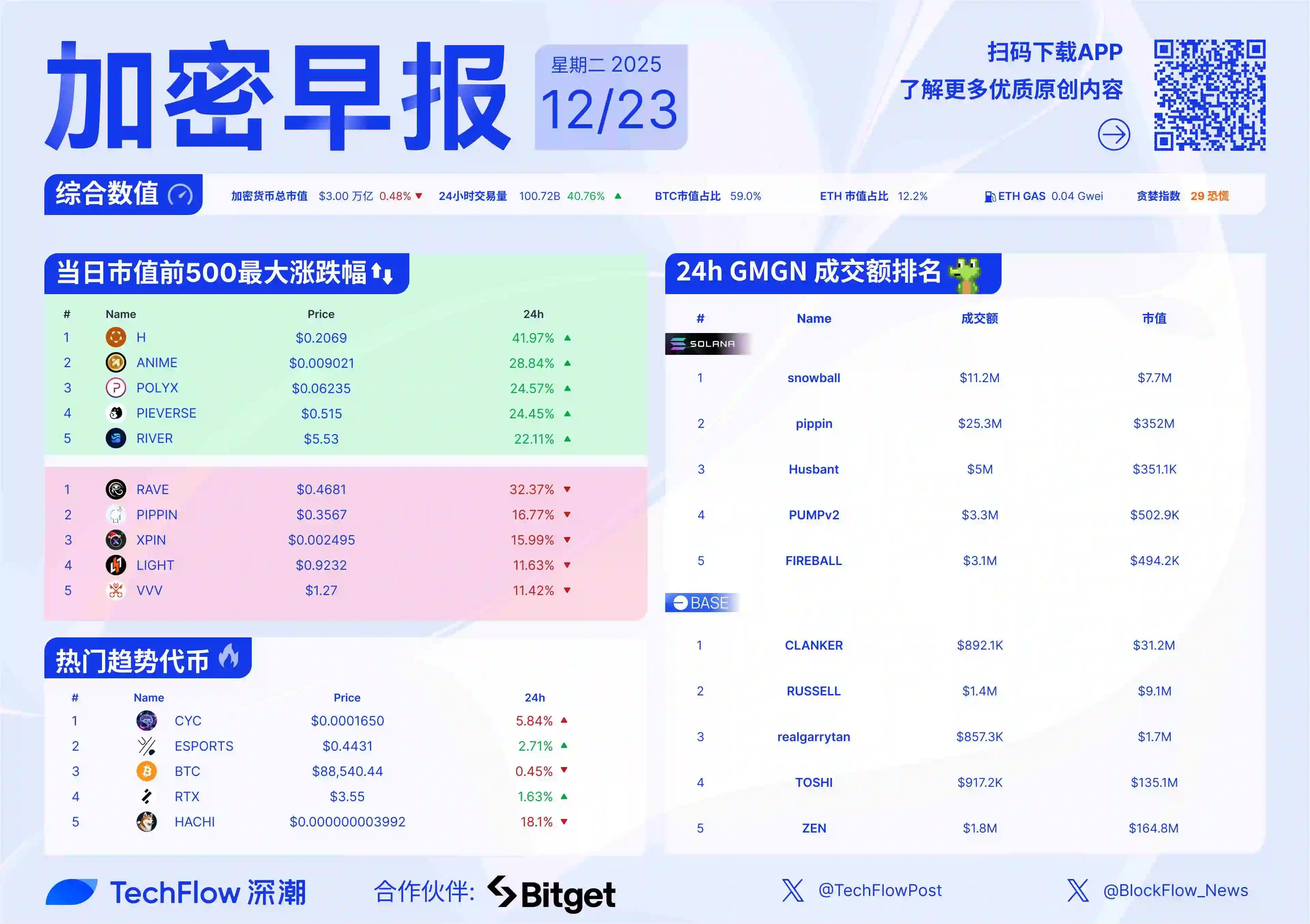
Market Trends
Recommended Reading

20x in 2 Days: A Quick Look at the Automated Market Making Mechanism of the New Meme Coin Snowball

This article details Snowball, a new type of Meme coin that uses an automated market-making mechanism to convert trading fees into buy pressure and liquidity, preventing developers from directly running away with funds. Snowball's mechanisms include: automatic token buybacks, increasing liquidity pool depth, and burning tokens to create deflation, with its creator fee ratio fluctuating with market capitalization. This mechanism relies on sustained growth in trading volume to maintain its snowball effect but may face challenges in the current sluggish market environment.

Coinbase 2026 Crypto Market Outlook: Deep Financial Integration, Innovating with Cautious Optimism

This article discusses how the crypto industry is at a critical stage of deep integration with the core of finance. It primarily explores the outlook for the 2026 crypto market, including analyses of market structure, tokenization, technological changes, and regulatory dynamics, and proposes key directions for future development. Additionally, the article mentions specific crypto industry trends, such as the rapid growth of stablecoins, the potential of prediction markets, and the composability of crypto derivatives.

Interpreting Messari's 100,000-Word Annual Report (Part 1): Why Did Market Sentiment Collapse Completely in 2025?

Based on Messari's annual report "The Crypto Theses 2026," this article analyzes the reasons for the complete collapse of crypto market sentiment in 2025. Although there was no systemic crash, sentiment fell to a historical low. The report points out that this phenomenon reflects a deep-seated misalignment between market participants and market structure, particularly the pressure on savers from imbalances in the monetary system. Furthermore, the report explores the establishment of Bitcoin (BTC) as "real money" and its impact on other Layer 1 blockchains.

Tracking 118 Coins Launched in 2025: 85% Are Below Their Launch Valuation

This article analyzes data from token generation events launched in 2025, finding that 85% of tokens currently have valuations below their issuance valuation, with the median token's fully diluted valuation down 71% and market capitalization down 67%. The crypto market is undergoing a transition from retail speculation-driven to institutionally dominated ecosystems. Stablecoin payments are increasingly centralized, with significant growth in trading volume and number of transactions. Additionally, the AI agent economy and crypto finance sectors also demonstrate potential and challenges for future development.

1,000 Wallets Contribute 85% of Trading Volume: Stablecoin Payments Are More Centralized Than You Think

This article analyzes the use of stablecoins in blockchain payments, focusing on the trading patterns of the two main stablecoins, USDT and USDC, on the Ethereum network. Using data filtering methods and label classification techniques, the article explores the adoption rate of stablecoin payments, the distribution of transaction types, the drivers of payments, and future trends.


Domande pertinenti

QWho has been officially sworn in as the new chairman of the U.S. CFTC, and what is his stance on digital assets?

AMichael Selig has been officially sworn in as the new chairman of the U.S. Commodity Futures Trading Commission (CFTC). He is known for being pro-Bitcoin and has emphasized that the CFTC will play a greater role in setting practical regulatory standards for the digital asset market while maintaining the stability and safety of the U.S. derivatives market.

QWhat is the 'UNIfication' proposal for Uniswap, and what is its expected impact on the UNI token?

AThe 'UNIfication' proposal is a fee switch mechanism for Uniswap that has passed with over 40 million votes. It will burn 100 million UNI tokens from the Uniswap Foundation treasury and implement a protocol fee discount auction system to increase liquidity provider rewards. These changes are expected to significantly improve the supply and demand dynamics of the UNI token and enhance its long-term holding value.

QWhich company is the largest corporate holder of Bitcoin in Japan, and what recent financial move did it approve?

AMetaplanet is the largest corporate holder of Bitcoin in Japan, with approximately 30,823 BTC valued at $2.75 billion. The company recently approved a capital structure overhaul that allows it to raise funds from institutional investors by issuing dividend-preferred shares.

QWhat major Wall Street bank is reportedly considering offering cryptocurrency trading services to its institutional clients?

AJPMorgan is reportedly considering offering cryptocurrency trading services to its institutional clients. The bank's markets division is exploring products and services that could include both spot and derivatives trading to expand its crypto business offerings.

QWhat did Hyperliquid emphasize in its response to recent transparency concerns about its platform?

AHyperliquid emphasized that its platform is built on-chain transparency, is fully solvent, and that every dollar is trackable and verifiable. It clarified that critics mistakenly ignored the existence of HyperEVM USDC and that its testnet functions cannot be executed on the mainnet. The platform has no privileged users or fee exemptions, and its CoreWriter function cannot arbitrarily mint tokens or move user funds.

Letture associate

Has Hook Summer Truly Arrived? sato, Lo0p, FLOOD Ignite the New Uniswap v4 Narrative

With the broader market showing signs of recovery, a new wave of interest has emerged around Ethereum-based meme coins. Following ASTEROID, tokens like sato, sat1, Lo0p, and FLOOD, built upon the Uniswap v4 Hook protocol, are capturing market attention. Their market capitalizations range from millions to tens of millions of dollars, injecting much-needed focused liquidity into a market lacking narratives. This article explores whether this trend signifies an incoming "Hook Summer" and its potential impact on UNI's price. Hooks are essentially plug-in smart contracts for Uniswap v4 liquidity pools, allowing developers to inject custom logic at key points in a pool's lifecycle (like initialization, adding/removing liquidity, swaps). This transforms the AMM into programmable building blocks. Key highlighted projects include: * **sato**: Peaked over $38M market cap. It utilizes a v4 curve for minting/burning; buying locks ETH as reserve to mint new tokens, while selling redeems ETH from the reserve and burns tokens. * **sat1**: Market cap briefly exceeded $10M, promoted as an "optimized sato," but later declined significantly. * **Lo0p**: Reached nearly $6.6M. It's a lending AMM protocol where buying LO0P tokens locks them as collateral, allowing users to borrow ETH from the pool reserve at 40% LTV, aiming to improve capital efficiency for idle ETH in LPs. * **FLOOD**: Peaked near $6M. Its mechanism directs asset reserves from buys into Aave v3 to generate yield, with fees and interest retained in the pool to potentially influence the token's price long-term. In the long term, the development of the Hook ecosystem can attract users and liquidity to Uniswap v4, benefiting UNI's fundamentals—especially combined with the recent activation of the protocol fee switch, where a portion of fees is used to burn UNI. However, in the short term, these Hook-based tokens are unlikely to directly drive significant UNI price appreciation. Their impact is moderated by factors like token sustainability, price volatility, and broader market and regulatory conditions. Currently, Uniswap v4's TVL ($595M) still trails behind v2 and v3, indicating adoption and growth will take time. The article concludes that while the Hook ecosystem provides long-term "nourishment" for UNI, its short-term role is more of a "catalyst" than a "booster." Readers are cautioned that these are early-stage experimental tokens and may carry unknown risks.

Odaily星球日报4 min fa

Has Hook Summer Truly Arrived? sato, Lo0p, FLOOD Ignite the New Uniswap v4 Narrative

Odaily星球日报4 min fa

Interview with Michael Saylor: I Did Say I Would Sell Bitcoin, But Never a Net Sale

Interview with Michael Saylor: I Said We'd Sell Bitcoin, But Never Be a Net Seller In a recent podcast, MicroStrategy Executive Chairman Michael Saylor clarified the company's stance on potentially selling Bitcoin. Following MicroStrategy's earnings call statement about being prepared to sell BTC to fund dividends for its STRC (Strategic) credit product, Saylor emphasized the distinction between selling and being a "net seller." Saylor explained the core business model: MicroStrategy sells credit instruments like STRC and uses the proceeds to buy Bitcoin, which is viewed as "digital capital" expected to appreciate around 30-40% annually. A portion of these capital gains can then be used to pay the dividends on the credit products. He stressed that even if the company sells some Bitcoin for dividends, it simultaneously buys much more with new credit issuance. For example, after raising $3.2 billion from STRC sales in April, the dividend obligation was only $80-90 million, making the company a net buyer. The clarification aims to counter market narratives questioning the value of Bitcoin on MicroStrategy's balance sheet if it were never sold, and to dismiss claims of a "Ponzi scheme." Saylor reiterated his personal philosophy for investors: "Don't be a net seller of bitcoin" and ensure your Bitcoin holdings increase each year. Saylor also discussed Bitcoin's role as the foundation for "digital credit," noting that STRC has become the largest and most liquid preferred stock issue in the U.S., offering high risk-adjusted returns (Sharpe ratio). He highlighted Bitcoin's deep liquidity, stating that even large purchases by MicroStrategy do not move the market significantly, which is driven by macro factors, geopolitical tensions, and capital flows from ETFs and credit products. Finally, Saylor reflected on his early inspiration from sci-fi books, which motivated his path to MIT, and maintained his fundamental thesis on Bitcoin remains unchanged: it is superior digital capital enabling superior digital credit.

链捕手8 min fa

Interview with Michael Saylor: I Did Say I Would Sell Bitcoin, But Never a Net Sale

链捕手8 min fa

Beaten SK Hynix Employees in China: Year-end Bonus Less Than 5% of Korean Staff's

"SK Hynix Chinese Staff Hit Hard: Bonuses Less Than 5% of Korean Counterparts" Driven by the AI boom, South Korea's SK Hynix is experiencing record performance, with media reports predicting massive year-end bonuses for its employees, making them highly desirable in the matchmaking market. However, this prosperity starkly contrasts with the situation for the company's Chinese employees. According to reports, SK Hynix operates under a rule allocating 10% of operating profit for employee bonuses. While projections suggest Korean employees could receive bonuses reaching millions of RMB, a Chinese employee with over a decade of technical experience revealed the disparity: "If they get 3 million, Chinese staff get less than 5% of that." After adjustments based on KPI ratings, this employee's highest bonus was slightly over 100,000 RMB. Bonuses are paid annually in Korea but semi-annually in China. During the industry downturn in 2023-2024, Chinese employees received no bonus at all. The gap extends beyond bonuses. Recruitment posts for SK Hynix's Chinese factories (in Wuxi, Dalian, Chongqing) show engineer monthly salaries ranging from 10,000 to 35,000 RMB, with a 13th-month salary promised. Chinese employees also receive standard benefits like annual leave but lack stock incentives, which are reportedly unavailable to them. Furthermore, management positions in China are predominantly held by Korean personnel, though industry observers note a gradual increase in local middle managers over time. SK Hynix has confirmed the 10% bonus rule but cautioned that specific future bonus amounts remain unpredictable. The company forecasts strong demand for HBM and other high-value enterprise products for the next 2-3 years, driven by AI infrastructure investment. This focus on business-to-business markets may continue to constrain supply for consumer products, potentially prolonging price increases for components like memory.

链捕手22 min fa

Beaten SK Hynix Employees in China: Year-end Bonus Less Than 5% of Korean Staff's

链捕手22 min fa

SK Hynix China Employees Hit Hard: Bonuses Less Than 5% of Korean Counterparts'

"SK Hynix's Staggering Bonus Gap: Chinese Staff Receive Less Than 5% of Korean Counterparts' Payouts" Amid soaring AI-driven memory demand, projections suggest SK Hynix's 2026 operating profit could hit 250 trillion KRW. Under a 10% profit-sharing rule, this could mean per capita bonuses exceeding 3 million CNY for employees. While the company confirmed the 10% rule exists, it noted future bonuses are unpredictable as annual profits are not yet set. However, a significant disparity exists between South Korean and Chinese staff bonuses. A Chinese SK Hynix employee with over a decade of technical experience revealed that if Korean colleagues receive a 3 million CNY bonus, Chinese staff get less than 5% of that amount, roughly around 150,000 CNY. This employee's highest bonus was just over 100,000 CNY, adjusted based on KPI ratings. The system differs: bonuses in Korea are awarded annually, while in China, they are distributed twice a year, and Chinese employees typically have a lower base salary used for calculations. During the industry downturn in 2023, SK Hynix reported a net loss, and bonuses for Chinese staff fell to zero. Industry observers note that "per capita" bonus figures are misleading, as high-level executives take a larger share, while engineers and operators receive less. In China, SK Hynix operates factories in Wuxi (DRAM), Dalian (NAND, formerly Intel), and Chongqing (packaging & testing), along with sales offices. Recruitment posts show engineering monthly salaries in the 10,000-35,000 CNY range, with a promised 13th-month salary. Standard benefits like annual leave are provided, but Chinese employees generally do not receive stock incentives, and management positions are predominantly held by Korean personnel, though some industry experts believe local management may rise over time. Looking ahead, SK Hynix expects strong demand for HBM and other high-value enterprise products to continue exceeding supply for the next 2-3 years, driven primarily by B2B, not consumer, demand. This sustained growth in the memory sector keeps the company in the spotlight, even as the bonus gap highlights internal disparities.

marsbit42 min fa

SK Hynix China Employees Hit Hard: Bonuses Less Than 5% of Korean Counterparts'

marsbit42 min fa

Trading

Spot
Futures

Articoli Popolari

Come comprare US

Benvenuto in HTX.com! Abbiamo reso l'acquisto di Talus Network (US) semplice e conveniente. Segui la nostra guida passo passo per intraprendere il tuo viaggio nel mondo delle criptovalute.Step 1: Crea il tuo Account HTXUsa la tua email o numero di telefono per registrarti il tuo account gratuito su HTX. Vivi un'esperienza facile e sblocca tutte le funzionalità,Crea il mio accountStep 2: Vai in Acquista crypto e seleziona il tuo metodo di pagamentoCarta di credito/debito: utilizza la tua Visa o Mastercard per acquistare immediatamente Talus NetworkUS.Bilancio: Usa i fondi dal bilancio del tuo account HTX per fare trading senza problemi.Terze parti: abbiamo aggiunto metodi di pagamento molto utilizzati come Google Pay e Apple Pay per maggiore comodità.P2P: Fai trading direttamente con altri utenti HTX.Over-the-Counter (OTC): Offriamo servizi su misura e tassi di cambio competitivi per i trader.Step 3: Conserva Talus Network (US)Dopo aver acquistato Talus Network (US), conserva nel tuo account HTX. In alternativa, puoi inviare tramite trasferimento blockchain o scambiare per altre criptovalute.Step 4: Scambia Talus Network (US)Scambia facilmente Talus Network (US) nel mercato spot di HTX. Accedi al tuo account, seleziona la tua coppia di trading, esegui le tue operazioni e monitora in tempo reale. Offriamo un'esperienza user-friendly sia per chi ha appena iniziato che per i trader più esperti.

378 Totale visualizzazioniPubblicato il 2025.12.11Aggiornato il 2025.12.11

Come comprare US

Discussioni

Benvenuto nella Community HTX. Qui puoi rimanere informato sugli ultimi sviluppi della piattaforma e accedere ad approfondimenti esperti sul mercato. Le opinioni degli utenti sul prezzo di US US sono presentate come di seguito.

活动图片