Crypto Morning Brief: Meme Coins Rally, Michael Saylor Releases Bitcoin Tracker Info

marsbitPubblicato 2026-01-05Pubblicato ultima volta 2026-01-05

Introduzione

In the latest crypto market update, meme tokens are experiencing a rally, while MicroStrategy founder Michael Saylor hints at further Bitcoin purchases by sharing a Bitcoin Tracker update. Key developments include an economist predicting five Fed rate cuts in 2026 due to a potential U.S. unemployment surge, and reports of major U.S. newspapers withholding news of a secret operation in Venezuela. Trump Media sees a rise in short positions ahead of a potential merger, and his family’s crypto project WLFI passes a proposal to boost USD1 adoption. Flow network resumes full operations post-outage, and Ranger announces an ICO on Solana. PwC increases its crypto focus amid U.S. regulatory shifts, and SlowMist warns of a critical vulnerability in HitBTC. Blue Origin now accepts Ethereum for space travel payments, and a major $1.8B crypto money laundering case is uncovered in Shanghai.

Author: Deep Tide TechFlow

Yesterday's Market Dynamics

Economist: U.S. Unemployment Wave Imminent, May Force Fed to Cut Rates 5 Times This Year

According to Jinshi Data, David Rosenberg, who previously worked at Merrill Lynch and has been running his own firm Rosenberg Research since 2020, stated that the U.S. economy will face significant challenges in 2026, with the job market likely to contract sharply, weakening the economy and forcing the Federal Reserve to respond with substantial interest rate cuts.

The U.S. unemployment rate has risen from 4% at the beginning of 2025 to 4.6% in November 2025. Rosenberg believes the unemployment rate will soon break above 5% and "likely test 6% by the end." Rosenberg stated that the collapse of the labor market and the ensuing recession will force the Fed to cut rates by 125 basis points to 2.25% (i.e., five 25-basis-point cuts) by the end of the year.

Notably, Rosenberg's view differs significantly from the general consensus among Wall Street economists, who expect the labor market to remain stable in 2026, with the Fed implementing one or two rate cuts. The median forecast from Fed officials is for one rate cut this year. However, the central bank has emphasized that it sees downside risks in the labor market. The Fed's latest staff projections note that "weaker labor market conditions and heightened economic uncertainty increase the risk of a more pronounced slowdown than expected."

Semafor: New York Times and Washington Post Knew About U.S. Secret Operation in Venezuela Before It Happened

According to a report by U.S. media site Semafor, The New York Times and The Washington Post were informed about the U.S. secret raid operation in Venezuela before it began but agreed to delay publication at the government's request to avoid endangering U.S. troops. President Trump approved the operation at 10:46 PM on Friday, which ultimately succeeded in capturing the President of Venezuela. Despite the tense relationship between the Trump administration and mainstream U.S. media, American media maintained traditional restraint regarding high-stakes national security operations. The Washington Post's editorial strongly supported this operation.

Previous news indicated that three suspected insider wallets placed bets in advance on the ouster of Venezuelan President Maduro, profiting over $630,000 in total. Affected by this, U.S. Congressman Ritchie Torres plans to propose a bill to prohibit federal officials from using insider information for trading on prediction markets.

Short Positions in Trump Media Company Surge; Trump's Personal Stake Would Drop to ~20% Upon Merger with TAE

According to a Reuters report, data from financial analysis firm S3 Partners shows that short positions in Trump Media & Technology Group surged recently after the company announced last month that it was seeking a $6 billion all-stock merger with Google-backed nuclear fusion energy company TAE Technologies. Short positions increased by 31% to nearly 16 million shares,接近 the highest level since October. It is reported that Trump himself holds approximately 115 million shares of Trump Media & Technology Group, representing about 40% of the company's shares. Due to equity dilution from the merger, Trump's stake would drop to about 20% upon merging with TAE.

WLFI Community Passes Proposal to Use Treasury Funds to Incentivize USD1 Adoption with 77.75% Support Rate

Trump family crypto project WLFI announced on platform X that a governance proposal to use part of the unlocked treasury funds to accelerate USD1 adoption passed with a 77.75% approval vote.

Flow: Network Fully Restored, Detailed Technical Post-Mortem Report to Be Released Within 48 Hours

According to an official announcement, the Flow network has been fully restored. Currently, 99.9% of accounts have full operational permissions in both execution environments. The Flow ecosystem is gradually recovering. The decentralized finance ecosystem has begun to resume operations, with decentralized exchanges like KittyPunch and IncrementFi back online and processing trades. Bridge partners are actively working on recovery protocols and are expected to resume operations after final verification.

Flow officials stated that a detailed technical post-mortem report, including the full attack vector, forensic analysis, and remediation methods, will be released within 48 hours. The network is currently secure, operational, and processing transactions in both execution environments. A full ecosystem recovery is expected to be completed this week.

Ranger Announces ICO Launch on January 7th

According to an official announcement, Solana生态 crypto derivatives exchange Ranger will launch a 4-day ICO starting January 7, 2026, at 00:00 UTC+8, with a minimum fundraising target of $6 million. This ICO will be conducted through MetaDAO, allocating 10 million RNGR tokens, representing 39.02% of the total supply. Tokens for ICO participants will be 100% unlocked at TGE, while team tokens will be unlocked upon meeting price milestone triggers.

PwC Significantly Increasing Efforts in the Cryptocurrency Space

According to the Financial Times, as the Trump administration embraces digital assets, PwC, one of the 'Big Four' accounting firms, has decided to increase its investment in this领域 after years of caution towards cryptocurrency.

PwC US lead Paul Griggs stated in an interview that this strategic pivot occurred last year against the backdrop of the U.S. appointing pro-crypto regulatory officials and Congress passing several new laws regulating digital assets, such as stablecoins.

Griggs said: "The Genius Act and the regulatory details around stablecoins will, I believe, boost market confidence in this product and asset class. Asset tokenization will also inevitably continue to evolve, and PwC must be within this ecosystem."

SlowMist: Discovers Potential Critical Vulnerability in HitBTC Exchange

According to an official message from SlowMist, the organization has discovered a potential critical security vulnerability in the HitBTC exchange. SlowMist stated that it had privately disclosed the information to HitBTC in advance but has not yet received a response.

It is reported that HitBTC is an established cryptocurrency exchange founded in 2013. The exchange's trading volume in the past 24 hours was $111,487,461.

Market News: Bezos' Blue Origin Now Accepts Ethereum for Space Travel Payments

According to Solid Intel, Jeff Bezos' space company Blue Origin now accepts Ethereum as a payment method for space travel.

Shanghai Prosecution Discloses a Job-Related Crime Case Involving Virtual Currency Money Laundering, Amounting to 1.8 Billion Yuan

According to a disclosure on the Shanghai Procuratorate's official account, the Shanghai Baoshan District Procuratorate, while handling a job-related crime case, conducted穿透式审查 (penetrative review) of funds, tracked the capital flow chain, and successfully initiated supervision over 24 cases involving 24 individuals. The prosecutor stated that the underground banking团伙 (syndicate) involved had a large number of accounts, making the case difficult to handle, with huge transaction volumes and money laundering amounts reaching 1.8 billion yuan. Ultimately, through pursuit and prosecution, money laundering activities involving cross-border transfer of illicit proceeds via virtual currency were cracked down on. Targeting new and complex money laundering crimes such as those involving underground banks and virtual currency, the Baoshan District Procuratorate guided public security organs to穿透资金账户 (penetrate fund accounts), clarify the source and destination of funds, secure electronic data, ensure precise and effective charges, and fully guarantee the quality and efficiency of money laundering case investigations.

Michael Saylor Again Releases Bitcoin Tracker Information, Hinting at Possible Further BTC Purchases

MicroStrategy founder Michael Saylor again released information related to the Bitcoin Tracker, stating, "Orange or Green?"

Based on previous patterns, MicroStrategy has always disclosed Bitcoin purchase information the day after related messages are posted.

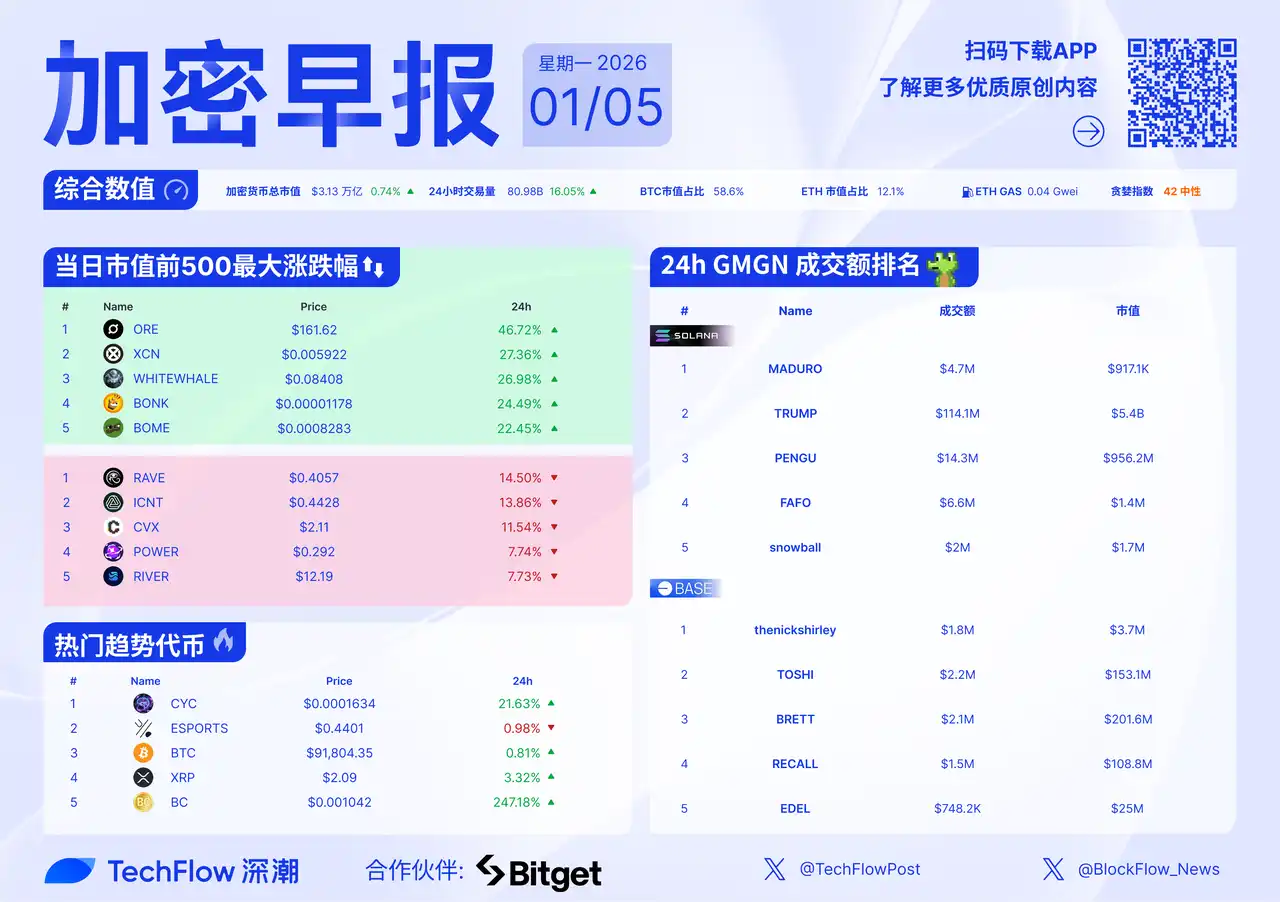
Market Trends
Recommended Reading

The Demise of the Petro: A Microcosm of Venezuela's Failure

This article recounts the failure of "Petro," the world's first sovereign state-backed digital currency launched by Venezuela. The Petro was initially held with high hopes to solve Venezuela's severe economic crisis and counter U.S. sanctions. However, due to technical issues, public indifference, external sanctions, internal corruption, and structural economic defects, the Petro ultimately failed, becoming a microcosm of national governance failure.

Pentagon's Pizza, Polymarket's Money

This article explores the phenomenon of predicting major military operations by analyzing changes in order volumes at pizzerias near the Pentagon. It reviews the history from Soviet agents monitoring Pentagon lights and vehicle numbers during the Cold War to using Google Maps and pizzeria customer traffic to predict war outbreaks today. It also mentions cases where individuals profited from such information on prediction markets and the ensuing discussions on information transparency and insider trading.

Analysis of All x402 Transaction Data in December: Nearly 60% Used for Practical Purposes, Not Speculation

This article primarily discusses the current state and development potential of the x402 protocol, analyzing transaction data from December 2025 and exploring trends in the micro-payment sector and its application potential in AI and blockchain. The article also mentions x402's solutions to payment issues, future challenges, and comparative advantages over other payment platforms.

Multicoin: Why We Are Bullish on Stablecoins Becoming FinTech 4.0?

This article delves into the development history of fintech and the revolutionary impact of stablecoins within it. It reviews the evolution from FinTech 1.0 to 4.0, analyzes the limitations of traditional financial infrastructure, and points out how stablecoins have changed the economic model of financial services through open, programmable networks. The emergence of stablecoins allows fintech companies to reduce operational costs, focus on serving specific niche markets, and achieve higher economic efficiency and deeper user understanding.

Four-Year Cycle Invalidated: 30 Institutions Bet on the New Crypto Landscape of 2026

This article discusses the major transformation the crypto industry will undergo in 2026, transitioning from "adolescent restlessness" to "adult steadiness," entering the so-called "industrialization phase." Various institutions have made predictions about future crypto trends, including decreased Bitcoin volatility, scaled commercial use of stablecoins and real-world assets (RWA), and deep integration of AI and blockchain. The article also mentions potential divergences and challenges, such as the quantum computing threat and competition in the AI payment layer.


Crypto di tendenza

Domande pertinenti

QAccording to economist David Rosenberg, how many times does he predict the Federal Reserve will be forced to cut interest rates in 2026?

ADavid Rosenberg predicts the Federal Reserve will be forced to cut interest rates 5 times (a total of 125 basis points) by the end of 2026.

QWhat action did Michael Saylor take that is often a precursor to his company, MicroStrategy, announcing a new Bitcoin purchase?

AMichael Saylor posted information about the 'Bitcoin Tracker' with the message 'Orange or green?', a pattern that has historically preceded announcements of Bitcoin acquisitions by MicroStrategy.

QWhich major accounting firm is increasing its focus on the cryptocurrency sector, as reported by the Financial Times?

APricewaterhouseCoopers (PwC) is increasing its focus and investment in the cryptocurrency sector.

QWhat was the outcome of the WLFI community governance proposal regarding the use of treasury funds to promote the adoption of USD1?

AThe WLFI community governance proposal to use part of the unlocked treasury funds to accelerate the adoption of USD1 passed with a 77.75% approval rate.

QWhich aerospace company, founded by Jeff Bezos, has begun accepting Ethereum as payment for space travel?

ABlue Origin, the aerospace company founded by Jeff Bezos, now accepts Ethereum as payment for space travel.

Letture associate

Two Legends Lost in Three Days: Is Google's AI Talent Dam Cracking?

In three days, Google lost two AI legends. On June 18, Noam Shazeer, co-author of the seminal "Attention is All You Need" paper and Gemini co-lead, left for OpenAI. Just 48 hours later, John Jumper, 2024 Nobel laureate and AlphaFold lead, departed DeepMind for Anthropic. This follows Andrej Karpathy joining Anthropic in May. These moves highlight a structural trend: top AI talent is concentrating at mission-driven, pre-IPO firms like OpenAI and Anthropic, while Google becomes a primary source. The exodus stems from a core mission mismatch. Google's ad-centric model often subordinates AI research to product and revenue goals, creating friction for pioneers like Shazeer, who returned in 2024 only to leave again. In contrast, OpenAI and Anthropic offer singular focus on pushing AI boundaries, whether towards AGI or safety-aligned models, which deeply appeals to top researchers like Jumper. Financial incentives amplify the pull. With both OpenAI and Anthropic nearing IPO, employees stand to gain immensely from equity, an upside Google's mature stock cannot match. Furthermore, the 2023 merger of Google Brain and DeepMind, intended to consolidate strength, has instead created cultural tension and slowed the path from research to product, as evidenced by Gemini's pace. This talent redistribution is reshaping the AI landscape. While Google retains vast data and compute resources, its true crisis is the quiet, continuous loss of the people who define the field's future. The real moat in AI is not infrastructure, but the concentration of brilliant minds—a battle Google is currently losing.

marsbit37 min fa

Two Legends Lost in Three Days: Is Google's AI Talent Dam Cracking?

marsbit37 min fa

Behind the AI Report Card, Lies a Chinese 'Exam Setter'

Beyond the familiar performance charts like MMLU-Pro and MMMU, which major AI models strive to ace, stands a key "examiner": Chinese-Canadian researcher Wenhu Chen. An assistant professor at the University of Waterloo and founder of TIGERLab, Chen addresses the crucial need for more rigorous AI evaluation. As models like GPT-4 began scoring near-perfect results on older benchmarks like MMLU, it became difficult to distinguish their true capabilities. In response, Chen introduced MMLU-Pro in 2024, featuring harder, more reasoning-focused questions with more answer choices, successfully reintroducing meaningful performance gaps. His work extends to multi-modal evaluation with MMMU and its enhanced version, MMMU-Pro. These benchmarks test a model's ability to understand and reason with complex information from images, charts, and text across diverse academic subjects, exposing the significant challenges even top models face in genuine comprehension. Chen's background in complex QA, table reasoning, and his experience at Google DeepMind on projects like Gemini inform his approach. He understands that effective benchmarks must anticipate how models might "cheat" by memorizing data or avoiding visual analysis. His lab also actively researches video understanding and generation models (e.g., UniVideo, Vamba), ensuring his evaluation work is grounded in practical model-building challenges. Now at Meta's Super Intelligence Lab, Chen continues his focus on multi-modal data and evaluation, representing the deep yet often unseen contributions of Chinese talent in shaping the fundamental tools of the AI industry.

marsbit48 min fa

Behind the AI Report Card, Lies a Chinese 'Exam Setter'

marsbit48 min fa

Alliance Co-founder's Letter to Entrepreneurs: Written at the Moment Cursor Sold for $600 Billion

Alliance Co-founder's Letter to Entrepreneurs: On Cursor's $60 Billion Sale Many aspiring founders see massive exits like Cursor's $60B sale and wonder why they can't achieve the same, often concluding opportunities are exhausted. But great companies aren't built in obvious, crowded spaces. Cursor, like Stripe, Figma, and Shopify before it, started with a non-consensus belief about the future. Before ChatGPT, they believed AI would transform knowledge work. They focused on a genuinely exciting domain, became their own customer, and obsessed over power users. Their journey involved years of "glass-chewing" effort before the market was ready. The pattern is consistent: identify a long-term technological shift, find a missed entry point, and execute for years before the trend becomes obvious. First-generation products (PayPal, Adobe, Amazon) prove a market exists. Second-generation winners (Stripe, Figma, Shopify) rebuild that market around new insights, technology, or changing customer behaviors. Founders must identify their phase in the cycle. Early entrants like Coinbase or Cursor focus on making new technology usable for power users. Later entrants find the "yin" to the established "yang"—the blind spots incumbents miss as they grow distant from individual users. The key is deep market immersion. Use every product in your space. Talk to users. Build an audience. Stop looking for ideas and start *seeing* them everywhere. Then, choose one. The idea must offer a 10x improvement or solve a "hair-on-fire" pain point—something severe enough that users are already crafting workarounds. When building, avoid feature bloat. Ask: why would someone switch? Great startups rarely force new behaviors; they improve familiar workflows with drastically lower friction (e.g., Cursor forked VS Code instead of creating a new editor). Distribution is the underestimated moat. Before product-market fit, achieve distribution-market fit. How do customers discover new tools? Founders like those at Airbnb, Stripe, and Cursor did unscalable, manual work to recruit early users. The final, unteachable ingredient is resilience. Cursor built for years pre-market, faced rejection, and persisted. So did Airbnb, Nvidia, and Rain (which launched post-FTX collapse). The lesson isn't that these founders were smarter, but that they stayed in the game long enough for their insights to compound. Framework: Spot technological cycles. Cultivate unique insight. Obsess over your market. Talk to customers. Find a hair-on-fire problem. Build the simplest wedge. Win your distribution channel. Above all, don't quit when it gets hard. Most people won't do these things consistently. The few who do build the next generation of great companies. Go build.

marsbit52 min fa

Alliance Co-founder's Letter to Entrepreneurs: Written at the Moment Cursor Sold for $600 Billion

marsbit52 min fa

Weekly Editor's Picks (0613-0619)

Weekly Editor's Picks (0613-0619): Market Insights & Analysis This weekly digest curates in-depth analysis often lost in the information flow, focusing on key insights across macro trends, investment, and technology. **Macro & Geopolitics:** With the Strait of Hormuz reopening and military conflict shifting to negotiation, markets are pivoting from "war shock" to "supply restoration." Trades include shorting crude risk premiums, longing airlines/tourism, Asian energy importers, and bond duration, while shorting inflation expectations. LNG, fertilizer, and chemical chains are also being repriced. **Investment & VC:** Ray Dalio advises against betting on concentrated AI giants dominating indices, advocating for diversified portfolios of high-quality, low-correlation assets instead. Analysis covers the 4-year crypto cycle, predicting the core surviving product by 2029 will be asset trading markets. Current BTC metrics suggest a potential bottoming zone, presenting a patient accumulation window. SpaceX's high-profile IPO at a $2.1T valuation faces scrutiny over fundamentals, with key watchpoints being its likely inclusion in the Nasdaq index and Q2 earnings. Concerns are raised about potential "gamma squeeze" and systemic risks if its narrative-driven valuation gets amplified by passive index funds. Robinhood (HOOD) is noted for breaking its high correlation with crypto, bolstered by its stock trading and new underwriting business. **Web3 & AI:** A warning highlights ~$1.8T in off-balance-sheet AI infrastructure commitments (purchase commitments, leases) as a potential systemic risk if AI monetization lags. AI models are being used for World Cup predictions, adding a new layer for betting markets. A cost breakdown of a $20 AI subscription reveals the supply chain from model companies to cloud, GPUs, and power. **Prediction Markets:** The emergence of prediction market "concept stocks" is noted, with Robinhood developing its own platform, Rothera, signaling a shift from market competition to a "channel war" for user access. **CeFi & DeFi:** The SpaceX IPO tested perpetual contract mechanisms for pre-IPO assets, highlighting challenges in handling corporate actions like stock splits on-chain. The de-pegging of STRC (Strategy's preferred share) to ~$89 reflects market concerns over MicroStrategy's capital structure and BTC-backed leverage model. BlackRock's covered-call Bitcoin ETF (BITA) offers yield but caps upside, appealing to yield-seeking institutions. **Ethereum:** An opinion piece argues Ethereum's core strength is its vast developer community and composability, solidifying its role as the default operating system for the financial internet. **Weekly Hot Topics:** Include the US-Iran deal reopening the Strait of Hormuz, Fed's hawkish hold, Anthropic restricting model access, SpaceX acquiring Cursor, and a humorous stock surge for "Liuliumei" due to its "LLM" ticker.

marsbit57 min fa

Weekly Editor's Picks (0613-0619)

marsbit57 min fa

Alliance's Co-Founder's Letter to Entrepreneurs: Written on the Occasion of Cursor's $60 Billion Sale

In this letter to entrepreneurs, Alliance reflects on the success of Cursor's $60 billion sale to Elon Musk, using it as a case study to counter the misconception that opportunities in crowded fields like AI or crypto are exhausted. The piece argues that great companies like Cursor, Stripe, Figma, and Shopify are not built by geniuses with perfect ideas, but by founders who start with a non-consensus belief about the future and build for years before that future becomes obvious to everyone. They identify long-term shifts, find overlooked entry points, and execute relentlessly. The framework for success involves: 1. **Identifying your place in the technology cycle**: Early-stage opportunities focus on making new tech usable for power users (e.g., Coinbase, Cursor). Later-stage opportunities involve finding the "yin" to an existing "yang"—the blind spots of first-generation players (e.g., Stripe vs. PayPal, Figma vs. Adobe). 2. **Cultivating unique insights**: Immerse yourself deeply in the market. Use every product, talk to users, and build an audience. Insights will emerge naturally from deep engagement. 3. **Finding a "hair-on-fire" problem**: Look for a 10x improvement or a severe, urgent pain point. The strongest signal is people already building clumsy workarounds. 4. **Building a focused MVP**: Don't just add features because you can. Ask why users would abandon their current tool for yours. The best startups rarely force new behaviors; they improve familiar workflows with drastically lower friction. 5. **Winning a distribution channel**: Distribution is often the moat. Before product-market fit, achieve channel-market fit. Find where your customers are and build an engine to reach them, even through unscalable, manual efforts initially. 6. **Persistence**: The final, unteachable ingredient is resilience. Success stories like Cursor, Airbnb, and Nvidia involved years of grinding, rejection, and perseverance when the path forward seemed unclear. The conclusion is that there is no secret. Most people fail to consistently execute these steps over the long term. The few who do build the companies that define the next era. The world is yours to create.

链捕手1 h fa

Alliance's Co-Founder's Letter to Entrepreneurs: Written on the Occasion of Cursor's $60 Billion Sale

链捕手1 h fa

Trading

Spot
Futures

Articoli Popolari

Cosa è MEME 2.0

Memecoin 2.0: L'Ascesa di $MEME 2.0 nel Mondo delle Criptovalute Introduzione Nel panorama in continua evoluzione delle criptovalute, è emerso un nuovo contendente. Memecoin 2.0, simboleggiato come $MEME 2.0, porta il concetto di meme coin a un livello emozionante. Come prodotto derivato dal Memecoin originale, questo progetto ha catturato l'attenzione della comunità crypto spostando il focus da incentivi finanziari tipici a un'esperienza coinvolgente e divertente. Operando sulla blockchain di Ethereum, Memecoin 2.0 ridefinisce audacemente l'impegno della comunità nella sfera crypto. Che cos'è Memecoin 2.0, $MEME 2.0? Alla base, Memecoin 2.0 è un progetto di criptovaluta che dà priorità allo spirito di comunità e al divertimento associato alla cultura meme. A differenza delle criptovalute convenzionali, che si concentrano su casi d'uso pratici e benefici tangibili, Memecoin 2.0 si distingue abbracciando il lato più leggero della moneta digitale. Il progetto esiste senza promesse di utilità, una roadmap strutturata o ritorni finanziari, concentrandosi invece sulla creazione di una comunità vibrante incentrata sui meme e sul divertimento condiviso. Facendo così, attinge alla crescente tendenza della cultura meme nello spazio online, rendendola un giocatore unico nel mondo degli asset digitali. Creatore di Memecoin 2.0, $MEME 2.0 Nonostante ricerche approfondite sulle origini di Memecoin 2.0, l'identità esplicita del suo creatore rimane sconosciuta. Questa anonimità non è rara nella comunità crypto, dove molti progetti sono guidati da individui o gruppi che preferiscono rimanere dietro le quinte. La mancanza di informazioni pubblicamente disponibili sul creatore potrebbe essere vista come una mossa strategica, mettendo in evidenza l'impegno della comunità piuttosto che la notorietà individuale all'interno dello spazio. Investitori di Memecoin 2.0, $MEME 2.0 Le informazioni riguardanti gli investitori o il supporto finanziario per Memecoin 2.0 sono scarse. Questa assenza di dettagli potrebbe suggerire che il progetto sia autofinanziato o che il suo focus sulla comunità piuttosto che sulle strutture d'investimento tradizionali abbia attratto un tipo diverso di sostenitore. Poiché il mondo delle meme coin coinvolge tipicamente un maggior coinvolgimento di base piuttosto che investimenti istituzionali, questo approccio si allinea con l'etica dei progetti guidati dalla comunità. Come funziona Memecoin 2.0, $MEME 2.0? Memecoin 2.0 opera interamente sulla blockchain di Ethereum, capitalizzando le sue robuste caratteristiche di sicurezza e scalabilità. Sfruttando i punti di forza di Ethereum, Memecoin 2.0 può offrire un ambiente sicuro per le interazioni degli utenti garantendo che le transazioni siano sia efficienti che convenienti. Uno degli attributi unici di Memecoin 2.0 risiede nella sua struttura guidata dalla comunità. Il valore e la popolarità del token $MEME 2.0 derivano dalla partecipazione attiva dei suoi utenti, piuttosto che dalla utilità intrinseca. Questo design rinforza il focus del progetto sull'aspetto dell'intrattenimento delle criptovalute, implicando che la risata e l'impegno della comunità siano le vere monete che guidano il suo successo. Inoltre, il progetto si inserisce all'interno dell'ecosistema più ampio delle meme coin, dove il valore di ciascuna meme coin oscilla in base alla cultura, alle tendenze e all'impegno della comunità piuttosto che ai principi economici tradizionali. Cronologia di Memecoin 2.0, $MEME 2.0 Per comprendere meglio l'evoluzione e le pietre miliari di Memecoin 2.0, ecco una cronologia che evidenzia eventi significativi nella sua storia: 2024: L'inizio di Memecoin 2.0 è riconosciuto come un ramo del Memecoin originale, affermandosi all'interno del contesto fiorente delle meme coin mentre opera sulla blockchain di Ethereum. 13 luglio 2024: Memecoin 2.0 si posiziona ufficialmente come una meme coin incentrata sulla comunità sulla rete Ethereum, enfatizzando il suo approccio centrato sull'intrattenimento che invita gli utenti a impegnarsi e partecipare alla sua crescita. Punti Chiave su Memecoin 2.0, $MEME 2.0 Diverse caratteristiche critiche definiscono Memecoin 2.0: Approccio Centrico alla Comunità: La missione principale di Memecoin 2.0 è creare un'esperienza comunitaria divertente e coinvolgente, capitalizzando il piacere collettivo derivante dalla cultura memetica. Costruita su Ethereum: Operare sulla blockchain di Ethereum fornisce al progetto un'infrastruttura essenziale che garantisce sicurezza e scalabilità. Mancanza di Utilità o Roadmap: In una marcata deviazione dalle criptovalute tradizionali, Memecoin 2.0 non promette alcuna caratteristica utilitaria o ritorni finanziari, riaffermando il suo impegno per il coinvolgimento della comunità e l'impegno sociale. Focus sulla Cultura Memetica: Abbracciando gli aspetti umoristici e culturali del fenomeno meme, Memecoin 2.0 offre una piattaforma per gli utenti per interagire con la crypto offline e online. Ulteriore Contesto: L'Importanza delle Meme Coin Le meme coin sono emerse come una classe distinta di criptovaluta, spesso guidata dall'umorismo e da un approccio spensierato al trading. Queste monete generalmente mancano di significative utilità o roadmap di sviluppo, attirando gli utenti con la promessa di divertimento, interazione comunitaria e rilevanza culturale. Nel panorama del più ampio ecosistema crypto, le meme coin rianimano l'importanza dell'impegno della comunità, opponendosi ad approcci esclusivamente orientati al profitto. Progetti come Memecoin 2.0 danno il via a un'era in cui l'intrattenimento può armonizzarsi con le aspirazioni finanziarie, trasformando la blockchain in un parco giochi per la creatività e l'interazione sociale. Conclusione Memecoin 2.0, o $MEME 2.0, incarna una nuova ondata di criptovaluta che dà priorità all'impegno della comunità rispetto a rigidi strutture finanziarie. Con un focus sull'umorismo e l'interazione sociale, capitalizza sulla fascinazione circondante la cultura meme. Operando sulla blockchain di Ethereum, Memecoin 2.0 sfrutta le capacità della tecnologia mantenendo fermo il suo impegno per il valore ricreativo della valuta digitale. Mentre lo spazio delle criptovalute continua a evolversi, Memecoin 2.0 serve come testimonianza della nozione che il futuro degli asset digitali potrebbe ben dipendere da esperienze condivise, risate e solidi legami comunitari. Nel mondo imprevedibile delle crypto, forse la gioia può essere altrettanto preziosa quanto il guadagno finanziario tradizionale.

94 Totale visualizzazioniPubblicato il 2024.04.04Aggiornato il 2024.12.03

Cosa è MEME 2.0

Come comprare MEME

Benvenuto in HTX.com! Abbiamo reso l'acquisto di Memeland (MEME) semplice e conveniente. Segui la nostra guida passo passo per intraprendere il tuo viaggio nel mondo delle criptovalute.Step 1: Crea il tuo Account HTXUsa la tua email o numero di telefono per registrarti il tuo account gratuito su HTX. Vivi un'esperienza facile e sblocca tutte le funzionalità,Crea il mio accountStep 2: Vai in Acquista crypto e seleziona il tuo metodo di pagamentoCarta di credito/debito: utilizza la tua Visa o Mastercard per acquistare immediatamente MemelandMEME.Bilancio: Usa i fondi dal bilancio del tuo account HTX per fare trading senza problemi.Terze parti: abbiamo aggiunto metodi di pagamento molto utilizzati come Google Pay e Apple Pay per maggiore comodità.P2P: Fai trading direttamente con altri utenti HTX.Over-the-Counter (OTC): Offriamo servizi su misura e tassi di cambio competitivi per i trader.Step 3: Conserva Memeland (MEME)Dopo aver acquistato Memeland (MEME), conserva nel tuo account HTX. In alternativa, puoi inviare tramite trasferimento blockchain o scambiare per altre criptovalute.Step 4: Scambia Memeland (MEME)Scambia facilmente Memeland (MEME) nel mercato spot di HTX. Accedi al tuo account, seleziona la tua coppia di trading, esegui le tue operazioni e monitora in tempo reale. Offriamo un'esperienza user-friendly sia per chi ha appena iniziato che per i trader più esperti.

300 Totale visualizzazioniPubblicato il 2024.12.12Aggiornato il 2026.06.02

Come comprare MEME

Discussioni

Benvenuto nella Community HTX. Qui puoi rimanere informato sugli ultimi sviluppi della piattaforma e accedere ad approfondimenti esperti sul mercato. Le opinioni degli utenti sul prezzo di MEME MEME sono presentate come di seguito.

活动图片