Crypto Morning Brief: Flow Protocol Hacked, Major Unlocks for HYPE, SUI, EIGEN Tokens This Week

深潮Pubblicato 2025-12-29Pubblicato ultima volta 2025-12-29

Introduzione

Crypto Morning Brief: Flow Protocol was hacked, with approximately $3.9 million exploited due to an execution layer flaw, though user deposits remain secure. The network is temporarily halted, with a target restart in 4-6 hours. Meanwhile, several tokens, including HYPE, SUI, and EIGEN, are set for significant unlocks this week, totaling hundreds of millions of dollars. In other news, Uniswap’s treasury burned 100 million UNI tokens ($596 million) following a passed proposal. Michael Saylor hinted at potential Bitcoin accumulation by MicroStrategy, while former Alameda CEO Caroline Ellison is scheduled for early release in January. Japan’s central bank emphasized the need for steady interest rate hikes in the coming months. Additionally, the SEC is shifting from enforcement to a "compliance" model starting in 2026.

Author: Deep Tide TechFlow

Yesterday's Market Dynamics

Bank of Japan Meeting Opinion: Need to Maintain a Steady Pace of Interest Rate Hikes in the Coming Months

Bank of Japan meeting opinion summary: One member stated that the Bank of Japan must raise interest rates at a pace of about once every few months for some time. Even if the policy rate is raised to 0.75%, Japan's real interest rates will still be in deeply negative territory.

Lighter AMA: 50% of Total Token Supply to be Allocated to Community, Token Buyback Mechanism Planned

Lighter team's Head of Marketing @Pilla_eth shared some TGE details in an AMA themed "Lighter TGE" today,主要包括:

1. TGE and airdrop will take place in 2025, with the airdrop amount being 25% of the total supply, with no lock-up restrictions. The airdrop does not require claiming and will be directly deposited into the Lightner wallets of points holders.

2. 50% of the token supply will be provided to the community. More tokenomics details will be gradually released. There will be token buybacks, but the specific amount is undecided. "Therefore, value will flow to the token."

3. LIT tokens will initially only be tradable on the Lighter platform. Coinbase and Bybit have added LIT to their roadmaps. They will not pay for exchange listings.

4. There will be no official Lighter NFT, but some community NFTs, like Fuego, are acknowledged. Meme coin airdrops are just rumors.

Additionally, @Pilla_eth revealed that Lighter is developing "a mobile app that can rival CEX apps."

Trust Wallet: Over 2,630 Claim Tickets Received, Amounts Ranging from $1.05M to $3.5M

Trust Wallet CEO Eowync.eth issued a security incident update. Trust Wallet has received over 2,630 claim tickets, with claim amounts ranging from $1.05 million to $3.5 million. The customer support team is doing its best to process claims as quickly as possible.

Flow: User Existing Balances Not Accessed in This Hack, All User Deposits Safe

Flow official posted on X platform stating that on December 27, 2025, attackers exploited a vulnerability in the Flow execution layer to transfer approximately $3.9 million in assets before the network went down. This attack did not access users' existing balances; all user deposits are safe.

Currently, approximately $3.9 million in funds have been primarily bridged out via bridges like Celer, Debridge, Relay, Stargate, etc. The attacker's wallet has been identified and flagged, and their money laundering activities through Thorchain and Chainflip are being tracked in real-time.

The Flow Foundation has submitted freeze requests to Circle, Tether, and major exchanges. The network is currently stopped to cut off all exit paths. A fix is undergoing final validation. The confirmed amount of funds outflow is manageable and does not threaten the network's solvency or user fund safety.

The target restart time is within 4 to 6 hours, depending on testnet validation results. FindLabs is releasing forensic data including transaction hashes and the attacker's Ethereum wallet address.

Uniswap Treasury Has Burned 100 Million UNI Worth $596 Million

According to on-chain analyst Yu Jian monitoring, following the passage of the Uniswap fee burn proposal the day before yesterday, 100 million $UNI ($596 million) was burned from the Uniswap treasury at 4:30 AM today.

According to the proposal, subsequent fees collected by Uniswap will also be used for UNI burns.

Huma Responds to Some Users' Vanguard Badges Being Revoked: Plans to Extend Staking Requirement Grace Period to January 5th

PayFi protocol Huma Finance posted on X platform stating that some users reported their Vanguard badges were revoked after the Season 2 airdrop event went live. In reality, holders need to continuously meet the relevant staking requirements to retain their badges, including holding 10,000 HUMA tokens or staking 100% of the airdropped tokens received. However, some users did not fully understand this ongoing requirement. Huma Finance has temporarily restored Vanguard badges and set a grace period until January 5, 2026, 00:00 (UTC).

Bit.com Announces Orderly Wind-Down of Existing Business, Launches "User Asset Migration Plan"

According to an official announcement, due to business adjustments, crypto exchange Bit.com will conduct an orderly wind-down of its existing business and simultaneously launch a "User Asset Migration Plan".

Bit.com承诺将在明确的时间窗口内,完成所有透明、可追溯的用户资产迁移工作。(Bit.com commits to completing all transparent and traceable user asset migration work within a clear timeframe.)

Effective immediately, Bit.com will suspend new user registration. Existing users can log in normally, view assets, and participate in the migration process.

All spot assets will remain queryable. Spot trading functionality will cease on January 31, 2026.

All users holding contract account balances, positions, or unsettled P&L on Bit.com, effective immediately, are prohibited from opening new contract positions, only closing is allowed.

Former Alameda CEO Caroline Ellison to Be Released Next Month, About 10 Months Early

According to Theblock, U.S. Federal Bureau of Prisons records show that former Alameda Research co-CEO Caroline Ellison will be released from federal supervision on January 21, 2026.

The 31-year-old Ellison has been transferred from a federal prison in Connecticut to a community confinement facility since October 2025. She pleaded guilty in December 2022 to fraud and conspiracy charges related to the collapse of the cryptocurrency exchange FTX, which caused customers to lose billions of dollars.

Ellison was sentenced to two years in prison and ordered to forfeit $11 billion in September 2024, but due to good behavior and cooperation in the FTX investigation, she will be released about 10 months earlier than her original sentence. Earlier this month, she also agreed to a 10-year ban from serving as an executive at public companies or cryptocurrency exchanges.

Meanwhile, FTX founder Sam Bankman-Fried is currently actively seeking a pardon from the U.S. President and is expected to be released in September 2044.

Supreme Court's Academic Journal Publishes Article: Commercial Law Reform for Digital Transactions, Electronic Money, and Virtual Property

The Supreme People's Court's official account published an article from its affiliated academic journal "Digital Rule of Law" titled "Commercial Law Reform for Digital Transactions, Electronic Money, and Virtual Property". It pointed out: The revised Uniform Commercial Code by the U.S. Uniform Law Commission and the American Law Institute was formally passed in 2022 and subsequently widely adopted by state legislatures in the U.S. It incorporates diverse transaction methods including electronic forms, clarifies the relationship between physical currency, central bank digital currency, and other virtual currencies, creates a new property type called "controllable electronic records," and defines the rules for controlling and transferring such property.

China's civil and commercial norms should also be practice-oriented and improved in response to the development of digital transactions, electronic money, and virtual property, thereby incentivizing economic and technological development and gaining an advantage in international institutional competition.

Michael Saylor Again Posts Bitcoin Tracker Information, May Increase Bitcoin Holdings Next Week

Michael Saylor posted Bitcoin Tracker information on the X platform again and said, "Back to Orange".

Based on previous patterns, MicroStrategy (note: Saylor's company) always discloses Bitcoin acquisition information the day after related messages are posted.

Major Unlocks for HYPE, SUI, EIGEN and Other Tokens This Week

According to Token Unlocks data, major unlocks for HYPE, SUI, EIGEN and other tokens are scheduled for this week;

HYPE will unlock 9.92 million tokens on December 29th at 3:30 PM, worth approximately $251 million, accounting for 2.87% of circulating supply;

SUI will unlock 43.69 million tokens on January 1st at 8:00 AM, worth approximately $63.36 million, accounting for 1.17% of circulating supply;

EIGEN will unlock 36.82 million tokens on January 1st at 12:00 PM, worth approximately $14.44 million, accounting for 9.74% of circulating supply;

KMNO will unlock 229 million tokens on December 30th at 8:00 PM, worth approximately $11.71 million, accounting for 5.35% of circulating supply;

OP will unlock 31.34 million tokens on December 31st at 8:00 AM, worth approximately $8.60 million, accounting for 1.65% of circulating supply;

ENA will unlock 40.63 million tokens on January 2nd at 3:00 PM, worth approximately $8.60 million, accounting for 0.56% of circulating supply;

SVL will unlock 234 million tokens on December 30th at 8:00 AM, worth approximately $6.80 million, accounting for 2.96% of circulating supply;

ZORA will unlock 166 million tokens on December 30th at 8:00 AM, worth approximately $6.70 million, accounting for 4.17% of circulating supply.

Market Trends
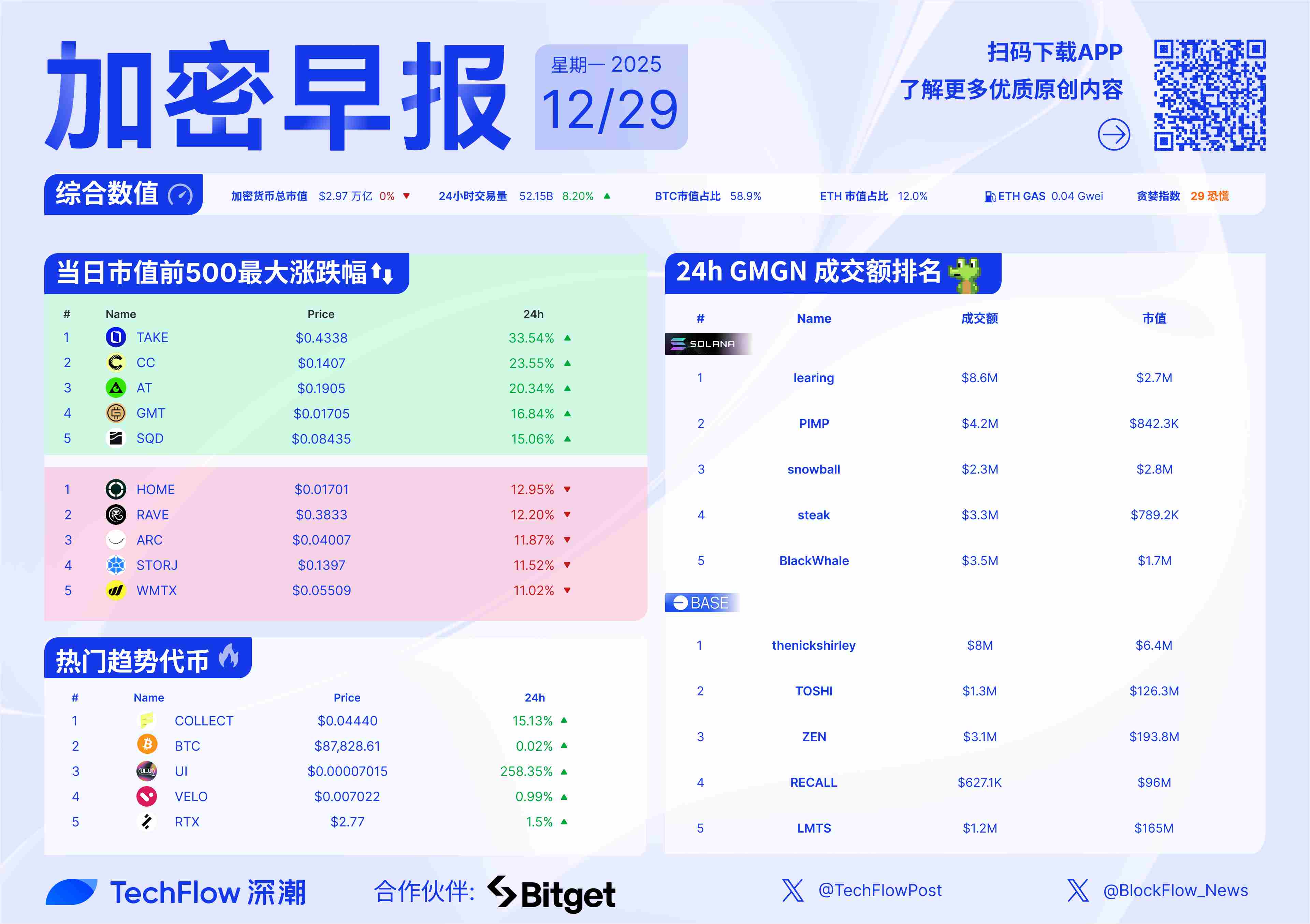
Recommended Reading

Conversation with Xie Jiayin: I Have Ambition, Bitget Also Has Ambition

This article, through an interview with Bitget exchange's Chinese language负责人 (responsible person) Xie Jiayin, explores in detail his career experience in the cryptocurrency industry, leadership philosophy, Bitget's development history, and future strategic planning. The article also covers the current state and future trends of the crypto market.

Web3 Recruitment & Job Hunting 2025 Year-End Review: Who's Making Money, Who's Paying to Work?

This article provides a comprehensive review and analysis of the Web3 industry's recruitment and job market in 2025, revealing the industry's current state, hiring trends, salary distribution, and the real experiences of practitioners. It delves into the opportunities and challenges of the Web3 industry while uncovering the difficulties and hopes faced by practitioners.

2025 Crypto Industry Workplace Survey: 70% Earn Less Than $4K Monthly, N+1 Severance a Luxury

This article, through a questionnaire survey in the crypto industry workplace, reveals the real situation of Web3 practitioners regarding income, work environment, career choices, etc., analyzes the current state of the industry and future development trends, lists popular and unpopular crypto companies, and explores hot careers in the crypto industry.

IOSG Founder: 2025 Was a Dark Year for the Crypto Market, So What About 2026?

This article discusses how 2025 was called a "dark year" for the crypto market, but it was actually a transition period from retail-driven to institution-driven dominance. Although crypto asset prices performed poorly, institutional investor participation increased significantly, and the market structure underwent fundamental changes. Meanwhile, policy environment support for the crypto market is also strengthening, laying the foundation for future growth.

SEC 2026 New Rules Detailed: Farewell to "Regulation by Enforcement", New Compliance Paradigm for Stablecoin Payments

This article analyzes the U.S. Securities and Exchange Commission (SEC)'s announcement to end the "regulation by enforcement" era for the crypto industry starting January 2026 and shift to a "compliance sandbox" model. The SEC introduced an "innovation exemption" policy, providing a 12 to 24-month compliance buffer period for eligible entities and simplifying information submission processes. The SEC's new rules mark the crypto industry's entry into an "embedded compliance" phase, where the integration of technology and compliance will be key to future survival.


Domande pertinenti

QWhat was the amount of assets stolen in the Flow protocol attack and how did the attacker move the funds?

AApproximately $3.9 million in assets were stolen. The attacker moved the funds primarily through cross-chain bridges like Celer, Debridge, Relay, and Stargate. Their wallet has been identified and marked, and their money laundering activities through Thorchain and Chainflip are being tracked in real-time.

QWhich tokens are scheduled for significant unlocks this week according to the article?

AThe tokens scheduled for significant unlocks this week are HYPE, SUI, EIGEN, KMNO, OP, ENA, SVL, and ZORA.

QWhat major action did Uniswap take regarding its treasury and UNI tokens?

AUniswap burned 100 million UNI tokens, worth $596 million, from its treasury. This action was taken after a fee burn proposal was passed, and future fees collected by Uniswap will also be used to burn UNI.

QWhat is the new regulatory approach the SEC is adopting for the crypto industry starting in 2026?

AThe SEC is ending the 'regulation by enforcement' era and moving to a 'compliance sandbox' model. It is introducing an 'Innovation Exemption' policy that offers a 12 to 24-month compliance buffer for qualified entities and simplifies the information submission process, marking an entry into an 'embedded compliance' phase.

QWhen is the former Alameda CEO Caroline Ellison scheduled to be released and why is it earlier than her original sentence?

ACaroline Ellison is scheduled to be released from federal supervision on January 21, 2026. She is being released approximately 10 months early due to good behavior and her cooperation in the investigation into the collapse of FTX.

Letture associate

The Shutdown of Claude Mythos Revealed the True Cost of Renting AI to Me

The sudden shutdown of Claude Mythos this week starkly highlights a critical, often overlooked risk for founders: when your core capability relies entirely on someone else's platform, your fate is not in your own hands. The key question becomes: who truly owns the intelligence your product depends on? For years, the debate around open-source models focused on cost. Now, the evidence is clear: fine-tuned open-source models can achieve frontier-level quality for specific, mission-critical tasks at a fraction of the cost. However, the deeper issue is control. Relying on a third-party API is like renting; it works until the landlord changes the rules, raises the rent, or asks you to leave—as Mythos experienced. The lesson is not to stop using frontier models—they are incredible infrastructure. The goal is ownership. Ownership means starting with a powerful open-source model and shaping it around what makes your company unique: your data, workflows, domain expertise, and definition of "good." Over time, the model becomes less generic and more reflective of your business, creating durable value. The optimistic conclusion is that AI's future doesn't hinge on one superior model. There is no single frontier. The frontier includes proprietary models, models fine-tuned on company-specific knowledge, specialized models for narrow problems, and intelligent routers orchestrating model ensembles. The most interesting development is not models getting smarter, but intelligence becoming increasingly customizable. The winning companies will be those that transform intelligence into a unique, owned asset. Looking ahead, the vision is not one model dominating all, but many teams owning the part of the frontier that matters most to them.

marsbit5 min fa

The Shutdown of Claude Mythos Revealed the True Cost of Renting AI to Me

marsbit5 min fa

Tiger Research: U.S. Strategic Bitcoin Reserve - Should the Market Be Happy or Disappointed?

Tiger Research analyzes the evolution of U.S. legislative efforts regarding a strategic Bitcoin reserve, concluding the market impact is limited in the short term but potentially positive long-term. The core event was a March 2025 executive order by former President Trump, which designated confiscated Bitcoin as a strategic reserve and promised not to sell existing holdings (approx. 190k BTC). As it contained no mandate to purchase new Bitcoin, the market reacted negatively, with prices dropping 5.7%. Legislative history shows a significant retreat from initial ambitions. The 2024 "BITCOIN Act" proposed mandatory purchases of 1 million BTC over five years. Reintroduced in 2025, it stalled due to high fiscal costs, concerns over dollar hegemony, and opposition from the Treasury Secretary. The current frontrunner, the 2026 "American Retirement and Monetary Advancement (ARMA) Act," is a compromise. It lacks any purchase requirement, instead focusing on consolidating existing government-held Bitcoin and legally prohibiting its sale for at least 20 years. While ARMA has higher passage odds due to bipartisan support and no purchase mandate, its immediate market effect is neutral. It eliminates potential government selling pressure but creates no new demand. The long-term significance is that formally establishing Bitcoin as a national reserve asset in law could later reignite debates on mandatory purchases. Therefore, the path to a government buyer is longer than initially priced by the market, but the directional narrative remains intact.

marsbit7 min fa

Tiger Research: U.S. Strategic Bitcoin Reserve - Should the Market Be Happy or Disappointed?

marsbit7 min fa

US Stock Market Trend (June 16): SpaceX Rises 42% in Two Days, New Fed Chairman Takes Office Today

**U.S. Stocks Trend (June 16): SpaceX Soars 42% in Two Days, New Fed Chair Takes Office Today** Markets surged on Monday following former President Trump's social media announcement of a completed U.S.-Iran deal to reopen the Strait of Hormuz, pending a June 19 signing. The news triggered a broad risk-on rally: oil prices crashed, tech stocks soared, bond yields fell, and defensive sectors lagged. **Market Performance:** The Nasdaq jumped 3.07%, led by semiconductor stocks like Micron (+9.2%). The S&P 500 gained 1.65%, and the Dow rose 0.92% to a record high. However, the Russell 2000 small-cap index underperformed (+0.72%). SpaceX continued its hot streak, rising another 5% pre-market after disclosures of large buys by an Australian billionaire and Cathie Wood's ARK. Boeing also rallied on the transportation optimism. Conversely, energy stocks like Chevron fell over 3% on the oil price plunge, with other defensive sectors also selling off. The day's action showed a clear rotation of funds from energy/defensive plays into AI and tech narratives. **Macro & Outlook:** The VIX fear index fell 8.37%. Treasury yields declined, and WTI crude dropped over 5%. Attention now shifts to a packed schedule: the Bank of Japan is widely expected to hike rates to 1.0% on Tuesday. The Fed's June meeting concludes Wednesday, marking new Chair Wash's debut. While rates are expected to hold, his tone on stubborn inflation and the "dot plot" will be crucial for gauging the 2024 rate path. The formal Iran deal signing is set for Friday. **Trend Perspective:** While the peace deal is a genuine positive, Monday's explosive rally may have gotten ahead of itself, pricing in a swift resolution to inflation concerns. The shortened trading week faces a triple test: BoJ tightening, the Fed's policy stance, and deal implementation details. Tech and semiconductors, which led the surge, remain vulnerable to any disappointment from these key events. The real price discovery begins with the central banks' communications this week.

marsbit29 min fa

US Stock Market Trend (June 16): SpaceX Rises 42% in Two Days, New Fed Chairman Takes Office Today

marsbit29 min fa

Xiaohongshu's Second Great Voyage, This Time Sailing Towards AI

Xiaohongshu's Second Voyage: Navigating Towards AI Since ChatGPT's emergence, Xiaohongshu's founder Mao Wenchao has been acutely aware of AI's potential threat, recognizing that the life advice people seek from chatbots overlaps directly with his platform's core business. Founded in 2013 as a PDF shopping guide for Chinese tourists, Xiaohongshu evolved into a massive community where millions share authentic, personal experiences—from product reviews to travel tips. This vast repository of "I've tried this" human judgment became its most valuable asset. However, the rise of AI, which delivers instant answers, challenges the very need for users to sift through numerous personal notes. Fearing its treasure trove of lived experience could become mere training data for others, Xiaohongshu is proactively adapting. In 2026, it established a dedicated AI division (Dots), launched RED Skill to turn user experiences into usable AI tools, and acquired the AI search product "Diandian." Its investments now extend to AI firms like MiniMax and hardware startups, moving upstream to address needs before they even become search queries. The platform's commercialization strategy is also evolving. With a newly acquired payment license and tools like the AIPS model to track consumer decision journeys, Xiaohongshu aims to seamlessly integrate recommendations with transactions, embedding commerce within AI-generated answers. Yet, a critical tension remains. While building smarter machines to organize and leverage its human experiences, Xiaohongshu must prevent AI from drowning out the authentic, flawed, and trustworthy "I've tried this" voices that built its community. Its core challenge is to harness AI's power without letting the map—the machine's perfect, synthesized answer—replace the territory of genuine human experience. This balance between technological advancement and preserving human trust defines its current journey and its future.

marsbit1 h fa

Xiaohongshu's Second Great Voyage, This Time Sailing Towards AI

marsbit1 h fa

Trading

Spot
Futures

Articoli Popolari

Come comprare FLOW

Benvenuto in HTX.com! Abbiamo reso l'acquisto di Flow (FLOW) semplice e conveniente. Segui la nostra guida passo passo per intraprendere il tuo viaggio nel mondo delle criptovalute.Step 1: Crea il tuo Account HTXUsa la tua email o numero di telefono per registrarti il tuo account gratuito su HTX. Vivi un'esperienza facile e sblocca tutte le funzionalità,Crea il mio accountStep 2: Vai in Acquista crypto e seleziona il tuo metodo di pagamentoCarta di credito/debito: utilizza la tua Visa o Mastercard per acquistare immediatamente FlowFLOW.Bilancio: Usa i fondi dal bilancio del tuo account HTX per fare trading senza problemi.Terze parti: abbiamo aggiunto metodi di pagamento molto utilizzati come Google Pay e Apple Pay per maggiore comodità.P2P: Fai trading direttamente con altri utenti HTX.Over-the-Counter (OTC): Offriamo servizi su misura e tassi di cambio competitivi per i trader.Step 3: Conserva Flow (FLOW)Dopo aver acquistato Flow (FLOW), conserva nel tuo account HTX. In alternativa, puoi inviare tramite trasferimento blockchain o scambiare per altre criptovalute.Step 4: Scambia Flow (FLOW)Scambia facilmente Flow (FLOW) nel mercato spot di HTX. Accedi al tuo account, seleziona la tua coppia di trading, esegui le tue operazioni e monitora in tempo reale. Offriamo un'esperienza user-friendly sia per chi ha appena iniziato che per i trader più esperti.

185 Totale visualizzazioniPubblicato il 2024.12.10Aggiornato il 2026.06.02

Come comprare FLOW

Discussioni

Benvenuto nella Community HTX. Qui puoi rimanere informato sugli ultimi sviluppi della piattaforma e accedere ad approfondimenti esperti sul mercato. Le opinioni degli utenti sul prezzo di FLOW FLOW sono presentate come di seguito.

活动图片