Crypto Morning Brief: Brevis Opens Airdrop Check, Trend Research Accumulates Over 46,000 ETH in a Single Day

marsbitPubblicato 2025-12-30Pubblicato ultima volta 2025-12-30

Introduzione

The SEC's corporate finance deputy director Cicely LaMothe, who led key crypto policies, has retired. Democratic Congresswoman Maxine Waters criticized SEC Chair Atkins for ending enforcement actions against crypto firms and demanded a hearing. Brevis opened its airdrop registration portal. SlowMist warned of a new NPM supply chain attack variant. Flow Foundation proposed a no-rollback recovery plan after a $3.9M exploit, while Trust Wallet confirmed 2,596 addresses were affected in a recent incident. Standard Chartered and Ant International launched a blockchain-based deposit solution in Hong Kong. Cantor Fitzgerald predicted a potential "crypto winter" by 2026 but expects continued institutional adoption. Trend Research accumulated over 46,000 ETH in a single day, and MicroStrategy added 1,229 BTC. Eightco Holdings announced a $125M stock buyback plan.

Author: Deep Tide TechFlow

Yesterday's Market Dynamics

SEC Corporate Finance Deputy Director Cicely LaMothe Announces Retirement, Led Multiple Cryptocurrency Policies

According to The Block, the U.S. Securities and Exchange Commission (SEC) announced on Monday that Deputy Director of Corporate Finance Cicely LaMothe is set to retire. LaMothe led several key cryptocurrency policies over the past year, including clarifying that meme coins are not securities and explaining the SEC's stance on staking. She joined the SEC's Division of Corporate Finance in 2002, having previously worked in the private sector and holding a CPA license. LaMothe's retirement comes as the SEC enters its second year of a more crypto-friendly direction, during which it has approved listing standards for specific crypto ETFs, initiated a "crypto project" to update digital asset rules, and dismissed enforcement cases against several prominent crypto companies. The SEC also announced that Nekia Hackworth Jones, Deputy Director of the Southeast Region in the Enforcement Division, completed her term at the end of December.

Democratic Congresswoman Waters Criticizes SEC Chairman Atkins for Terminating Cryptocurrency Enforcement Actions, Demands Hearing

According to CoinDesk, House Financial Services Committee Ranking Member Maxine Waters sent a letter to Committee Chairman French Hill on Monday, demanding that SEC Chairman Paul Atkins appear at a hearing regarding the termination of major enforcement actions against crypto companies like Coinbase, Binance, and Justin Sun. Waters questioned the SEC's rationale for dropping these cases and how it plans to prevent market fraud, noting that some companies announced the termination news before a formal committee vote. She also criticized Atkins for using the SEC agenda as a government tool, implementing policy shifts through staff statements rather than formal rulemaking.

Brevis Launches Airdrop Registration and Eligibility Check Portal

The ZK verifiable computing platform Brevis has launched an airdrop registration and eligibility check portal. Users must first check if they are eligible and complete all necessary steps before applying. The application window will be open from December 29 to January 3. The allocation amount will be announced when claiming opens in the future.

SlowMist: New Variant of NPM Supply Chain Attack, Shai-Hulud 3.0, Reappears

SlowMist Chief Information Security Officer 23pds issued a security alert stating that the latest variant of the NPM supply chain attack, Shai-Hulud 3.0, has reappeared, reminding all projects and platforms to strengthen their defenses. The previous Trust Wallet API key leak might have been a result of the Shai-Hulud 2.0 attack.

Flow Foundation: Releases No-Rollback Recovery Plan, Over 99.9% of Accounts Unaffected

The Flow Foundation has proposed a new recovery plan for the security incident that occurred on December 27. Developed in consultation with bridge operators, exchanges, and infrastructure partners, the plan's main features are:

  • No Network Rollback: No network reorganization or requirement for partners to replay transactions

  • Preserves Legitimate User Activity: Over 99.9% of accounts are unaffected and will function normally after restart

  • Precise Fixing: Temporary restrictions applied only to accounts that received fraudulent tokens

  • Transparent Handling: Fraudulent tokens to be burned via on-chain transactions verified by an independent blockchain forensics company for transparency and auditability

The recovery plan will be implemented in four phases:

  1. Cadence Environment Recovery Online, EVM Temporarily Read-Only

  2. Cadence Environment Repair Completed (approx. 24-48 hours)

  3. EVM Environment Repaired and Re-enabled

  4. Bridges/Exchanges Resume Operations After Verifying Network Stability

The attack resulted in the transfer of approximately $3.9 million in assets. The Flow Foundation is currently working closely with validators and the community to ensure a secure network recovery.

Trust Wallet CEO: Security Incident Confirmed to Affect 2,596 Addresses, Reimbursement Verification Ongoing

Trust Wallet CEO Eowync.eth provided an update on December 29th, stating the company is actively investigating the browser extension v2.68 security incident. 2,596 wallet addresses have been confirmed affected so far, and the team has received about 5,000 reimbursement claims. The company is carefully verifying each claim to distinguish genuine victims from malicious actors and promises to share more investigation details tomorrow. This incident and the subsequent reimbursement work have become the company's top priority, with all team members working full-time on it.

Standard Chartered Bank and Ant International Launch Blockchain-Based Tokenized Deposit Solution in Hong Kong

Standard Chartered Bank (Hong Kong) Ltd. (SCBHK) and Ant International have officially commercially launched a blockchain-based tokenized deposit solution, enabling real-time, 24/7 fund transfers in HKD, offshore RMB, and USD. The system, via Ant International's proprietary Whale platform, provides global enterprises with "just-in-time" liquidity management, overcoming traditional banking time constraints and settlement delays.

Investment Bank Cantor Fitzgerald Predicts New "Crypto Winter" in 2026, But Institutional Adoption Continues to Grow

According to CoinDesk, Cantor Fitzgerald analyst Brett Knoblauch predicted in a recent report that Bitcoin may be entering a long-term downtrend, reflecting its historical four-year cycle pattern, with prices potentially testing MicroStrategy's average cost basis of around $75,000. However, unlike the past, this "crypto winter" will not see massive liquidations or structural collapses but will be characterized by institutional investors driving market trends.

Trend Research Withdraws Another 13,462 ETH, Accumulates Over 46,000 ETH in a Single Day

According to on-chain analyst Ai Yi (@ai_9684xtpa) monitoring, Trend Research withdrew another 13,462 ETH (worth approximately $39.31 million) from Binance 5 minutes ago.

The institution's on-chain ETH holdings have now been updated to 626,071, with a total value exceeding $1.83 billion and an average holding cost of approximately $3,105.5. The institution currently has an unrealized loss of about $110 million. Data shows that Trend Research accumulated 46,036.72 ETH within a single day.

MicroStrategy Increases Holdings by 1,229 Bitcoin Last Week, Now Holds Total of 672,497 Bitcoin

According to a tweet by MicroStrategy founder and Executive Chairman Michael Saylor, MicroStrategy has purchased an additional 1,229 bitcoin for approximately $108.8 million in cash, at an average price of approximately $88,568 per bitcoin. As of December 28, 2025, MicroStrategy holds 672,497 bitcoin acquired for approximately $50.44 billion at an average purchase price of $74,997 per bitcoin. MicroStrategy's bitcoin investment has generated a return of 23.2% year-to-date in 2025.

WLD Treasury Company Eightco Holdings Launches $125 Million Stock Buyback Plan

According to PRNewswire, Nasdaq-listed WLD treasury company Eightco Holdings announced that its board of directors has approved the initiation of a stock repurchase program of up to $125 million. The company also stated it will drive the construction of a universal digital identity and authentication framework through strategic investments and partnerships to address the evolving identity verification market challenges posed by large-scale AI applications.

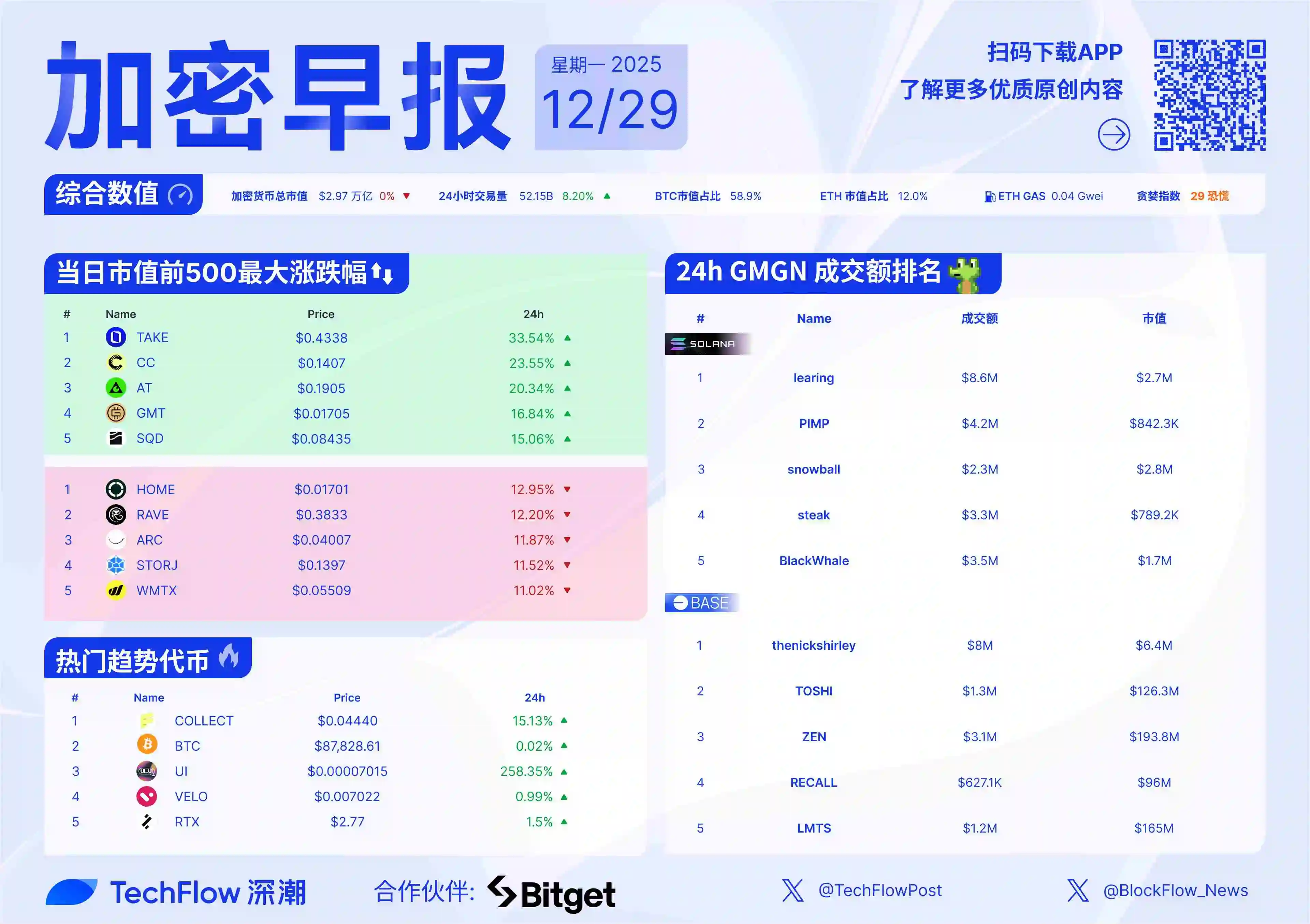
Market Trends
Recommended Reading

2025 Global Trading Guide: 11 Key Trades at the Intersection of Politics and Markets

This article provides a comprehensive analysis of key trades and trends in the global financial markets for 2025, covering investment dynamics and their political and economic backgrounds across various fields including cryptocurrency, artificial intelligence, defense stocks, gold, and bond markets.

In Today's Web3 Narrative, Everyone Loves Contrast

This article explores the importance of introducing "contrast" in Web3 narratives, emphasizing that contrast and transformation make content more engaging and resonant. The article points out that content lacking contrast often appears bland, while contrast can spark reader interest, create memorable points, and even make content more authentic and credible. Showcasing genuine transformation and emotional resonance can make content stand out.

Silver Soars: 25% Surge in 10 Days, Buy Now or Take Profits?

This article analyzes the volatility in the silver market and the driving factors behind it. It mentions reasons for the recent sharp rise in silver prices, including China's implementation of a licensing system for silver exports, increased demand for silver from the solar industry, the impact of a stronger US dollar on precious metal prices, and margin hikes in the futures market. Additionally, the article discusses the supply and demand fundamentals of the silver market, the feasibility and timeline of copper substitution, and the current state of market speculation. Finally, it offers short-term and long-term market investment advice and reminds investors to pay attention to relevant market signals.

Deciphering Messari's 100,000-Word Annual Report (Part 2): ETH Underperforms BTC, Marginalization or Pricing Dilemma?

This article analyzes Ethereum's (ETH) market performance during 2024-2025 and explores the reasons for its underperformance compared to Bitcoin (BTC). Based on Messari's annual report, it delves into ETH's value capture dilemma, the impact of multi-chain competition, and the relationship between ETH and BTC. Although ETH dominates in on-chain finance, stablecoins, and institutional settlement, its pricing logic as an asset has become more complex, and the market's perception of its value is not yet fully independent of BTC.

Crypto Payments 2049 | Can Stablecoins Cross the Chasm?

This article discusses the possibility of stablecoins moving from the crypto market to the real economy, analyzing the challenges and breakthroughs regarding institutional gaps. Using the theoretical framework of "Crossing the Chasm," it explores the gaps between stablecoins and public monetary arrangements in terms of equivalence, elasticity, and integrity. Through case studies, it analyzes regulatory paths in the EU, US, and Hong Kong, further proposing the possibility of stablecoins achieving localized breakthroughs in specific scenarios and their structural impact on the financial system.


Domande pertinenti

QWhat key SEC official recently retired, and what was their role in cryptocurrency policy?

ASEC Corporate Finance Deputy Director Cicely LaMothe recently retired. She led several key cryptocurrency policies, including clarifying that meme coins are not securities and explaining the SEC's stance on staking.

QWhat is the ZK verifiable computing platform Brevis currently offering to users?

ABrevis has launched an airdrop registration and eligibility query portal. Users can check if they are eligible and complete the necessary steps to apply. The application window is open from December 29th to January 3rd.

QHow much ETH did Trend Research accumulate in a single day according to the report?

ATrend Research accumulated over 46,000 ETH in a single day. A specific transaction involved withdrawing 13,462 ETH from Binance, bringing their total holdings to 626,071 ETH.

QWhat was the nature of the security incident affecting the Flow network, and what is the proposed solution?

AThe Flow network experienced a security breach that resulted in approximately $3.9 million in assets being transferred. The proposed recovery solution does not require a network rollback, preserves legitimate user activity (over 99.9% of accounts are unaffected), and involves a phased plan to repair the Cadence and EVM environments.

QWhat prediction did Cantor Fitzgerald analysts make about the cryptocurrency market cycle for 2026?

ACantor Fitzgerald analysts predicted that 2026 will usher in a new 'crypto winter,' a prolonged downturn cycle for Bitcoin reflecting its historical four-year pattern. However, unlike past cycles, this one is expected to be characterized by institutional investor dominance rather than massive liquidations or structural collapses.

Letture associate

Will the Next Crypto Bull Run Start with On-Chain Trading of SpaceX?

This article presents a scenario-based forecast for the crypto industry from 2026 to 2029, arguing that the next major cycle will be driven not by technological narratives but by legal access to real-world assets. The author predicts that by mid-2026, pre-IPO perpetual contracts for top private companies like SpaceX, OpenAI, and Anthropic on platforms like Hyperliquid will become the primary gateway for accessing quality assets, as most crypto-native tokens fail to capture real value. The much-hyped AI x Crypto intersection largely fails except for prediction markets, which thrive on betting on AI model supremacy. By 2027, public blockchain foundations are forced to choose between catering to retail speculation or building compliant infrastructure for institutions, with many opting for the latter. Growth in stablecoins and tokenized private credit/equity hits a "triple ceiling" due to regulatory and political uncertainty rather than market demand. The pivotal shift is forecast for 2028. A major liquidation event in pre-IPO perpetuals exposes the structural flaw of synthetic markets lacking a real underlying asset anchor. In response, regulatory changes finally allow the public solicitation of private securities resales to verified accredited investors. This creates a legitimate secondary market for real company equity, which then becomes the core asset class of the new bull market, relegating synthetic perps to a niche role. By 2029, the industry becomes "boring" but foundational. Tokens without claims on real cash flows or assets cease trading. Stablecoin growth is steady but politically capped. Crypto infrastructure fades from view as it gets absorbed into traditional finance backends. The article's central thesis is that the key bottleneck for crypto's next phase is legal and regulatory channels for real asset ownership, not technology.

marsbit1 h fa

Will the Next Crypto Bull Run Start with On-Chain Trading of SpaceX?

marsbit1 h fa

The Value Distribution of Stablecoins

**Summary: The Value Distribution of Stablecoins** The article argues that stablecoins are evolving from mere trading tools into broader channels for dollar access. It divides the stablecoin ecosystem into four layers to analyze how value is distributed: 1. **Issuance Layer:** Mints stablecoins, holds reserve assets, and captures the spread between reserve yield and user costs (e.g., Tether, Circle). This layer currently earns the largest profit margin. 2. **Infrastructure Layer:** Connects stablecoins to the traditional financial system, handling fiat on/off-ramps, banking integration, compliance (KYC/AML), and asset management (e.g., Bridge, BVNK). This is the "unglamorous" but critical work, building the essential bridges between crypto and real-world finance. 3. **Acquiring/Distribution Layer:** Integrates stablecoins into merchant systems, manages payment flows, and provides enterprise financial software (e.g., Stripe, Coinbase). They act as the access point for businesses. 4. **Application Layer:** The end-users and businesses that ultimately use stablecoins for payments, settlements, or as a store of value. They benefit from convenience but have little pricing power. The core thesis is that while the issuance layer currently dominates profits, the often-overlooked **infrastructure layer holds significant long-term potential**. The real challenge and barrier to mass adoption is not the on-chain transfer of stablecoins (which is simple), but the complex "last mile" integration into existing business workflows, banking systems, and regulatory frameworks across different countries. Companies in this layer are currently in a "land grab" phase, investing heavily to build networks, secure bank partnerships, and establish compliance pathways. While their position is currently pressured by the profitable issuers above and distribution platforms below, the article suggests that if stablecoins become a default financial rail for businesses, the infrastructure providers who have done the hard work of integration will ultimately gain strong pricing power and become entrenched, essential players.

marsbit8 h fa

The Value Distribution of Stablecoins

marsbit8 h fa

The Value Distribution of Stablecoins

The Value Distribution of Stablecoins The article argues that stablecoins are evolving from a mere trading tool into a broad "dollar channel." It analyzes the industry's value chain through four layers: 1. **Issuance Layer (e.g., Tether, Circle):** The top layer that mints stablecoins, holds reserve assets, and captures the thickest interest rate spread. 2. **Infrastructure Layer (e.g., Bridge, BVNK):** Connects stablecoins to the traditional financial system, handling critical but complex "dirty work" like fiat on/off-ramps, banking integration, compliance (KYC/AML), and cross-border settlement. 3. **Acquiring/Distribution Layer (e.g., Stripe, Coinbase):** Embeds stablecoins into merchant systems, manages payment flows, and integrates with enterprise software. 4. **Application Layer:** End-users and businesses that ultimately use stablecoins for payments, settlement, or storing value. The author posits that while the issuance layer currently captures the most profit, the most overlooked and potentially critical layer is infrastructure. The core challenge for stablecoin adoption isn't the on-chain transfer (which is simple), but bridging the gap between blockchain and the real-world financial system. This involves solving practical problems for businesses: fiat conversion, reconciliation, tax handling, and user onboarding. Infrastructure companies are currently in a difficult "land-grab" phase—building networks, securing banking relationships, and achieving compliance country-by-country. They face pressure from both the profitable issuance layer above and distribution platforms below. However, the author suggests this layer is building a crucial moat. Once stablecoins become a default business rail, the infrastructure players who have done the hard work of integration may gain significant, durable value and pricing power.

链捕手8 h fa

The Value Distribution of Stablecoins

链捕手8 h fa

Trading

Spot
Futures

Articoli Popolari

Cosa è ATWO

I. Introduzione al ProgettoArena Two è una piattaforma interattiva decentralizzata che consente ai fan di svolgere un ruolo attivo e tokenizzato nei risultati degli eventi in tempo reale. A differenza dei modelli di trasmissione tradizionali che riducono i fan a spettatori passivi, Arena Two sfrutta la tecnologia blockchain per consentire ai fan di votare direttamente in tempo reale e influenzare i risultati sul campo.II. Informazioni sul TokenNome del token: ATWO(Arena Two)III. Link CorrelatiSito web:https://arenatwo.com/Esploratori:https://basescan.org/token/0x499D35eBE6cEe9B2Ac35Fd003fcBbeeB9CFc7B32Twitter:https://x.com/arenatwoXNota: L'introduzione al progetto proviene dai materiali pubblicati o forniti dal team ufficiale del progetto, che è solo a scopo di riferimento e non costituisce consulenza sugli investimenti. HTX non si assume responsabilità per eventuali perdite dirette o indirette derivanti.

214 Totale visualizzazioniPubblicato il 2026.05.18Aggiornato il 2026.06.02

Cosa è ATWO

Come comprare ATWO

Benvenuto in HTX.com! Abbiamo reso l'acquisto di Arena Two (ATWO) semplice e conveniente. Segui la nostra guida passo passo per intraprendere il tuo viaggio nel mondo delle criptovalute.Step 1: Crea il tuo Account HTXUsa la tua email o numero di telefono per registrarti il tuo account gratuito su HTX. Vivi un'esperienza facile e sblocca tutte le funzionalità,Crea il mio accountStep 2: Vai in Acquista crypto e seleziona il tuo metodo di pagamentoCarta di credito/debito: utilizza la tua Visa o Mastercard per acquistare immediatamente Arena TwoATWO.Bilancio: Usa i fondi dal bilancio del tuo account HTX per fare trading senza problemi.Terze parti: abbiamo aggiunto metodi di pagamento molto utilizzati come Google Pay e Apple Pay per maggiore comodità.P2P: Fai trading direttamente con altri utenti HTX.Over-the-Counter (OTC): Offriamo servizi su misura e tassi di cambio competitivi per i trader.Step 3: Conserva Arena Two (ATWO)Dopo aver acquistato Arena Two (ATWO), conserva nel tuo account HTX. In alternativa, puoi inviare tramite trasferimento blockchain o scambiare per altre criptovalute.Step 4: Scambia Arena Two (ATWO)Scambia facilmente Arena Two (ATWO) nel mercato spot di HTX. Accedi al tuo account, seleziona la tua coppia di trading, esegui le tue operazioni e monitora in tempo reale. Offriamo un'esperienza user-friendly sia per chi ha appena iniziato che per i trader più esperti.

121 Totale visualizzazioniPubblicato il 2026.05.18Aggiornato il 2026.06.02

Come comprare ATWO

Cosa è ZEST

I. Introduzione al Progetto1. Cos'è Zest Protocol?Zest Protocol è un protocollo di prestito nativo di Bitcoin costruito su Stacks Layer 2 che consente agli utenti di guadagnare rendimento con BTC o di prendere in prestito asset collaterizzando BTC. I contratti intelligenti del protocollo sono scritti nel linguaggio Clarity, operano interamente on-chain e sono open-source, con un design ispirato a Aave v3. Zest è attualmente il più grande protocollo DeFi su Stacks, con oltre 800 BTC depositati e un TVL massimo che supera i 100 milioni di dollari. Nel maggio 2026, il protocollo ha ulteriormente introdotto i Bitcoin Collateral Vaults, estendendo le capacità di prestito da Stacks alla rete principale di Bitcoin. Questo consente agli utenti di prendere in prestito stablecoin senza spostare BTC dalla rete Bitcoin, abilitando prestiti in custodia autonoma.2. Come Funziona Zest Protocol?Zest Protocol è composto da due mercati. Il mercato di Stacks è costruito su Aave v3, consentendo agli utenti di depositare asset come sBTC, STX e USDC per guadagnare rendimento o prendere prestiti sovra-collaterizzati. Il LTV massimo predefinito è del 50% (70% per sBTC). Il mercato di Bitcoin opera attraverso i recentemente lanciati Bitcoin Collateral Vaults. Gli utenti prendono in prestito stablecoin bloccando BTC in vaults di custodia autonoma sulla catena di Bitcoin. Il collaterale rimane sulla rete principale di Bitcoin durante l'intero processo, e gli utenti mantengono la custodia a meno che la posizione non venga liquidata.3. Chi Ha Fondato Zest Protocol?Tycho Onnasch (Co-Fondatore): Laureato all'Università di Oxford. Coinvolto nella ricerca e nei finanziamenti per la Stacks Open Internet Foundation. Ex Manager presso Trust Machines e Fondatore di Deedmob. Profilo LinkedIn: https://www.linkedin.com/in/tychokoonnasch/.Fernando Foy (Co-Fondatore): Ha precedentemente lavorato nella consulenza IT presso Objectif Emploi. Profilo LinkedIn: https://www.linkedin.com/in/fernando-foy/.Emil E. (Co-Fondatore): Ha un Master in Fisica dall'Università di Warwick. Ex Partner Ingegneristico presso Trust Machines, Sviluppatore Full-Stack per progetti Web3 e Data Scientist presso HSBC. Profilo LinkedIn: https://www.linkedin.com/in/emil-e-49771a145/.Dettagli sul Finanziamento: Nel maggio 2024, Zest Protocol ha annunciato il completamento di un round di finanziamento seed da 3,5 milioni di dollari guidato da Tim Draper, con la partecipazione di Binance Labs, Flow Traders, Trust Machines e altri.4. Tokenomics di $ZEST$ZEST è il token nativo di Zest Protocol con un'offerta totale fissa di 1 miliardo di token e senza meccanismo inflazionistico.Comunità (27,83%): Utilizzato per airdrop e incentivi per gli utenti;Sviluppo dell'Ecosistema (24,82%): Utilizzato per liquidità, partnership, marketing, listing su exchange, ecc.;Investitori (22,35%): Sostegno alle parti investitrici che hanno supportato lo sviluppo iniziale di Zest Protocol;Team (25%): Allocato per i contributori principali.Piano di Vesting: I token del Team e degli Investitori sono soggetti a un periodo di lock-up di 1 anno seguito da 3 anni di sblocco lineare.5. Cronologia delle Pietre Miliari Chiave2022: Zest Protocol è ufficialmente fondato.Marzo 2024: Completato l'audit di sicurezza e lanciato il mercato di prestiti di Stacks sulla mainnet.Nel febbraio 2026, viene lanciato il Mercato Stacks V2, introducendo i Gruppi di Rischio.Nel maggio 2026, sono stati introdotti i Bitcoin Collateral Vaults e un prototipo operativo della mainnet è ora disponibile. Questo consente agli utenti di utilizzare BTC in custodia autonoma sulla L1 di Bitcoin come collaterale per prendere in prestito stablecoin su catene EVM, ponendo fine a bridging, wrapping e custodia di terze parti. Questo rollout è diviso in due fasi. Fase 1: Utilizza transazioni pre-firmate per limitare il movimento di BTC; Fase 2: Utilizza BitVM per la verifica. II. Informazioni sul TokenNome del token: ZEST (Zest Protocol)III. Link CorrelatiSito web: https://www.zestprotocol.com/Esploratori: https://bscscan.com/token/0x5506599c722389a60580b5213ea1da60d64754a1Twitter: https://twitter.com/ZestProtocolNota: L'introduzione del progetto proviene dai materiali pubblicati o forniti dal team ufficiale del progetto, che è solo a scopo di riferimento e non costituisce consulenza per gli investimenti. HTX non si assume responsabilità per eventuali perdite dirette o indirette risultanti.

114 Totale visualizzazioniPubblicato il 2026.05.19Aggiornato il 2026.06.02

Cosa è ZEST

Discussioni

Benvenuto nella Community HTX. Qui puoi rimanere informato sugli ultimi sviluppi della piattaforma e accedere ad approfondimenti esperti sul mercato. Le opinioni degli utenti sul prezzo di A A sono presentate come di seguito.

活动图片





