Crypto Morning Brief: Backpack Plans to Offer Equity to Stakers, WLFI Claims USD1 Was Attacked

marsbitPubblicato 2026-02-24Pubblicato ultima volta 2026-02-24

Introduzione

Crypto Daily Digest: Key market developments include Backpack's announcement to offer equity to token stakers, allocating 20% of company shares for this program. WLFI reported an attack on its USD1 stablecoin, claiming attackers targeted co-founder accounts to spread FUD and short the token, but the stablecoin held its peg due to its 1:1 asset backing. In policy news, the Trump administration is considering new national security tariffs on six industries, including batteries and telecom equipment. Tether will discontinue its offshore yuan stablecoin (CNH₮) due to low demand. Meanwhile, China’s regulatory approach now distinguishes RWA tokens from virtual currencies, allowing conditional overseas issuance. Ethereum Foundation established a dedicated DeFi team to support permissionless and censorship-resistant protocols. Meme coin TRUMP unveiled a growth plan involving up to 5% of its supply for ecosystem expansion. Bitcoin miner Bitdeer clarified its BTC sales are for liquidity preparation amid land acquisition plans. Other highlights: SBI Holdings launched a $64.5M blockchain bond offering XRP rewards, and private credit firm Blue Owl Capital sold $1.4B in loan assets, sparking concerns about market stress. Market analysis sections cover AI agent teams, yen carry trade impacts on Bitcoin, and shifting institutional capital from tokens to equity.

Author: Deep Tide TechFlow

Yesterday's Market Dynamics

US Media: Trump Administration Considers New National Security Tariffs on Six Major Industries, Covering Batteries, Pig Iron, and Iron Fittings, etc.

According to the Wall Street Journal, the Trump administration is considering imposing new "national security tariffs" on six industries. Sources familiar with the matter revealed that the scope of the tariffs under consideration may cover large batteries, pig iron and iron fittings, plastic pipes, industrial chemicals, as well as power grid and telecommunications equipment industries. These tariffs will be levied under Section 232 of the Trade Expansion Act of 1962. The new US tariffs on the six major industries will be implemented separately from the new global 15% tariff. It is currently unclear when the investigations, which are the responsibility of the Department of Commerce, will be announced, and when the tariffs will ultimately be imposed. Section 232 requires a lengthy investigation before tariffs can be imposed, but once implemented, the president can modify them unilaterally.

US Trade Representative: US Bilateral Trade Agreements Remain Valid After Supreme Court Tariff Ruling

According to Jinshi, US Trade Representative Greer said on CBS's "Face the Nation" on Sunday that those agreements reached with countries such as the EU and South Korea are still valid. He sought to distinguish these agreements from the 15% global tariff that Trump announced plans to implement on Saturday. Greer said: "We want them to understand that these deals will be successful deals. We will fully support these deals. We also expect our partners to fully support these deals." He also stated that other US trade tools, including means to investigate the trade practices of other countries, will provide the US with advantages. He spoke with EU officials this weekend and will also communicate with officials from other major US trading partners to convey a message of reassurance.

WLFI Response: Attacker Hacked WLFI Co-founder's Account to Spread FUD and Heavily Short, But the Attack Was Not Successful

World Liberty Financial officially issued an announcement on social media stating:

"This morning, a coordinated attack was launched against USD1. The attacker hacked the accounts of several WLFI co-founders, hired KOLs to spread panic, and heavily opened short positions on WLFI, attempting to profit from this artificially created chaos.

But this attack was not successful.

Thanks to USD1's robust minting and redemption mechanism and fully 1:1 asset backing, USD1's trading price has remained stable at par value. No fraudster can shake the long-term commitment of the entire WLFI team and co-founders to USD1.

Reminder to users: Please only obtain accurate information through verified official channels."

Meme Coin TRUMP Team Plans to Deploy No More Than 5% of Tokens for Ecosystem Growth Plan

According to official news, the Meme coin TRUMP team announced the next phase of development, focusing on improving market liquidity depth, expanding application scenarios, and promoting long-term value growth through more disciplined capital operations. Based on community feedback, the project will simultaneously advance three initiatives: a revenue and liquidity plan, institutional-grade market structure optimization, and strategic inventory management, to improve trading quality and strengthen the ecosystem.

In terms of liquidity, holders will soon be able to participate in the revenue plan through the Kamino vault, receiving TRUMP and stablecoin rewards. The related incentive scale exceeds $10 million at most to support on-chain liquidity and DEX capital efficiency. At the same time, new professional market makers will strengthen liquidity support in centralized and decentralized markets, improving price discovery capabilities and trading execution stability.

In addition, TRUMP will, according to the public token unlock schedule, strategically use no more than 5% of the unlocked tokens in the coming months for ecological investments, partnerships, and growth plans. This includes an ecological fund of up to $3.5 million, potential acquisitions and partnerships, as well as entertainment and gaming layouts promoted by The TRUMP Game Studio, with the first project being the Web3 game TRUMP Billionaires Club.

Bitdeer Responds to Bitcoin Sale Decision: Preparing Liquidity in Advance for Land Acquisition, Hashrate Growth Plan Unchanged

Bitdeer (BTDR), the bitcoin mining company under Wu Jihan, stated, "The company's decision to sell bitcoin should not cause market-level concerns. This move is aimed at preparing liquidity in advance for several non-binding power land acquisition opportunities currently under evaluation. The company emphasizes that the hashrate will continue to grow, and it will continue to mine for the benefit of shareholders."

Ethereum Foundation Establishes DeFi Team to Support New Protocol Development, Reiterates Belief in "DeFipunk" Philosophy

According to The Block, the Ethereum Foundation is establishing a dedicated decentralized finance (DeFi) department under its Application Relations team to support new protocol development. The Foundation appointed Charles St. Louis, former CEO of DELV and MakerDAO governance architect, as DeFi Protocol Expert, and Ivan (ivangbi), co-founder of Gearbox Protocol, as DeFi Coordinator.

The Ethereum Foundation stated: "We want to see DeFi flourish, but we have a clear view of what it should be: permissionless, censorship-resistant, privacy-first, self-custodial, and open-source." St. Louis added on platform X: "The Ethereum Foundation believes in DeFipunk: not finance that is slightly better than traditional finance, but finance that would not be possible without Ethereum."

The team will support existing DeFi projects while focusing on the development of "tomorrow's DeFi," including innovative directions such as user-controlled artificial intelligence and high-throughput on-chain futures markets.

Backpack Plans to Offer Company Equity to Token Stakers, Company Has Already Reserved 20% of Equity for This Plan

According to Decrypt, the cryptocurrency exchange Backpack plans to allow holders of its upcoming token to obtain company equity through staking. According to a statement by Backpack CEO Armani Ferrante on social media, users can convert their staked tokens into company equity at a fixed ratio after staking for at least one year. The company has already reserved 20% of its equity for this plan.

Ferrante stated that this move aims to improve the existing model, as many projects have failed to deliver on the promise of supporting tokens based purely on utility value. The exchange has not yet announced a token issuance date but has asked users to verify their personal information to determine eligibility for claiming.

Tether Announces Discontinuation of Support for Offshore RMB Stablecoin CNH₮

February 21, according to an official announcement, Tether announced on February 20, 2026, that it will gradually phase out its CNH₮ stablecoin service. Effective immediately, Tether has stopped issuing new CNH₮ tokens and will completely terminate redemption support after one year.

This decision is based on changes in market conditions, low product interest, and limited community demand relative to other assets. Holders of CNH₮ are advised to redeem their assets as soon as possible and must complete the operation before the redemption deadline.

Director of Shanghai Finance and Development Laboratory: Regulators Distinguish RWA Tokens from Virtual Currency for the First Time and Do Not Mandate Absolute Decentralization

Caixin published an article "Strict Management of Overseas RWA," in which Zeng Gang, Director and Chief Expert of the Shanghai Finance and Development Laboratory, stated that the 42nd document jointly issued by eight departments adopts a regulatory framework of "prohibition domestically, strict management overseas," distinguishing RWA tokens from virtual currency for the first time. The China Securities Regulatory Commission (CSRC) has designated "asset-backed security tokens" as the first operable type of RWA, opening a specific path for compliant overseas issuance by domestic enterprises. The regulatory authorities neither deny the potential value of RWA tokens as new financing tools nor relax risk prevention. The 42nd document emphasizes the use of "encryption technology and distributed ledger or similar technology" and does not mandate absolute decentralization. The core principle is: the entire process of overseas issuance must ensure that domestic entities do not come into contact with token transactions, funds entering the country must go through compliant cross-border investment and foreign exchange management channels, and an event reporting mechanism must be established post-issuance to ensure that major events are reported to the CSRC in a timely manner.

US Private Credit Giant Blue Owl Capital Announces Sale of Approximately $1.4 Billion in Loan Assets

According to CoinDesk, US private credit giant Blue Owl Capital announced the sale of approximately $1.4 billion in loan assets to match investor redemption demands from its retail-oriented private credit fund (Blue Owl Capital Corp II). The fund will return about 30% of its net asset value (NAV) to qualified investors, with the assets sold at a price equivalent to 99.7% of face value. Affected by this, Blue Owl stock (OWL) fell nearly 15% this week, with a cumulative decline of over 50% compared to the same period last year; stocks of other private equity firms such as Blackstone, Apollo Global, and Ares Management also fell significantly.

Experts compare this to the "canary in the coal mine" signal before the 2007 financial crisis (such as the Bear Stearns hedge fund collapse), warning that overexpansion in the private credit market (especially AI-related investments) may trigger systemic risks, credit crunches, and bank contagion. If the pressure intensifies, forcing central banks to cut interest rates and inject liquidity, it could replay the post-2020 pandemic scenario, injecting momentum into the Bitcoin and crypto markets and driving the next bull run.

SBI Holdings Launches 10 Billion Yen On-Chain Bond, Rewarding Investors with XRP

According to CoinDesk, Japanese financial giant SBI Holdings announced the issuance of an on-chain bond "SBI START Bonds" worth 10 billion yen (approximately $64.5 million). The bond targets retail investors and is issued, managed, and settled entirely on the blockchain platform "ibet for Fin." Qualified investors (holding an SBI VC Trade account and investing over 100,000 yen) can receive XRP rewards equivalent to the investment amount at the time of issuance and subsequent interest payment dates (until 2029), with every 100,000 yen corresponding to 200 yen worth of XRP. The bond has a three-year term and offers a fixed interest rate. Secondary trading will commence on the Osaka Digital Exchange on March 25, 2026.

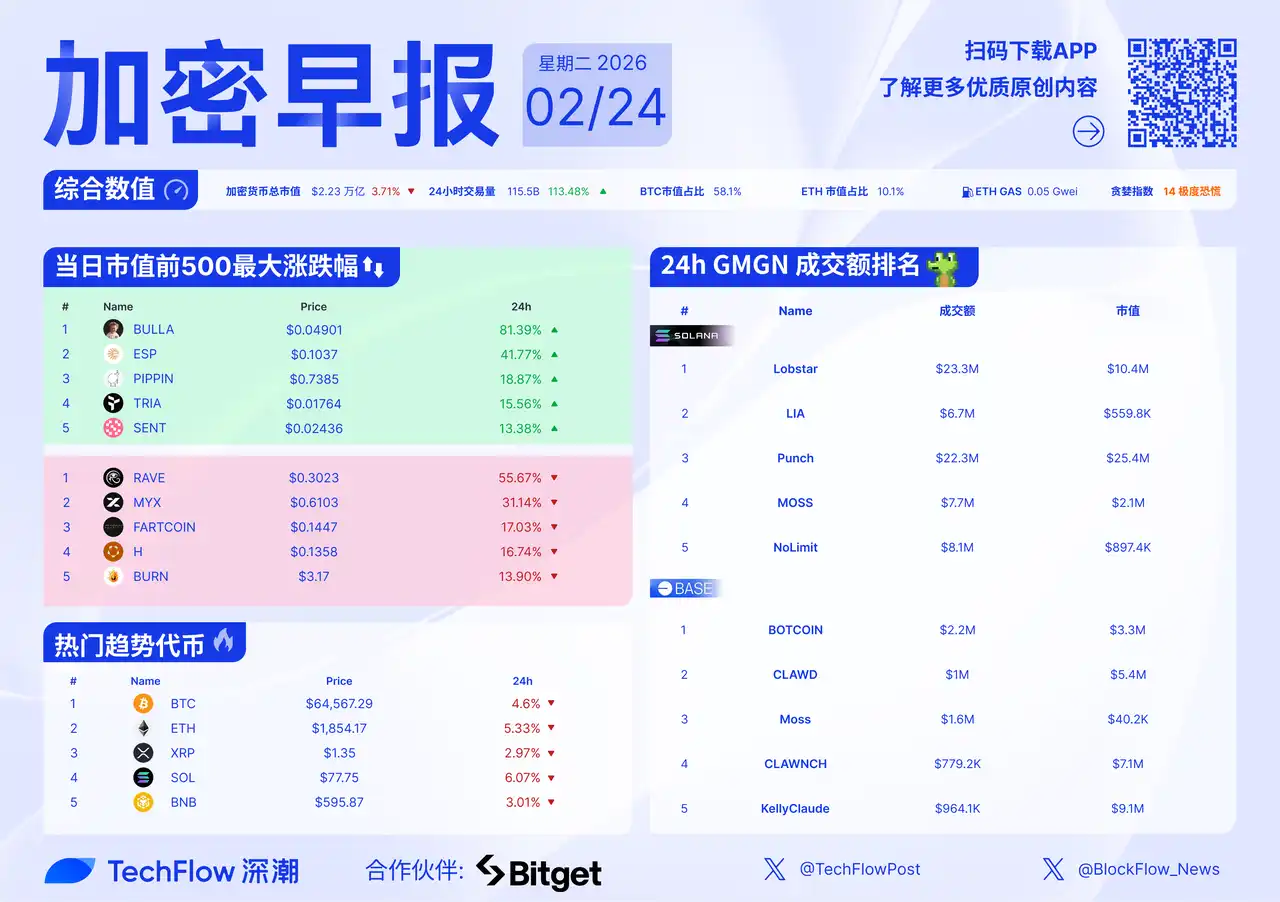
Market Dynamics
Recommended Reading

Google Senior AI Product Manager: 6 Agents Take Over My Daily Tasks, Costing Less Than $400 per Month, Running 24/7

This article details how to build a team of autonomous AI Agents that work together through six different role-based Agents to complete tasks such as research, content creation, code review, and newsletter production. The author shares practical experience, including file structure, cost details, problem-solving, and step-by-step setup suggestions.

In-Depth Analysis: Unwinding of Yen Carry Trade Triggers Chain Reaction of Bitcoin Selling

This article analyzes the mechanism by which the unwinding of the yen carry trade affects Bitcoin price volatility through cross-asset deleveraging and liquidity conditions. Through yen exchange rate fluctuations and official statements, it reveals the potential impact of yen financing channels on the global risk situation and crypto markets, and provides a five-signal early warning framework to identify deleveraging windows.

80% of New Tokens Fall Below Issue Price, Institutional Capital Shifting from Tokens to Crypto Equity

This article explores the capital flow trends in the cryptocurrency market, pointing out that institutional investors are gradually shifting from tokens to crypto equity investments. Behind this trend are the dual drivers of institutional compliance requirements and realistic valuation systems. The article analyzes the price performance of new tokens after listing, noting that most tokens depreciate quickly after listing, while crypto-related IPO and M&A activities have grown significantly. The article also explains why investors prefer crypto equity and the difference between tokens and real businesses.

Wintermute CEO: The Crypto Industry Is Lost, Only Personal Sovereignty Is the Path Worth Taking

This article is a manifesto on the philosophy of the crypto industry written by Wintermute CEO Evgeny Gaevoy, analyzing the current state of the crypto industry and future path choices. Starting from the concept of the "Golden Path" in "Dune," he criticizes the current迷失 (lost state) of the crypto industry and emphasizes the importance of personal sovereignty and independence, while analyzing three possible future development paths and emphasizing the necessity of building systems that cannot be controlled.

First Rise in the Year of the Horse, AI Stocks Go Crazy

This article discusses in detail the performance of the AI large model field in the capital market, focusing on the soaring stock prices of two domestic AI large model companies in the Hong Kong stock market—Zhipu and MiniMax—and the wealth creation effect behind them. The article also mentions the financing situation of other AI large model enterprises and future competition trends in the capital market.


Domande pertinenti

QWhat is Backpack's plan for its token stakers and how much equity has been reserved for this initiative?

ABackpack plans to allow its upcoming token holders to stake their tokens for at least one year to receive company equity at a fixed ratio. The company has reserved 20% of its equity for this program.

QAccording to WLFI, what was the nature of the attack on USD1 and what was the outcome?

AWLFI stated that attackers hacked the accounts of several WLFI co-founders, hired KOLs to spread FUD (Fear, Uncertainty, and Doubt), and took large short positions on WLFI in an attempt to profit from the artificially created chaos. The attack was unsuccessful, and the price of USD1 remained stable at its face value due to its robust minting and redemption mechanism and full 1:1 asset backing.

QWhat major decision did Tether announce regarding its CNH₮ stablecoin and what was the reason behind it?

ATether announced it will gradually cease its CNH₮ (offshore Chinese yuan) stablecoin service. It has stopped issuing new CNH₮ tokens and will completely terminate redemption support after one year. This decision was based on changing market conditions, low product interest, and limited community demand relative to other assets.

QWhat new team has the Ethereum Foundation established and what are its core principles for DeFi?

AThe Ethereum Foundation has established a dedicated DeFi team under its Ecosystem Support Program. The team's core principles for DeFi are that it should be permissionless, censorship-resistant, privacy-first, self-custodial, and open-source. They refer to this belief as 'DeFipunk'—finance that is not just slightly better than traditional finance, but finance that would not be possible without Ethereum.

QWhat significant move did the Japanese financial giant SBI Holdings make involving XRP?

ASBI Holdings issued a 10 billion yen (approximately $64.5 million) on-chain bond called 'SBI START Bonds' on the 'ibet for Fin' blockchain platform. Qualified retail investors who hold an SBI VC Trade account and invest over 100,000 yen will receive XRP rewards equivalent to 200 yen for every 100,000 yen invested, both at issuance and on subsequent interest payment dates until 2029.

Letture associate

Has the 'Digital Gold' Narrative for BTC Failed?

**Title: Has the "Digital Gold" Narrative for Bitcoin Failed?** The article argues that Bitcoin's "digital gold" narrative remains valid despite a recent sharp price decline (from a peak near $126k in Oct 2025 to briefly under $61k in Feb 2026). It presents a long-term investment framework based on three core points: **1. Viewing Bitcoin as an Asset:** Bitcoin is presented as a superior potential store of value compared to gold. Key arguments are its absolute scarcity (21 million cap), superior portability, and transparent auditability via its public ledger. While acknowledging its current use in early, volatile stages (~3-4% global adoption), the author draws parallels to the early, disruptive phases of the internet and e-commerce. **2. Understanding the Recent Downturn:** The current ~50% correction is framed as a predictable, consensus-driven cycle following its post-halving peak (the 2024 halving preceded the Oct 2025 high). A crucial factor is a historic "changing of hands": the influx of new institutional buyers via ETFs allowed early, low-cost holders (miners, OG believers) to take profits. The author notes that while severe, Bitcoin's historical drawdowns (e.g., 93% in 2011, 77% in 2021-22) have been progressively smaller, suggesting maturing holder structure and decreasing volatility over time. **3. The Long-Term Perspective:** The long-term thesis hinges on Bitcoin capturing a portion of gold's market value. With Bitcoin's market cap at ~$1.4 trillion (at $70k) versus gold's ~$20 trillion, significant upside potential exists if the "digital gold" narrative is partially realized. However, the author strongly cautions that short-term risks remain, the bottom is unpredictable, and high volatility is inherent. The real risk is not Bitcoin failing but poor personal position management (over-leverage, wrong capital) and a lack of deep understanding, which can force investors out during severe downturns. The conclusion uses Amazon's 95% crash post-2000 dot-com bubble and subsequent 42x recovery as an analogy. The ultimate question is not if Bitcoin's price will rise, but if an investor's strategy and conviction can withstand the volatility to see the long-term play out. The recent divergence (gold up, Bitcoin down) is posed not as a narrative failure, but as potential evidence of this ongoing, painful transition from a speculative asset to a mainstream allocation.

marsbit53 min fa

Has the 'Digital Gold' Narrative for BTC Failed?

marsbit53 min fa

Has BTC's 'Digital Gold' Narrative Failed?

The article discusses Bitcoin's "digital gold" narrative, its recent price drop, and long-term outlook through the perspective of "Jason". It argues the narrative is not a failure but that Bitcoin represents a superior, new asset class due to its fixed supply (21 million), portability, and auditability. The piece compares its current ~3-4% global adoption rate to early internet/e-commerce, suggesting significant growth potential. Regarding the 2025-2026 price decline (from ~$126k to briefly under $61k), the author views it as a predictable, consensus-driven sell-off within Bitcoin's ~4-year cycle post-halving, exacerbated by a major "handover" from early, low-cost holders to new institutional buyers via ETFs. A key observation is that historical peak-to-trough drawdowns have lessened over time (e.g., 93% in 2011 to ~50% in 2026), indicating maturing volatility as holder structure changes. For the long term, the author uses a simple framework: Bitcoin's total market cap (~$1.4T at $70k) is only about 7% of gold's (~$20T). Even capturing 30-50% of gold's value would imply substantial upside. However, the article strongly cautions against viewing this as investment advice, emphasizing extreme volatility and the critical importance of risk management, position sizing, and deep fundamental understanding to survive severe drawdowns. It concludes by drawing a parallel to Amazon's 95% crash in 2000 and subsequent 42x recovery, stressing that the key is surviving market cycles to realize long-term potential.

链捕手1 h fa

Has BTC's 'Digital Gold' Narrative Failed?

链捕手1 h fa

From Code to Cognition: A Ten-Thousand-Word Guide to the Evolution of the Robot Brain

"From Code to Cognition: The Evolution of Robot Brains" The journey of robotic intelligence has shifted dramatically from manually coded systems to AI-driven brains. For decades, robots relied on layered software stacks—perception, state estimation, planning, control—each handcrafted. While predictable, they lacked adaptability. The 2010s saw deep learning revolutionize perception (e.g., object detection) and control (via reinforcement learning), but learned skills remained narrow. The arrival of Large Language Models (LLMs) marked a turning point. LLMs acted as high-level planners, interpreting natural language instructions and generating sequences of actions for traditional robotic systems to execute. However, true integration came with Visual-Language-Action (VLA) models, which fused vision, language, and motion prediction into a single network. Pioneered by models like RT-2 and open-source projects like OpenVLA, VLAs enable robots to reason and act directly from visual input and commands. The most advanced humanoid robots now employ a "dual-brain" architecture: a slow-thinking, large VLA (System 2) for reasoning and planning, and a fast-reacting, small network (System 1) for high-frequency motion control, sometimes with an even lower-level System 0 for balance. This split balances cognition with the physics of real-time movement. Computation is split between onboard hardware (e.g., NVIDIA Jetson) for safety-critical control loops and cloud/edge servers for non-critical tasks like learning and interfaces. A crucial driver is the open-source ecosystem—models like GR00T and OpenVLA allow startups to build upon pre-trained brains and fine-tune them with their own data, accelerating development. Despite progress, current systems struggle with recovery from errors, sample inefficiency, and long-horizon tasks. This has spurred the rise of **World Models**—neural networks that predict the consequences of actions. By simulating possible futures before acting (like NVIDIA Cosmos or Meta V-JEPA), robots can plan, recover, and generalize better. This represents the next frontier: shifting intelligence from learned reactions to an internal model of physics and cause-and-effect. The field is rapidly evolving. While not yet at its "ChatGPT moment," the convergence of cheaper hardware, scalable simulation, and world models points toward robots that are increasingly capable, adaptive, and useful. The question is shifting from "what can robots do?" to "what *should* they do?"

marsbit1 h fa

From Code to Cognition: A Ten-Thousand-Word Guide to the Evolution of the Robot Brain

marsbit1 h fa

AI Bubble Is Bursting

The AI Bubble is Bursting: A Necessary Purge on the Path to Ubiquitous Intelligence Market volatility has reignited debates about an AI bubble, with figures like Ray Dalio pointing to high valuations. However, this parallels the dot-com bubble, which, despite its crash, laid the physical infrastructure for today's internet era. The current AI investment frenzy, with tech giants planning trillions in infrastructure spending far outstripping current AI application revenues, appears similarly imbalanced. This 'bubble' is seen as an inevitable phase for a disruptive technology, paying the "innovation tax." Critically, AI inference costs have plummeted over 99.7% since 2023, making intelligence nearly free at the margin. This hasn't reduced spending but has instead unlocked massive new demand, as seen in enterprise AI cloud expenditure tripling. This follows the Jevons Paradox: efficiency gains lead to greater total consumption. The market is now entering a cleansing phase, weeding out speculative ventures lacking real moats. The deeper shift is a move from capital expenditure (CapEx) on hardware to value creation in operational expenditure (OpEx) through AI applications that solve real industry problems. While infrastructure valuations are high, rapid earnings growth from widespread AI adoption across sectors—from manufacturing and finance to law and healthcare—may digest these valuations over time. Ultimately, this creative destruction will leave behind robust infrastructure and optimized models, cheaply powering an AI-augmented future for all industries, much as the internet became indispensable after its own bubble burst. The core productive potential remains undiminished.

链捕手1 h fa

AI Bubble Is Bursting

链捕手1 h fa

Trading

Spot
Futures

Articoli Popolari

Come comprare WLFI

Benvenuto in HTX.com! Abbiamo reso l'acquisto di Official World Liberty Financial (WLFI) semplice e conveniente. Segui la nostra guida passo passo per intraprendere il tuo viaggio nel mondo delle criptovalute.Step 1: Crea il tuo Account HTXUsa la tua email o numero di telefono per registrarti il tuo account gratuito su HTX. Vivi un'esperienza facile e sblocca tutte le funzionalità,Crea il mio accountStep 2: Vai in Acquista crypto e seleziona il tuo metodo di pagamentoCarta di credito/debito: utilizza la tua Visa o Mastercard per acquistare immediatamente Official World Liberty FinancialWLFI.Bilancio: Usa i fondi dal bilancio del tuo account HTX per fare trading senza problemi.Terze parti: abbiamo aggiunto metodi di pagamento molto utilizzati come Google Pay e Apple Pay per maggiore comodità.P2P: Fai trading direttamente con altri utenti HTX.Over-the-Counter (OTC): Offriamo servizi su misura e tassi di cambio competitivi per i trader.Step 3: Conserva Official World Liberty Financial (WLFI)Dopo aver acquistato Official World Liberty Financial (WLFI), conserva nel tuo account HTX. In alternativa, puoi inviare tramite trasferimento blockchain o scambiare per altre criptovalute.Step 4: Scambia Official World Liberty Financial (WLFI)Scambia facilmente Official World Liberty Financial (WLFI) nel mercato spot di HTX. Accedi al tuo account, seleziona la tua coppia di trading, esegui le tue operazioni e monitora in tempo reale. Offriamo un'esperienza user-friendly sia per chi ha appena iniziato che per i trader più esperti.

500 Totale visualizzazioniPubblicato il 2025.09.01Aggiornato il 2026.06.02

Come comprare WLFI

Discussioni

Benvenuto nella Community HTX. Qui puoi rimanere informato sugli ultimi sviluppi della piattaforma e accedere ad approfondimenti esperti sul mercato. Le opinioni degli utenti sul prezzo di WLFI WLFI sono presentate come di seguito.

活动图片