Crypto May No Longer Be Treated Like Penny Stocks Under SEC Plan

bitcoinistPubblicato 2026-03-17Pubblicato ultima volta 2026-03-17

Introduzione

The US Securities and Exchange Commission (SEC) has proposed amending Exchange Act Rule 15c2-11 to apply only to equity securities, a move that could significantly impact crypto market structure. The rule, historically used to prevent fraud in over-the-counter equity markets, would no longer broadly apply to other asset classes like cryptocurrencies. This change is seen as a meaningful shift away from forcing crypto into existing securities frameworks. By excluding crypto from these rules—originally designed for penny stocks—the SEC signals a more tailored regulatory approach. The proposal is open for public comment, reflecting the agency's growing willingness to treat crypto differently from traditional equities.

The US Securities and Exchange Commission has proposed narrowing Exchange Act Rule 15c2-11 so that it applies only to equity securities, a technical change that could carry outsized significance for crypto market structure. For digital assets, the proposal signals a more tailored regulatory approach after years of trying to force crypto into frameworks built for traditional securities.

In a press release issued March 16, the SEC said Rule 15c2-11 has historically focused on preventing manipulative and fraudulent schemes in over-the-counter equity markets. The proposed amendment would revise the rule so it refers only to equity securities, rather than leaving room for broader application to other asset classes.

Quiet But Meaningful Win For Crypto

That matters because Rule 15c2-11 governs certain information gathering and review requirements for broker-dealers that publish quotations for, or maintain a continuous quoted market in, securities in the OTC market. By explicitly tying the rule to equities, the SEC appears to be drawing a cleaner line around where those obligations begin and end.

SEC Chairman Paul S. Atkins framed the move as a matter of regulatory fit rather than ideology. “Regulations should be appropriately tailored to fit the asset class to which they apply,” Atkins said. “This proposal would clarify regulatory obligations when publishing quotations and affirm what was always understood: Rule 15c2-11 applies to equity securities.”

For crypto market participants, the proposal reads as more than a drafting cleanup. Marty Bent, writing on X (@TFTC), argued that the shift quietly reverses the posture that defined much of the prior SEC era. “The SEC just proposed excluding crypto assets from OTC market rules that govern broker-dealer quotations. These are regulations originally designed for penny stocks and thinly traded equities.”

He went further, casting the amendment as a subtle but meaningful break from the agency’s past playbook. “This is a quiet but meaningful shift. Instead of forcing Bitcoin and crypto into existing securities frameworks, the SEC is explicitly carving it out. The rules being amended (Rule 15c2-11) dictate how broker-dealers can publish quotes for securities. By clarifying that crypto doesn’t fall under these requirements, the SEC is signaling it doesn’t view these assets through the same lens as traditional equities.”

That interpretation is likely to resonate because Rule 15c2-11 was never designed with digital assets in mind. Its original function was tied to OTC equities, particularly the kind of thinly traded names that have historically been vulnerable to quote manipulation and fraud. In that context, the SEC’s proposal does not create a bespoke crypto regime, but it does something nearly as important: it narrows the set of legacy securities rules that might otherwise be stretched to cover crypto by default.

Bent also contrasted the proposal with the enforcement-heavy approach associated with former Chair Gary Gensler. “Under Gensler, the approach was the opposite, force everything into existing rules, then sue when companies couldn’t comply. This is the regulatory posture flipping from ‘prove you’re not a security’ to ‘these rules weren’t built for you.’”

The proposal is now headed to the standard public process. The SEC said the release will be published on SEC.gov and later in the Federal Register, with a 60-day comment period beginning after Federal Register publication. That leaves room for revisions, but the message is already clear enough: the agency is increasingly willing to distinguish crypto from the infrastructure and assumptions of legacy equity markets.

At press time, the total crypto market cap stood at $2.51 trillion.
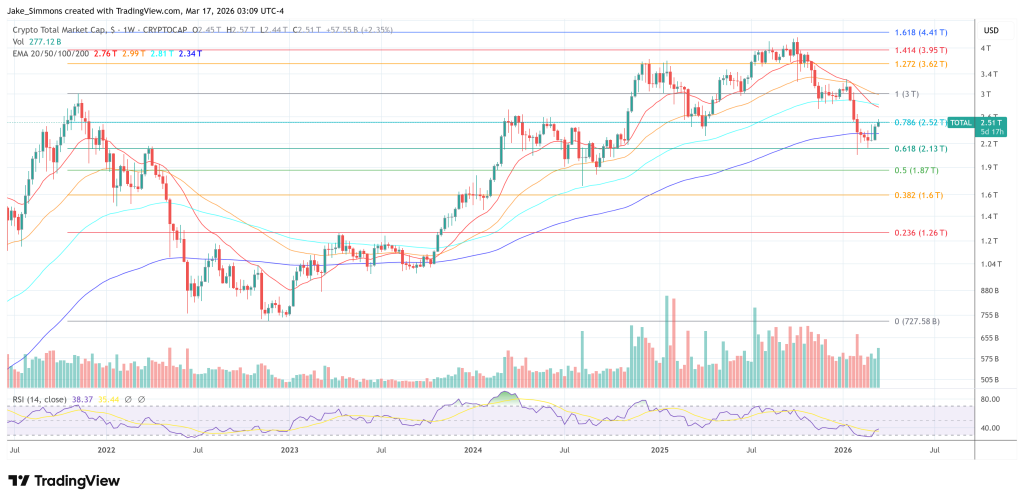
Total crypto market cap must reclaim the 0.786 Fib, 1-week chart | Source: TOTAL on TradingView.com

Domande pertinenti

QWhat is the main change proposed by the SEC regarding Rule 15c2-11?

AThe SEC has proposed narrowing Exchange Act Rule 15c2-11 so that it applies only to equity securities, rather than having broader application to other asset classes like crypto.

QWhy is this proposal considered a significant shift for the crypto market?

AIt signals a more tailored regulatory approach, distinguishing crypto from traditional securities frameworks and reversing the previous posture of forcing crypto into existing rules designed for equities like penny stocks.

QHow did SEC Chairman Paul S. Atkins justify the proposed amendment?

AHe framed it as a matter of regulatory fit, stating that regulations should be appropriately tailored to the asset class they apply to, and that the proposal clarifies Rule 15c2-11 was always understood to apply to equity securities.

QWhat does Marty Bent suggest about the SEC's change in approach compared to the Gary Gensler era?

ABent argues this shifts from an enforcement-heavy approach that forced crypto into existing rules and then sued for non-compliance, to a posture that acknowledges these rules weren't built for crypto assets.

QWhat is the next step for this SEC proposal after its announcement?

AThe proposal will go through a standard public process with a 60-day comment period after being published in the Federal Register, leaving room for potential revisions.

Letture associate

STRC Major De-pegging's First Financial Report, How Will Strategy Repair Its Capital Flywheel?

Bitcoin treasury company Strategy released its Q2 2026 earnings report on July 31. Despite a 6.9% year-over-year revenue increase to $122 million, the company recorded a net loss of $8.22 billion, largely due to $8.32 billion in unrealized losses from Bitcoin price fluctuations. As of quarter-end, Strategy holds 843,775 BTC with an average cost of $75,000 per coin, and Bitcoin per share increased. The report highlights a critical shift in Strategy's capital model following the de-pegging of its key financing tool, STRC (Strategic Coin), which fell below its $100 target. Management's top priority is restoring STRC to its target value, aiming for a recovery by September 8. They rule out discounted STRC issuances and plan to maintain its dividend yield at 12%, instead focusing on bolstering its $3.75 billion cash reserve. Strategy has moved from a one-way "buy-and-hold" Bitcoin strategy to active capital management. This new approach, part of its "Digital Credit Capital Framework," involves flexibly managing its balance sheet across four elements: BTC, USD cash, common stock (MSTR), and digital credit securities like STRC. This allows for BTC monetization (having sold $218.4 million in BTC so far), strategic repurchases of discounted securities, and debt optimization, as seen with a $1.5 billion convertible bond buyback. The company's future hinges on two key tests: successfully re-pegging STRC to restore market confidence in its digital credit system, and a long-term recovery in Bitcoin's price to ultimately support its growth thesis.

marsbit20 min fa

STRC Major De-pegging's First Financial Report, How Will Strategy Repair Its Capital Flywheel?

marsbit20 min fa

STRC's First Financial Report Post-Depegging, How is Strategy Restoring the Capital Flywheel?

On July 31, 2026, Bitcoin treasury company Strategy released its Q2 financial report. Despite a 6.9% year-over-year increase in revenue to $122 million, the company recorded a substantial net loss of $8.22 billion, primarily due to $8.32 billion in unrealized losses from Bitcoin holdings. While Strategy's core Bitcoin strategy remains intact—its holdings grew 11% to 843,775 BTC—the company is undergoing a fundamental shift in its capital model. Following the de-pegging of its key financing tool, the STRCoin (STRC), from its $100 target in May, Strategy has pivoted from a one-directional "raise funds, buy Bitcoin" cycle to a more dynamic, multi-asset capital management approach. A key part of this new framework is the "Monetization Program," through which Strategy has sold approximately $218.4 million worth of BTC to bolster liquidity. The company's top priority is repairing STRC's peg, committing not to issue discounted shares until it returns to its target range. It has initiated a $1 billion buyback program for discounted digital credit securities, having repurchased $28.9 million face value of STRC so far. Management aims to restore the peg around September 8, 2026. Strategy now actively manages a matrix of assets: Bitcoin (for accumulation or strategic sales), USD cash reserves (now at $3.75 billion), common stock (MSTR), and digital credit securities like STRC. This allows for tactical moves like repurchasing discounted debt or equity to capture value. The future success of Strategy's "capital flywheel" hinges on two factors: the short-term ability to successfully re-peg STRC to restore market confidence in its digital credit system, and the long-term price trajectory of Bitcoin, upon which its entire investment thesis ultimately depends.

Odaily星球日报25 min fa

STRC's First Financial Report Post-Depegging, How is Strategy Restoring the Capital Flywheel?

Odaily星球日报25 min fa

With Two Consecutive Quarters of Losses, Coinbase Must Rely on Paths Beyond Trading

Coinbase posted its second consecutive quarterly net loss of $359 million on $1.22 billion in revenue for Q2, highlighting its vulnerability to crypto market cycles where weaker prices and lower volatility reduce user trading. However, the report also reveals a strategic shift in its business model. Despite a 25% quarter-over-quarter decline in global spot trading volume, Coinbase increased its market share to a company-record 10.3%. This suggests its position as a compliant U.S. on-ramp is strengthening even in a cooler market. A key development is the diversification of revenue streams. Transaction revenue fell to $599 million, nearly equaling subscription and services revenue of $555 million. Stablecoin services, generating $292 million, are becoming a crucial revenue "floor." This income, derived from interest on the $20 billion average USDC balance held on its platform, is less tied to daily trading activity. Furthermore, while spot trading volume dropped significantly, derivatives volume held steady at $1.03 trillion. Coinbase is pushing to integrate spot, stablecoin, and derivatives liquidity to create a more interconnected and sticky ecosystem for users. The GAAP net loss includes non-cash expenses like stock-based compensation and crypto asset valuation changes. Its adjusted EBITDA remained positive at $208 million for the 14th straight quarter, indicating core operations can cover ongoing costs. The company is also reducing expenses to manage the downturn. The central question moving forward is whether Coinbase's growing market share, stablecoin revenues, and expanding product integration can sufficiently offset the inherent cyclicality of its core trading business during future market contractions.

marsbit41 min fa

With Two Consecutive Quarters of Losses, Coinbase Must Rely on Paths Beyond Trading

marsbit41 min fa

Trading

Spot
活动图片