Crypto May Be Loud Online, But Only 4% Of Voters Care: Poll

bitcoinistPubblicato 2026-05-14Pubblicato ultima volta 2026-05-14

Introduzione

A Politico survey reveals a stark disconnect between crypto industry lobbying and U.S. voter priorities. While crypto groups have spent over $130 million on the 2024 elections, only 4% of voters say a candidate's position on crypto would influence their vote. Affordable housing, consumer fraud protection, and lower bank fees rank as far more important issues for voters. The poll also shows public ambivalence toward digital assets. Only 27% support government efforts to make crypto mainstream, while 31% oppose it. Over half of respondents have never traded crypto and don't plan to. Among those who have traded, 7% say a candidate's stance would sway their vote. Furthermore, 45% view crypto investing as a risk not worth taking. Despite low voter interest, Congress is advancing crypto regulation. The Senate Banking Committee is set to vote on a regulatory framework bill, a version of which already passed the House in June.

A separate poll released Friday by HarrisX found that 47% of registered voters said they would consider crossing party lines to support a candidate who backed crypto regulation legislation — a figure that stands in sharp contrast to new data showing crypto barely moves the needle for most Americans when they head to the polls.

The Lobbying Machine Behind The Legislation

The Politico survey, conducted by polling firm Public First and covering 2,035 US adults, found that only 4% of respondents would factor a candidate’s position on crypto into their voting decision.

Source: Politico

Affordable housing topped the list of issues voters want Congress to address, followed by consumer fraud protection and lower bank fees. Crypto regulation came in last.

That gap between voter priorities and industry muscle is hard to ignore. Crypto lobbies spent more than $130 million during the 2024 elections — more than any other industry — and have already committed $320 million to shape the upcoming November midterms, according to data compiled by researcher Molly White.
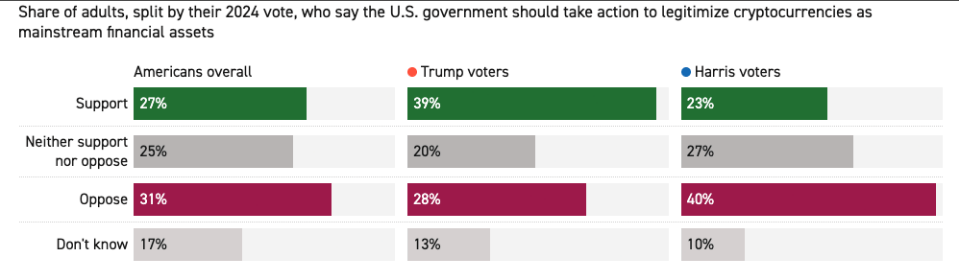
Survey results on public opinion regarding whether the US government should formally adopt crypto as a mainstream financial asset. Source: Politico.

In Illinois alone, crypto-aligned PACs have spent over $5.5 million opposing specific congressional candidates this year.

BTCUSD currently trading at $79,593. Chart: TradingView

Republican Representative Dusty Johnson acknowledged the disconnect. Most voters don’t think about digital assets, he told Politico, but those who do feel strongly about it. He described it as a high-intensity issue that is slowly growing in public awareness, even if the numbers remain small.

A Public Still Divided On Digital Assets

The survey also captured a broader wariness toward crypto among ordinary Americans. Only 27% said they support or strongly support the US government taking steps to make crypto a mainstream financial asset.

A slightly larger share — 31% — said they oppose or strongly oppose such a move. More than half of respondents said they had never traded crypto and had no plans to do so.

Image: Pexels

Among the 19% who had actually traded crypto, 7% said a candidate’s stance on the issue would influence their vote. The poll also found that 45% of respondents considered crypto investing a risk not worth taking, even with the promise of high returns. Only 25% disagreed.

Senate Moving On Crypto Regulation This Week

Meanwhile, Congress is pushing ahead. The Senate Banking Committee is set to vote on whether to advance a long-awaited bill that would establish a regulatory framework for the crypto industry.

A version of the bill — known as the Clarity Act — already cleared the House in June. Reports indicate the White House has been involved in negotiations between crypto interests and banking lobbies to shape the final version.

Featured image from Unsplash, chart from TradingView

Domande pertinenti

QAccording to the poll, what percentage of voters would factor a candidate's position on crypto into their voting decision?

AAccording to the Politico survey, only 4% of respondents would factor a candidate's position on crypto into their voting decision.

QWhat issue topped the list of voter priorities that they want Congress to address, as revealed in the article?

AAffordable housing topped the list of issues voters want Congress to address, according to the survey.

QHow much money did crypto lobbies spend during the 2024 elections, and how does this compare to other industries according to the data cited?

ACrypto lobbies spent more than $130 million during the 2024 elections, which was more than any other industry.

QWhat percentage of survey respondents support the US government taking steps to make crypto a mainstream financial asset?

AOnly 27% of survey respondents said they support or strongly support the US government taking steps to make crypto a mainstream financial asset.

QWhat legislative action is the Senate Banking Committee set to take regarding crypto, as mentioned in the article?

AThe Senate Banking Committee is set to vote on whether to advance a long-awaited bill, known as the Clarity Act, which would establish a regulatory framework for the crypto industry.

Letture associate

Standing in the Light: A Comprehensive Guide to the Optical Module and CPO Supply Chain

"Standing in the Light: Understanding the Optical Module and CPO Industry Chain" This article analyzes the critical role of optical communication technology, specifically optical modules and Co-Packaged Optics (CPO), as the "nervous system" for modern AI data centers. With exponential growth in AI computational demands (e.g., NVIDIA's Vera Rubin architecture), traditional electrical interconnects using copper cables face severe bottlenecks in bandwidth, power consumption, and signal integrity over distance. The core function of an optical module is to act as a "translator," converting electrical signals from chips into optical signals for transmission over fiber (and vice-versa). Key internal components include lasers, modulators, photodetectors, drivers, and DSP chips. The industry is currently transitioning from 800G to 1.6T modules. However, the future lies in CPO. This next-generation technology integrates the optical engine directly with the switch ASIC/XPU on the same package substrate, drastically reducing power consumption (by ~3.5x according to NVIDIA), overcoming bandwidth density limits, and minimizing signal attenuation compared to traditional pluggable modules. Key challenges for CPO include advanced packaging capacity (dominated by TSMC), thermal management, repairability, and standardization. The article details the broader technology landscape, including Near-Packaged Optics (NPO, a pragmatic intermediate step), Linear-drive Pluggable Optics (LPO), Optical I/O (OIO for chip-level integration), and Optical Circuit Switches (OCS). A comprehensive CPO industry chain is mapped, highlighting shifting power dynamics: * **Architecture Definers:** NVIDIA, Broadcom, and Marvell now hold greater influence. * **Advanced Packaging & Manufacturing:** TSMC is central; Fabrinet is a key EMS player. * **Lasers ("The Heart"):** A strategic bottleneck. EML lasers are led by Lumentum and Coherent (both receiving major NVIDIA investments). CW lasers, favored for CPO/silicon photonics, see strong Chinese players like Source Photonics and Sicoya. * **Silicon Photonics Chips:** The mainstream path for CPO engines, with key players like Broadcom, Intel, Marvell, and China's Accelink. * **Fiber Connectivity Components:** A major new, high-growth market created by CPO, including Fiber Array Units (FAU), Polarization-Maintaining Fiber (PMF), and MPO connectors. Companies like Tianfu Communication and US Conec are leaders. * **Fiber & Cable:** Experiencing a super-cycle (e.g., Corning, Yangtze Optical Fiber). * **PCB/Substrates:** Requiring advanced materials (e.g., Shengyi Tech). * **DSP & SerDes:** Functions are integrated into switch ASICs in the CPO era (e.g., Broadcom, Astera Labs). * **Optical Module Makers:** Transitioning from standalone module suppliers to providers of optical engines and NPO/LPO solutions while riding the current pluggable boom (e.g., Zhongji Innolight, Eoptolink). The investment timeline is segmented: Short-term (2026-2027) features the "last feast" for pluggable modules and CPO's initial rollout. Medium-term (2027-2029) will see CPO expand and NPO peak. Long-term (2029-2032+) involves CPO/OIO penetration into intra-rack scaling. In conclusion, optical interconnects are fundamental to AI infrastructure. The competitive landscape sees US firms leading in architecture and high-end chips, TSMC in advanced packaging, and Chinese firms holding strong positions in modules, connectivity components, CW lasers, and fiber/cable. The future belongs to companies that can navigate the technological shift from "selling shovels" (modules) to "building highways" (CPO/OIO infrastructure).

marsbit9 min fa

Standing in the Light: A Comprehensive Guide to the Optical Module and CPO Supply Chain

marsbit9 min fa

Trading

Spot
Futures

Articoli Popolari

Come comprare 4

Benvenuto in HTX.com! Abbiamo reso l'acquisto di 4 (4) semplice e conveniente. Segui la nostra guida passo passo per intraprendere il tuo viaggio nel mondo delle criptovalute.Step 1: Crea il tuo Account HTXUsa la tua email o numero di telefono per registrarti il tuo account gratuito su HTX. Vivi un'esperienza facile e sblocca tutte le funzionalità,Crea il mio accountStep 2: Vai in Acquista crypto e seleziona il tuo metodo di pagamentoCarta di credito/debito: utilizza la tua Visa o Mastercard per acquistare immediatamente 44.Bilancio: Usa i fondi dal bilancio del tuo account HTX per fare trading senza problemi.Terze parti: abbiamo aggiunto metodi di pagamento molto utilizzati come Google Pay e Apple Pay per maggiore comodità.P2P: Fai trading direttamente con altri utenti HTX.Over-the-Counter (OTC): Offriamo servizi su misura e tassi di cambio competitivi per i trader.Step 3: Conserva 4 (4)Dopo aver acquistato 4 (4), conserva nel tuo account HTX. In alternativa, puoi inviare tramite trasferimento blockchain o scambiare per altre criptovalute.Step 4: Scambia 4 (4)Scambia facilmente 4 (4) nel mercato spot di HTX. Accedi al tuo account, seleziona la tua coppia di trading, esegui le tue operazioni e monitora in tempo reale. Offriamo un'esperienza user-friendly sia per chi ha appena iniziato che per i trader più esperti.

351 Totale visualizzazioniPubblicato il 2025.10.20Aggiornato il 2026.06.02

Come comprare 4

Discussioni

Benvenuto nella Community HTX. Qui puoi rimanere informato sugli ultimi sviluppi della piattaforma e accedere ad approfondimenti esperti sul mercato. Le opinioni degli utenti sul prezzo di 4 4 sono presentate come di seguito.

活动图片