Crypto market’s weekly winners and losers – TAO, CC, DOT, WLD

ambcryptoPubblicato 2026-03-29Pubblicato ultima volta 2026-03-29

Introduzione

The crypto market saw mixed performance over the past week, with Bitcoin declining by 3% and altcoins dropping 1.52%. Despite the overall bearish sentiment, several tokens stood out as winners. Bittensor (TAO) led with a 44.7% rally, breaking key resistance levels. Memecore surged 33%, boosting the memecoin sector, while Canton (CC) rose 13.47% in a single day. Other notable gainers included DeXe (18.5%), FET (11.8%), and Chiliz (11.9%). On the losing side, Polkadot (DOT) fell sharply, testing February support levels. Aave dropped 10.7%, continuing a six-month downtrend, and NEAR Protocol declined 9.7%. Other underperformers included ICP, ENA, MNT, and Worldcoin (WLD), which fell 12.5%. Despite Bitcoin holding above $65.6k and Ethereum above $2k, market stability remains fragile amid macroeconomic uncertainties.

Bitcoin [BTC] was down by another 3% over the past week, having fallen 3.8% the previous week. The altcoin market cap was down by 1.52%, meaning that Bitcoin has registered more losses than the altcoin market put together.

Nevertheless, many of the top 50 crypto assets by market cap were in the red due to Bitcoin’s correction and the wider market fear. A few select tokens outperformed the market by a wide margin.

Let’s take a closer look at these outperformers and their bearish counterparts.

Weekly winners

TAO at the helm of bullish altcoins once more
Source: TAO/USDT on TradingView

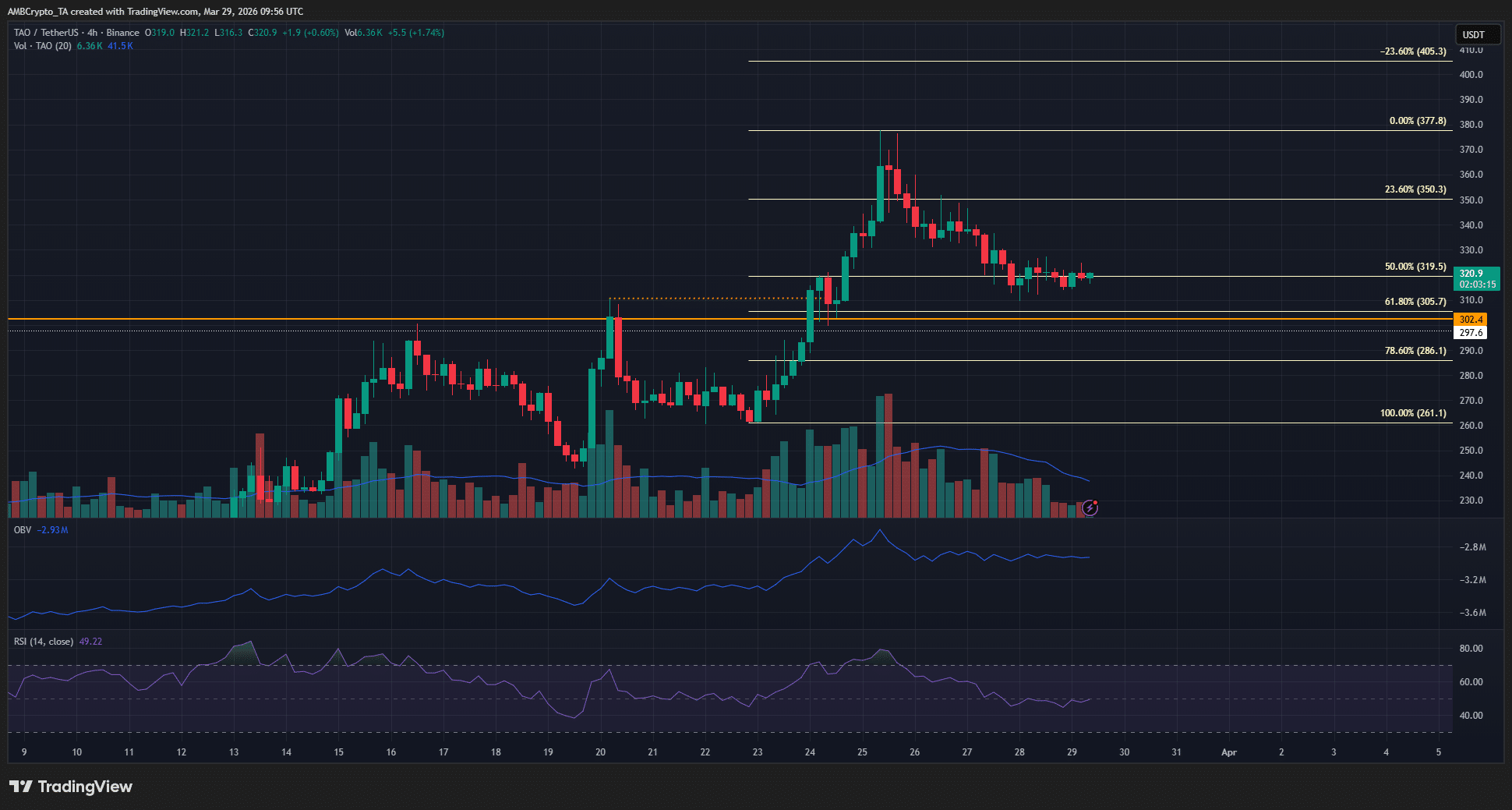
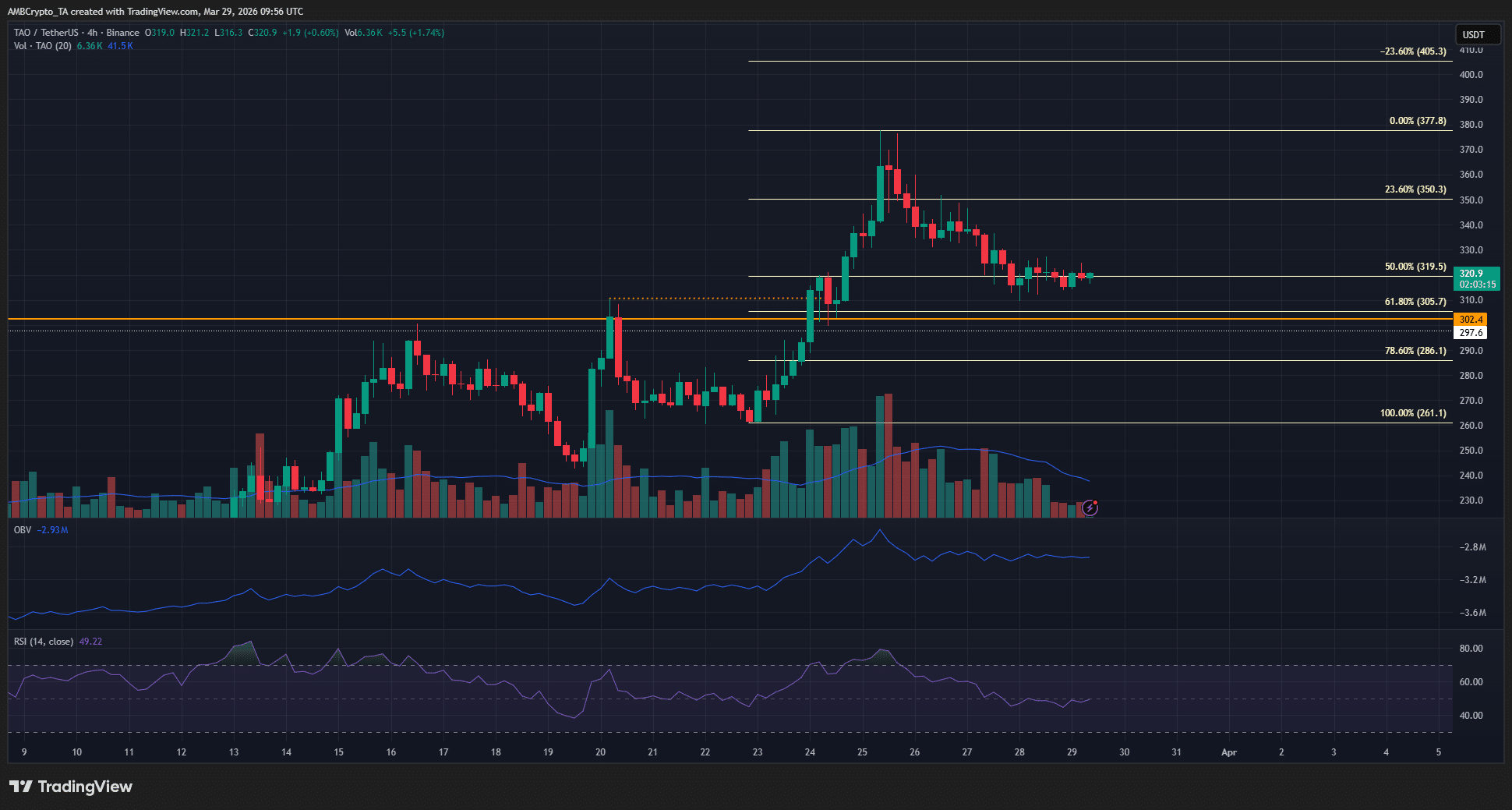
The move above $302 earlier in March broke the 1-day structure bullishly. Last week, a local high at $310.6 was breached (dotted orange), showing a bullish structure break. In other words, Bittensor experienced a bullish price structure on multiple timeframes.

The rally last week reached from $261.1 to $377.8, a whopping 44.7% move at its zenith. It has since receded to the 50% level. To the south, the $286 and $305 are key retracement zones to keep an eye on.

So long as the price is above $261, the bullish chances of TAO remain strong.

Memecore eclipses major memecoins with a 33% move

Glassnode data showed that the memecoin sector has been an outperforming one over the past week. It was up 5.8%, while Bitcoin and Ethereum [ETH] were down by 3.5% and 5%, respectively.

Memecore’s strong gains likely boosted the overall memecoin market cap. Another meme, siren [SIREN], also contributed.

Other popular memes such as Dogecoin [DOGE], Shiba Inu [SHIB], and Pepe [PEPE] have moved less than 0.5% each.

Canton rockets to local highs after being in retracement mode in March

Canton was a surprise weekly winner. It rallied 13.47% in 12 hours on Saturday, the 28th of March. The higher timeframe price structure was bullish, but CC has been retracing from $0.19 to $0.14 since the first week of February.

Towards the end of February, it saw a rally that challenged the local high at $0.175, measuring almost 9% in a day, before the retracement continued. A similar scenario can play out once again.

Other notable winners

DeXe [DEXE] and Artificial Superintelligence Alliance [FET] were up 18.5% and 11.8% for the week. Chiliz rallied by 11.9% over speculation of increased fan token activity for the upcoming FIFA World Cup 2026.

Midnight [NIGHT] rallied almost 9% but continued to labor within a downtrend, having faced rejection at $0.065 at the start of March. Ondo [ONDO] also rallied by 8.4% as RWA inflows bolstered its narrative.

Weekly losers

Polkadot sinks back to February support
Source: DOT/USDT on TradingView

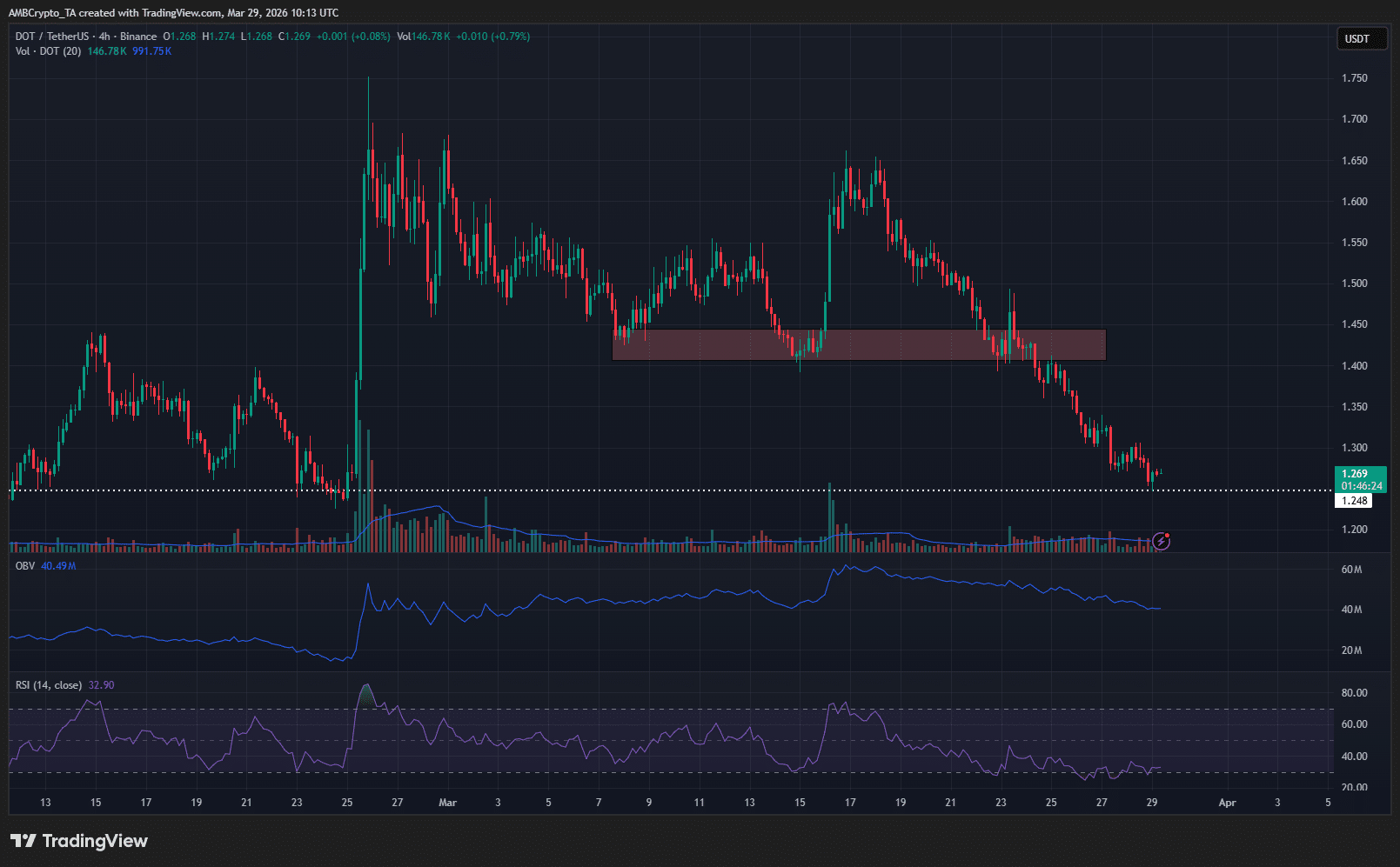
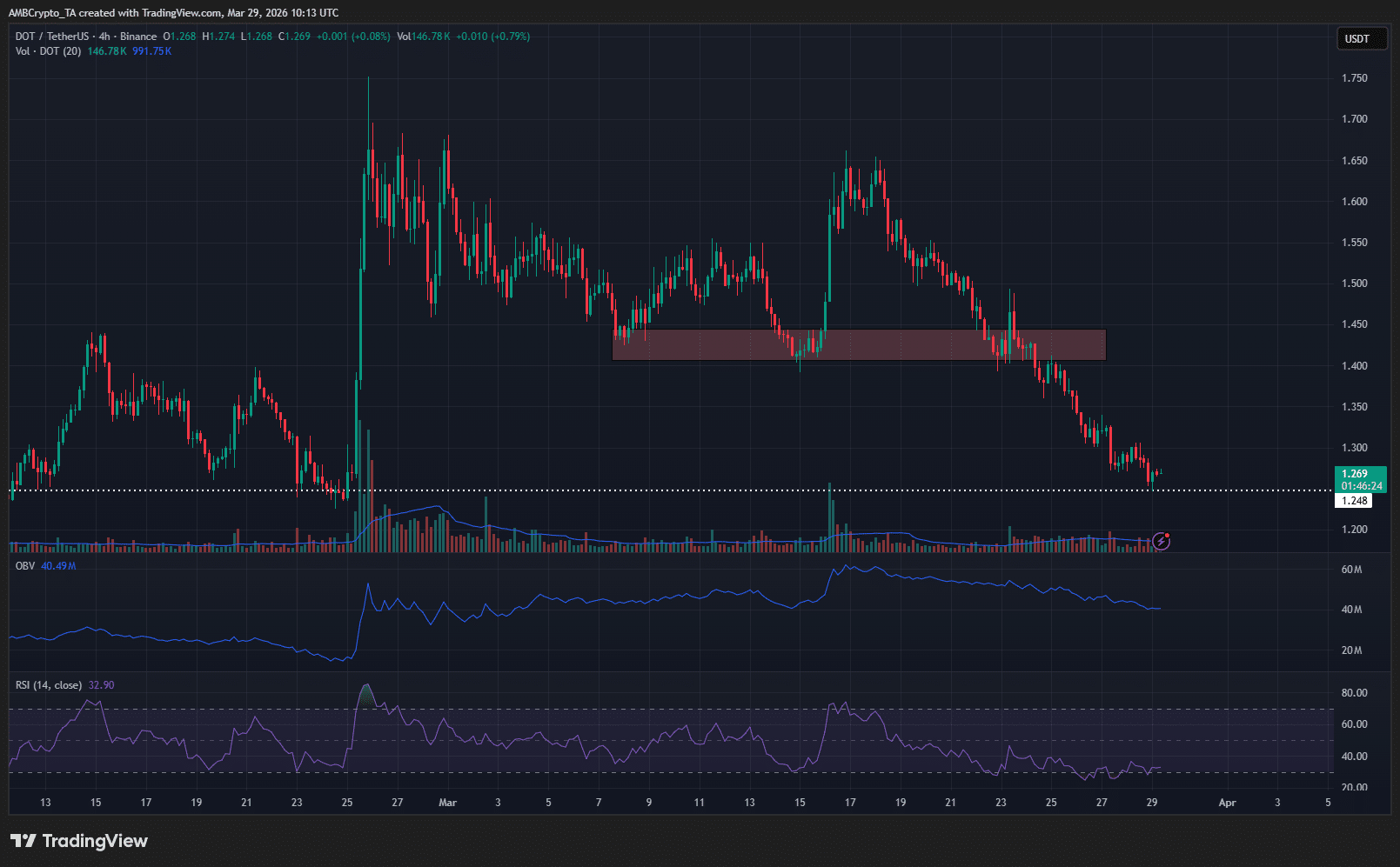
DOT has been in down-only mode on the price charts over the past week. The mid-March support at $1.40-$1.45 was tested on Monday, the 23rd of February. It held for a brief time but was broken by the selling pressure a day later.

At the time of writing, the $1.25 support from early February was under siege. The RSI was forming a bullish divergence with the price in recent days, which could yield a price bounce soon.

Aave racks up considerable weekly losses

Popular DeFi protocol Aave continued its six-month downtrend and notched up 10.7% loss for the week. The $100-$105 support zone from February was finally breached.

Rising exchange reserves reinforced selling pressure. As things stand, more losses remain likely for the altcoin.

NEAR Protocol prices test $1.3 as resistance before sliding lower

The relative strength of the AI sector has faded away, with only a few tokens showing remarkable strength. NEAR was not one of them, having shed 9.7% over the past week.

The $1.3 and $1.2 levels had been interim supports established earlier in the month but had fallen below them both and were at $1.16 at the time of writing.

Other notable losers

The erratic crypto AI sector token performance was highlighted by Internet Computer [ICP] falling 7.1% for the week. The sector has tokens in both categories, showing that select, strong altcoins and evolving narratives are what traders should look out for.

Ethena [ENA] and Mantle [MNT] shed 6.5% and 7.2%, respectively. Worldcoin [WLD] was another standout weak performer, with a weekly drop of 12.5%.

Bitcoin is at a decision point, but volatility could still hit hard

It was encouraging that Bitcoin was able to defend the $65.6k local lows, and Ethereum continued to remain above $2,000. This stability could be fragile. Oil-driven inflation and escalations in the Middle East could put further stress on the crypto market.


Final Summary

  • DeXe and FET continued their stellar performance, with Bittensor being a leading bull in the altcoin sector.
  • Memecore and SIREN performances gave a positive spin to an otherwise stagnant memecoin market.

Crypto di tendenza

Domande pertinenti

QWhich cryptocurrency was highlighted as the top weekly performer and what was its key support level?

ATAO (Bittensor) was the top weekly performer, with a key support level at $261.

QWhat was the overall trend for Bitcoin and the altcoin market cap over the past week?

ABitcoin was down by 3%, while the altcoin market cap decreased by 1.52%.

QWhich memecoin significantly outperformed major memecoins like Dogecoin and Shiba Inu?

AMemecore significantly outperformed with a 33% move, while Dogecoin, Shiba Inu, and Pepe moved less than 0.5% each.

QWhat were the primary reasons for Chiliz's (CHZ) price rally?

AChiliz rallied due to speculation of increased fan token activity for the upcoming FIFA World Cup 2026.

QWhich two major support levels did Polkadot (DOT) lose during its decline?

APolkadot lost the mid-March support at $1.40-$1.45 and was testing the $1.25 support from early February.

Letture associate

Within Strategy's Framework, STRC's Dividend Yield Remains at 12% as Share Price Stays Below Par Value

Michael Saylor, Executive Chairman of Strategy (MSTR), confirmed that the dividend rate for its STRC perpetual preferred shares will remain at 12.00% through August 2026. The rate has increased from 9% at its July 2025 launch to the current high via a "ratchet" mechanism, which permanently raises the rate by 0.5% whenever the share price falls below $95. This mechanism is intended to push the price back toward its $100 par value and support Strategy's "at-the-market" (ATM) program for issuing new shares to fund Bitcoin purchases. However, the mechanism has not worked as intended. STRC shares closed at $89.46 on July 31, remaining about 10-11% below par value despite the record-high dividend. Competition from rival Strive's higher-yielding SATA securities has pressured demand. The persistent discount has forced Strategy to suspend new STRC issuances via its ATM program, limiting this funding channel for Bitcoin acquisitions. STRC's struggles reflect Bitcoin's own volatility, as the preferred shares historically move in tandem. Analysts have warned the ratchet structure carries long-term, one-way risk. A law firm is investigating Strategy's ability to maintain dividend payments if Bitcoin's price stays low. Retail investors own roughly 83% of outstanding STRC shares, a group seen as prone to panic selling during downturns. In response, Strategy has established financial reserves, including a liquidity cushion covering about 26 months of dividend/interest obligations, and a $2 billion share buyback program alongside a Bitcoin monetization framework, though the company emphasized it is not obligated to sell any Bitcoin.

cryptonews.ru5 min fa

Within Strategy's Framework, STRC's Dividend Yield Remains at 12% as Share Price Stays Below Par Value

cryptonews.ru5 min fa

Analyst: Bitcoin's Price Will Drop to $60k in August, Then Rebound to $70k

Financial analyst Andrey Poroshin has provided a new forecast for Bitcoin's price dynamics in August. Poroshin, an analyst at the Bitbanker exchange, expects the cryptocurrency market to experience a downturn this month, with prices retesting the $60,000 level due to a lack of supportive macroeconomic catalysts. He noted that the recent US Federal Reserve decision to hold interest rates did not significantly impact the market, while inflation remains above the 2% target. Poroshin stated that Bitcoin is ending July under pressure from moderate volatility and a lack of new macroeconomic stimuli, leading to continued market caution. According to his base scenario, Bitcoin will drop to a range of $60,000 to $62,000 before recovering to $70,000. He pointed out that even $70,000 remains below the cost of mining in the US, which has prompted some miners to shift towards AI data center operations. Poroshin cited the winding down of BitMEX's operations as a potential catalyst for a price rebound, suggesting the exit of weaker players often coincides with market reversals and reduced short-term selling pressure. He believes Bitcoin is currently less susceptible to geopolitical shocks, such as the Iran-US conflict, and does not expect significant market changes in August related to the pending CLARITY Act. Looking ahead, Poroshin forecasts that September will bring more active price fluctuations driven by potential Fed rate decisions and possible discussions or approval of the CLARITY Act.

cryptonews.ru5 min fa

Analyst: Bitcoin's Price Will Drop to $60k in August, Then Rebound to $70k

cryptonews.ru5 min fa

In Jinjiang, Fujian, a Storage Super Unicorn Lies Quiet

In Fujian's Jinjiang, a city known for sportswear, lies a quiet semiconductor giant: Fujian Jinhua Integrated Circuit Co. (JHICC). Once a promising domestic DRAM manufacturer alongside Yangtze Memory and ChangXin Memory Technologies (CXMT), its journey was derailed in 2018 when the U.S. placed it on an Entity List and filed criminal charges for alleged trade secret theft. This halted production for years. A turning point came in February 2024 when a U.S. federal court found JHICC not guilty. However, it had lost crucial time. While CXMT soared to become a top-valued A-share company in 2024, JHICC, with an estimated valuation of 80 billion RMB, was just restarting. Its current output is primarily customized DDR4 chips, not the advanced DDR5/HBM demanded for AI, but it still benefits from the broader memory chip upcycle. JHICC's story is tied to Chen Zhengkun, a veteran engineer who left Micron to lead the venture. Founded in 2016 with state-backed funding, JHICC partnered with Taiwan's UMC to develop DRAM technology. Rapid progress was cut short by the U.S. actions, which Micron initiated, partly due to its heavy reliance on the Chinese market. Post-sanctions, Chen's team worked to rebuild the production line with reduced reliance on U.S. technology. According to its records, JHICC achieved small-scale production and revenue growth under immense pressure. It now focuses on the stable "niche" DRAM market (e.g., TVs, routers) with a monthly capacity of ~40,000 wafers, aiming for 60,000 by 2026. It holds over 1,000 patents but remains on the Entity List. For Jinjiang, investing in JHICC was a bold industrial leap. The local government provided unwavering financial and logistical support during the crisis, helping the company survive. JHICC has become the anchor for a growing local semiconductor cluster. Though its scale lags behind domestic peers, JHICC's persistence symbolizes a hard-won foothold in a global market long dominated by Samsung, SK Hynix, and Micron. Having missed one boom, it seeks a place in the new AI-driven memory supercycle.

marsbit2 h fa

In Jinjiang, Fujian, a Storage Super Unicorn Lies Quiet

marsbit2 h fa

Trading

Spot

Articoli Popolari

Come comprare WLD

Benvenuto in HTX.com! Abbiamo reso l'acquisto di Worldcoin (WLD) semplice e conveniente. Segui la nostra guida passo passo per intraprendere il tuo viaggio nel mondo delle criptovalute.Step 1: Crea il tuo Account HTXUsa la tua email o numero di telefono per registrarti il tuo account gratuito su HTX. Vivi un'esperienza facile e sblocca tutte le funzionalità,Crea il mio accountStep 2: Vai in Acquista crypto e seleziona il tuo metodo di pagamentoCarta di credito/debito: utilizza la tua Visa o Mastercard per acquistare immediatamente WorldcoinWLD.Bilancio: Usa i fondi dal bilancio del tuo account HTX per fare trading senza problemi.Terze parti: abbiamo aggiunto metodi di pagamento molto utilizzati come Google Pay e Apple Pay per maggiore comodità.P2P: Fai trading direttamente con altri utenti HTX.Over-the-Counter (OTC): Offriamo servizi su misura e tassi di cambio competitivi per i trader.Step 3: Conserva Worldcoin (WLD)Dopo aver acquistato Worldcoin (WLD), conserva nel tuo account HTX. In alternativa, puoi inviare tramite trasferimento blockchain o scambiare per altre criptovalute.Step 4: Scambia Worldcoin (WLD)Scambia facilmente Worldcoin (WLD) nel mercato spot di HTX. Accedi al tuo account, seleziona la tua coppia di trading, esegui le tue operazioni e monitora in tempo reale. Offriamo un'esperienza user-friendly sia per chi ha appena iniziato che per i trader più esperti.

207 Totale visualizzazioniPubblicato il 2024.12.11Aggiornato il 2026.06.02

Come comprare WLD

Discussioni

Benvenuto nella Community HTX. Qui puoi rimanere informato sugli ultimi sviluppi della piattaforma e accedere ad approfondimenti esperti sul mercato. Le opinioni degli utenti sul prezzo di WLD WLD sono presentate come di seguito.

活动图片