Crypto Market Shows Signs Of Life As Trump Drops Greenland Tariff Push

bitcoinistPubblicato 2026-01-23Pubblicato ultima volta 2026-01-23

Introduzione

Cryptocurrency markets rebounded cautiously after former US President Donald Trump abandoned proposed tariffs related to Greenland, easing geopolitical tensions. The initial shock had triggered a massive selloff, liquidating between $620 million to $870 million in leveraged positions as Bitcoin and altcoins declined. Following the political retreat, risk appetite slowly returned, allowing stocks and crypto to recover some losses, though trading volume remained thin and sentiment fragile. The event highlighted crypto's continued sensitivity to geopolitical headlines and the risks of leveraged trading during periods of high volatility, leaving traders watchful for further policy developments.

Markets showed signs of life after a sudden political retreat in Davos. Prices that had tumbled earlier this week found buyers again, though the mood stayed cautious and quick to keep an eye on the next headline.

Political Shift Calms Markets

According to Reuters, US President Donald Trump announced he would not go ahead with planned tariffs tied to Greenland after talks with NATO officials, calling the outcome an outline for future cooperation.

Reports say the initial shock knocked big chunks off crypto positions. More than $600 million in leveraged bets were wiped out within a day as Bitcoin and major altcoins slid during the selloff.

Market sentinels counted over $620 million in liquidations, while other market trackers put the toll as high as about $870 million as traders rushed to close risky positions.
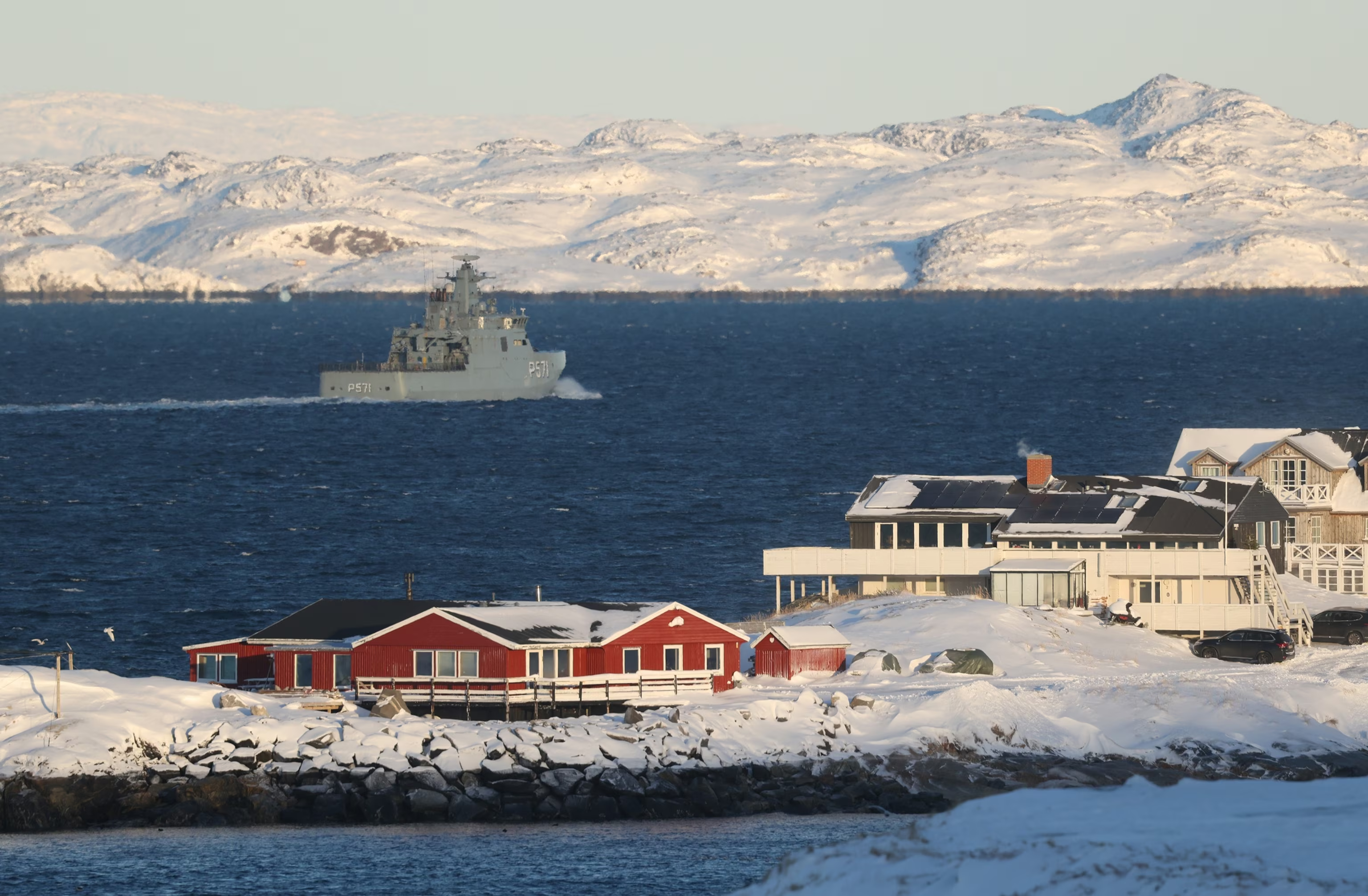
Tensions over Greenland flare among allies before Trump’s Davos talk. Source: ABC News

Risk Appetite Returned, Slowly

After the tariff threat was pulled, stock indexes rallied. The pan-European STOXX 600 gained back ground, rising about 1.2% as traders stepped back into risk assets and some panic cooled. London shares also moved up in a broad rally that reflected relief across sectors.

Short, sharp moves hit markets. One minute confidence; the next minute forced selling. That pattern left bitcoin and ether lower from recent highs, and it reminded many investors that headlines still drive big swings.

Some long holders were squeezed out. Some traders were burned by over-extended bets. Reports note rare split liquidations where both long and short positions were affected.

Bitcoin is now trading at $89,946. Chart: TradingView

Recovery Was Cautious Not Complete

According to market stories, crypto prices rebounded after the immediate scare, but volume stayed thin and sentiment stayed tilted toward fear.

Traders who saw the drop as a buying chance kept their distance, while short-term players moved back in to chase quick gains. The bounce was real, but fragile.
Image: Brookings Institution

On Crypto & Geopolitical Noise

This episode shows that geopolitical noise can still push crypto the same way it pushes stocks. Even when the issue is not directly about digital assets, risk appetite matters.

When big, headline-driven moves happen, leveraged markets get whipsawed and people who bet too much either lose a lot or get forced out of their positions.

According to reports, the tariff retreat eased immediate worry and allowed markets to recover some lost ground, but the relief felt measured and watchful.

News can move markets fast. The mental framing of the selloff will probably keep traders cautious for a while, and any new twist in policy or diplomacy could bring fresh volatility.

Featured image from Unsplash, chart from TradingView

Domande pertinenti

QWhat was the immediate market reaction after President Trump announced he would not impose tariffs on Greenland?

AMarkets showed signs of life, with stock indexes rallying and the pan-European STOXX 600 gaining about 1.2% as traders stepped back into risk assets.

QHow much in leveraged crypto positions was liquidated during the initial selloff triggered by the geopolitical tension?

AMarket sentinels reported over $620 million in liquidations, with some trackers estimating the toll as high as approximately $870 million.

QWhat does the article suggest is the relationship between geopolitical events and the cryptocurrency market?

AThe article states that geopolitical noise can push crypto markets in the same way it pushes stocks, as it affects overall risk appetite, even when the issue is not directly about digital assets.

QWhat was the price of Bitcoin mentioned in the article's chart during the market events?

ABitcoin was trading at $89,946 according to the chart from TradingView featured in the article.

QHow did the article characterize the market's recovery after the initial scare?

AThe recovery was described as cautious and not complete, with thin trading volume and sentiment that remained tilted toward fear, making the bounce fragile.

Letture associate

Breaking: OpenAI Undergoes Major Reorganization, President Brockman Assumes Command

OpenAI has announced a major internal reorganization just months before its anticipated IPO. The company is merging its three flagship product lines—ChatGPT, Codex, and the API platform—into a single, unified product organization. The most significant leadership change involves co-founder and President Greg Brockman moving from a background technical role to take full, permanent control over all product strategy. This follows the indefinite medical leave of AGI Deployment CEO Fidji Simo. Additionally, ChatGPT's longtime lead, Nick Turley, has been reassigned to enterprise products, with former Instagram executive Ashley Alexander taking over consumer offerings. The consolidation, internally framed as a strategic move towards an "Agentic Future," aims to break down internal silos and create a cohesive "Super App." This planned desktop application would integrate ChatGPT's conversational abilities, Codex's coding power, and a rumored internal web browser named "Atlas" to autonomously perform complex user tasks. The reorganization occurs amid significant internal and external pressures. OpenAI has recently seen a wave of high-profile departures, including Sora co-lead Bill Peebles and other senior technical leaders, leading to concerns about a thinning executive bench. Externally, rival Anthropic recently secured funding at a staggering $900 billion valuation, surpassing OpenAI's own. Google's upcoming I/O developer conference also poses a competitive threat. Analysts suggest the dramatic restructure is a pre-IPO move to present a clearer, more focused narrative to Wall Street—streamlining operations and demonstrating decisive leadership under Brockman to counter internal turbulence and intense market competition.

marsbit1 h fa

Breaking: OpenAI Undergoes Major Reorganization, President Brockman Assumes Command

marsbit1 h fa

Two Survival Structures of Market Makers and Arbitrageurs

Market makers and arbitrageurs represent two distinct survival structures in high-frequency trading. Market makers primarily use limit orders (makers) to profit from the bid-ask spread, enjoying high capital efficiency (nominally 100%) but bearing inventory risk. This "inventory risk" arises from passive, fragmented, and discontinuous order fills in the limit order book (LOB). This risk, while a potential cost, can also contribute to excess profit if managed within control boundaries, allowing for mean reversion. Market makers essentially sell "time" (uncertainty over execution timing) to the market for price control and low fees. In contrast, cross-exchange arbitrageurs typically use market orders (takers) to exploit price differences or funding rates, resulting in lower nominal capital efficiency (requiring capital on both exchanges) and higher transaction costs. Their risk exposure stems from asymmetries in exchange rules (e.g., minimum order sizes), execution latency, and infrastructure risks (e.g., ADL, oracle drift). These exposures are active, exogenous gaps that primarily erode profits rather than contribute to them. Arbitrageurs essentially sell "space" (capital sunk across venues) for localized, immediate certainty. Both strategies engage in a trade-off between execution friction and residual risk. Optimal systems allow for temporary, controlled risk exposure rather than enforcing zero exposure at all costs. Their evolution converges towards hybrid models: arbitrageurs may use maker orders to reduce costs, while market makers may use taker orders or hedges for risk management. Ultimately, both use different forms of risk exposure—market makers exposing inventory, arbitrageurs immobilizing capital—to extract marginal, hard-won certainty from the market.

链捕手1 h fa

Two Survival Structures of Market Makers and Arbitrageurs

链捕手1 h fa

Who Will Define the Rules of the AI Era? Anthropic Discusses the 2028 US-China AI Landscape

This article, based on Anthropic's analysis, outlines the intensifying systemic competition between the U.S./allies and China for AI leadership by 2028. It argues that access to advanced computing power ("compute") is the critical bottleneck, where the U.S. currently holds a significant advantage through chip export controls and allied innovation. However, China's AI labs remain competitive by exploiting policy loopholes—via chip smuggling, overseas data center access, and "model distillation" attacks to copy U.S. model capabilities—keeping them close to the frontier. The piece presents two contrasting scenarios for 2028. In the first, decisive U.S. action to tighten compute controls and curb distillation locks in a 12-24 month AI capability lead, cementing democratic influence over global AI norms, security, and economic infrastructure. In the second, policy inaction allows China to achieve near-parity through continued access to U.S. technology, enabling Beijing to promote its AI stack globally and integrate advanced AI into its military and governance systems, altering the strategic balance. Anthropic contends that maintaining a decisive U.S. lead is essential for shaping safe AI development and governance. The core recommendation is for U.S. policymakers to urgently close compute and model access loopholes while promoting global adoption of the U.S. AI technology stack to secure a lasting strategic advantage.

marsbit3 h fa

Who Will Define the Rules of the AI Era? Anthropic Discusses the 2028 US-China AI Landscape

marsbit3 h fa

Trading

Spot
Futures

Articoli Popolari

Come comprare PUSH

Benvenuto in HTX.com! Abbiamo reso l'acquisto di Push Protocol (PUSH) semplice e conveniente. Segui la nostra guida passo passo per intraprendere il tuo viaggio nel mondo delle criptovalute.Step 1: Crea il tuo Account HTXUsa la tua email o numero di telefono per registrarti il tuo account gratuito su HTX. Vivi un'esperienza facile e sblocca tutte le funzionalità,Crea il mio accountStep 2: Vai in Acquista crypto e seleziona il tuo metodo di pagamentoCarta di credito/debito: utilizza la tua Visa o Mastercard per acquistare immediatamente Push ProtocolPUSH.Bilancio: Usa i fondi dal bilancio del tuo account HTX per fare trading senza problemi.Terze parti: abbiamo aggiunto metodi di pagamento molto utilizzati come Google Pay e Apple Pay per maggiore comodità.P2P: Fai trading direttamente con altri utenti HTX.Over-the-Counter (OTC): Offriamo servizi su misura e tassi di cambio competitivi per i trader.Step 3: Conserva Push Protocol (PUSH)Dopo aver acquistato Push Protocol (PUSH), conserva nel tuo account HTX. In alternativa, puoi inviare tramite trasferimento blockchain o scambiare per altre criptovalute.Step 4: Scambia Push Protocol (PUSH)Scambia facilmente Push Protocol (PUSH) nel mercato spot di HTX. Accedi al tuo account, seleziona la tua coppia di trading, esegui le tue operazioni e monitora in tempo reale. Offriamo un'esperienza user-friendly sia per chi ha appena iniziato che per i trader più esperti.

529 Totale visualizzazioniPubblicato il 2024.12.13Aggiornato il 2025.03.21

Come comprare PUSH

Discussioni

Benvenuto nella Community HTX. Qui puoi rimanere informato sugli ultimi sviluppi della piattaforma e accedere ad approfondimenti esperti sul mercato. Le opinioni degli utenti sul prezzo di PUSH PUSH sono presentate come di seguito.

活动图片












