Crypto market bottom in? Why Goldman Sachs sees ‘attractive entry point’

ambcryptoPubblicato 2026-03-27Pubblicato ultima volta 2026-03-27

Introduzione

Goldman Sachs suggests the cryptocurrency market may have bottomed, presenting an attractive entry point for select crypto-related stocks. Analyst James Yaro noted the market decline has reached approximately the historical peak-to-trough average, with the current cycle at 95% and 90% relative to historical price and volume declines. The firm highlighted Robinhood (HOOD), Figure Technologies (FIGR), and Coinbase (COIN) as key stocks, lowering COIN's price target to $235 (still implying over 35% upside) and HOOD's to $91 (30% potential upside). Both stocks are down about 55% from October 2025 highs. While Goldman joins other firms like Fidelity in calling a market bottom, research from Ecoinometrics cautions that Bitcoin's recovery could take around 10 months based on current drawdowns.

The crypto market may have established its bottom, offering an ‘attractive entry point’ for a few related stocks, according to investment bank Goldman Sachs.

On the 26th of March, in a note to investors, Goldman analyst James Yaro wrote,

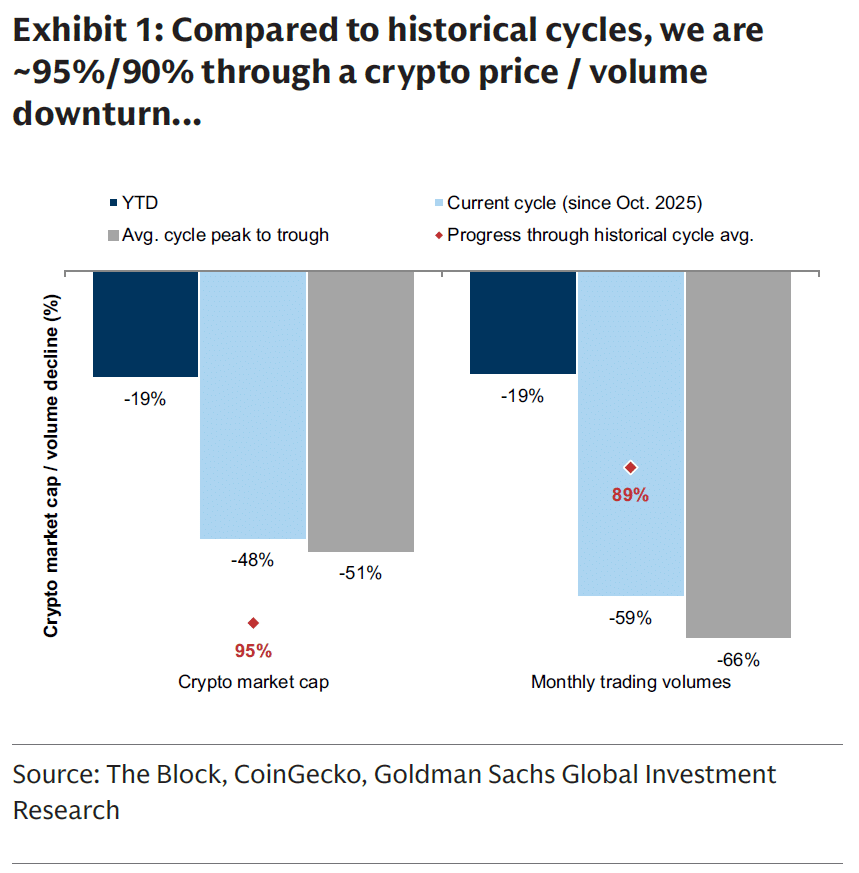
The crypto market price decline has approximately reached the historical peak-to-trough average.
Source: Goldman Sachs

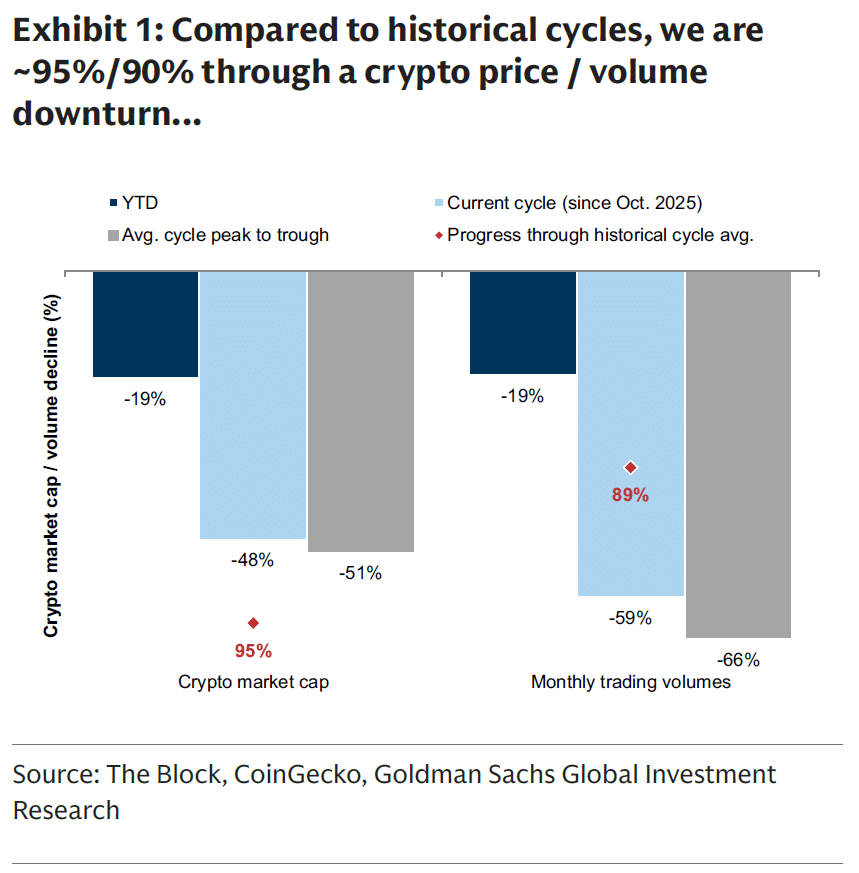
The investment research side of the firm referenced historical crypto price and volume downturns. According to the attached chart, the current cycle was at 95% and 90% relative to historical price/volume decline.

Yaro added,

All in, we see an increasingly attractive entry point to our digital-asset sensitive coverage, albeit selectively, across the group. Valuation is becoming more attractive, especially in names that are less exposed directly to crypto prices.

Crypto stocks vs. Bitcoin

The investment firm singled out Robinhood (Nasdaq: HOOD), Figure Technologies (Nasdaq: FIGR), and Coinbase (Nasdaq: COIN) as key crypto-related stocks of interest as the market stabilizes.

It lowered the Coinbase price target from $270 to $235. Still, this implied over 35% upside from its current COIN price of $173. Similarly, it downgraded its HOOD’s target from $102 to $91, implying a 30% upside potential from the press time value of $70.35.
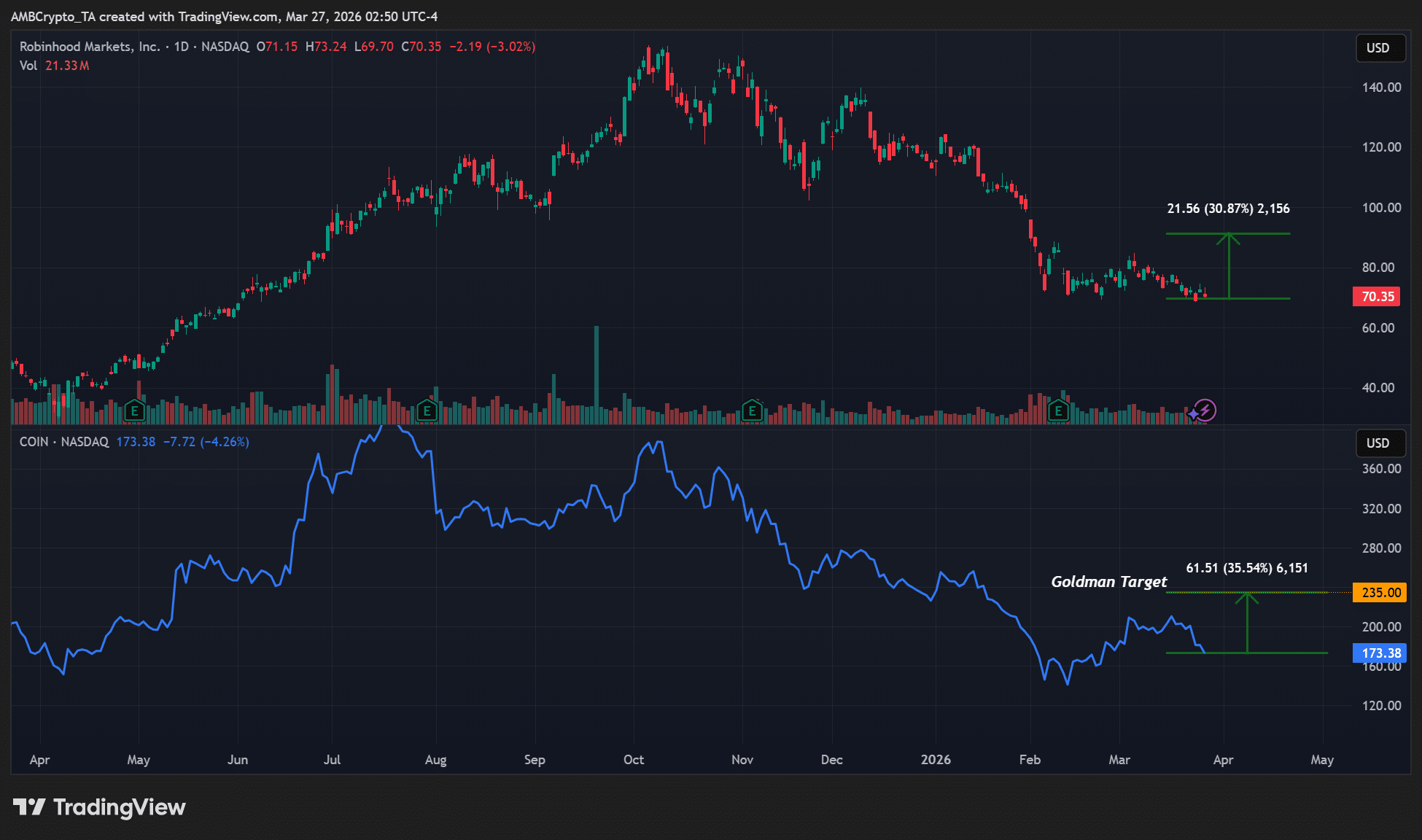
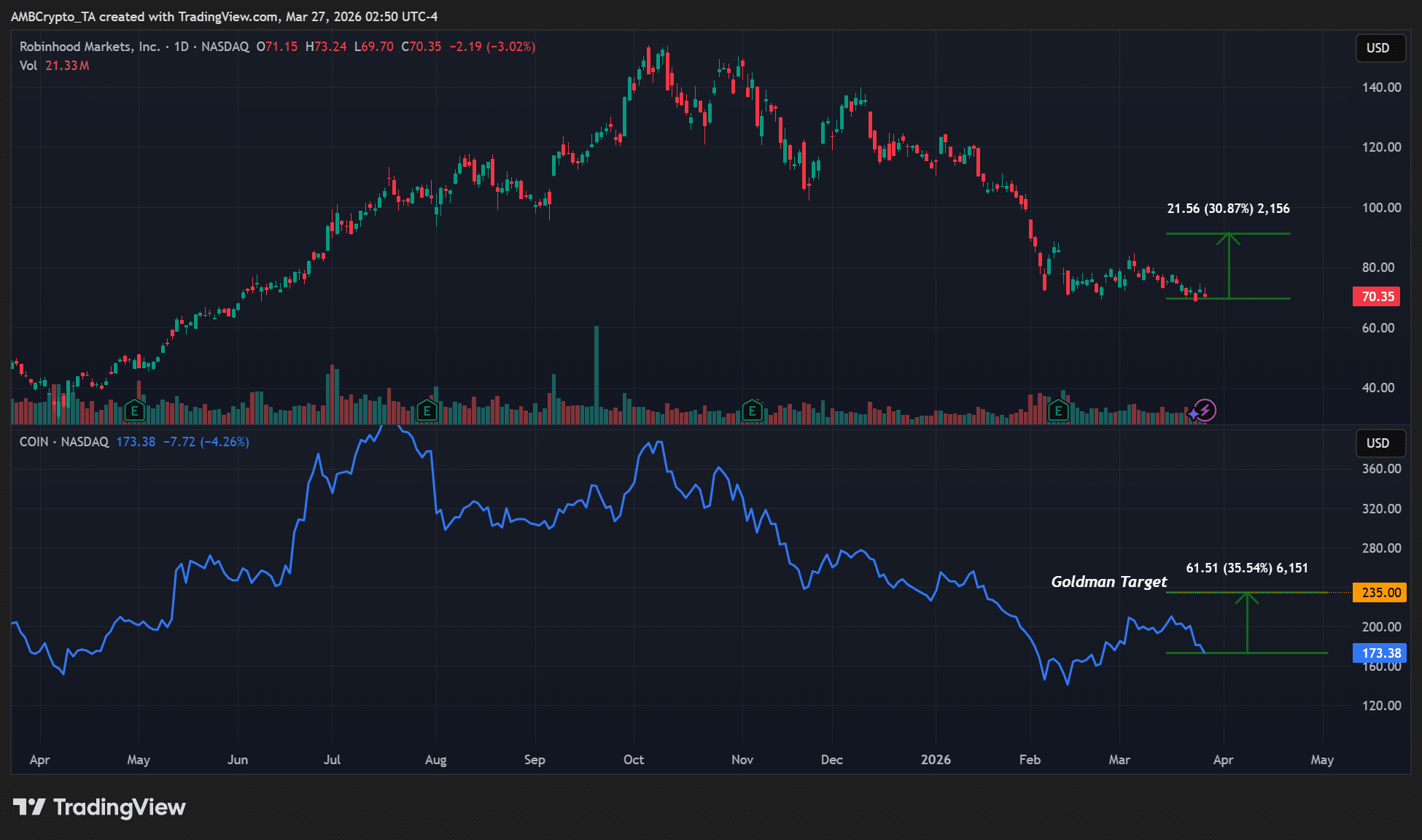
Source: HOOD vs. COIN price performance

Both crypto stocks were down about 55% from their October 2025 highs. Hence, this could be a discounted window if the crypto market rebounds strongly from here.

Goldman is the latest to make a crypto market bottom call, following Fidelity, Bitwise, and others who made similar projections after Bitcoin slipped to $60K in February.

In fact, from a price chart perspective, the 200-Weekly Moving Average (WMA) was at $59K as of writing, reinforcing the above projections. The past bear markets bottomed around this support.
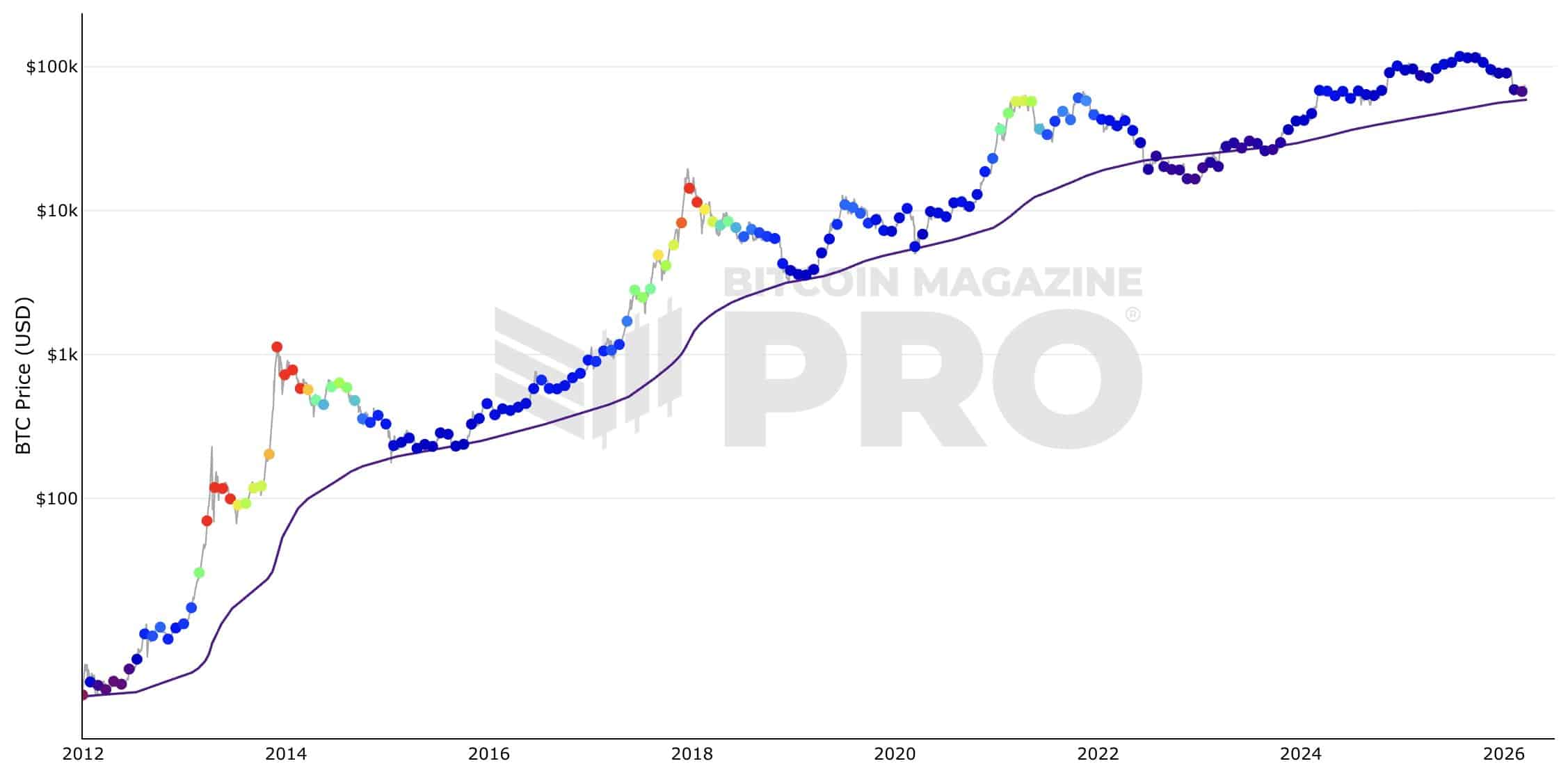
Source: BM Pro

Still, it could take way longer for Bitcoin to rebound than most people anticipate. According to crypto research firm Ecoinometrics, the “deeper Bitcoin falls, the longer it takes to recover.” The firm noted that for every 10% drop, it takes about 80 days for the asset to bounce back.

At the current drawdown, which implied 300 days (about 10 months) for BTC to fully recover, the firm cautioned.
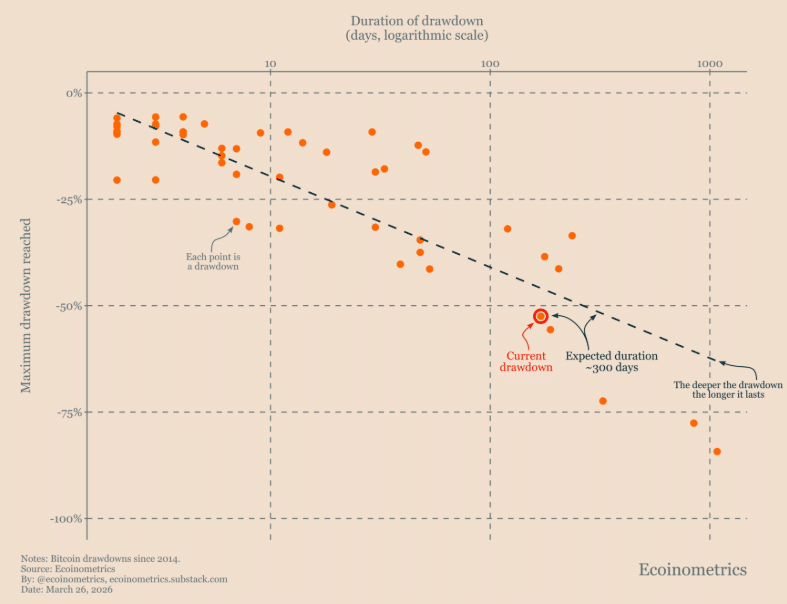
Source: Ecoinometrics

Final Summary

  • Goldman Sachs projected that the crypto market bottom may be near, as progress hit over 90% based on historical price and volume downturns.
  • However, Ecoinometrics cautioned that it could take an additional 10 months for a strong Bitcoin recovery.


Domande pertinenti

QAccording to Goldman Sachs, what percentage of the historical price and volume decline has the current crypto market cycle reached?

AThe current cycle has reached 95% of the historical price decline and 90% of the historical volume decline.

QWhich three crypto-related stocks did Goldman Sachs single out as key stocks of interest?

AGoldman Sachs singled out Robinhood (HOOD), Figure Technologies (FIGR), and Coinbase (COIN).

QWhat is Goldman Sachs' new price target for Coinbase (COIN) and what upside potential does it imply from the current price?

AGoldman Sachs lowered the Coinbase price target from $270 to $235, which implies over 35% upside from its current price of $173.

QWhat key technical indicator, mentioned in the article, reinforces the projection that the crypto market may have bottomed?

AThe 200-Weekly Moving Average (WMA) for Bitcoin, which was at $59K, reinforces the projection as past bear markets have bottomed around this support level.

QAccording to Ecoinometrics, how long does it take for Bitcoin to recover for every 10% drop in price, and what is the estimated total recovery time at the current drawdown?

AAccording to Ecoinometrics, for every 10% drop, it takes about 80 days for Bitcoin to recover. At the current drawdown, it is estimated to take 300 days (about 10 months) for a full recovery.

Letture associate

Annual Salary of Millions Competing for Electricians, Meta Rushes to Open Its Own Technical School

The AI boom is facing an unexpected bottleneck: a severe shortage of skilled construction workers and electricians. As tech giants like Meta, OpenAI, and Alphabet race to build massive data centers—such as OpenAI's $16 billion "Stargate" project—they are hitting a critical labor wall. The U.S. needs an estimated 130,000 more electricians, 240,000 construction workers, and 150,000 supervisors by 2030 for AI infrastructure alone, but tens of thousands of electrician jobs go unfilled each year. While AI companies offer high premiums, with electricians earning up to $280,000 annually, worker scarcity still causes massive losses—delays on a single project can cost $14.2 million per month. The complexity of building AI data centers, which require immense power (equivalent to powering hundreds of thousands of homes), sophisticated electrical systems, and advanced liquid cooling solutions, demands highly skilled technicians who are in short supply. To combat this, companies are investing heavily in training. Meta has committed $115 million to a free training school offering tuition, housing, and stipends, targeting 5,000 new workers. OpenAI is partnering with unions to secure skilled labor. These efforts are paying off, with a significant rise in Gen Z interest in trade schools over college. However, the power demands are staggering. AI data centers are driving a rapid surge in electricity consumption, projected to account for up to 12% of U.S. power use by 2028 and raising costs for consumers. Furthermore, the construction boom is project-based, leading to a potential future glut of trained workers once building peaks, which could depress wages industry-wide. The race for AI supremacy now depends as much on skilled hands as on advanced chips.

marsbit1 h fa

Annual Salary of Millions Competing for Electricians, Meta Rushes to Open Its Own Technical School

marsbit1 h fa

OpenAI No Longer Sells Its Most Expensive Model for Profit

OpenAI is shifting its business strategy away from promoting its most expensive, flagship models for every task. Recent price cuts—80% for GPT-5.6 Luna and 20% for Terra—signal a deeper change: the company now actively advises users that many tasks don't require the most powerful model. Instead, OpenAI recommends a tiered approach: use the high-end GPT-5.6 Sol for complex planning and analysis, then delegate execution to cheaper models like Luna. This mirrors moves by Anthropic, which recently launched Claude Opus 5 at half the price of its top model, Fable 5. Both companies are de-emphasizing flagship models as primary revenue drivers, using them instead for brand prestige and technological showcases. The industry is entering a "mass-market" phase, similar to automotive, where high-volume, cost-effective models handle daily operations and drive scale. OpenAI's price reductions are partly enabled by AI models themselves optimizing underlying code and infrastructure, creating a self-reinforcing cycle of efficiency gains and cost reduction. Competition is shifting from "who is smartest" to "who offers the best value." The goal is no longer selling individual models but fostering widespread API adoption and ecosystem lock-in. By making AI calls cheap and ubiquitous, companies like OpenAI aim to become the indispensable, utility-like infrastructure powering automated workflows—the "water and electricity" of software, quietly embedded everywhere.

marsbit1 h fa

OpenAI No Longer Sells Its Most Expensive Model for Profit

marsbit1 h fa

Trading

Spot
活动图片