Crypto Investors Cheer As South Korea Scraps Punishing Tax Plan

bitcoinistPubblicato 2026-03-20Pubblicato ultima volta 2026-03-20

Introduzione

South Korea's main opposition party, the People Power Party, has proposed a bill to abolish the planned 20% tax on cryptocurrency gains, which was scheduled to take effect in 2027. The tax had been repeatedly delayed due to political debates and concerns over fairness, as it imposed a lower threshold compared to stock gains. The proposal aims to integrate crypto income into a unified financial investment tax framework instead of maintaining a separate regime. While this offers short-term relief for investors, the country continues to advance broader crypto regulations, including user protection laws and AI-powered tracking systems, indicating that a more comprehensive and integrated tax environment may still emerge in the future.

South Korean right-wing lawmakers have proposed a bill to abolish the taxation of crypto assets scheduled to take effect on January 1, 2027.

A Long Chain Of Regulation Delays

According to Korean outlet Digital Asset, Korea’s main opposition party the People Power Party is advancing a plan that would effectively abolish the dedicated 20% “crypto tax” by merging virtual‐asset income into a unified financial investment tax framework, instead of enforcing a separate regime just for digital assets.

The proposal comes after multiple postponements. Ruling and opposition parties alternated between promising delays and demanding quick implementation, repeatedly using crypto tax timelines as an election wedge with youth voters. The original 20% tax on gains over roughly ₩2.5 million was pushed from 2022 to 2023, then to 2025, and then again toward 2027 amid political infighting and concerns over investor protection.

The core issue has lays in parity. Crypto gains were set to be taxed at 20% above a very low threshold, while stock gains only paid similar rates above ₩50 million, fueling claims that young, retail‐heavy crypto traders were being unfairly targeted. Song Eon-seok, floor leader of the party and the responsible for introducing the bill, explained:

Given that the financial investment income tax has been abolished for the development of the capital market and the protection of investors, imposing a separate income tax on digital assets raises issues regarding equity and consistency in the tax system.

Kim Han-gyu, senior deputy floor leader for policy of the Democratic Party, responded to the proposal saying that they ruling party will discuss the bill now that it’s been introduced, although “there is no serious discussion or consensus within the party”, local media reported.

South Korea In The Forefront Of Crypto Regulation

South Korea has already rolled out the Virtual Asset User Protection Act and is still fighting over a second‐phase “Virtual Asset Law” covering stablecoins and more comprehensive oversight, underscoring that taxation is only one piece of a much tougher framework.

While many jurisdictions are tightening tax enforcement on digital assets, South Korea is prioritizing regulatory safeguards and market structure first. It’s worth noting, however, that South Korea’s National Tax Service is also moving ahead with a strong AI Crypto Tracking System, as reported by Bitcoinist on March 12.

A more balanced tax design could reduce incentives for Korean traders to move volume offshore or into grey‐area platforms, potentially supporting onshore liquidity and institutional participation. The apparent end of a standalone crypto tax is a short‐term relief, but once the unified financial investment tax kicks in, sophisticated reporting and on‐chain tracing tools mean evasion risks will climb. Active traders should prepare for stricter KYC, better record‐keeping, and the possibility that today’s relief turns into tomorrow’s more robust, integrated tax regime.
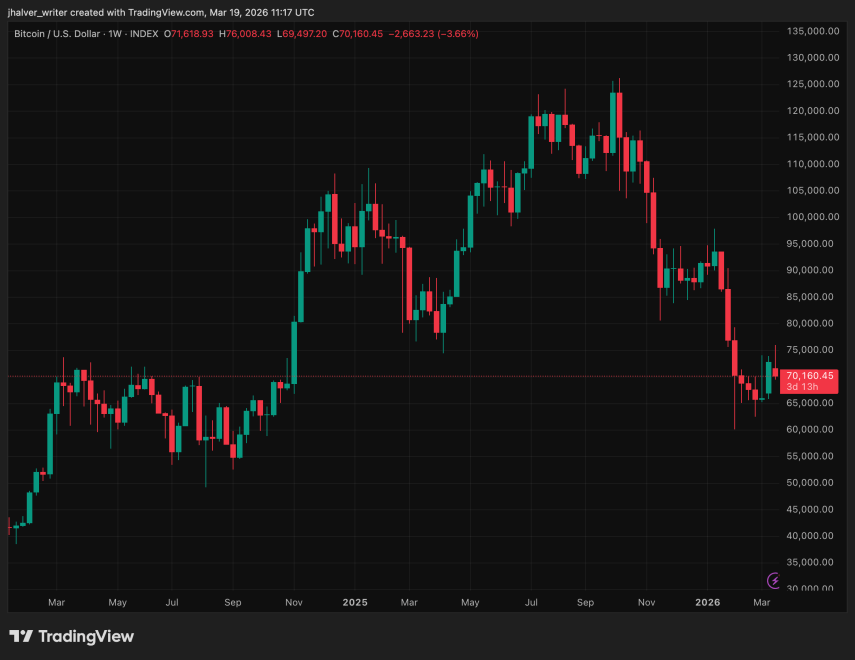
At the moment of writing, BTC’s trades for $70k on the daily chart. Source: BTCUSD on Tradingview

Cover image from Perplexity, BTCUSD chart from Tradingview

Domande pertinenti

QWhat is the main reason South Korean lawmakers are proposing to abolish the dedicated crypto tax?

AThey aim to address issues of equity and consistency in the tax system by merging virtual-asset income into a unified financial investment tax framework, rather than having a separate regime just for digital assets.

QHow many times has the implementation of South Korea's 20% crypto tax been postponed?

AThe tax has been postponed multiple times, originally from 2022 to 2023, then to 2025, and again to 2027.

QWhat was the key disparity between crypto and stock taxation that fueled claims of unfair targeting?

ACrypto gains were set to be taxed at 20% above a very low threshold (around ₩2.5 million), while stock gains only paid similar rates above a much higher threshold of ₩50 million.

QWhat broader regulatory framework is South Korea implementing alongside the tax discussion?

ASouth Korea has rolled out the Virtual Asset User Protection Act and is developing a second-phase 'Virtual Asset Law' covering stablecoins and more comprehensive oversight.

QWhat potential market impact could a more balanced tax design have according to the article?

AIt could reduce incentives for Korean traders to move volume offshore or into grey-area platforms, potentially supporting onshore liquidity and institutional participation.

Letture associate

Bitcoin Withdrawals Continue: 8 Years of Storage in a Coldcard Cold Wallet Ended in Zero

Coldcard Hardware Wallet Hacked: Losses Mount Due to Vulnerable Seed Generation A critical vulnerability in Coldcard hardware wallets has led to a continued wave of fund thefts. According to Galaxy Research, the total stolen has reached 1,367.05 BTC (approx. $88.6 million) from 4,585 addresses, a significant increase from the initial 594.5 BTC reported on July 30, 2026. Most of the stolen funds remain on the attackers' addresses. The issue is not with the current firmware, which Coinkite has updated, but with seed phrases generated on vulnerable devices between March 2021 and the release of fixed firmware versions. Due to a programmer error, devices switched from using a hardware random number generator to the software-based Yasmarang generator, which was initialized with publicly accessible data like the chip's serial number. This made the seed phrases predictable through offline brute-force attacks, meaning wallets remain at risk until funds are moved to a new wallet generated with the patched firmware. Affected devices include Mk2/Mk3 with firmware 4.0.1–4.1.9 (and up to 5.0.3), Mk4/Mk5 up to version 5.6.0, and Q models up to 1.5.0Q. The only exceptions are seeds created with a high-entropy method like at least 50 independent dice rolls or a strong unique BIP-39 passphrase. All other owners must generate a new seed on the fixed firmware and transfer their assets. A case highlighting the human impact involves a 39-year-old long-term investor who lost 2 BTC (approx. $130,000) in minutes. He had accumulated the Bitcoin over eight years through physical labor, viewing it as a financial lifeline and a retirement plan in a country suffering from hyperinflation. His story underscores that even conservative "buy and hold in cold storage" strategies can be compromised by such underlying technical flaws. From a technical perspective, this incident echoes historical failures where weak random number generators undermined cryptographic security, challenging the assumption that offline storage is automatically foolproof.

cryptonews.ru2 h fa

Bitcoin Withdrawals Continue: 8 Years of Storage in a Coldcard Cold Wallet Ended in Zero

cryptonews.ru2 h fa

Trading

Spot
活动图片





