Crypto Industry Watches As Poland Advances Long-Delayed Regulatory Bill

bitcoinistPubblicato 2026-05-16Pubblicato ultima volta 2026-05-16

Introduzione

Poland's parliament has passed a long-delayed cryptocurrency regulatory bill, driven by urgency following a fraud scandal at a local exchange. Prime Minister Donald Tusk cited the Zondacrypto case, where users lost access to funds and which had alleged Russian ties, as proof of the need for investor protections. The approved bill grants Poland's Financial Supervision Authority (KNF) broad powers to oversee the market, impose penalties, and block accounts or transactions. However, the legislation faces potential rejection, as it retains contentious account-blocking provisions that led President Karol Nawrocki to veto two prior versions. Critics argue it lacks sufficient judicial oversight. A third veto would prolong regulatory uncertainty as Poland races to align with the EU's MiCA framework by a July deadline. The bill prevailed over three other competing proposals in a parliamentary vote.

Poland’s prime minister has tied the country’s repeated failure to pass crypto rules to a high-profile fraud case — a charge that added urgency to a parliamentary vote that had already failed twice before.

A Scandal Shapes The Debate

Prime Minister Donald Tusk pointed to Zondacrypto, a Polish crypto exchange now under a prosecutor’s fraud probe, as evidence of what happens when investor protections are not in place.

Thousands of the exchange’s users reportedly could not access their funds, and Tusk alleged the platform had ties to Russian capital and influence dating to its early years.

He argued that Poland’s inability to finalize a regulatory framework had slowed any official response to the crisis.

The exchange scandal cast a long shadow over this week’s sitting of the Sejm, Poland’s lower house of parliament, where lawmakers debated four separate crypto bills simultaneously.
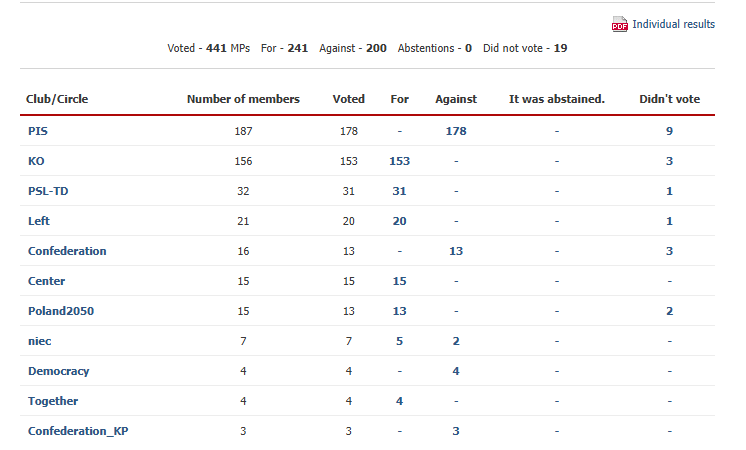
Source: SEJM

On Friday, they approved the government-backed bill — numbered 2529 and supported by the Ministry of Finance — by a vote of 241 to 200. It was the third time the government had pushed this kind of legislation through parliament after President Karol Nawrocki vetoed two earlier versions.

The approved bill hands broad authority to Poland’s Financial Supervision Authority, known as the KNF, to monitor crypto market participants, impose administrative penalties, and block accounts and transactions when deemed necessary.

Critics Point To Unchanged Provisions

Not everyone in the crypto community welcomed the outcome. Market participants and commentators noted that the account and transaction blocking provisions — the same ones that prompted Nawrocki’s previous vetoes — remained largely intact in the final text. Proposed changes such as stronger judicial oversight of enforcement actions were not included.

BTCUSD trading at $79,182 on the 24-hour chart: TradingView

With those concerns unresolved, many observers expect the president to veto the bill again. That prospect worries industry players, since a third rejection would deepen regulatory uncertainty at a particularly inconvenient time.

Poland is required to bring its rules in line with the European Union’s Markets in Crypto-Assets Regulation, known as MiCA, with implementation deadlines approaching in July.

Four Bills, One Outcome

The vote came after lawmakers reviewed competing proposals from four separate sources: the government, the president, the Confederation party, and a parliamentary group. A committee merged the texts before the final vote, and the government version ultimately prevailed.

Featured image from Hotels.com, chart from TradingView

Domande pertinenti

QWhat event did Poland's Prime Minister Donald Tusk link to the need for cryptocurrency regulation?

APrime Minister Donald Tusk linked the need for cryptocurrency regulation to the scandal surrounding the Zondacrypto exchange, which is under a fraud probe, where thousands of users reportedly could not access their funds.

QWhat is the main regulatory body granted authority under the newly passed Polish crypto bill, and what powers does it have?

AUnder the newly passed bill, Poland's Financial Supervision Authority (KNF) is granted broad authority to monitor crypto market participants, impose administrative penalties, and temporarily block accounts and transactions when deemed necessary.

QWhy do critics expect the Polish President to veto the recently passed cryptocurrency bill?

ACritics expect the President to veto the bill because it retains controversial provisions, such as the power to block accounts and transactions without the stronger judicial oversight that was proposed but not included, which were the same reasons for his previous vetoes.

QWhat is the external regulatory deadline that Poland is facing regarding cryptocurrency legislation?

APoland is facing a deadline to align its national rules with the European Union's Markets in Crypto-Assets Regulation (MiCA), with implementation deadlines approaching in July.

QHow many different cryptocurrency bills were debated in the Sejm, and which one was ultimately approved?

ALawmakers debated four separate cryptocurrency bills from different sources: the government, the president, the Confederation party, and a parliamentary group. The government-backed bill (number 2529) was the one ultimately approved after a committee merged the texts for a final vote.

Letture associate

Who Funds the Agents?

**Summary: Who Funds AI Agents?** OpenAI recently shut down a feature allowing AI agents to shop for users, highlighting the challenge of creating a secure and regulated environment for agent-driven transactions. While payment infrastructure exists, a crucial governance layer—defining spending limits, fraud detection, tax handling, and return policies—is largely missing. The potential is enormous: AI agents already processed $73M across 176M transactions last year, with McKinsey forecasting this could grow to $3-5T in global consumer commerce by 2030. The core competition isn't just about processing payments, which can be very cheap (especially with crypto-based settlement), but about controlling the rules that govern agent spending. Key players like Stripe and Coinbase are racing to dominate this governance layer. Stripe's acquisition of wallet provider Privy allows it to set spending policies, identity checks, and human-in-the-loop approvals directly at the wallet level. Similarly, Coinbase's stack, including its x402 protocol and AgentKit, embeds governance rules. This vertical integration across settlement, wallet, and governance layers is becoming the dominant strategy. Control over the governance layer is where significant future value lies. If agents handle trillions in transactions, even a small fee for managing compliance, fraud prevention, and policy enforcement could generate billions in annual revenue. The companies that successfully integrate across the payment stack will capture value from idle agent balances, transaction fees, and governance services, positioning themselves as the foundational banks of the AI agent economy.

marsbit24 min fa

Who Funds the Agents?

marsbit24 min fa

A Nation Blocks Chips, a Giant Buys a Nuclear Power Plant: Why It's Time to Seriously Consider DeAI

**Title: Great Powers Blockade Chips, Giants Buy Nuclear Plants: Why It's Time to Seriously Consider DeAI** In May 2026, the US closed loopholes for Chinese firms to acquire advanced NVIDIA chips via overseas subsidiaries. That same month, Kenya halted a $1B geothermal data center project involving Microsoft, fearing its immense energy consumption. Meanwhile, Huawei announced mass production of its Ascend AI chip. These disparate events underscore a new reality: the competition for computing power ("compute") has escalated beyond the tech industry, becoming a geopolitical and infrastructural battleground. A new era of oligopoly is forming, with control over the AI stack—from GPU chips (NVIDIA) and cloud platforms (AWS, Azure, Google Cloud) to foundational models (OpenAI, Anthropic)—concentrating in a few Western "AI Octopus" corporations. This centralization creates systemic risks: pricing power and platform lock-in for users, infrastructure fragility, and a widening "compute divide" that threatens to marginalize nations without independent AI capacity. An "AI Iron Curtain" is deepening through export controls. In response, some nations like Saudi Arabia and the UAE are investing heavily to buy compute power, aiming to transition from oil to AI economies. The EU seeks to triple its compute capacity by 2030 to reduce dependency. However, the spending gap is vast, with four US tech giants alone planning ~$750B in AI capex for 2026. The race is increasingly constrained by energy, with AI tasks consuming up to 1000x more power than web searches, pushing firms to even acquire nuclear plants. This landscape is fueling interest in Decentralized AI (DeAI). It proposes a third way: using open protocols to coordinate a global network of idle GPUs, independent developers, and data centers, creating an AI infrastructure without a single controlling entity. Leveraging blockchain and cryptographic verification, DeAI aims to break market concentration, disperse energy demands, reduce geopolitical dependencies, and enhance transparency. While still nascent in performance and stability, DeAI's core promise is not immediate superiority but providing a crucial alternative architecture to resist monopoly, censorship, and centralized power. As specialized AI hardware costs fall and open-source models flourish, the window to build this foundation is open. The very existence of such competition serves as a vital check against the inevitable abuse of concentrated power.

marsbit1 h fa

A Nation Blocks Chips, a Giant Buys a Nuclear Power Plant: Why It's Time to Seriously Consider DeAI

marsbit1 h fa

Trading

Spot
Futures

Articoli Popolari

Come comprare BILL

Benvenuto in HTX.com! Abbiamo reso l'acquisto di Billions Network (BILL) semplice e conveniente. Segui la nostra guida passo passo per intraprendere il tuo viaggio nel mondo delle criptovalute.Step 1: Crea il tuo Account HTXUsa la tua email o numero di telefono per registrarti il tuo account gratuito su HTX. Vivi un'esperienza facile e sblocca tutte le funzionalità,Crea il mio accountStep 2: Vai in Acquista crypto e seleziona il tuo metodo di pagamentoCarta di credito/debito: utilizza la tua Visa o Mastercard per acquistare immediatamente Billions NetworkBILL.Bilancio: Usa i fondi dal bilancio del tuo account HTX per fare trading senza problemi.Terze parti: abbiamo aggiunto metodi di pagamento molto utilizzati come Google Pay e Apple Pay per maggiore comodità.P2P: Fai trading direttamente con altri utenti HTX.Over-the-Counter (OTC): Offriamo servizi su misura e tassi di cambio competitivi per i trader.Step 3: Conserva Billions Network (BILL)Dopo aver acquistato Billions Network (BILL), conserva nel tuo account HTX. In alternativa, puoi inviare tramite trasferimento blockchain o scambiare per altre criptovalute.Step 4: Scambia Billions Network (BILL)Scambia facilmente Billions Network (BILL) nel mercato spot di HTX. Accedi al tuo account, seleziona la tua coppia di trading, esegui le tue operazioni e monitora in tempo reale. Offriamo un'esperienza user-friendly sia per chi ha appena iniziato che per i trader più esperti.

183 Totale visualizzazioniPubblicato il 2026.05.07Aggiornato il 2026.06.02

Come comprare BILL

Discussioni

Benvenuto nella Community HTX. Qui puoi rimanere informato sugli ultimi sviluppi della piattaforma e accedere ad approfondimenti esperti sul mercato. Le opinioni degli utenti sul prezzo di BILL BILL sono presentate come di seguito.

活动图片













