Crypto groups slam Citadel for urging tighter DeFi tokenization rules

cointelegraphPubblicato 2025-12-13Pubblicato ultima volta 2025-12-13

Introduzione

A coalition of crypto organizations, including Andreessen Horowitz and the Uniswap Foundation, has criticized Citadel Securities for urging the SEC to impose stricter regulations on DeFi platforms offering tokenized stocks. The group argues that Citadel's proposal relies on a flawed analysis of securities laws and would inappropriately extend registration requirements to decentralized entities. They contend that regulating DeFi under traditional securities frameworks is impractical and fails to recognize that autonomous software cannot act as a regulated intermediary. While sharing the goal of investor protection, the coalition believes it can be achieved through onchain markets without mandatory registration. Citadel had warned that exempting DeFi could create a dual regulatory system and deprive investors of key protections. The debate arises as the SEC seeks feedback on regulating tokenized assets.

A group of crypto organizations has pushed back on Citadel Securities’ request that the Securities and Exchange Commission tighten regulations on decentralized finance when it comes to tokenized stocks.

Andreessen Horowitz, the Uniswap Foundation, along with crypto lobby groups the DeFi Education Fund and The Digital Chamber, among others, said they wanted “to correct several factual mischaracterizations and misleading statements” in a letter to the SEC on Friday.

The group was responding to a letter from Citadel earlier this month, which urged the SEC not to give DeFi platforms “broad exemptive relief” for offering trading of tokenized US equities, arguing they could likely be defined as an “exchange” or “broker-dealer” regulated under securities laws.

“Citadel’s letter rests on a flawed analysis of the securities laws that attempts to extend SEC registration requirements to essentially any entity with even the most tangential connection to a DeFi transaction,” the group said.

The group added they shared Citadel’s aims of investor protection and market integrity, but disagreed “that achieving these goals always necessitates registration as traditional SEC intermediaries and cannot, in certain circumstances, be met through thoughtfully designed onchain markets.”

Citadel’s ask would be impractical, group says

The group argued that regulating decentralized platforms under securities laws “would be impracticable given their functions” and could capture a broad range of onchain activities that aren’t usually considered as offering exchange services.

The letter also took aim at Citadel’s characterization that autonomous software was an intermediary, arguing it can’t be a “‘middleman’ in a financial transaction because it is not a person capable of exercising independent discretion or judgment.”
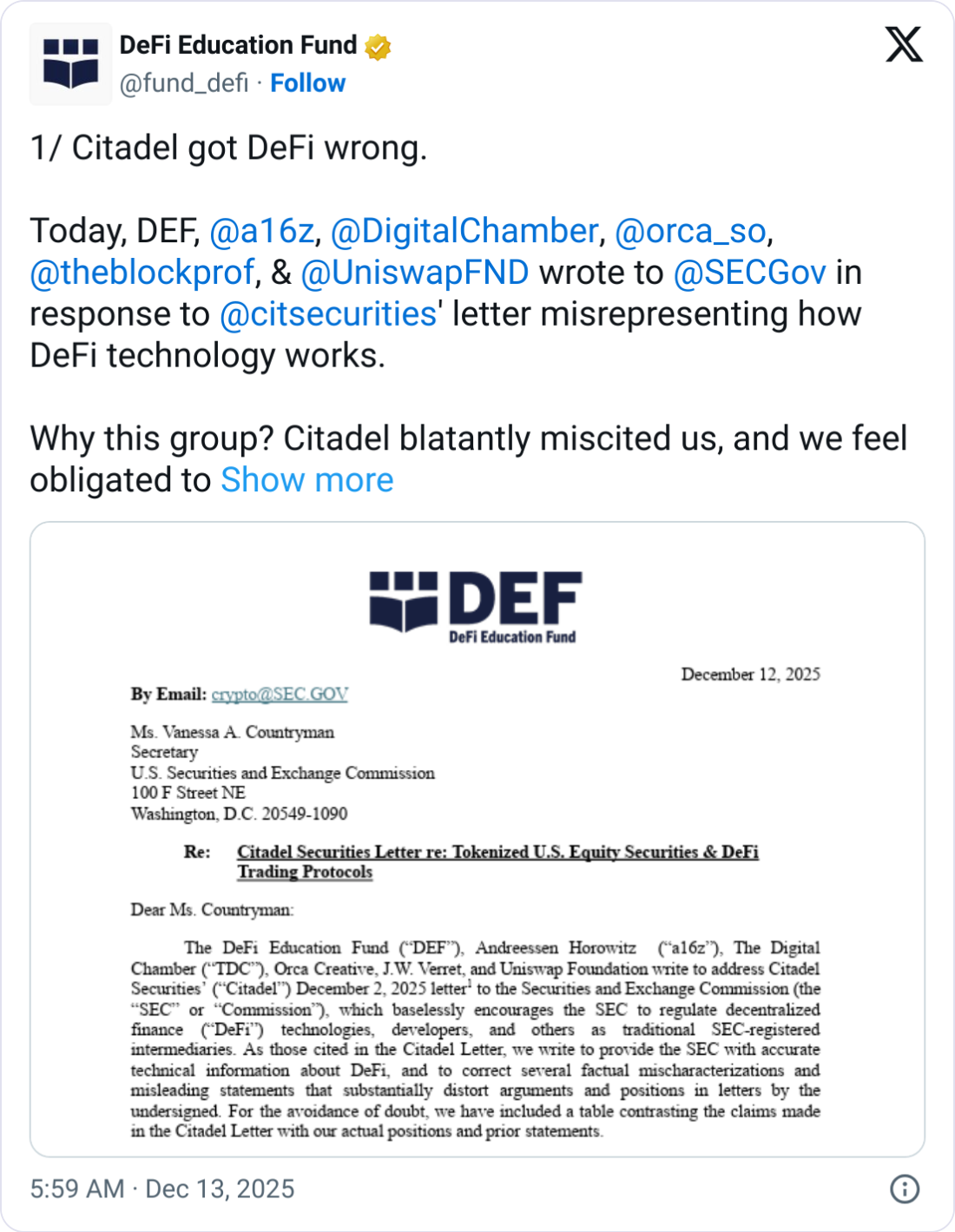
Source: DeFi Education Fund

“DeFi technology is a new innovation that was designed to address market risks and resiliency in a different way than traditional financial systems do, and DeFi protects investors in ways that traditional finance cannot,” the group argued.

Related: SEC’s Crenshaw takes aim at crypto in final weeks at agency

In its letter, Citadel had argued that the SEC giving the green light to tokenized shares on DeFi “would create two separate regulatory regimes for the trading of the same security” and would undermine “the ‘technology-neutral’ approach taken by the Exchange Act.”

Citadel argued that exempting DeFi platforms from securities laws could harm investors, as the platforms wouldn’t have protections such as venue transparency, market surveillance and volatility controls, among others.

The letter initially drew considerable backlash, with Blockchain Association CEO Summer Mersinger saying Citadel’s stance was an “overbroad and unworkable approach.”

The letters come as the SEC looks for feedback on how it should approach regulating tokenized stocks, and agency chair Paul Atkins has said that the US financial system could embrace tokenization in a “couple of years.”

Tokenization has exploded in popularity this year, but NYDIG warned on Friday that assets moving onchain won’t immediately be of great benefit to the crypto market until regulations allow them to more deeply integrate with DeFi.

Magazine: SEC’s U-turn on crypto leaves key questions unanswered

Letture associate

Wall Street Capital Enters ARC, Circle Sparks a System-Level Competition for Stablecoins

Wall Street Capital Enters the ARC Arena as Circle Launches a System-Level Battle for Stablecoin Dominance On May 11, Circle successfully raised $222 million in a pre-sale funding round for its new blockchain and native token, ARC, giving the network a fully diluted valuation of $3 billion. The investor lineup, featuring Wall Street giants like BlackRock and Intercontinental Exchange alongside top-tier venture capital firms such as a16z and ARK Invest, signaled a collective strategic bet on future financial infrastructure. This move marks Circle's significant evolution from a stablecoin issuer (notably USDC) to a designer of financial systems. While USDC operates on external blockchains like Ethereum, making Circle dependent on their performance, ARC aims to create a dedicated infrastructure for the circulation, payment, and clearing of stablecoins. This would integrate currency issuance and circulation into one system, potentially shifting Circle's business model from asset management to infrastructure provision. The convergence of traditional finance and crypto-native capital in this funding round underscores a broader industry shift: stablecoins are transitioning from being mere trading tools to becoming core components of financial infrastructure. By controlling both the issuance (via USDC) and the流通 pathway (via ARC), Circle could establish a closed-loop system from issuance to settlement. If successful, this infrastructure could optimize costs, lower barriers for institutional adoption, and promote standardization in on-chain finance. Ultimately, it has the potential to challenge traditional systems like SWIFT in areas such as cross-border payments, representing a possible step toward the重构 of global financial infrastructure.

marsbit1 h fa

Wall Street Capital Enters ARC, Circle Sparks a System-Level Competition for Stablecoins

marsbit1 h fa

Circle's Three-Dimensional Valuation Framework: Where Is the Bottom, Where Is the Top

"Circle's 3D Valuation Framework: Where is the Bottom, Where is the Top?" - Article Summary The article analyzes Circle's valuation following its Q1 2026 earnings. While its core business generates substantial interest income from USDC reserves ($6.53B in Q1, up 17% YoY), this revenue is highly sensitive to interest rates and shared significantly with Coinbase. The author proposes a three-dimensional valuation framework: 1. **Interest Business (The Floor):** Valued like a bank (8-15x P/E) on net interest income after Coinbase's share. This provides a conservative valuation baseline. 2. **Payment & Platform Business (The Inflection Point):** Includes CPN (Circle Payments Network) and "Other Revenue" (transaction, integration services). This high-growth segment, not shared with Coinbase, is valued on a platform/network model (higher P/S multiples), similar to Visa/Mastercard. It represents Circle's shift beyond pure interest income. 3. **Arc Network & ARC Token (The Future / Optionality):** Arc is an institutional-focused, EVM-compatible L1 blockchain where USDC is the native gas token. A $222M ARC token pre-sale at a $3B FDV attracted major traditional finance players (BlackRock, Apollo, ICE). While Circle holds 25% of ARC tokens, their value is separate from CRCL equity. This dimension represents the long-term, high-upside bet on Circle becoming an "economic operating system." Current market cap (~$30B) prices in significant future growth beyond the sum-of-the-parts valuation derived from current earnings. The investment thesis hinges on believing in Circle's transition from a "stablecoin issuer" to a broader financial infrastructure and network platform. Key variables for the future include USDC adoption growth, CPN network effects, Arc's success, and potential renegotiation of the Coinbase revenue-sharing agreement.

marsbit2 h fa

Circle's Three-Dimensional Valuation Framework: Where Is the Bottom, Where Is the Top

marsbit2 h fa

Trading

Spot
Futures
活动图片