Ripple CEO Brad Garlinghouse is slated to appear on a World Economic Forum (WEF) panel on tokenization during Davos 2026, while Hedera says it will sponsor and participate in a slate of senior-level events running alongside the annual gathering. The WEF Annual Meeting 2026 is scheduled for Jan. 19–23 in Davos-Klosters.
Ripple Joins WEF Davos Tokenization Panel
Garlinghouse is once again listed among the public speakers for a WEF session titled “Is Tokenization the Future?” set for Jan. 21 (10:15–11:00 CET). The panel also lists Coinbase CEO Brian Armstrong, Standard Chartered CEO Bill Winters, ECB Governor François Villeroy de Galhau, Eurazeo CEO Valérie Urbain, and moderator Karen Tso.
The session framing is explicitly market-structure oriented, positioning tokenization as something moving beyond pilots and into mainstream financial rails. In the WEF description, organizers write: “Asset tokenization is accelerating quickly, moving from early experiments to full deployment across major asset classes. As adoption expands, it promises new ways for individuals to invest while presenting traditional firms and emerging innovators with complex new dynamics.”
A separate thread of Ripple’s Davos presence may run through “USA House,” a privately organized venue that typically operates in parallel with the official WEF perimeter. Venue materials list Ripple among sponsors of USA House for Davos 2026.
Hedera Brings EcoGuard Global To Davos
Hedera, for its part, is leaning into Davos week as a convening calendar rather than a single stage appearance. In a statement via X, Hedera announced: “Hedera is proud to be an official sponsor of the USA House during the WEF Annual Meeting in Davos, and will contribute to senior-level discussions on digital assets, AI, central banking, and G20 coordination.”
Hedera is also sponsoring Global Blockchain Business Council’s “Blockchain Central Davos,” which runs Jan. 19–22 alongside the WEF meeting, according to Hedera and GBBC materials.
Separately, a Hedera-built carbon-market initiative called EcoGuard Global is scheduled to officially launch in Davos on Jan. 20 at Turmhotel Victoria (3:00–6:00 PM), per EcoGuard’s announcement.
The EcoGuard description pitches an end-to-end infrastructure play around integrity and lifecycle accounting:
“EcoGuard Global is a full carbon lifecycle company building and operating digital infrastructure and managed marketplaces—while actively participating in carbon markets as a developer, investor, and market enabler for high-integrity climate projects... Built on the Hedera network by The Hashgraph Group, EcoGuard Global combines trusted digital infrastructure with market operations, capital, and partnerships to support credible, investable, and scalable carbon markets.”
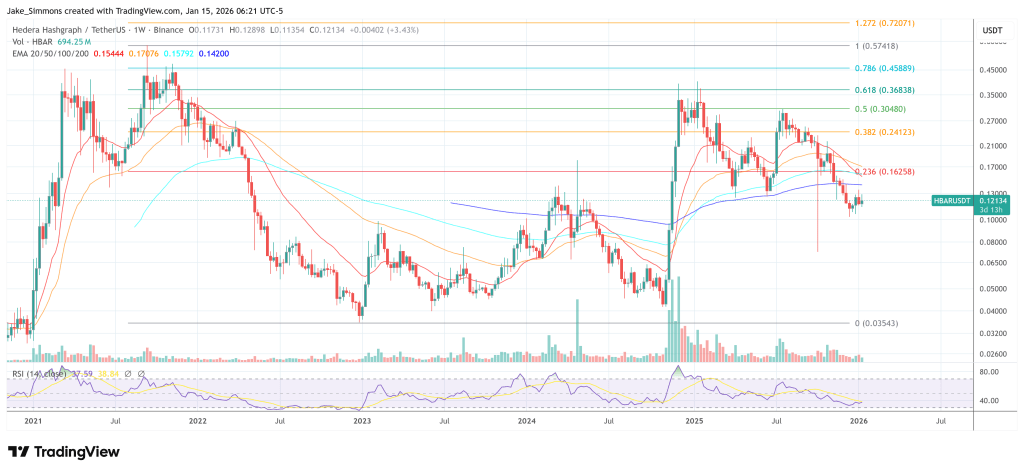
At press time, HBAR traded at $0.12134.