Crypto Giant a16z Sets Up Shop In South Korea In Major Asia Push

bitcoinistPubblicato 2025-12-11Pubblicato ultima volta 2025-12-11

Introduzione

Crypto venture capital firm Andreessen Horowitz (a16z) has opened its first Asian office in Seoul, South Korea, to expand its regional presence. The office will be led by Sungmo Park, Head of APAC go-to-market, and aims to support portfolio companies and build local partnerships. This move is driven by significant growth in the Asia-Pacific crypto market, which saw $2.36 trillion in on-chain value over the past year. South Korea is a key market, with nearly one in three adults holding crypto assets. The office will focus on go-to-market support, helping founders navigate local markets and access global partners, rather than large-scale investing initially. This expansion reflects increasing competition and activity in Asia's crypto sector.

Crypto venture capital firm Andreessen Horowitz (A16z) has opened its first Asian office in Seoul, South Korea, signaling a deeper push into the region where on-chain activity and user adoption have surged. According to the firm, the new hub will support portfolio companies and help build local partnerships and communities.

A16z Moves Into Seoul

The office will be led by Sungmo Park, who has held roles at Monad and Polygon, and who joins a16z as Head of APAC go-to-market. Reports have disclosed that Anthony Albanese, the fund’s chief operating officer, announced the move and framed it as a way to put teams closer to where users and builders are located.

A16z said Seoul will act as a gateway for interacting with companies across Asia and for giving portfolio firms local support on partnerships, marketing and expansion. Park will focus on regional strategy and on helping founders navigate local markets. This is not described as a small PR outpost; it is positioned as a real operating base for the region.

Based on reports, Asia-Pacific recorded about US$2.36 trillion in on-chain value over the 12 months ending June 2025, an increase of close to 70% from the prior year. That growth helped convince a16z that Asia needs a local presence. Chainalysis and several industry trackers show heavy on-chain flows and deep retail participation across the region.

Why Korea Matters To Crypto

South Korea itself is highlighted as one of the largest national crypto markets. According to a16z and other coverage, nearly one in three adults in South Korea hold crypto assets — a rate that in some measures is higher than local stock ownership. That level of retail use, plus a thriving developer community, made Seoul an attractive choice for the firm.

BTCUSD now trading at $90,257. Chart: TradingView

What The Move Could Mean

The entry of a major US venture firm into Seoul may boost interest among local startups seeking international partners and could make capital more accessible for teams in South Korea and nearby markets. Several news outlets describe the office as focused on go-to-market support rather than immediate, large-scale local investing, at least at launch.

Competition For Deals

Reports note that other global funds and crypto firms have been increasing activity in Asia this year. A16z’s decision comes as several markets across the region report rising developer activity and fresh funding rounds. For founders, having an established US investor with a local office may speed introductions to global customers and partners.

Featured image from Unsplash, chart from TradingView

Letture associate

When Hyperliquid Takes Away Solana's "Internet Capital Markets" Script

The article discusses how Solana's vision of becoming the "Internet Capital Markets" is being challenged, primarily by the rise of Hyperliquid. While Solana positioned itself as a high-performance blockchain for tokenizing all global assets, its native token SOL has significantly underperformed, and its core narrative faces pressure. Hyperliquid, initially a perpetual contracts platform, has evolved into a specialized Layer 1 financial network. Its focused, trading-optimized design is attracting users and capital, suggesting a vertical L1 may be better suited for a core capital market than a general-purpose chain like Solana. This external competition was compounded by an internal $200M+ exploit on Solana's key derivatives protocol, Drift, creating a strategic vacuum. In response, Solana founder Anatoly Yakovenko heavily promoted the Phoenix protocol as a decentralized, composable alternative. However, Phoenix's trading volume remains far behind leading platforms. Solana supporters also launched critiques against Hyperliquid's decentralization, citing its limited validators and closed-source code. Critics countered that Solana's own decentralization metrics have weakened, and the foundation's overt backing of Phoenix caused friction with other ecosystem builders. The piece concludes that Solana risks losing the "Internet Capital Markets" race if it cannot regain dominance in derivatives, potentially remaining a meme coin hub rather than achieving its grand ambition of hosting all global assets.

marsbit1 h fa

When Hyperliquid Takes Away Solana's "Internet Capital Markets" Script

marsbit1 h fa

Trump Signs Executive Order, Kraken, Coinbase and Others May Gain Access to Fed Payment Channels

President Trump has signed an executive order, "Incorporating Financial Technology Innovation into the Regulatory Framework," pressuring the Federal Reserve to reassess its rules on granting non-bank financial companies—including crypto and fintech firms—access to its payment systems, specifically master accounts that connect to the Fedwire settlement system. Currently, such accounts are primarily reserved for depository institutions. The order mandates a review to determine if broader access is permissible and to establish an application process. This move, supported by figures like Senator Cynthia Lummis, aims to reduce barriers to innovation and lower public payment costs by fostering fairer competition. It does not grant immediate access but could pave the way for companies like Kraken, Coinbase, Ripple, and Circle to reduce reliance on intermediary banks, lowering costs and speeding up settlements. A key precedent is the Kansas City Fed granting Kraken's parent company a restricted master account in March, offering limited payment services without interest or credit privileges. This model is seen as a potential template for allowing controlled access while mitigating systemic risk. Other firms like Anchorage, Paxos, and BitGo, which hold specialized banking charters, are also well-positioned to apply. The banking industry, represented by the American Bankers Association, opposes easing access, arguing any institution handling bank-like payments must meet the same stringent regulatory, consumer protection, and risk-management standards as traditional banks. Their core concerns include potential systemic risks, compliance gaps in areas like anti-money laundering, and the diversion of liquidity from the traditional banking system. The outcome of the Fed's review will be crucial in determining whether and how crypto and fintech firms can integrate more directly into the core U.S. financial infrastructure, balancing innovation with financial stability.

marsbit1 h fa

Trump Signs Executive Order, Kraken, Coinbase and Others May Gain Access to Fed Payment Channels

marsbit1 h fa

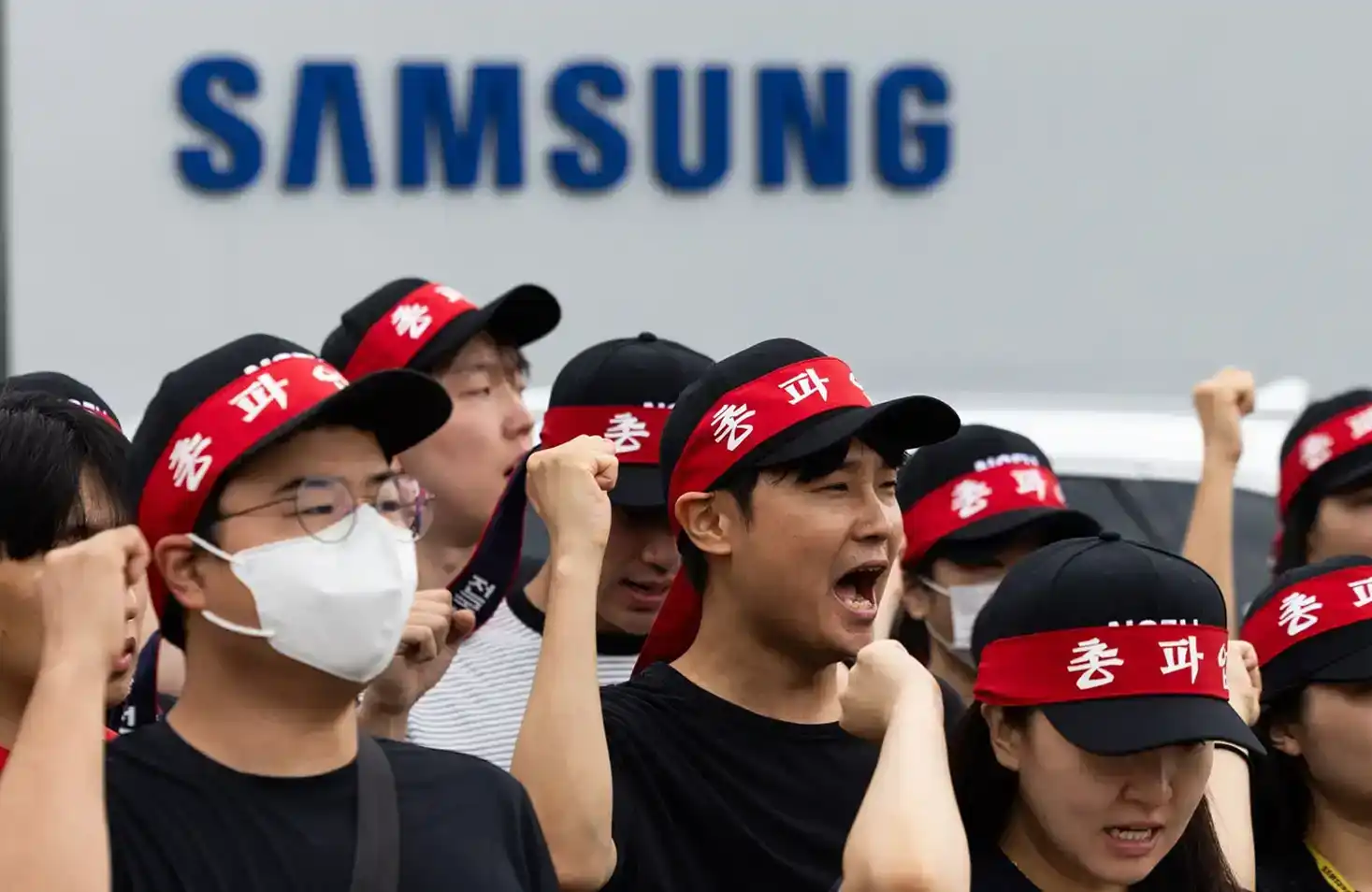
The First Large-Scale Strike in the AI Era Comes from the Factories That Build AI

The article describes a potential large-scale strike at Samsung Electronics, narrowly averted in May 2026 after a temporary agreement. The strike, planned by the company's union, would have been the first major labor action in the AI era targeting a core AI supply chain player. Samsung, alongside SK Hynix, produces roughly two-thirds of the world's memory chips, critical components for AI training and data centers like HBM. An 18-day strike could have disrupted global supply, affecting prices and production for tech companies and cloud providers. For South Korea, where semiconductors constitute about 35% of exports and Samsung represents a quarter of the stock market's value, such an action threatens national economic stability. The union's demands include a 7% base wage increase and, crucially, a clear, substantial profit-sharing model. They want 15% of annual operating profit as an employee bonus pool and the removal of the existing cap (about 50% of annual salary). This frustration is amplified by seeing rival SK Hynix successfully negotiate a deal granting employees 10% of operating profit as bonuses, with reports suggesting some workers could receive bonuses equivalent to hundreds of thousands of dollars. The conflict stems from deeper issues in South Korea's chaebol (conglomerate) system, where rapid national industrialization often prioritized corporate growth over labor rights. Samsung long maintained a "no union" policy until a 2020 apology from its leader. The article argues this strike highlights a fundamental tension in the AI age: as technology advances and corporate profits soar—often driven by AI—the workers who build the infrastructure are demanding a fair share and dignity, rejecting the notion that they are mere expendable components in a machine that "must not stop." The piece concludes that the true test of the AI era isn't just computational power, but whether the people who build the future can secure a stable and valued place within it.

marsbit2 h fa

The First Large-Scale Strike in the AI Era Comes from the Factories That Build AI

marsbit2 h fa

Ripple’s Fed Master Account Bid Gains Momentum After Trump Order

President Donald Trump has signed an executive order directing financial regulators and the Federal Reserve to review expanding fintech and crypto firms' access to core payment infrastructure. This order significantly advances the industry's push for direct Fed connectivity, a central issue for Ripple. The company has been seeking a Federal Reserve master account as part of its strategy for its RLUSD stablecoin, which would allow it to hold reserves directly with the central bank and access its payment rails. The order, titled "Integrating Financial Technology Innovation into Regulatory Frameworks," mandates a Fed review within 120 days on allowing access for entities like uninsured depository institutions and non-bank financial companies, including those in digital assets. This creates a formal policy timeline for resolving whether crypto payment firms must rely on traditional bank intermediaries. Ripple's application for a national bank charter and a master account is part of this broader landscape. The issue gained precedent when Kraken Financial received a limited-purpose master account, while Custodia Bank's application was denied after a legal battle. The Fed has also proposed a more restricted "payment account" option. Trump's order does not guarantee approval for Ripple but forces a high-level examination of the regulatory barriers, bringing the company's long-running effort to the forefront of Washington's financial policy agenda.

bitcoinist2 h fa

Ripple’s Fed Master Account Bid Gains Momentum After Trump Order

bitcoinist2 h fa

Trading

Spot
Futures

Articoli Popolari

Come comprare PUSH

Benvenuto in HTX.com! Abbiamo reso l'acquisto di Push Protocol (PUSH) semplice e conveniente. Segui la nostra guida passo passo per intraprendere il tuo viaggio nel mondo delle criptovalute.Step 1: Crea il tuo Account HTXUsa la tua email o numero di telefono per registrarti il tuo account gratuito su HTX. Vivi un'esperienza facile e sblocca tutte le funzionalità,Crea il mio accountStep 2: Vai in Acquista crypto e seleziona il tuo metodo di pagamentoCarta di credito/debito: utilizza la tua Visa o Mastercard per acquistare immediatamente Push ProtocolPUSH.Bilancio: Usa i fondi dal bilancio del tuo account HTX per fare trading senza problemi.Terze parti: abbiamo aggiunto metodi di pagamento molto utilizzati come Google Pay e Apple Pay per maggiore comodità.P2P: Fai trading direttamente con altri utenti HTX.Over-the-Counter (OTC): Offriamo servizi su misura e tassi di cambio competitivi per i trader.Step 3: Conserva Push Protocol (PUSH)Dopo aver acquistato Push Protocol (PUSH), conserva nel tuo account HTX. In alternativa, puoi inviare tramite trasferimento blockchain o scambiare per altre criptovalute.Step 4: Scambia Push Protocol (PUSH)Scambia facilmente Push Protocol (PUSH) nel mercato spot di HTX. Accedi al tuo account, seleziona la tua coppia di trading, esegui le tue operazioni e monitora in tempo reale. Offriamo un'esperienza user-friendly sia per chi ha appena iniziato che per i trader più esperti.

530 Totale visualizzazioniPubblicato il 2024.12.13Aggiornato il 2025.03.21

Come comprare PUSH

Discussioni

Benvenuto nella Community HTX. Qui puoi rimanere informato sugli ultimi sviluppi della piattaforma e accedere ad approfondimenti esperti sul mercato. Le opinioni degli utenti sul prezzo di PUSH PUSH sono presentate come di seguito.

活动图片