Crypto Funds Extend Three-Week Run With $1B Inflows Despite Geopolitical Stress

bitcoinistPubblicato 2026-03-17Pubblicato ultima volta 2026-03-17

Global crypto funds attracted a remarkable $1 billion in inflows last week, marking their third consecutive week of positive net flows and best performance in two months, while underscoring resilience amid geopolitical challenges.

Crypto Funds’ Positive Streak Extends

According to the latest CoinShares data, crypto funds drew $1.06 billion in inflows last week, continuing their positive net flows run for the third consecutive week and extending their best performance since the year started.

Notably, crypto Exchange-Traded Products (ETPs) had a five-week run of negative net flows from January 19 to February 20 amid market weakness and broader negative sentiment. The investment products had cumulative outflows of $4 billion, registering their worst performance since the October 10 crash.

The US market experienced most of the negative net flows during this period, while Bitcoin-based ETPs saw the weakest performance among major cryptocurrencies, with over $3.80 billion in outflows.

However, US investors’ renewed demand for digital asset investment products since the end of February, particularly Bitcoin Exchange-Traded Funds (ETFs), has reduced the prior one-month outflows streak, bringing the three-week run of inflows to $2.62 billion.
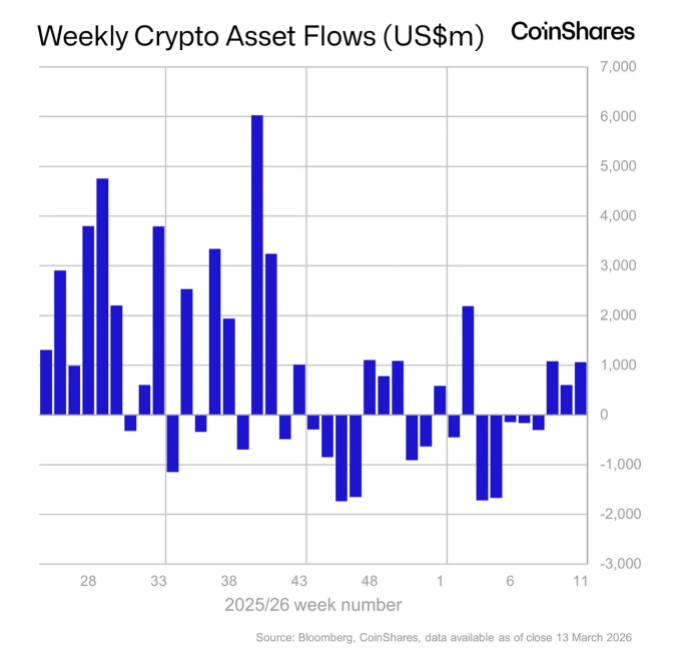
Crypto funds attract massive inflows for the third consecutive week.  Source: CoinShares

Regionally, 96% of the inflows originated from the US, with Canada and Switzerland following with $19.4 million and $10.4 million, respectively. Hong Kong also attracted $23.1 million in inflows, marking the best performance since August 2025. In contrast, Germany recorded outflows of $17.1 million, its first negative net flows in 2026, according to CoinShares’ data.

Funds based on the flagship cryptocurrency showed the strongest performance this week, with $793 million in inflows. This accounts for 75% of total inflows, bringing BTC’s three-week inflows to $2.2 billion.

The report noted that short Bitcoin investment products also attracted $8.1 million in inflows last week, highlighting that market opinion remains somewhat polarized.

Meanwhile, Ethereum funds also saw meaningful inflows worth $315 million, partially driven by BlackRock’s debut of its staked Ether ETF in the US. This brings the category’s year-to-date (YTD) flows, which are on a net outflow position, near a net-neutral position.

Digital Assets, Bitcoin’s ‘Safe Haven’ Narrative Reinforced

James Butterfill, head of research at CoinShares, highlighted crypto funds’ strong performance despite the increasing Middle East tensions, explaining that “significant geopolitical disruption has reinforced digital assets, particularly Bitcoin, as a relative safe haven compared with other asset classes.”

Since the beginning of the Iran crisis, total assets under management (AuM) in crypto ETPs have risen by 9.4% to $140 billion, Butterfill noted on Monday. Notably, Nate Geraci, co-founder of the ETF Institute, recently affirmed that ETF investors have “largely displayed diamond hands” since the October correction began.

The expert emphasized that 50% drawdowns “are a walk in the park for long-time BTC investors,” but observed that newer ETF investors also appear unfazed by the recent market volatility.

Bloomberg Intelligence Senior ETF Analyst Eric Balchunas also shared a similar perspective on the performance of spot Bitcoin ETFs, calling the investment products’ resilience “absurd” amid the market conditions.

The latest QCP Market Colour highlighted that crypto is rallying and institutional liquidity is also returning, while equities and gold remain under pressure. According to the Monday analysis, recent price actions suggest a resurgence of Bitcoin’s narrative as a “digital safe haven” or “geopolitical hedge,” with “markets stress-testing that thesis in real time.”

“If this pattern persists, it would be a late-quarter plot twist, given crypto’s underdog status and its familiar habit of correlating with traditional assets mostly on the way down,” the report stated.
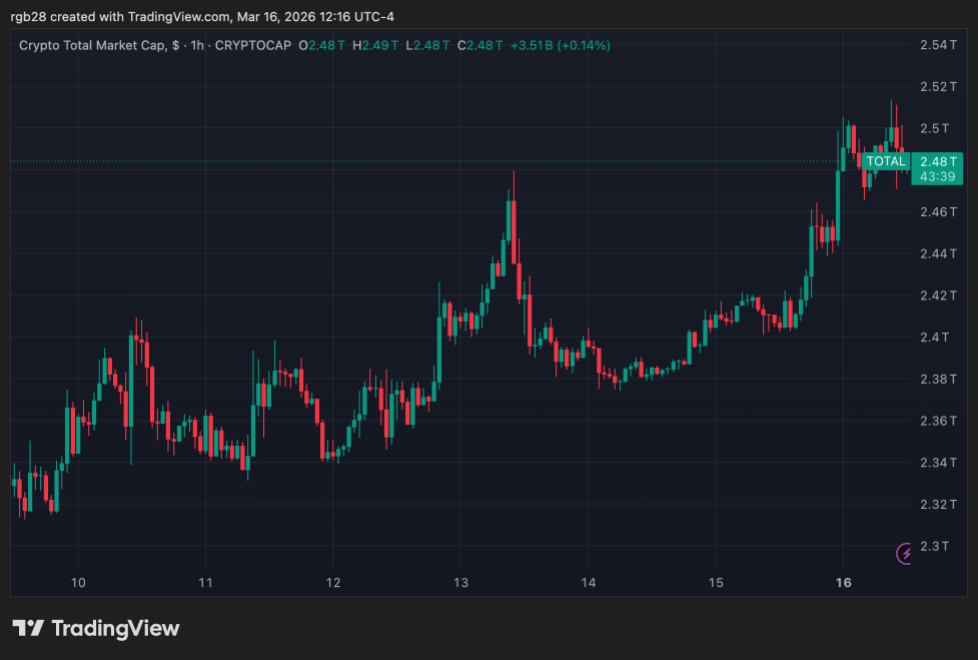
The total crypto market capitalization is at $2.48 trillion on the one-week chart. Source: TOTAL on TradingView


Domande pertinenti

QHow much in inflows did crypto funds attract last week, and what does this represent?

ACrypto funds attracted $1.06 billion in inflows last week, marking their third consecutive week of positive net flows and their best performance in two months.

QWhich region was the primary source of the crypto fund inflows, and how much did it contribute?

AThe United States was the primary source, contributing 96% of the total inflows.

QWhat was the performance of Bitcoin-based funds specifically, and how much did they attract in inflows?

ABitcoin-based funds showed the strongest performance, attracting $793 million in inflows, which accounts for 75% of the total inflows for the week.

QAccording to the head of research at CoinShares, how has recent geopolitical disruption affected the perception of digital assets?

AJames Butterfill stated that significant geopolitical disruption has reinforced digital assets, particularly Bitcoin, as a relative safe haven compared to other asset classes.

QWhat notable inflow did Ethereum funds see, and what was a key driver behind this activity?

AEthereum funds saw inflows of $315 million, partially driven by BlackRock's debut of its staked Ether ETF in the US.

Letture associate

From Theft to Re-entry: How Was $292 Million "Laundered"?

A sophisticated crypto laundering operation was executed following the $292 million hack of Kelp DAO on April 18. The attack, attributed to the North Korean Lazarus group, began with anonymous infrastructure preparation using Tornado Cash to fund wallets untraceably. The hacker exploited a vulnerability in Kelp’s cross-chain bridge, stealing 116,500 rsETH. To avoid crashing the market, the attacker used Aave and Compound as laundering tools—depositing the stolen rsETH as collateral to borrow $190 million in clean, liquid ETH. This move triggered a bank run on Aave, causing an $8 billion drop in TVL. After consolidating funds, the attacker fragmented them across hundreds of wallets to evade detection. A major breakpoint was THORChain, where over $460 million in volume—30 times its usual activity—was processed in 24 hours, converting ETH into Bitcoin. This shift to Bitcoin’s UTXO model exponentially increased tracing complexity by shattering funds into countless untraceable fragments. The final destination was Tron-based USDT, the primary channel for illicit crypto flows. From there, funds were cashed out via OTC brokers in China and Southeast Asia, using unlicensed underground banks and UnionPay networks outside Western sanctions scope. Ultimately, the laundered money supports North Korea’s weapons programs, which rely heavily on crypto hacking for foreign currency. The incident underscores structural challenges in DeFi: its openness, composability, and lack of central control make such laundering not just possible, but inherently difficult to prevent.

marsbit1 h fa

From Theft to Re-entry: How Was $292 Million "Laundered"?

marsbit1 h fa

Google and Amazon Simultaneously Invest Heavily in a Competitor: The Most Absurd Business Logic of the AI Era Is Becoming Reality

In a span of four days, Amazon announced an additional $25 billion investment, and Google pledged up to $40 billion—both direct competitors pouring over $65 billion into the same AI startup, Anthropic. Rather than a typical venture capital move, this signals the latest escalation in the cloud wars. The core of the deal is not equity but compute pre-orders: Anthropic must spend the majority of these funds on AWS and Google Cloud services and chips, effectively locking in massive future compute consumption. This reflects a shift in cloud market dynamics—enterprises now choose cloud providers based on which hosts the best AI models, not just price or stability. With OpenAI deeply tied to Microsoft, Anthropic’s Claude has become the only viable strategic asset for Google and Amazon to remain competitive. Anthropic’s annualized revenue has surged to $30 billion, and it is expanding into verticals like biotech, positioning itself as a cross-industry AI infrastructure layer. However, this funding comes with constraints: Anthropic’s independence is challenged as it balances two rival investors, its safety-first narrative faces pressure from regulatory scrutiny, and its path to IPO introduces new financial pressures. Globally, this accelerates a "tri-polar" closed-loop structure in AI infrastructure, with Microsoft-OpenAI, Google-Anthropic, and Amazon-Anthropic forming exclusive model-cloud alliances. In contrast, China’s landscape differs—investments like Alibaba and Tencent backing open-source model firm DeepSeek reflect a more decoupled approach, though closed-source models from major cloud providers still dominate. The $65 billion bet is ultimately about securing a seat at the table in an AI-defined future—where missing the model layer means losing the cloud war.

marsbit7 h fa

Google and Amazon Simultaneously Invest Heavily in a Competitor: The Most Absurd Business Logic of the AI Era Is Becoming Reality

marsbit7 h fa

Trading

Spot
Futures
活动图片




