Crypto Funding Soars 50%, But Most Startups Are Getting Shut Out: Analysts

bitcoinistPubblicato 2026-03-10Pubblicato ultima volta 2026-03-10

Introduzione

Cryptocurrency fundraising surged nearly 50% year-over-year through March 2026, but the number of individual deals dropped by 46%, according to Messari data. The average deal size soared 272% to $34 million, reflecting a trend of capital concentration in fewer, larger rounds. Three major deals in February alone accounted for 44% of the month’s total funding. While early-stage activity remains fragmented, late-stage and strategic mega-rounds dominate. A significant concern is the decline in new venture fund closures, with few major crypto VCs raising fresh capital beyond Dragonfly’s recent $650 million fund. This suggests that despite headline growth, the industry faces a potential future funding shortage.

Three deals last February ate up nearly half of all the money raised in crypto that month. Just three. That single fact tells you more about where crypto funding stands right now than the headline numbers do.

A Shrinking Pool Of Big Bets

According to data from research firm Messari, total crypto fundraising climbed almost 50% in the 12 months ending March 2026 compared to the year before.

But the number of individual deals fell 46% over the same period. Fewer rounds. Bigger checks. The average deal size hit $34 million — a 272% jump from a year earlier. The number of active investors dropped by about a third, down to 3,225.

Those three February standouts were Tether’s $200 million investment into online marketplace Whop, a $75 million Series B for sports prediction platform Novig led by Pantera Capital, and a $70 million Series B for ARQ, a Latin American fintech app built around stablecoins, backed by Sequoia Capital. Together, they accounted for 44% of the close to $800 million raised across the entire month.

Messari describes the pattern as capital concentration driven by late-stage and strategic mega-rounds. A handful of well-positioned companies are pulling in enormous sums while smaller players scramble for scraps.

Early-stage fundraising, reports say, remains active but scattered. Messari pointed to Interstate’s $1.5 million round, which pulled in more than 15 backers — a mix of firms like Bloccelerate VC and individual angel investors. That kind of fragmented, small-dollar activity is happening in volume. But it exists in a different world from the mega-rounds grabbing the headlines.
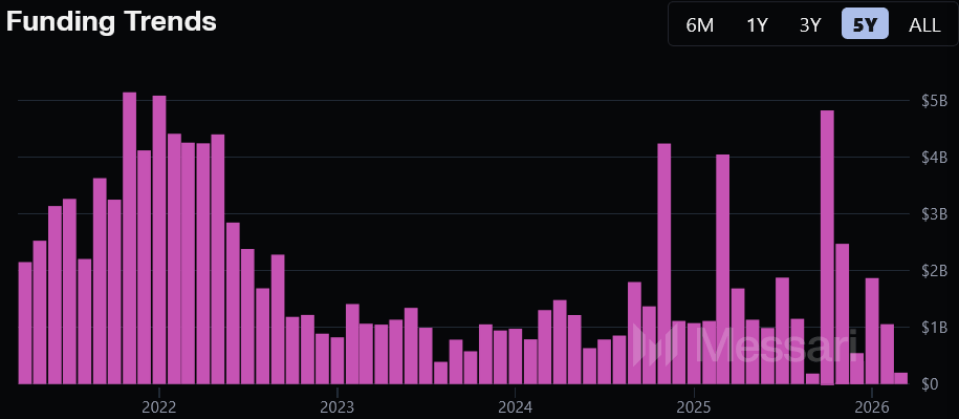
Five-year trend of monthly crypto fundraising changes. Source: Messari

The VC Drought No One Is Talking About

Here is the part the headline buries. Messari CEO Eric Turner flagged a problem that goes beyond deal counts: outside of Dragonfly Capital, no major crypto venture firm has recently closed a new fund. Dragonfly closed a $650 million fund with a focus on real-world assets, but it stands largely alone. Turner put it bluntly — the industry needs fresh capital.

BTCUSD trading at $68,749 on the 24-hour chart: TradingView

Crypto Investors Stay Active As New Funds Decline

That matters because venture funds have a shelf life. Firms raise a fund, deploy it over several years, then raise again. When new fund closes dry up, the money flowing into deals eventually does too.

The 50% year-over-year gain may look strong on paper, but it is being powered by existing pools that are not being replenished at the same rate.

Coinbase Ventures, QUBIC Labs, and Somnia ranked as the three most active crypto investors over the past three months, based on Messari data.

Featured image from KuCoin, chart from TradingView

Crypto di tendenza

Domande pertinenti

QWhat was the overall trend in crypto fundraising in the 12 months ending March 2026, and what was the percentage change?

ATotal crypto fundraising climbed almost 50% in the 12 months ending March 2026 compared to the year before.

QDespite the increase in total funds raised, what happened to the number of individual deals and the average deal size?

AThe number of individual deals fell 46% over the same period, while the average deal size hit $34 million, a 272% jump from a year earlier.

QAccording to Messari, what is the pattern driving the concentration of capital in the crypto fundraising market?

AMessari describes the pattern as capital concentration driven by late-stage and strategic mega-rounds, where a handful of well-positioned companies are pulling in enormous sums.

QWhich major crypto venture firm was noted as a standout for closing a new fund recently, and how much did it raise?

ADragonfly Capital was the standout, closing a $650 million fund with a focus on real-world assets.

QWhat problem did Messari CEO Eric Turner flag that goes beyond the deal counts in the crypto fundraising space?

AHe flagged that outside of Dragonfly Capital, no major crypto venture firm has recently closed a new fund, indicating a need for fresh capital in the industry.

Letture associate

Podcast Notes | Conversation with GSR Asset Management Head: To Determine if This Crypto Rally is Real, Just Watch the Lending Rates on Aave

Podcast Summary: Dialogue with GSR's Head of Asset Management: To Determine if This Crypto Rally is Real, Just Check Lending Rates on Aave Andy Baehr, Managing Director of Asset Management at GSR, discusses the current crypto market, characterizing it as stuck in a state of "ambivalence" with short-lived, unsustainable rallies. He outlines a simple framework: the market moves between "ambivalence" and "conviction" (sustained upward momentum). Currently, every rally resembles a single-stage rocket booster that quickly fizzles out. Baehr identifies three key signals to watch: 1) DeFi lending rates, 2) the potential passage of the CLARITY Act, and 3) the market forming a consensus on the "Fed hawkish peak." He emphasizes that the most immediate indicator for the sustainability of the recent CPI-triggered rally is the USDC borrowing rate on Aave, currently around 3.75%—close to U.S. Treasury yields. The absence of a credit spread indicates low leverage demand and a lack of market energy. He explains that a healthy, sustained rally requires layered buying pressure. Last year's rally progressed from an ETH short squeeze to crypto-native trader influx and finally to ETF inflows. Currently, this structure is missing. Other potential structural buyers like Digital Asset Treasury (DAT) companies are absent, and ETF flows have proven transient. Baehr notes that while small-cap crypto tokens outperformed large caps in Q2—a potential sign of capitation in major assets—capital is also flowing to more exciting opportunities like AI stocks and tech IPOs, leaving crypto sidelined. Regarding DeFi, he highlights that platforms like Aave provide a clear, real-time signal of leverage demand through their supply/demand-driven interest rates. A significant, sustained rate increase would signal genuine market conviction. He also observes the quiet emergence of fixed-income-like products and vaults in DeFi. On regulation, the probability of the CLARITY Act passing before the August 7th deadline has dropped linearly from 75% to below 40% on Polymarket. Baehr suggests its passage would be treated as a bullish surprise, a potent driver for price movement. However, political hurdles, including ethical clause debates and disclosures about the First Family's crypto profits, remain significant obstacles. Ultimately, the market awaits clarity on the Fed's terminal rate under Chair Warsh. Until the "Fed Solstice"—the point where the market collectively understands the peak of hawkish policy—sustained conviction will be difficult to achieve.

marsbit18 min fa

Podcast Notes | Conversation with GSR Asset Management Head: To Determine if This Crypto Rally is Real, Just Watch the Lending Rates on Aave

marsbit18 min fa

7 Months After the Collapse of Huiwang, Southeast Asia's Escrow Platforms Undergo a Major Reshuffle

Following the collapse of Huione Pay—dubbed the "Alipay of Southeast Asia"—seven months ago, the region's underground financial guarantee platform sector is undergoing a significant reshuffle. This power vacuum has been swiftly filled by emerging platforms such as XinBi, Tiger/Navigator, JinBei (renamed JinBo), Dali/Tiancheng, and FullyLight. These platforms, operating largely via Telegram and offering services like escrow for illicit transactions, have absorbed the vast user base and markets left behind by Huione. While positioning themselves as "trust intermediaries," their primary clientele consists of networks involved in online scams, money laundering, illegal gambling, and even human trafficking. For instance, the Tiger/Navigator platform explicitly provides "escrow" services for kidnapping-for-ransom operations ("强押车交易"). Data underscores the immense scale: Huione alone processed over $103 billion in cryptocurrency payments and facilitated over $31 billion through its escrow market before its downfall, linking it to Cambodia's notorious Prince Group. Since its collapse, competitors have seen explosive growth. For example, the XinBi platform has accumulated over $1.6 billion in total USDT revenue, while platforms like NewPay, OkPay (under Dali), and FullyLight Wallet collectively processed over $4.8 billion in USDT in a single year. This ecosystem thrives in regions like Cambodia and Myanmar, where regulatory gaps allow these platforms to act as critical financial infrastructure for sprawling cybercrime industries, from scam compounds to online casinos. The article concludes that the moniker "Southeast Asian Alipay" is a misnomer, obscuring the platforms' fundamental role in enabling serious criminal enterprises rather than representing legitimate financial innovation.

Odaily星球日报1 h fa

7 Months After the Collapse of Huiwang, Southeast Asia's Escrow Platforms Undergo a Major Reshuffle

Odaily星球日报1 h fa

Trading

Spot

Articoli Popolari

Come comprare T

Benvenuto in HTX.com! Abbiamo reso l'acquisto di Threshold Network Token (T) semplice e conveniente. Segui la nostra guida passo passo per intraprendere il tuo viaggio nel mondo delle criptovalute.Step 1: Crea il tuo Account HTXUsa la tua email o numero di telefono per registrarti il tuo account gratuito su HTX. Vivi un'esperienza facile e sblocca tutte le funzionalità,Crea il mio accountStep 2: Vai in Acquista crypto e seleziona il tuo metodo di pagamentoCarta di credito/debito: utilizza la tua Visa o Mastercard per acquistare immediatamente Threshold Network TokenT.Bilancio: Usa i fondi dal bilancio del tuo account HTX per fare trading senza problemi.Terze parti: abbiamo aggiunto metodi di pagamento molto utilizzati come Google Pay e Apple Pay per maggiore comodità.P2P: Fai trading direttamente con altri utenti HTX.Over-the-Counter (OTC): Offriamo servizi su misura e tassi di cambio competitivi per i trader.Step 3: Conserva Threshold Network Token (T)Dopo aver acquistato Threshold Network Token (T), conserva nel tuo account HTX. In alternativa, puoi inviare tramite trasferimento blockchain o scambiare per altre criptovalute.Step 4: Scambia Threshold Network Token (T)Scambia facilmente Threshold Network Token (T) nel mercato spot di HTX. Accedi al tuo account, seleziona la tua coppia di trading, esegui le tue operazioni e monitora in tempo reale. Offriamo un'esperienza user-friendly sia per chi ha appena iniziato che per i trader più esperti.

448 Totale visualizzazioniPubblicato il 2024.12.10Aggiornato il 2026.06.02

Come comprare T

Discussioni

Benvenuto nella Community HTX. Qui puoi rimanere informato sugli ultimi sviluppi della piattaforma e accedere ad approfondimenti esperti sul mercato. Le opinioni degli utenti sul prezzo di T T sono presentate come di seguito.

活动图片













