Crypto downturn reveals gap between VC valuations and market cap

cointelegraphPubblicato 2025-12-24Pubblicato ultima volta 2025-12-24

Introduzione

The crypto market downturn has exposed a significant gap between venture capital valuations and actual market capitalizations for numerous blockchain startups. Data from CryptoRank reveals that projects once valued near $1 billion, such as Humanity Protocol ($285M market cap), Fuel Network ($11M), and Bubblemaps ($6M), have seen drastic devaluations. This trend reflects how aggressive VC pricing during bull markets often leads to severe corrections when sentiment fades. The reset affects even lower-valued projects, with examples like Camp Network and Treehouse now trading at just $15M and $16M despite previous $400M valuations. The report advises investors to maintain caution and assess risks carefully. Meanwhile, crypto VC funding remains weak, with only 57 disclosed rounds in November, despite a few large raises like Revolut's $1 billion round.

Several blockchain startups once valued near $1 billion now have market capitalizations that are only a fraction of those figures, as tighter liquidity forces valuation resets.

This is evident across several high profile projects, according to data compiled by CryptoRank.

Humanity Protocol, which carried a venture valuation of around $1 billion, now has a market capitalization of about $285 million. Fuel Network, also previously valued near $1 billion, is trading closer to $11 million, while Bubblemaps, once assigned a similar venture capital (VC) valuation, has a market cap of about $6 million.

“During bull runs and narrative hype, VCs tend to overprice projects and assign aggressive valuations,” Fundraising Digest, CryptoRank’s venture deals tracker, wrote on X. “However, once sentiment fades or the narrative loses traction, most projects get a reality check and the market resets those euphoric numbers.”

The recent crypto market downturn has exposed gaps between venture capital valuations and public market pricing, revealing how aggressively projects were priced during the last bull cycle.

Related: HashKey secures $250M for new crypto fund amid ‘significant interest’

More crypto projects see sharp reset from VC valuations

The gap continues with projects with relatively lower valuations.

Plasma, which was valued at about $500 million by venture investors now trades around $224 million. ICNT fell from a $470 million VC valuation to a market cap near $247 million. DoubleZero, valued at roughly $400 million in its last round, currently sits near $373 million.

Other projects show even steeper disconnects. Camp Network and Treehouse, each previously valued at about $400 million, now carry market caps of roughly $15 million and $16 million, respectively. Everlyn, once valued near $250 million, trades around $26 million, while SoSoValue has slipped from a $200 million valuation to about $152 million.
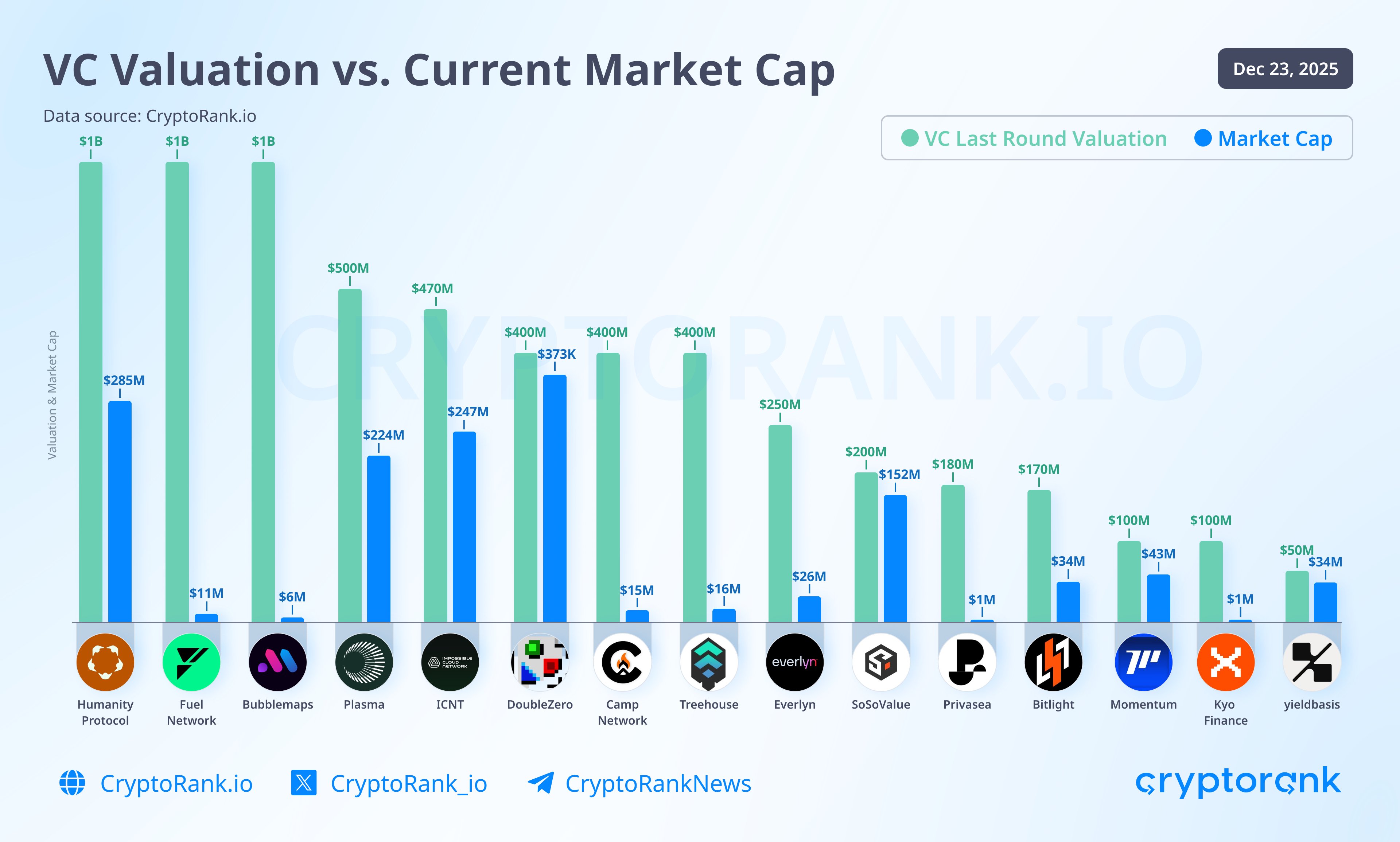
VC valuations vs. market caps. Source: Fundraising Digest

“That’s why it's important to keep a cool head and weigh risk across multiple outcomes, before investing,” Fundraising Digest said.

Related: From FTX fallout to fresh capital: Former US chief raises $35M for new exchange

Crypto VC funding stays weak

As Cointelegraph reported, venture capital funding in the crypto sector remained subdued in November, extending a slowdown that has persisted through late 2025.

While total capital raised has been supported by a handful of big rounds, overall deal activity continues to lag, with just 57 disclosed funding rounds recorded during the month.

High-profile funding included Revolut’s $1 billion round and Kraken’s $800 million raise ahead of its anticipated initial public offering, which have masked broader weakness in early- and mid-stage investment.

Magazine: 2026 is the year of pragmatic privacy in crypto — Canton, Zcash and more

Domande pertinenti

QWhat is the main reason for the gap between VC valuations and market caps in crypto projects?

ATighter liquidity forces valuation resets, and during bull runs, VCs tend to overprice projects due to hype, but market sentiment fading leads to a reality check.

QWhich project had the largest percentage drop from its $1 billion VC valuation to its current market cap?

AFuel Network, which dropped from a $1 billion VC valuation to a market cap of about $11 million, representing the steepest decline among the mentioned projects.

QWhat does Fundraising Digest advise investors to do before investing in crypto projects?

AFundraising Digest advises investors to keep a cool head and weigh risk across multiple outcomes before investing.

QHow has overall crypto VC funding activity been in November 2025?

ACrypto VC funding remained subdued in November 2025, with overall deal activity lagging and only 57 disclosed funding rounds recorded, despite a few large rounds supporting total capital raised.

QWhat are two examples of projects that were valued around $400 million by VCs but now have market caps below $20 million?

ACamp Network and Treehouse, each previously valued at about $400 million, now have market caps of roughly $15 million and $16 million, respectively.

Letture associate

The Essence of AI Layoffs: Why More AI Adoption Leads to More Corporate Anxiety?

The author, awaiting potential inclusion on an 8000-person layoff list, analyzes the true nature of recent "AI-driven" layoffs. They argue that while AI use, particularly tools like Claude for code generation, has skyrocketed and boosted developer output (e.g., 2-5x more code commits), this has not translated into proportional business growth or revenue. The core issue is a misalignment between increased "Input" (code) and tangible "Outcomes" (user value, revenue). AI acts as a costly B2B SaaS, inflating operational expenses without guaranteed returns. Two key problems emerge: 1) The friction that once filtered out bad ideas is gone, as AI allows cheap pursuit of even weak concepts. 2) Organizational "alignment tax"—the difficulty of coordinating across teams—becomes crippling when development velocity outpaces consensus-building. Thus, layoffs serve two immediate purposes: 1) To offset ballooning AI costs (Token consumption) and maintain cash flow, as rising input costs without outcome growth destroys unit economics. 2) To reduce organizational bloat and alignment friction by simply removing teams, thereby speeding up execution in the short term. Therefore, these layoffs are fundamentally caused by AI, even if AI doesn't directly replace roles. They represent a painful correction until companies learn to convert AI-driven productivity into real business outcomes and streamline organizational coordination to match the new pace of work. The cycle will continue until this learning curve is mastered.

marsbit53 min fa

The Essence of AI Layoffs: Why More AI Adoption Leads to More Corporate Anxiety?

marsbit53 min fa

Can the Solana Foundation and Google's Collaboration on Pay.sh Bridge the Payment Link Between Web2 and Web3 in the Agent Economy?

Solana Foundation, in collaboration with Google Cloud, has launched Pay.sh, a payment gateway designed to bridge the gap between AI agents and enterprise-grade service infrastructure. The initiative aims to solve a key bottleneck in the "agent economy": existing payment systems are ill-suited for autonomous AI agents. Traditional methods like credit cards require human verification, while newer on-chain protocols like x402 and MPP create a separate, Web3-native system that raises barriers for service providers. Pay.sh functions as a universal payment layer. It allows users to fund a Solana wallet via credit card or stablecoin, which then acts as an identity and payment proxy for AI agents. When an agent needs to access a paid API service (e.g., Google Cloud, Alibaba Cloud), Pay.sh handles the transaction seamlessly. It leverages the HTTP 402 status code ("Payment Required") to initiate payments, intelligently choosing between one-time transfers (x402-style) or session-based authorizations (MPC-style) based on the service's billing model. This spares agents from manual account registration and API key management. A key feature for service providers is low integration effort. They can adopt Pay.sh by providing a declarative configuration file, enabling features like tiered pricing, free tiers, and automatic revenue splitting to multiple addresses (e.g., for royalties, cloud costs). Providers can also list their APIs in a central Pay Skill Registry for agent discovery. The collaboration with Google Cloud provides crucial infrastructure for API proxying, traffic routing, and compliance logging, aiming to keep agent activities within regulated boundaries. By connecting Web2 services with Web3 payment rails, Pay.sh positions the Solana wallet as a foundational identity and payment tool for AI agents, potentially driving more transaction volume to the Solana ecosystem. However, the report notes challenges. The service registry currently lacks robust vetting, risking exposure to unauthorized or malicious third-party APIs. Pay.sh also inherits security and compatibility risks from its underlying payment protocols (x402, MPC). Furthermore, adoption may be hindered by varying regional data privacy and payment compliance regulations among API providers. Despite these hurdles, Pay.sh represents a significant step towards integrating Web2 and Web3 for autonomous agent commerce.

marsbit1 h fa

Can the Solana Foundation and Google's Collaboration on Pay.sh Bridge the Payment Link Between Web2 and Web3 in the Agent Economy?

marsbit1 h fa

Bitcoin's Bull-Bear Cycle Indicator Turns Positive for the First Time in 7 Months: End of Bear Market or False Breakout?

Bitcoin's "Bull-Bear Market Cycle Indicator" from CryptoQuant has turned positive for the first time since October 2025. This gauge, based on the P&L Index relative to its 365-day moving average, suggests a potential shift from a bear market phase. Concurrently, the Bull Score Index rose to a neutral reading of 50 in late April. The indicator's move into positive territory follows a roughly 35% price rebound from a low near $60,000 in February to above $81,000. The recovery over approximately three months was faster than the 12-month period observed during the 2022 bear market. However, analysts caution against premature optimism, citing a historical precedent from March 2022. Back then, the Bull Score Index briefly hit 50, but it proved to be a false signal as Bitcoin's price subsequently plunged further. Structural differences exist in the current cycle, including consistent inflows into spot Bitcoin ETFs and an increase in large holder addresses. Yet, some models, referencing the four-year halving cycle, suggest a potential deeper bottom near $50,000 might still be possible around late 2026. In summary, while on-chain data shows marked improvement and the worst panic may be over, market participants remain cautious. A convincing trend reversal confirmation likely requires Bitcoin to sustainably break above key resistance, such as the 200-day moving average near $82,000.

marsbit1 h fa

Bitcoin's Bull-Bear Cycle Indicator Turns Positive for the First Time in 7 Months: End of Bear Market or False Breakout?

marsbit1 h fa

Trading

Spot
Futures

Articoli Popolari

Come comprare NEAR

Benvenuto in HTX.com! Abbiamo reso l'acquisto di NEAR Protocol (NEAR) semplice e conveniente. Segui la nostra guida passo passo per intraprendere il tuo viaggio nel mondo delle criptovalute.Step 1: Crea il tuo Account HTXUsa la tua email o numero di telefono per registrarti il tuo account gratuito su HTX. Vivi un'esperienza facile e sblocca tutte le funzionalità,Crea il mio accountStep 2: Vai in Acquista crypto e seleziona il tuo metodo di pagamentoCarta di credito/debito: utilizza la tua Visa o Mastercard per acquistare immediatamente NEAR ProtocolNEAR.Bilancio: Usa i fondi dal bilancio del tuo account HTX per fare trading senza problemi.Terze parti: abbiamo aggiunto metodi di pagamento molto utilizzati come Google Pay e Apple Pay per maggiore comodità.P2P: Fai trading direttamente con altri utenti HTX.Over-the-Counter (OTC): Offriamo servizi su misura e tassi di cambio competitivi per i trader.Step 3: Conserva NEAR Protocol (NEAR)Dopo aver acquistato NEAR Protocol (NEAR), conserva nel tuo account HTX. In alternativa, puoi inviare tramite trasferimento blockchain o scambiare per altre criptovalute.Step 4: Scambia NEAR Protocol (NEAR)Scambia facilmente NEAR Protocol (NEAR) nel mercato spot di HTX. Accedi al tuo account, seleziona la tua coppia di trading, esegui le tue operazioni e monitora in tempo reale. Offriamo un'esperienza user-friendly sia per chi ha appena iniziato che per i trader più esperti.

257 Totale visualizzazioniPubblicato il 2024.12.10Aggiornato il 2025.03.21

Come comprare NEAR

Discussioni

Benvenuto nella Community HTX. Qui puoi rimanere informato sugli ultimi sviluppi della piattaforma e accedere ad approfondimenti esperti sul mercato. Le opinioni degli utenti sul prezzo di NEAR NEAR sono presentate come di seguito.

活动图片













