Crypto Criminals In Crosshairs As Chainalysis Partners With South Korean Police

bitcoinistPubblicato 2026-06-11Pubblicato ultima volta 2026-06-11

Introduzione

South Korea's national police have partnered with blockchain analytics firm Chainalysis to strengthen their investigative capabilities against crypto-related crimes. The agreement, formalized through a memorandum of understanding, provides Korean investigators with access to specialized training and certification programs. This collaboration aims to build institutional expertise for tackling a broad spectrum of virtual asset crimes, including money laundering and state-sponsored hacking. The move follows the recent creation of a dedicated multi-agency task force to eradicate crypto-based money laundering. While North Korea-linked crypto theft, which saw massive losses in 2025, is a significant concern, officials emphasize the partnership is designed to enhance overall investigative capacity for handling complex, cross-border crypto crime cases.

South Korea’s national police launched a special multi-agency task force just weeks ago to go after crypto-based money laundering. Now they have a new partner in that fight.

Building Investigative Muscle

Blockchain analytics firm Chainalysis signed a memorandum of understanding with the Korean National Police Agency on Wednesday, a deal aimed at strengthening the KNPA’s ability to investigate virtual asset crimes.

The agreement will give South Korean investigators access to personalized training content, professional certification programs, and hands-on practical instruction developed by Chainalysis.

The partnership comes at a time when North Korea-linked crypto theft has been surging. Data shows that in 2025, hackers tied to the DPRK were responsible for $2 billion in crypto losses — a 51% jump from the year before, according to research from CrowdStrike.

By April of this year, theft attributed to North Korea had already reached close to $580 million, with attacks on Kelp DAO and the Drift Protocol among the largest incidents.

South Korea’s police have been described as being at the forefront of confronting those state-level threats. But Chainalysis country director Ryan Kwon said the MoU is built around a wider purpose than targeting any single adversary.

A Wider Mandate

“While North Korean-driven attacks are understandably a national security focus, this partnership isn’t designed around a single threat,” Kwon said. “It’s fundamentally about building institutional capability.”

Chainalysis has worked alongside South Korean law enforcement before. In September last year, police in Seoul dismantled an international hacking ring that had stolen roughly $30 million.
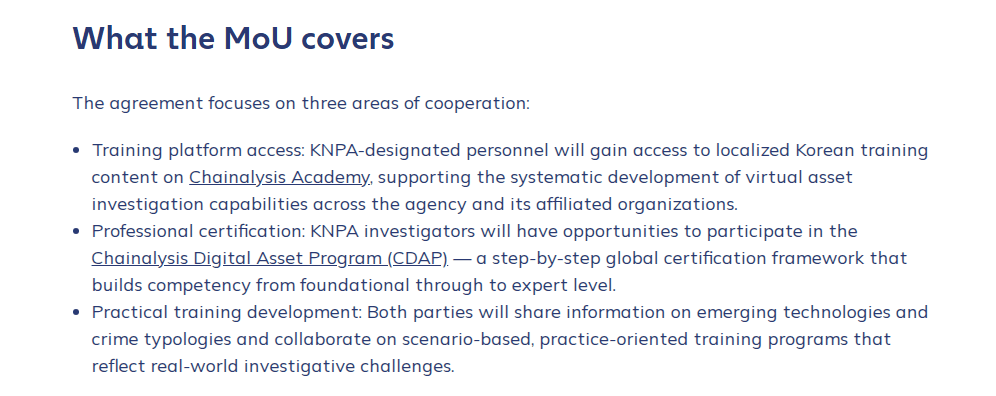
Source: Chainalysis

The investigation started in South Korea and eventually led authorities to Thailand, with Chainalysis playing a supporting role throughout.

The newly signed agreement builds on that existing relationship. According to Chainalysis, Korean investigators need global visibility into how illicit funds move across blockchains to handle these cases effectively — and that cross-border reach is part of what the training is designed to provide.

BTCUSD trading at $62,044 on the 24-hour chart: TradingView

Casting The Net On Crypto Crime

The MoU follows the May launch of the Money Laundering Eradication Task Force, a multi-agency unit under South Korea’s Economic Crime Investigation Division created specifically to go after crypto-based financial crimes.

The back-to-back moves suggest a deliberate push by South Korean authorities to sharpen their tools against a growing range of threats — from state-sponsored hackers to scams targeting ordinary investors.

Chainalysis said the goal is not just to chase individual cases but to leave the KNPA better equipped long after any single investigation wraps up.

Featured image from Getty Images, chart from TradingView

Domande pertinenti

QWhat is the main purpose of the Memorandum of Understanding signed between Chainalysis and the Korean National Police Agency?

AThe main purpose is to strengthen the KNPA's ability to investigate virtual asset crimes by providing personalized training content, professional certification programs, and hands-on practical instruction developed by Chainalysis.

QAccording to the article, what was the estimated value of crypto losses attributed to North Korea-linked hackers in 2025?

AAccording to research from CrowdStrike, North Korea-linked hackers were responsible for an estimated $2 billion in crypto losses in 2025.

QWhat recent initiative by South Korean authorities does the Chainalysis MoU follow, and what is its focus?

AThe MoU follows the May launch of the Money Laundering Eradication Task Force, a multi-agency unit created specifically to go after crypto-based financial crimes.

QWhat does Chainalysis country director Ryan Kwon say is the fundamental goal of the partnership with the KNPA?

ARyan Kwon states that the partnership is fundamentally about building institutional capability within the KNPA, rather than being designed solely around targeting a single threat like North Korean-driven attacks.

QHow did Chainalysis previously assist South Korean law enforcement, as mentioned in the article?

AChainalysis played a supporting role in an investigation where Seoul police dismantled an international hacking ring that had stolen roughly $30 million, with the investigation starting in South Korea and leading to Thailand.

Letture associate

IOSG Founder: Ethereum Doesn't Need Another Leap of Technical Faith, It Needs a Musk-style Compromise

Jocy, founder of IOSG Ventures, argues that Ethereum does not need renewed technological faith but a "Musk-like compromise." The recent formation of ETHLabs—funded by major ETH holders like BitMine and Lubin—highlights a market-driven move to fill a gap left by the Ethereum Foundation (EF), signaling a loss of confidence in its decentralized, hands-off approach. The core critique contrasts Vitalik Buterin's (V) idealistic, technology-first vision with Elon Musk's pragmatic, business-driven execution. The author asserts Ethereum's current shortage is not another technical roadmap but a clear, real-world application narrative and a leader willing to engage directly with commercial realities—like Musk. Internal issues are emphasized, citing EF's management problems and talent drain. While the new decentralized model with independent nodes like ETHLabs addresses the single foundation's limitations, it risks fragmentation without cohesive direction. True cohesion, the author suggests, must come from a shared, compelling narrative around ETH's value, not just from aligned financial interests. Independence claims for new entities are seen as aspirational, needing years of transparency to build trust. The ultimate threat is not competitors like Solana, but the broader shift of attention and talent toward AI. Ethereum has a limited window—12 to 18 months—to recapture focus by delivering tangible, real-world applications. The conclusion urges V to shift from abstract ideals to grounded, pragmatic leadership. The time for this crucial pivot is running out.

marsbit1 h fa

IOSG Founder: Ethereum Doesn't Need Another Leap of Technical Faith, It Needs a Musk-style Compromise

marsbit1 h fa

Google Starts Selling TPUs, Big Tech Aims to Produce "Low-Cost Tokens" with AI Chips

Google has begun selling its proprietary TPU chips and AI computing hardware directly to third-party data centers and clients, marking a strategic shift. Previously only accessible via cloud rentals, TPUs are specialized processors designed for the matrix and tensor operations central to AI models. By combining thousands into supercomputing clusters managed by CPUs, Google achieves high-efficiency AI processing. This move enables Google’s Gemini AI to offer competitive token pricing, challenging rivals like OpenAI. It also signals a broader industry trend where AI compute is becoming a commoditized resource like electricity. While NVIDIA remains dominant with its CUDA ecosystem and high-performance GPUs, the focus is shifting from raw power to cost efficiency and system integration. Google’s approach mirrors NVIDIA’s by selling an entire ecosystem—hardware, software, and data center expertise—rather than just chips. This threatens NVIDIA’s grip on the mid-range inference market, where lower-cost, efficient solutions are increasingly demanded. Similarly, cloud providers like Huawei Cloud and Alibaba Cloud in China are developing their own AI chip ecosystems (e.g., Ascend, Zhenwu), packaging chips, clusters, and tools into full-stack solutions. They aim to reduce token costs and capture market share through integrated systems. In summary, the AI infrastructure race is evolving from a competition for the strongest chips to a contest for the most efficient and cost-effective systems. Google’s TPU sales highlight this transition, emphasizing that future success lies in delivering affordable, scalable AI compute as a foundational service.

marsbit1 h fa

Google Starts Selling TPUs, Big Tech Aims to Produce "Low-Cost Tokens" with AI Chips

marsbit1 h fa

Trading

Spot
Futures
活动图片