Crypto Crime Crackdown Escalates As Myanmar Targets Scammers With Execution

bitcoinistPubblicato 2026-05-16Pubblicato ultima volta 2026-05-16

Introduzione

Myanmar's military government has proposed a harsh new law, the Anti-Online Fraud Bill, which mandates prison sentences of 10 years to life for digital currency fraud, with the death penalty for operators of scam centers whose coerced or trafficked workers die. The bill responds to online fraud threatening national stability. This crackdown is part of a broader regional effort; China executed 11 people in January linked to Myanmar-based scams, and U.S. authorities have collaborated internationally to arrest hundreds and shut down centers. Southeast Asian scam compounds, often using cryptocurrency, pose a global law enforcement challenge. The move comes as the FBI reports Americans lost over $11 billion to crypto fraud in 2024. Myanmar's parliament, reconvening after a 2021 coup and controversial 2026 elections, may consider the bill in June.

Americans lost more than $11 billion to crypto-related fraud last year, according to an FBI report released in April — and the pressure on governments across Southeast Asia to crack down has only grown since then.

A Deadly Business

Myanmar’s military government has now responded with one of the harshest proposed laws of its kind anywhere in the world.

The Anti-Online Fraud Bill, made public Thursday, would send anyone convicted of digital currency fraud to prison for anywhere between ten years and life.

In the most serious cases, offenders could face the death penalty.

The law specifically targets operators of scam centers who cause the death of workers coerced or trafficked into committing fraud on their behalf — those individuals would be sentenced to death under the proposed legislation.

Myanmar’s parliament, the Pyidaungsu Hluttaw, said it drafted the bill in response to online fraud that threatened the country’s sovereignty and stability.
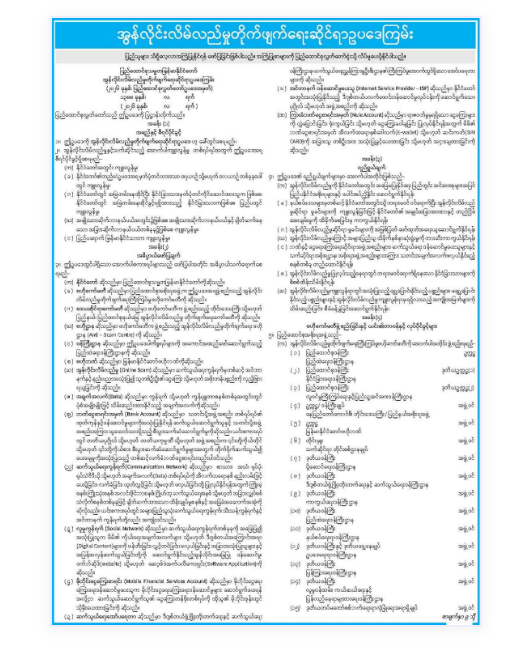
Source: Myanmar National Portal

Not The First Execution In The Region

Myanmar is not alone in taking a hard line. China executed 11 people in January tied to Myanmar-based scam operations, according to reports. Those operations had been responsible for trafficking Chinese nationals into forced labor inside the compounds.

The US has also stepped up its response. In April, American authorities worked alongside officials in China and Dubai to arrest more than 200 people and shut down nine scam centers.

US President Donald Trump signed an executive order in March directing officials to go after scam compounds and cybercrime.

BTCUSD now trading at $78,336. Chart: TradingView

The FBI’s Scam Center Strike Force has since focused its investigations on senior figures running compounds in Cambodia, Laos, and Burma, including affiliates of Chinese organized crime networks.

Online scam centers across Southeast Asia have become a growing problem for law enforcement worldwide. Schemes range from pig butchering and romance scams to fake investment platforms — many of them relying on crypto to move money.

A Government With A Complicated Record

Myanmar’s military took power in a coup in 2021. The country’s parliament did not meet again until March 2026, following elections that independent observers said were neither free nor fair. The government is scheduled to convene during the first week of June, when lawmakers may take up the bill.

Beyond crypto fraud, Americans lost more than $20 billion in total to online scams in 2025, FBI data shows. The agency’s task force has been working to identify and prosecute leaders of the most dangerous scam operations in the region.

Featured image from Unsplash, chart from TradingView

Domande pertinenti

QWhat is the maximum penalty for digital currency fraud under Myanmar's proposed Anti-Online Fraud Bill?

AUnder the proposed Anti-Online Fraud Bill, the maximum penalty for digital currency fraud in Myanmar is the death penalty, applicable in the most serious cases, such as when scam center operators cause the death of coerced or trafficked workers.

QAccording to the article, how much did Americans lose to crypto-related fraud last year based on the FBI report?

AAccording to an FBI report released in April, Americans lost more than $11 billion to crypto-related fraud last year.

QWhich other country has executed people connected to Myanmar-based scam operations, as mentioned in the article?

AChina executed 11 people in January who were tied to Myanmar-based scam operations, according to reports cited in the article.

QWhat is the name of the FBI task force investigating senior figures running scam compounds in Southeast Asia?

AThe FBI task force investigating senior figures running scam compounds in Southeast Asia is called the Scam Center Strike Force.

QWhen is Myanmar's parliament, the Pyidaungsu Hluttaw, scheduled to convene, potentially to take up the Anti-Online Fraud Bill?

AMyanmar's parliament, the Pyidaungsu Hluttaw, is scheduled to convene during the first week of June, when lawmakers may take up the Anti-Online Fraud Bill.

Letture associate

Who Funds the Agents?

**Summary: Who Funds AI Agents?** OpenAI recently shut down a feature allowing AI agents to shop for users, highlighting the challenge of creating a secure and regulated environment for agent-driven transactions. While payment infrastructure exists, a crucial governance layer—defining spending limits, fraud detection, tax handling, and return policies—is largely missing. The potential is enormous: AI agents already processed $73M across 176M transactions last year, with McKinsey forecasting this could grow to $3-5T in global consumer commerce by 2030. The core competition isn't just about processing payments, which can be very cheap (especially with crypto-based settlement), but about controlling the rules that govern agent spending. Key players like Stripe and Coinbase are racing to dominate this governance layer. Stripe's acquisition of wallet provider Privy allows it to set spending policies, identity checks, and human-in-the-loop approvals directly at the wallet level. Similarly, Coinbase's stack, including its x402 protocol and AgentKit, embeds governance rules. This vertical integration across settlement, wallet, and governance layers is becoming the dominant strategy. Control over the governance layer is where significant future value lies. If agents handle trillions in transactions, even a small fee for managing compliance, fraud prevention, and policy enforcement could generate billions in annual revenue. The companies that successfully integrate across the payment stack will capture value from idle agent balances, transaction fees, and governance services, positioning themselves as the foundational banks of the AI agent economy.

marsbit20 min fa

Who Funds the Agents?

marsbit20 min fa

A Nation Blocks Chips, a Giant Buys a Nuclear Power Plant: Why It's Time to Seriously Consider DeAI

**Title: Great Powers Blockade Chips, Giants Buy Nuclear Plants: Why It's Time to Seriously Consider DeAI** In May 2026, the US closed loopholes for Chinese firms to acquire advanced NVIDIA chips via overseas subsidiaries. That same month, Kenya halted a $1B geothermal data center project involving Microsoft, fearing its immense energy consumption. Meanwhile, Huawei announced mass production of its Ascend AI chip. These disparate events underscore a new reality: the competition for computing power ("compute") has escalated beyond the tech industry, becoming a geopolitical and infrastructural battleground. A new era of oligopoly is forming, with control over the AI stack—from GPU chips (NVIDIA) and cloud platforms (AWS, Azure, Google Cloud) to foundational models (OpenAI, Anthropic)—concentrating in a few Western "AI Octopus" corporations. This centralization creates systemic risks: pricing power and platform lock-in for users, infrastructure fragility, and a widening "compute divide" that threatens to marginalize nations without independent AI capacity. An "AI Iron Curtain" is deepening through export controls. In response, some nations like Saudi Arabia and the UAE are investing heavily to buy compute power, aiming to transition from oil to AI economies. The EU seeks to triple its compute capacity by 2030 to reduce dependency. However, the spending gap is vast, with four US tech giants alone planning ~$750B in AI capex for 2026. The race is increasingly constrained by energy, with AI tasks consuming up to 1000x more power than web searches, pushing firms to even acquire nuclear plants. This landscape is fueling interest in Decentralized AI (DeAI). It proposes a third way: using open protocols to coordinate a global network of idle GPUs, independent developers, and data centers, creating an AI infrastructure without a single controlling entity. Leveraging blockchain and cryptographic verification, DeAI aims to break market concentration, disperse energy demands, reduce geopolitical dependencies, and enhance transparency. While still nascent in performance and stability, DeAI's core promise is not immediate superiority but providing a crucial alternative architecture to resist monopoly, censorship, and centralized power. As specialized AI hardware costs fall and open-source models flourish, the window to build this foundation is open. The very existence of such competition serves as a vital check against the inevitable abuse of concentrated power.

marsbit1 h fa

A Nation Blocks Chips, a Giant Buys a Nuclear Power Plant: Why It's Time to Seriously Consider DeAI

marsbit1 h fa

Trading

Spot
Futures
活动图片