Crypto Crime Crackdown Escalates As Myanmar Targets Scammers With Execution

bitcoinistPubblicato 2026-05-16Pubblicato ultima volta 2026-05-16

Introduzione

Myanmar's military government has proposed a harsh new law, the Anti-Online Fraud Bill, which mandates prison sentences of 10 years to life for digital currency fraud, with the death penalty for operators of scam centers whose coerced or trafficked workers die. The bill responds to online fraud threatening national stability. This crackdown is part of a broader regional effort; China executed 11 people in January linked to Myanmar-based scams, and U.S. authorities have collaborated internationally to arrest hundreds and shut down centers. Southeast Asian scam compounds, often using cryptocurrency, pose a global law enforcement challenge. The move comes as the FBI reports Americans lost over $11 billion to crypto fraud in 2024. Myanmar's parliament, reconvening after a 2021 coup and controversial 2026 elections, may consider the bill in June.

Americans lost more than $11 billion to crypto-related fraud last year, according to an FBI report released in April — and the pressure on governments across Southeast Asia to crack down has only grown since then.

A Deadly Business

Myanmar’s military government has now responded with one of the harshest proposed laws of its kind anywhere in the world.

The Anti-Online Fraud Bill, made public Thursday, would send anyone convicted of digital currency fraud to prison for anywhere between ten years and life.

In the most serious cases, offenders could face the death penalty.

The law specifically targets operators of scam centers who cause the death of workers coerced or trafficked into committing fraud on their behalf — those individuals would be sentenced to death under the proposed legislation.

Myanmar’s parliament, the Pyidaungsu Hluttaw, said it drafted the bill in response to online fraud that threatened the country’s sovereignty and stability.
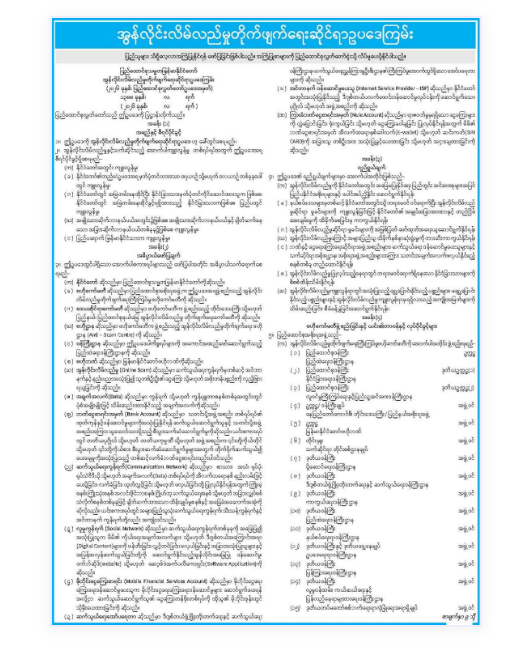
Source: Myanmar National Portal

Not The First Execution In The Region

Myanmar is not alone in taking a hard line. China executed 11 people in January tied to Myanmar-based scam operations, according to reports. Those operations had been responsible for trafficking Chinese nationals into forced labor inside the compounds.

The US has also stepped up its response. In April, American authorities worked alongside officials in China and Dubai to arrest more than 200 people and shut down nine scam centers.

US President Donald Trump signed an executive order in March directing officials to go after scam compounds and cybercrime.

BTCUSD now trading at $78,336. Chart: TradingView

The FBI’s Scam Center Strike Force has since focused its investigations on senior figures running compounds in Cambodia, Laos, and Burma, including affiliates of Chinese organized crime networks.

Online scam centers across Southeast Asia have become a growing problem for law enforcement worldwide. Schemes range from pig butchering and romance scams to fake investment platforms — many of them relying on crypto to move money.

A Government With A Complicated Record

Myanmar’s military took power in a coup in 2021. The country’s parliament did not meet again until March 2026, following elections that independent observers said were neither free nor fair. The government is scheduled to convene during the first week of June, when lawmakers may take up the bill.

Beyond crypto fraud, Americans lost more than $20 billion in total to online scams in 2025, FBI data shows. The agency’s task force has been working to identify and prosecute leaders of the most dangerous scam operations in the region.

Featured image from Unsplash, chart from TradingView

Domande pertinenti

QWhat is the maximum penalty for digital currency fraud under Myanmar's proposed Anti-Online Fraud Bill?

AUnder the proposed Anti-Online Fraud Bill, the maximum penalty for digital currency fraud in Myanmar is the death penalty, applicable in the most serious cases, such as when scam center operators cause the death of coerced or trafficked workers.

QAccording to the article, how much did Americans lose to crypto-related fraud last year based on the FBI report?

AAccording to an FBI report released in April, Americans lost more than $11 billion to crypto-related fraud last year.

QWhich other country has executed people connected to Myanmar-based scam operations, as mentioned in the article?

AChina executed 11 people in January who were tied to Myanmar-based scam operations, according to reports cited in the article.

QWhat is the name of the FBI task force investigating senior figures running scam compounds in Southeast Asia?

AThe FBI task force investigating senior figures running scam compounds in Southeast Asia is called the Scam Center Strike Force.

QWhen is Myanmar's parliament, the Pyidaungsu Hluttaw, scheduled to convene, potentially to take up the Anti-Online Fraud Bill?

AMyanmar's parliament, the Pyidaungsu Hluttaw, is scheduled to convene during the first week of June, when lawmakers may take up the Anti-Online Fraud Bill.

Letture associate

Fei-Fei Li's Team Clarifies the Concept of 'World Models', Sora Merely a Renderer

"World Models" has become a widely used yet confusing term in AI. To address this, a team led by Fei-Fei Li and World Labs proposed a functional taxonomy based on the Partially Observable Markov Decision Process framework. This taxonomy categorizes systems called "world models" into three distinct projections: Renderers, Simulators, and Planners. Renderers, like OpenAI's Sora and other video generation models, focus on producing photorealistic visual outputs for human perception. They prioritize visual fidelity over physical accuracy. Simulators, such as NVIDIA Omniverse, aim to compute precise future environmental states for computational tasks like engineering analysis or digital twins. Planners, like Vision-Language-Action models, take in observations and goals to output executable actions for robots or agents. The article clarifies that most current "world models," including Sora, are primarily Renderers. They generate convincing visuals but lack the core ability to simulate state transitions based on actions, a key requirement for a true world model in classic reinforcement learning definitions. This conceptual confusion has practical implications, leading to potential misalignment in technology selection, investment, and public understanding of AI capabilities. Clear categorization is crucial. It helps enterprises avoid costly mistakes (e.g., using a renderer for robot training), allows investors to accurately assess markets, and enables researchers to build comparable benchmarks. While future systems may integrate these functions, recognizing current boundaries is essential for honest assessment and progress.

marsbit1 h fa

Fei-Fei Li's Team Clarifies the Concept of 'World Models', Sora Merely a Renderer

marsbit1 h fa

Bloomberg Uncovered: How Do China's Wealthy Circumvent the Annual $50,000 Limit to Transfer Assets?

**Summary: How Wealthy Chinese Circumvent $50,000 Annual Foreign Exchange Limits** Despite China's strict capital controls, including an annual $50,000 per person foreign exchange quota, an estimated $150 billion in funds still leaves the country annually via various gray and underground channels. This report outlines the evolution of China's "capital wall" and the methods used to bypass it. **The Evolving Capital Controls:** * **Foundation (1994):** The system of "current account convertibility with strict capital account controls" was established. * **Quota Set (2007):** The $50,000 individual annual forex purchase limit was formalized. * **Crackdown Begins (2015-2017):** Following market volatility, enforcement tightened. Banks were required to scrutinize transactions, and channels like using UnionPay cards for Hong Kong insurance premiums or buying overseas property were blocked. * **Digital & Legal Upgrades (2024-2026):** Enhanced algorithms now flag suspicious patterns (e.g., "smurfing"). The Common Reporting Standard (CRS) provides Chinese tax authorities with data on citizens' offshore accounts. Unlicensed cross-border brokers have been targeted. **Five Primary Methods for Moving Capital:** 1. **Underground Banking / "Hawala" (Duiqiao):** The largest-scale method. No money crosses borders. Clients pay RMB to a domestic account; an overseas associate deposits equivalent foreign currency into the client's offshore account. Risks include high fees, account freezes, and legal penalties. 2. **"Smurfing" or "Ant Moving":** Using multiple individuals' $50,000 quotas to pool funds for one offshore recipient. Increasingly detected by anti-money laundering algorithms. 3. **Trade Invoice Manipulation:** Businesses over-invoice imports or under-invoice exports via offshore shell companies, creating a pretext to transfer excess funds abroad under the guise of trade. 4. **Channel Migration:** After a crackdown on internet brokers, funds flow toward more compliant but costly channels like major banks' cross-border wealth management services or Qualified Domestic Institutional Investor (QDII) quotas. 5. **Structural Arrangements:** High-net-worth individuals use complex, high-cost legal structures involving offshore trusts, insurance, and investment migration programs to transfer asset ownership. **Regulatory Response: Focusing on People, Not Just Money** The current strategy extends oversight from enterprises to **individual residents**. Tools like CRS allow retroactive visibility into offshore assets. Cryptocurrencies, once seen as a potential loophole, are now actively monitored and prosecuted as an illegal channel. The underlying driver remains: with significant wealth concentrated among millions of affluent households seeking diversification amid domestic economic shifts, the incentive to move assets offshore persists despite regulatory barriers.

marsbit1 h fa

Bloomberg Uncovered: How Do China's Wealthy Circumvent the Annual $50,000 Limit to Transfer Assets?

marsbit1 h fa

Trading

Spot
Futures
活动图片





