Crypto Community Reacts as U.S. Strategy Push AI While Leaving Digital Assets Undefined

bitcoinistPubblicato 2025-12-09Pubblicato ultima volta 2025-12-09

Introduzione

The United States' new national security strategy, released by the Trump administration, has sparked debate in the crypto community by omitting any direct reference to digital assets or blockchain technology. The 33-page document instead prioritizes artificial intelligence, biotechnology, and quantum computing as core to the nation's technological ambitions. This silence on crypto contrasts with recent pro-crypto political statements and market momentum, creating policy uncertainty. While the strategy includes a vague reference to strengthening U.S. leadership in "digital finance," analysts see it as a broad gesture rather than concrete policy. The omission comes despite significant crypto-related actions this year, such as the GENIUS Act for stablecoins and the establishment of a national Bitcoin reserve. Following the release, Bitcoin's price briefly fell below $90,000, amid broader macroeconomic pressures. The industry is left navigating a familiar gap between political rhetoric and the lack of a comprehensive regulatory framework.

The United States’ new national security strategy has renewed debate across the crypto community after omitting any direct reference to digital assets or blockchain technology.

Released by the Trump administration, the document outlines the nation’s long-term security priorities and technological ambitions, yet its silence on crypto stands in contrast with both market momentum and recent political statements.

As global financial systems increasingly integrate digital assets, many observers see the absence as a signal of policy uncertainty at a time when regulatory clarity is becoming more important for industry growth.
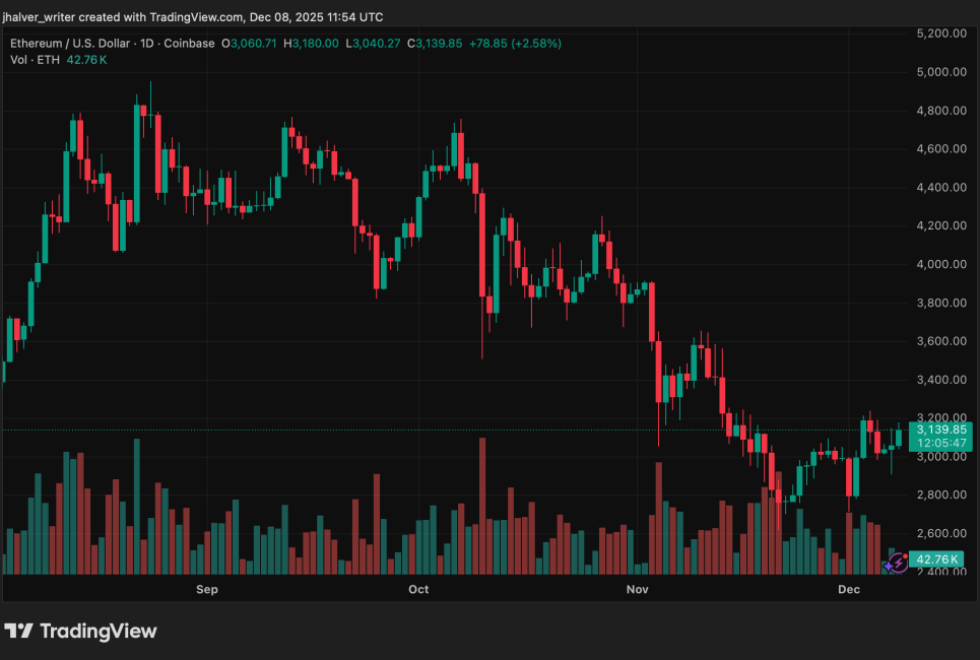
ETH's price records small profits on the daily chart. Source: ETHUSD on Tradingview

Why Has AI Taken the Spotlight

Across its 33 pages, the strategy places artificial intelligence, biotechnology, and quantum computing at the center of America’s next-generation competition.

The administration states that U.S. technology and standards must “drive the world forward,” underscoring a focus on advanced computing rather than decentralized finance. Digital assets, which had gained prominence through previous remarks from officials, receive no explicit mention.

This stands at odds with comments from President Trump in recent months. In a CBS 60 Minutes interview, he warned that China should not become the global leader in virtual assets and insisted that Bitcoin mining should remain within U.S. borders.

A Subtle Reference, but No Clear Policy

While crypto is not named in the strategy, the document does reference strengthening American “leadership in digital finance and innovation.”

Analysts view this as a broad gesture rather than a firm policy direction, but it leaves open the possibility that digital assets may still influence future regulatory or economic strategies.

This ambiguity comes despite a year of significant pro-crypto actions. Measures such as the GENIUS Act for stablecoin oversight, the formation of a crypto enforcement task force, reduced regulatory pressures on exchanges, and opposition to a central bank digital currency have all shaped expectations.

The establishment of a national Bitcoin reserve, funded through forfeited digital assets, further signals that crypto remains a strategic consideration even if not formally acknowledged in the latest blueprint.

Market Response and Broader Implications

Currently trading around $91,900, Bitcoin briefly fell below $90,000 following the release of the strategy, a move compounded by broader macroeconomic pressures and anticipation of a Federal Reserve rate decision.

The administration’s call for increased defense spending among NATO allies has also raised questions about inflation and monetary policy, factors that could influence investor appetite for digital assets.

For now, the omission leaves the industry navigating a familiar gap of strong political rhetoric, scattered policy initiatives, but no comprehensive framework. As the U.S. centers its priorities around AI and quantum computing, crypto’s position in national strategy remains undefined. Is this the end of the ‘Crypto Administration’?

Cover image from ChatGPT, ETHUSD chart from Tradingview

Letture associate

Not Speculation but a Necessity: The 4 Unique Values of Prediction Markets

Polymarket's recent $4 billion funding round and soaring valuation of $15 billion highlight the explosive growth of prediction markets, with trading volume reaching $25.7 billion in March 2026—a 10.6% monthly increase. This analysis argues that prediction markets serve critical non-speculative functions, positioning them as essential tools rather than mere gambling platforms. Prediction markets offer four unique values: entertainment consumption, insurance-like protection, risk hedging, and truth discovery. Firstly, they stimulate economic activity by engaging users in event-based betting, similar to the broader sports industry. Secondly, they act as a form of decentralized insurance, allowing users to hedge against specific, well-defined risks (e.g., weather events) transparently and without traditional overhead costs. Thirdly, institutions and individuals use these markets to hedge against geopolitical and commodity price risks, as demonstrated during the U.S.-Iran conflict and the launch of 24/7 commodity markets on platforms like Kalshi. Finally, prediction markets counter media bias by aggregating crowd-sourced information, often achieving 30% higher accuracy than surveys due to users' vested interests. Experts like Bitwise’s Jeff Park and SIG’s Jeff Yass emphasize the markets' role in risk transfer and financial innovation. As these platforms evolve, they are poised to become trillion-dollar markets, offering more reliable, decentralized mechanisms for information pricing and risk management.

marsbit2 h fa

Not Speculation but a Necessity: The 4 Unique Values of Prediction Markets

marsbit2 h fa

Trading

Spot
Futures

Articoli Popolari

Come comprare PUSH

Benvenuto in HTX.com! Abbiamo reso l'acquisto di Push Protocol (PUSH) semplice e conveniente. Segui la nostra guida passo passo per intraprendere il tuo viaggio nel mondo delle criptovalute.Step 1: Crea il tuo Account HTXUsa la tua email o numero di telefono per registrarti il tuo account gratuito su HTX. Vivi un'esperienza facile e sblocca tutte le funzionalità,Crea il mio accountStep 2: Vai in Acquista crypto e seleziona il tuo metodo di pagamentoCarta di credito/debito: utilizza la tua Visa o Mastercard per acquistare immediatamente Push ProtocolPUSH.Bilancio: Usa i fondi dal bilancio del tuo account HTX per fare trading senza problemi.Terze parti: abbiamo aggiunto metodi di pagamento molto utilizzati come Google Pay e Apple Pay per maggiore comodità.P2P: Fai trading direttamente con altri utenti HTX.Over-the-Counter (OTC): Offriamo servizi su misura e tassi di cambio competitivi per i trader.Step 3: Conserva Push Protocol (PUSH)Dopo aver acquistato Push Protocol (PUSH), conserva nel tuo account HTX. In alternativa, puoi inviare tramite trasferimento blockchain o scambiare per altre criptovalute.Step 4: Scambia Push Protocol (PUSH)Scambia facilmente Push Protocol (PUSH) nel mercato spot di HTX. Accedi al tuo account, seleziona la tua coppia di trading, esegui le tue operazioni e monitora in tempo reale. Offriamo un'esperienza user-friendly sia per chi ha appena iniziato che per i trader più esperti.

514 Totale visualizzazioniPubblicato il 2024.12.13Aggiornato il 2025.03.21

Come comprare PUSH

Discussioni

Benvenuto nella Community HTX. Qui puoi rimanere informato sugli ultimi sviluppi della piattaforma e accedere ad approfondimenti esperti sul mercato. Le opinioni degli utenti sul prezzo di PUSH PUSH sono presentate come di seguito.

活动图片