Crypto CLARITY Act set for Senate markup in January, says Sacks

cointelegraphPubblicato 2025-12-18Pubblicato ultima volta 2025-12-18

Introduzione

The long-awaited Crypto CLARITY Act is set for a Senate markup in January, according to White House AI and crypto czar David Sacks. Senate Banking Committee Chair Tim Scott and Agriculture Committee Chair John Boozman confirmed the bipartisan bill will advance next month. The legislation aims to define crypto securities and commodities, clarify regulatory roles between the SEC and CFTC, and reduce uncertainty for crypto firms. Supporters say it will establish clearer compliance pathways, encourage innovation, and strengthen investor protections. Work on the bill continued during the recent government shutdown, with regulators meeting executives from major crypto companies and venture firms.

The long-awaited Digital Asset Market Clarity Act, or CLARITY Act, is moving closer to passage, with a Senate markup expected in January, says White House artificial intelligence and crypto czar David Sacks.

Sacks posted to X on Thursday that Senate Banking Committee Chair Tim Scott and Agriculture Committee Chair John Boozman had confirmed that the bipartisan crypto bill will reach the Senate next month.

”We are closer than ever to passing the landmark crypto market structure legislation that President Trump has called for. We look forward to finishing the job in January!”
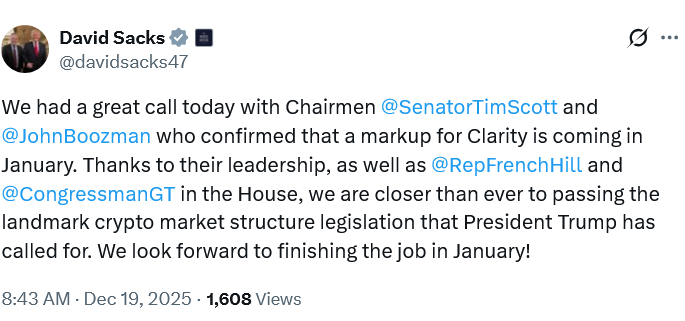
Source: David Sacks

The CLARITY Act would define crypto securities and commodities and clarify the roles of the Securities and Exchange Commission, the Commodity Futures Trading Commission, and other financial regulators.

Backers of the bill say it will reduce regulatory uncertainty for crypto firms by establishing clearer compliance pathways and encourage innovation while strengthening investor protections.

Related: Bitcoin institutional buys flip new supply for the first time in 6 weeks

US regulators continued to work on the CLARITY Act during the record 43-day government shutdown across October and November, meeting with executives from the likes of Coinbase, Ripple, Kraken, Circle, and tech-focused venture capital firms a16z and Paradigm.

Magazine: Quantum attacking Bitcoin would be a waste of time: Kevin O’Leary

Domande pertinenti

QWhat is the name of the crypto bill expected to be marked up in the Senate in January?

AThe Digital Asset Market Clarity Act, or CLARITY Act.

QWho announced that the CLARITY Act will reach the Senate next month?

AWhite House artificial intelligence and crypto czar David Sacks.

QWhich two Senate committee chairs confirmed the upcoming markup for the crypto bill?

ASenate Banking Committee Chair Tim Scott and Agriculture Committee Chair John Boozman.

QWhat is the main purpose of the CLARITY Act according to its backers?

ATo define crypto securities and commodities, clarify the roles of financial regulators like the SEC and CFTC, reduce regulatory uncertainty, establish clearer compliance pathways, encourage innovation, and strengthen investor protections.

QWhich major crypto and tech firms did US regulators meet with to work on the CLARITY Act during the government shutdown?

AExecutives from Coinbase, Ripple, Kraken, Circle, and tech-focused venture capital firms a16z and Paradigm.

Letture associate

HKEX Welcomes Its Largest IPO of the Day

Today (July 8th), Momenta successfully listed on the Hong Kong Stock Exchange, becoming the "first Physical AI stock." The company, founded in 2016 by Tsinghua University alumnus Cao Xudong, focuses on autonomous driving as an entry point into Physical AI research. Momenta's IPO price was HK$295.6 per share. With a market cap exceeding HK$70 billion post-listing, it was the largest among the five companies debuting that day. The offering raised approximately HK$6.8 billion and attracted a "star-studded" lineup of 14 cornerstone investors, including top-tier international funds, leading strategic industrial investors like Mercedes-Benz and BYD, and major Chinese financial institutions. The company has pioneered a "flywheel" strategy, integrating mass-produced advanced driver-assistance systems (ADAS) with its full-self-driving (L4) development. Data from over 1 million vehicles equipped with its systems fuels its AI models, enabling continuous improvement. This massive real-world data scale is a core competitive advantage. In April, Momenta launched its self-developed R7 World Model for mass production, a foundational model designed to understand and predict physical world dynamics. The company positions itself not just as an automotive tech supplier, but as a platform-level Physical AI company. Its technology platform has the potential to expand beyond autonomous vehicles into areas like logistics and embodied AI. Financially, Momenta's revenue grew from RMB 743 million in 2023 to RMB 2.413 billion in 2025, with licensing income surging 42-fold during this period. While still reporting adjusted losses, it is nearing breakeven. The company boasts partnerships with 24 global automakers, including 9 of the world's top 10, and holds a 65% market share in China's third-party urban NOA segment. The listing marks a significant moment for Physical AI in global capital markets, reflecting strong investor confidence in Momenta's unique technology path and commercial execution.

marsbit4 min fa

HKEX Welcomes Its Largest IPO of the Day

marsbit4 min fa

Not Betting on Goals but on 'Tears': Polymarket Users Argue Over Ronaldo's Final World Cup Match

Title: Beyond Goals, Betting on Tears: Polymarket Users Clash Over Ronaldo's Emotional World Cup Exit On July 6, Portugal's 0-1 loss to Spain in the World Cup round of 16 marked the final tournament for Cristiano Ronaldo. The 41-year-old star's emotional reaction—red eyes, wiping his face, fighting back tears—was captured globally. Concurrently, a fierce debate erupted on the crypto prediction platform Polymarket over a specific market: "Will Ronaldo cry during the 2026 FIFA World Cup?" The market, with over $23 million in volume, saw its "YES" probability surge to 99% after the match, but the result was disputed and entered a final review phase. The core conflict centered on the market's precise rules: it required "clearly visible tears streaming down [Ronaldo's] face" in photos/videos taken on the field or bench area during Portugal's matches. While major media outlets described Ronaldo as "in tears" and footage showed him emotional, "NO" bettors argued visible tear tracks were not conclusively evident, only red eyes and dampness. Polymarket's official clarification on July 8 stated that eligible evidence existed showing Ronaldo crying with visible tears on his face post-match. The dispute now goes to a UMA oracle community vote for resolution. This incident highlights a recurring challenge for prediction markets: they excel with quantifiable events but can spark major controversies over subjective, visual, or emotional interpretations. It also serves as a reminder for participants to scrutinize rule wording meticulously, not rely on general perception. Ultimately, such high-profile disputes drive significant trading volume and attention for the platform.

Foresight News1 h fa

Not Betting on Goals but on 'Tears': Polymarket Users Argue Over Ronaldo's Final World Cup Match

Foresight News1 h fa

Trading

Spot
活动图片