Crypto Clarity Act: No Deal in White House Yield Meeting

bitcoinistPubblicato 2026-02-11Pubblicato ultima volta 2026-02-11

Introduzione

A White House meeting on the Clarity Act, focused on the contentious issue of stablecoin rewards, ended without a deal. Banking groups pushed for a near-total ban on offering any form of reward to stablecoin holders, arguing such payments could destabilize traditional banking and reduce lending. Crypto advocates sought broader definitions for "permissible activities" that would allow rewards. Despite the lack of a compromise, participants from both sides described the talks as productive and a shift toward serious problem-solving. The White House urged stakeholders to reach an agreement by March 1, with further discussions expected soon.

A White House meeting aimed at breaking the logjam over stablecoin rewards under pending crypto market structure legislation aka Clarity Act ended without a compromise, even as both banking and crypto participants described the session as “productive,” according to details shared by Crypto In America reporter Eleanor Terrett citing sources in the room.

The follow-up gathering, smaller than the first meeting last week, zoomed in on what has become the most combustible line item in the Clarity Act debate: whether, and under what constraints, crypto firms can offer “rewards” tied to stablecoin usage. The White House urged both sides to reach a deal by March 1, Terrett reported, though it remains unclear whether another meeting of this scale will occur before the end of the month.

Crypto Clarity Act Update

Terrett said banks and banking trade groups came prepared with a written handout titled “Yield and Interest Prohibition Principles,” framing “payment stablecoins” as payment instruments and pushing for a bright-line ban on consideration paid to holders.

“In the GENIUS Act, Congress specifically designed payment stablecoins to be payment instruments,” the document states. “Consistent with this design, market structure legislation should incorporate the following yield and interest prohibition principles to limit deposit outflows that reduce the availability of credit for communities.”

The handout’s core demand is sweeping: “No person may provide any form of financial or non-financial consideration to a payment stablecoin holder in connection with the payment stablecoin holder’s purchase, use, ownership, possession, custody, holding, or retention of a payment stablecoin.” It pairs that with a call for regulator enforcement authority and civil monetary penalties, anti-evasion language, and strict marketing and disclosure rules that would bar firms from implying rewards are “interest,” “risk-free,” or comparable to insured deposits.

One source highlighted a narrow shift in bank posture: the inclusion of “any proposed exemptions” language, which Terrett said was viewed as a concession because banks had previously been unwilling to discuss exemptions “with respect to offering rewards on a transaction-based basis at all.” Even so, the handout insists exemptions must be “extremely limited in scope” and must not “drive deposit flight that would undercut Main Street lending.”

Terrett reported that a major share of the discussion centered on “permissible activities”: the types of account behavior that could qualify a crypto firm to offer rewards. Crypto representatives want those definitions broad; banks want them narrowed. That framing captures the heart of the dispute: whether rewards can be designed as functional incentives for payments activity, or whether any such consideration is inherently deposit-like and therefore destabilizing for traditional funding models.

Ripple Chief Legal Officer Stuart Alderoty struck an optimistic tone after the session, writing via X: “Productive session at the White House today – compromise is in the air. Clear, bipartisan momentum remains behind sensible crypto market structure legislation. We should move now – while the window is still open – and deliver a real win for consumers and America.”

Dan Spuller, EVP of the Blockchain Association, described the meeting as a shift from general debate to “serious problem-solving,” while underscoring the gap that remains. “Stablecoin rewards were front and center,” he wrote. “Banks did not come to negotiate from the bill text, instead arriving with broad prohibitive principles, which remains a key disagreement.”

The meeting was led by Patrick Witt, Executive Director of the President’s Crypto Council, and included Senate Banking Committee staff, Terrett reported. Crypto-side attendees included Coinbase’s Paul Grewal, a16z’s Miles Jennings, Ripple’s Alderoty, Paxos’s Josh Rosner, Blockchain Association CEO Summer Mersinger, and Ji Kim of the Crypto Council. Banks represented included Goldman Sachs, JPMorgan, Bank of America, Wells Fargo, Citi, PNC Bank, and U.S. Bank, alongside trade groups including the Bank Policy Institute, the American Bankers Association, and ICBA.

Mersinger said the continued convenings signal momentum even without a deal. “Today’s second White House meeting reflects continued, meaningful momentum toward delivering bipartisan digital asset market structure legislation, and we’re encouraged by the progress being made as stakeholders remain constructively engaged on resolving outstanding issues,” she said. “We’re thankful to Patrick Witt and the Administration for their continued leadership and commitment to keeping this process moving forward.”

For now, the White House appears to be applying time pressure rather than dictating terms. Further discussions are expected “in the coming days,” Terrett reported, setting up a race to define “permissible activities” narrowly enough to satisfy banks, but broadly enough for crypto firms to preserve rewards as a competitive product feature before the March 1 target date.

At press time, the total crypto market cap stood at $2.26 trillion.
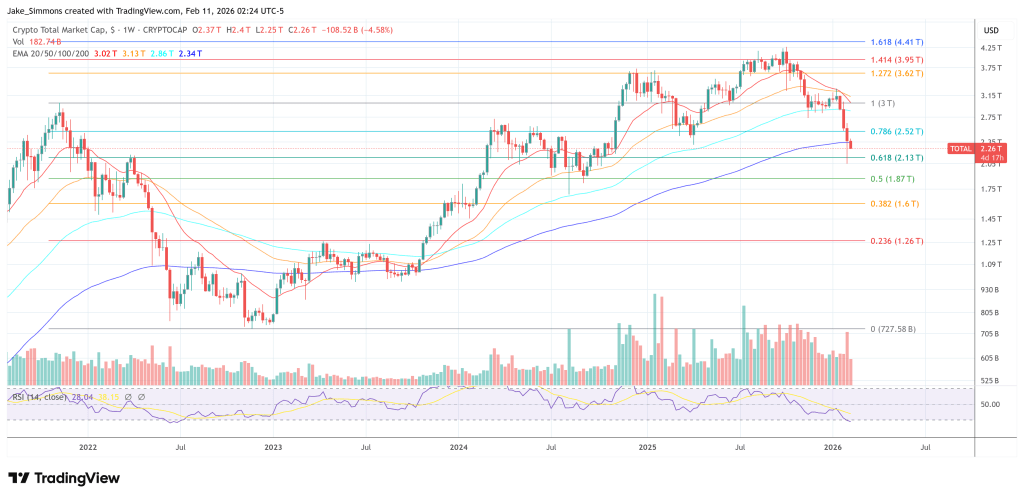
Total crypto market cap falls below the 200-week EMA, 1-week chart | Source: TOTAL on TradingView.com

Crypto di tendenza

Domande pertinenti

QWhat was the main topic of disagreement discussed in the White House meeting regarding the Crypto Clarity Act?

AThe main topic of disagreement was whether, and under what constraints, crypto firms can offer 'rewards' tied to stablecoin usage.

QWhat was the core demand of the banking trade groups' document titled 'Yield and Interest Prohibition Principles'?

AThe core demand was a sweeping prohibition: 'No person may provide any form of financial or non-financial consideration to a payment stablecoin holder' in connection with their use of the stablecoin, effectively pushing for a ban on rewards.

QHow did Ripple's Chief Legal Officer, Stuart Alderoty, characterize the meeting?

AStuart Alderoty struck an optimistic tone, calling it a 'productive session' and stating that 'compromise is in the air' with 'clear, bipartisan momentum' behind sensible legislation.

QWhat did Dan Spuller of the Blockchain Association identify as a 'key disagreement' with the banks?

AHe identified that the banks 'did not come to negotiate from the bill text, instead arriving with broad prohibitive principles,' which was a key point of disagreement.

QWhat is the deadline the White House urged both sides to reach a deal by, and what is the focus of the ongoing discussions?

AThe White House urged both sides to reach a deal by March 1. The ongoing discussions are focused on defining 'permissible activities' narrowly enough to satisfy banks but broadly enough for crypto firms to preserve rewards as a competitive product.

Letture associate

Vitalik's Algorithmic Stablecoin Vision: Interpreting the Mechanism and Challenges from an Options Perspective

Vitalik Buterin's recent algorithmic stablecoin proposal envisions using an option-like mechanism to create a stablecoin without the liquidation risks inherent in traditional collateralized debt position (CDP) models. The design splits one unit of ETH into two components: a 'stable' leg (P) that maintains value up to a certain strike price, and an 'upside' leg (N) that captures any appreciation above that price. Together, they always sum to one ETH, eliminating the need for debt or liquidation mechanisms. From an options perspective, the stable leg essentially functions as a synthetic, covered call position. However, significant challenges exist. For the stable asset to maintain its peg, it must continuously roll deep in-the-money call options, leading to potential rollover slippage, predictable trading paths vulnerable to front-running, and liquidity issues. Crucially, the system's scalability depends on a constant demand for the upside leg—a form of leveraged ETH long position without funding rates or liquidation risk. It's unclear if such persistent, specific demand will materialize from speculators or market makers who have simpler alternatives like perpetual swaps. The author, drawing from experience with Rysk, argues that DeFi options have struggled as standalone trading products due to complexity and fragmented liquidity. Their potential lies instead as foundational infrastructure underpinning more complex financial primitives like stablecoins, structured yields, or index products—transforming from a direct product into a core pricing and risk distribution engine for the next generation of on-chain finance.

marsbit17 min fa

Vitalik's Algorithmic Stablecoin Vision: Interpreting the Mechanism and Challenges from an Options Perspective

marsbit17 min fa

GPT-5.6 Countdown: Abandon the Illusion of a Single API, Computational Iteration Can't Outpace a Single Page of Compliance

In mid-June, three seemingly independent industry events—the compliance-driven throttling of Fable 5, the open-sourcing of GLM-5.2, and the leaked release timeline for GPT-5.6—are pushing the global AI industry toward a watershed moment. These shifts signal a fundamental restructuring of the industry's underlying logic. First, **"usability" has substantially overtaken "advanced capabilities"** as the primary weight, pushing the global large language model (LLM) supply chain into a "dual-track" phase of controlled closed-source and local open-source coexistence. Second, **the competitive moats of closed-source giants are shifting**. Their technical focus is moving from "language intelligence" toward "spatial intelligence (world models)"—a domain heavily reliant on computing power. Third, faced with常态化 transnational compliance risks, **a "model-agnostic" decoupled design has become a survival necessity for application-layer developers to maintain business continuity.** The article details how Anthropic's Fable 5, despite its advanced engineering feats, was restricted for non-U.S. citizens within 72 hours of launch, highlighting how geopolitical compliance can instantly limit even the most advanced models. In response, the open-source camp, exemplified by Zhipu AI's MIT-licensed GLM-5.2, is gaining market share by offering stable performance improvements and significant cost advantages (up to 70% savings for enterprises), while achieving full adaptation with domestic semiconductor platforms. Meanwhile, closed-source leaders like OpenAI are pivoting. The anticipated GPT-5.6 reportedly shifts focus from language to spatial intelligence and world models, aiming to rebuild a generational gap in areas like 3D understanding, simulation, and industrial design that demand immense compute. The core conclusion is that the LLM supply chain's logic has changed. Enterprises must now evaluate infrastructure based on a composite of technical performance and policy compliance. For developers, complete reliance on a single closed-source API poses unacceptable risk. Implementing a truly model-agnostic architecture—enabling swift switches to compliant, locally deployable open-source alternatives—is no longer just good practice but a fundamental baseline for business continuity.

marsbit3 h fa

GPT-5.6 Countdown: Abandon the Illusion of a Single API, Computational Iteration Can't Outpace a Single Page of Compliance

marsbit3 h fa

Is the 'Token Subsidy War' Among AI Giants Almost Over?

The article discusses the ongoing "token subsidy war" among AI giants like OpenAI and Anthropic, questioning whether it's nearing its end. It reveals that current AI subscription prices are heavily subsidized, with some plans offering tokens at up to 70 times the actual cost to attract and retain heavy users, especially developers and enterprises. This strategy mirrors past internet-era subsidy battles, but with a key difference: AI tokens lack "lock-in" effects. Unlike ride-hailing or food delivery apps, users can easily switch between AI providers as APIs become standardized, making it difficult for companies to raise prices post-subsidy. The piece highlights a structural asymmetry in the competition. Giants like Google, with massive advertising revenue, can afford to subsidize tokens indefinitely, akin to using "tokens as a weapon." In contrast, venture-backed companies like OpenAI and Anthropic face pressure to become profitable, especially as they approach IPO. The article cites Google Ventures founder Bill Maris, who suggests Google could slash token prices by 80%, putting immense pressure on competitors. Two potential endgames are presented: the "internet service" model (subsidize, monopolize, then raise prices) and the "utility" model (tokens become a standardized, low-margin commodity like electricity). Given the low switching costs, the latter seems more likely. The competition may not have a single winner but could instead accelerate AI's evolution into a foundational, infrastructure-level technology, akin to a public utility. For now, users continue to benefit from heavily subsidized token costs.

marsbit3 h fa

Is the 'Token Subsidy War' Among AI Giants Almost Over?

marsbit3 h fa

Trading

Spot
Futures

Articoli Popolari

Come comprare HOUSE

Benvenuto in HTX.com! Abbiamo reso l'acquisto di Housecoin (HOUSE) semplice e conveniente. Segui la nostra guida passo passo per intraprendere il tuo viaggio nel mondo delle criptovalute.Step 1: Crea il tuo Account HTXUsa la tua email o numero di telefono per registrarti il tuo account gratuito su HTX. Vivi un'esperienza facile e sblocca tutte le funzionalità,Crea il mio accountStep 2: Vai in Acquista crypto e seleziona il tuo metodo di pagamentoCarta di credito/debito: utilizza la tua Visa o Mastercard per acquistare immediatamente HousecoinHOUSE.Bilancio: Usa i fondi dal bilancio del tuo account HTX per fare trading senza problemi.Terze parti: abbiamo aggiunto metodi di pagamento molto utilizzati come Google Pay e Apple Pay per maggiore comodità.P2P: Fai trading direttamente con altri utenti HTX.Over-the-Counter (OTC): Offriamo servizi su misura e tassi di cambio competitivi per i trader.Step 3: Conserva Housecoin (HOUSE)Dopo aver acquistato Housecoin (HOUSE), conserva nel tuo account HTX. In alternativa, puoi inviare tramite trasferimento blockchain o scambiare per altre criptovalute.Step 4: Scambia Housecoin (HOUSE)Scambia facilmente Housecoin (HOUSE) nel mercato spot di HTX. Accedi al tuo account, seleziona la tua coppia di trading, esegui le tue operazioni e monitora in tempo reale. Offriamo un'esperienza user-friendly sia per chi ha appena iniziato che per i trader più esperti.

287 Totale visualizzazioniPubblicato il 2025.04.27Aggiornato il 2026.06.02

Come comprare HOUSE

Discussioni

Benvenuto nella Community HTX. Qui puoi rimanere informato sugli ultimi sviluppi della piattaforma e accedere ad approfondimenti esperti sul mercato. Le opinioni degli utenti sul prezzo di HOUSE HOUSE sono presentate come di seguito.

活动图片