Crypto Biz: How Ripple quietly convinced Wall Street

cointelegraphPubblicato 2025-12-12Pubblicato ultima volta 2025-12-12

It has been a long and arduous journey for Ripple. After emerging from a multiyear battle with the US Securities and Exchange Commission, the blockchain-based payments and infrastructure company is pressing ahead with broad ambitions to unify custody, treasury and prime-brokerage services, each underpinned by blockchain technology and stablecoins.

Despite the bruising legal fight and the reputational damage that came with it, Ripple has still managed to win over some of Wall Street’s biggest players.

This week’s Crypto Biz looks at how Ripple secured a striking $40 billion valuation, and why some of its backers are quietly placing bets on an XRP (XRP) surge.

Elsewhere, WisdomTree rolled out a new options-income strategy through a tokenized fund, Bitwise shifted its crypto index fund to the NYSE Arca, and Jack Mallers’ Twenty-First Capital made its public debut on the New York Stock Exchange.

The story behind Ripple’s $40 billion valuation

In November, Ripple raised $500 million at a valuation of $40 billion, attracting investors including Citadel Securities, Fortress Investment Group and funds tied to Brevan Howard, Pantera Capital and Galaxy Digital. New reporting now sheds light on how the deal came together.

According to Bloomberg, Ripple secured commitments by offering investors substantial downside protection. The terms allowed participating funds to sell their shares back to Ripple after three or four years for a guaranteed annualized return of 10%. Ripple also retained the right to repurchase those shares during the same window, at an annualized return of 25% for investors.

Ripple has since broadened its strategy, pushing deeper into the stablecoin market and pursuing acquisitions in brokerage and treasury management. Still, sources told Bloomberg that some backers were motivated not only by the company’s expansion plans but also by expectations for the future performance of XRP.
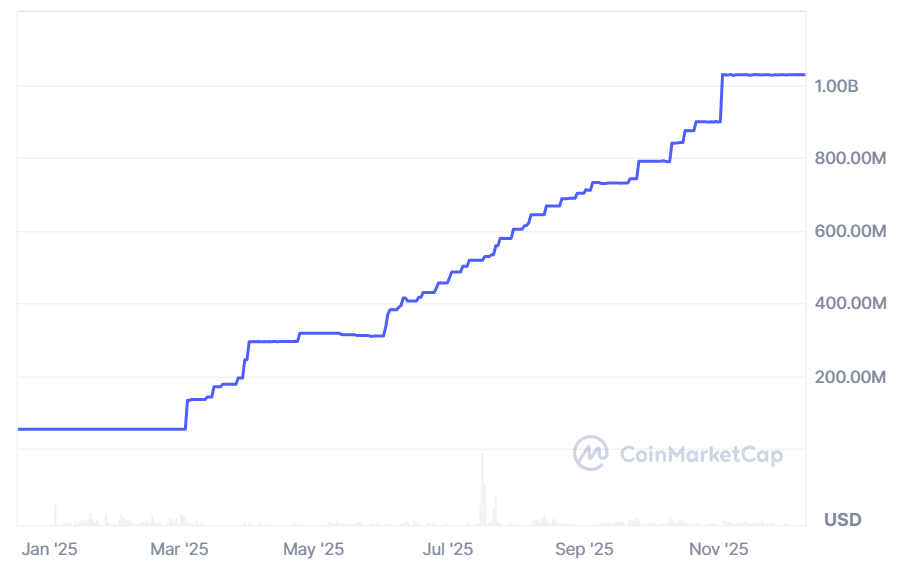
Ripple’s RLUSD stablecoin has grown to a market cap of more than $1 billion. Source: CoinMarketCap

WisdomTree launches tokenized fund targeting options-income strategy

Asset manager WisdomTree is bringing a complex options strategy onchain with a new tokenized fund designed to track the price and yield performance of the Volos US Large Cap Target 2.5% PutWrite Index. The fund, called the WisdomTree Equity Premium Income Digital Fund, is now available under the token ticker EPXC and the fund ticker WTPIX.

The Volos benchmark is modeled on a “put-writing” strategy, in which the index sells cash-secured put options to generate income. Instead of writing options directly on the S&P 500, the strategy uses contracts tied to the SPDR S&P 500 ETF Trust (SPY), allowing it to collect option premiums as the seller.

The launch marks another step in the convergence of traditional finance and blockchain, giving volatility-wary investors a way to access a put-writing strategy through an onchain fund.

Source: WisdomTree Prime

Bitwise’s crypto index fund lists on NYSE Arca

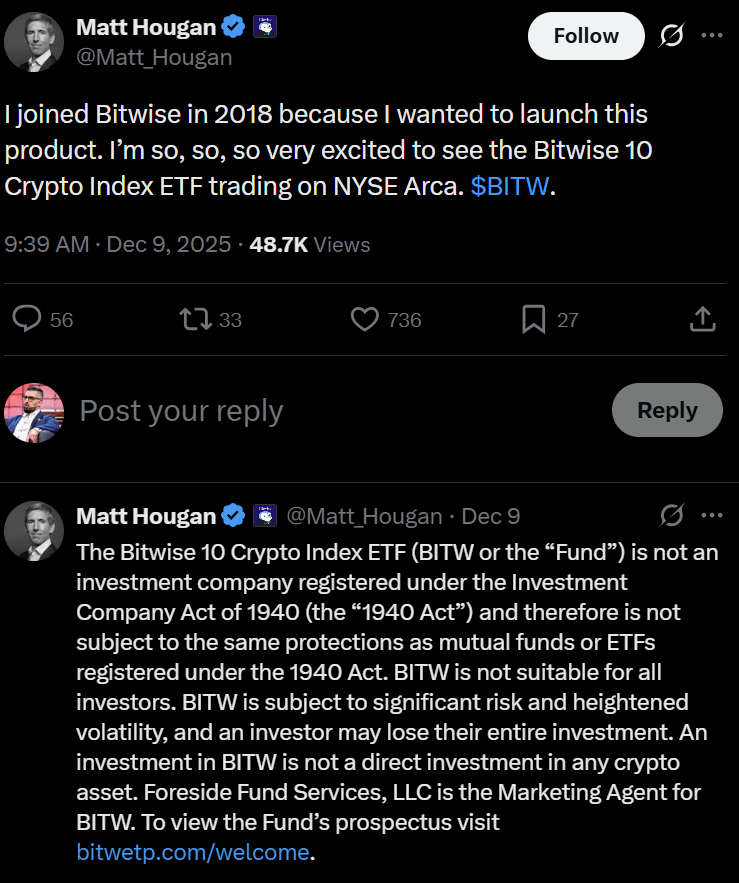
On Dec. 10, Bitwise Asset Management’s 10 Crypto Index Fund (BITW) transitioned from the over-the-counter market to NYSE Arca, broadening its visibility and opening the door to greater institutional participation. The fund is now available as an exchange-traded product.

BITW provides diversified exposure to the 10 largest crypto assets by market capitalization, including Bitcoin (BTC), Ether (ETH), Solana (SOL) and XRP.

“Most investors we meet are convinced crypto is here to stay, but they don’t know who the winners will be or how many will succeed,” said Matt Hougan, Bitwise’s chief investment officer. “The index approach is a way for people to invest in the thesis without having to predict the future.”

An NYSE Arca listing may help BITW attract investors who are hesitant to buy crypto directly through exchanges.
Source: Matt Hougan

Twenty One Capital opens with a strong public debut

Bitcoin treasury company Twenty One Capital began trading on the New York Stock Exchange on Tuesday, marking a notable step in the growing institutional push into digital assets. The listing follows the company’s merger with Cantor Equity Partners.

The company, now trading under the ticker XXI, holds more than 43,000 BTC, valued at nearly $4 billion.

“Bitcoin is honest money. That’s why people choose it, and that’s why we built Twenty One on top of it,” CEO Jack Mallers said as the company went public.

Backed by Cantor Fitzgerald, Tether, Bitfinex and SoftBank, Twenty One Capital has exceeded its Bitcoin accumulation targets after a series of large purchases throughout the year.
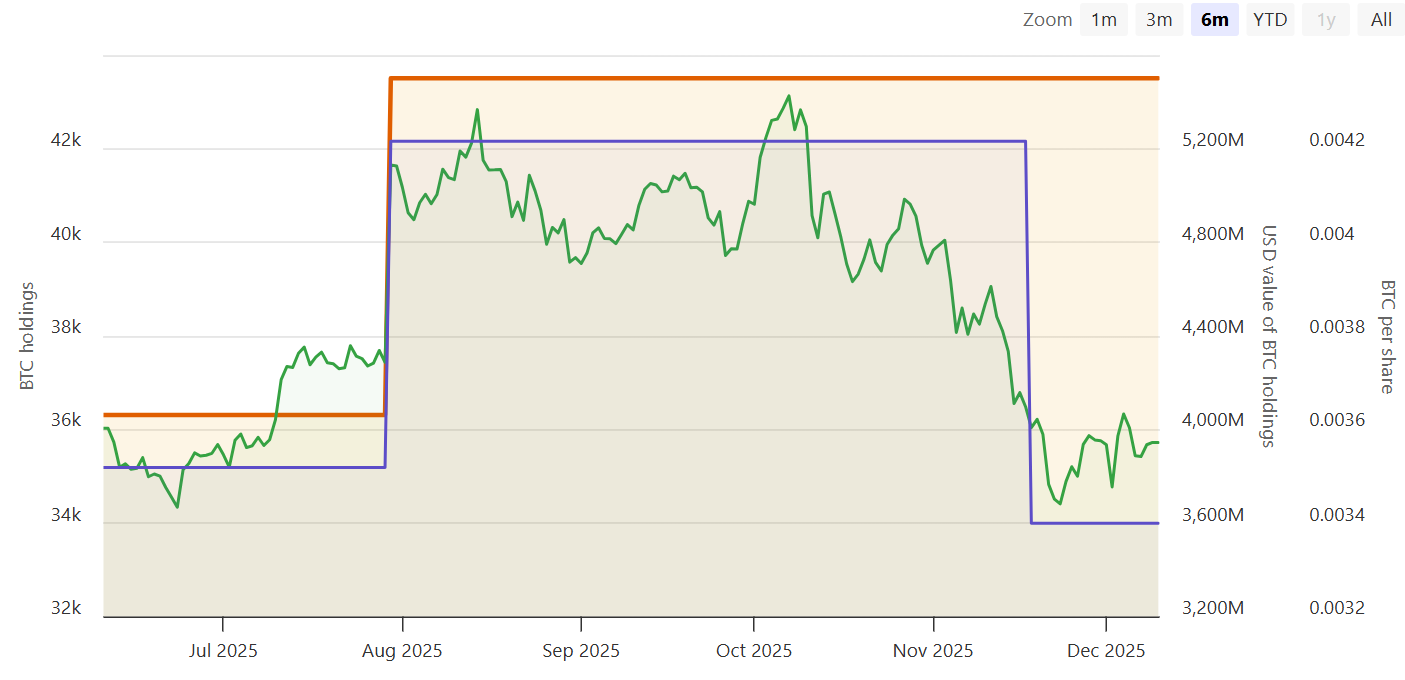
Twenty One Capital’s Bitcoin accumulation this year. Source: BitcoinTreasuries.NET

Crypto Biz is your weekly pulse on the business behind blockchain and crypto, delivered directly to your inbox every Thursday.


Letture associate

From Survival to Accelerated Growth: The Journey of Zcash's Three-Year Rise as Told by the Founder of ZODL

**From Survival to Accelerated Growth: Zcash Founder Details the 3-Year Rise** Three years ago, Zcash (ZEC) was a struggling pioneer in privacy technology, with a price near $30, low shielded supply (11%), and a community mired in governance disputes. Today, ZEC trades around $600, with over 31% of its supply (~$3B) in user-controlled shielded pools. This transformation resulted from breaking key constraints. First, **governance shackles were removed**. The old model guaranteed funding to two entities (ECC and ZF) regardless of performance, creating a monopoly. In 2024, ECC rejected further direct funding, forcing a change. The NU6 upgrade ended direct funding, allocating 8% to community grants and 12% to a protocol-controlled treasury for retroactive rewards, expiring in 2028 unless renewed by overwhelming consensus. The entities also relinquished their trademark-based veto power, freeing community governance. Second, the **product focus shifted** from pure cryptography to user growth. Previously, engineering excelled at privacy tech but failed to attract users. In early 2024, the team (later ZODL) pivoted to building products users wanted, like the Zodl wallet (default privacy, hardware support, cross-asset swaps). This drove shielded supply to grow over 400% in ZEC terms, with 86.5% of recent transactions being shielded, representing real user adoption. Third, the **narrative evolved** from the limiting "privacy coin" label to "unstoppable private money." This clarified Zcash's value proposition: a Bitcoin-like monetary policy with verifiable private payments via advanced cryptography. This structural narrative—protocol (Zcash), asset (ZEC), gateway (Zodl)—enabled broader exchange listings, institutional interest, and ETF filings. Finally, **organizational constraints were broken**. In early 2026, the ECC team left its non-profit structure after disputes over control, forming Zcash Open Development Lab (ZODL). ZODL raised $25M from top VCs (Paradigm, a16z, etc.), gaining the capital and agility of a startup to scale consumer products. Current metrics show strong momentum: social discussion volume for ZEC surged 15,245% in a year, with 81% positive sentiment. The focus is now on enhancing user experience (Zodl wallet), scalability (Tachyon project targeting Visa-level throughput with 25-second blocks), and post-quantum security (quantum-recoverable wallets coming soon). Zcash is positioned to become faster, more usable, scalable, and quantum-resistant.

marsbit3 min fa

From Survival to Accelerated Growth: The Journey of Zcash's Three-Year Rise as Told by the Founder of ZODL

marsbit3 min fa

Five Counterparty Risk Architectures: A Settlement-Layer Methodology for Classifying TradFi Models in Crypto Exchanges

**Summary:** This companion piece reframes the five TradFi-on-crypto exchange architectures, previously classified by "architectural fingerprint," through the lens of counterparty risk. The core question is: whose balance sheet bears the loss first in a stress scenario, and has it historically done so? Each of the five models corresponds to a distinct risk holder with its own documented failure modes. * **Model 1 (Stablecoin-Settled CEX Perpetuals):** Risk is held by the stablecoin issuer (e.g., reserve composition, bank connectivity) and the CEX's own book. History includes Tether's banking disconnections (2017) and reserve misrepresentations (CFTC 2021 Order). * **Model 2 (CFD Brokers):** Risk resides on the broker's balance sheet (B-book model). Regulatory differences (e.g., ESMA's mandatory negative balance protection vs. Mauritius FSC's lack thereof) define loss allocation rules, as seen in the 2015 SNB event (Alpari UK insolvency). * **Model 3 (Off-Chain Custody & Transfer Agent Chain):** Risk lies with the off-chain custodian/platform. User asset recovery depends on Terms of Use and corporate structure, exemplified by the Celsius bankruptcy ruling (2023) where Earn Account assets were deemed property of the estate. * **Model 4 (DEX Perpetual Protocols):** No single balance sheet bears risk. Loss absorption relies on a protocol's insurance fund and Auto-Deleveraging (ADL) mechanism, as demonstrated in the GMX V1 (2022) and dYdX v3 YFI (2023) incidents. * **Model 5 (Regulated CCP - DCM-DCO-FCM):** The most institutionalized model concentrates risk in the Central Counterparty (CCP). However, history shows CCPs can employ non-standard tools under extreme stress, such as mass trade cancellation (LME Nickel, 2022) or enabling negative price settlements (CME WTI, 2020). The report argues that regulatory choices and counterparty risk structures are co-extensive, not in an upstream-downstream relationship. It concludes with five separate observation checklists (not predictions) for monitoring the structural vulnerabilities of each risk model.

marsbit20 min fa

Five Counterparty Risk Architectures: A Settlement-Layer Methodology for Classifying TradFi Models in Crypto Exchanges

marsbit20 min fa

Trading

Spot
Futures

Articoli Popolari

Come comprare CC

Benvenuto in HTX.com! Abbiamo reso l'acquisto di CC(Canton) (CC) semplice e conveniente. Segui la nostra guida passo passo per intraprendere il tuo viaggio nel mondo delle criptovalute.Step 1: Crea il tuo Account HTXUsa la tua email o numero di telefono per registrarti il tuo account gratuito su HTX. Vivi un'esperienza facile e sblocca tutte le funzionalità,Crea il mio accountStep 2: Vai in Acquista crypto e seleziona il tuo metodo di pagamentoCarta di credito/debito: utilizza la tua Visa o Mastercard per acquistare immediatamente CC(Canton)CC.Bilancio: Usa i fondi dal bilancio del tuo account HTX per fare trading senza problemi.Terze parti: abbiamo aggiunto metodi di pagamento molto utilizzati come Google Pay e Apple Pay per maggiore comodità.P2P: Fai trading direttamente con altri utenti HTX.Over-the-Counter (OTC): Offriamo servizi su misura e tassi di cambio competitivi per i trader.Step 3: Conserva CC(Canton) (CC)Dopo aver acquistato CC(Canton) (CC), conserva nel tuo account HTX. In alternativa, puoi inviare tramite trasferimento blockchain o scambiare per altre criptovalute.Step 4: Scambia CC(Canton) (CC)Scambia facilmente CC(Canton) (CC) nel mercato spot di HTX. Accedi al tuo account, seleziona la tua coppia di trading, esegui le tue operazioni e monitora in tempo reale. Offriamo un'esperienza user-friendly sia per chi ha appena iniziato che per i trader più esperti.

276 Totale visualizzazioniPubblicato il 2026.04.21Aggiornato il 2026.04.21

Come comprare CC

Come comprare BLEND

Benvenuto in HTX.com! Abbiamo reso l'acquisto di Fluent (BLEND) semplice e conveniente. Segui la nostra guida passo passo per intraprendere il tuo viaggio nel mondo delle criptovalute.Step 1: Crea il tuo Account HTXUsa la tua email o numero di telefono per registrarti il tuo account gratuito su HTX. Vivi un'esperienza facile e sblocca tutte le funzionalità,Crea il mio accountStep 2: Vai in Acquista crypto e seleziona il tuo metodo di pagamentoCarta di credito/debito: utilizza la tua Visa o Mastercard per acquistare immediatamente FluentBLEND.Bilancio: Usa i fondi dal bilancio del tuo account HTX per fare trading senza problemi.Terze parti: abbiamo aggiunto metodi di pagamento molto utilizzati come Google Pay e Apple Pay per maggiore comodità.P2P: Fai trading direttamente con altri utenti HTX.Over-the-Counter (OTC): Offriamo servizi su misura e tassi di cambio competitivi per i trader.Step 3: Conserva Fluent (BLEND)Dopo aver acquistato Fluent (BLEND), conserva nel tuo account HTX. In alternativa, puoi inviare tramite trasferimento blockchain o scambiare per altre criptovalute.Step 4: Scambia Fluent (BLEND)Scambia facilmente Fluent (BLEND) nel mercato spot di HTX. Accedi al tuo account, seleziona la tua coppia di trading, esegui le tue operazioni e monitora in tempo reale. Offriamo un'esperienza user-friendly sia per chi ha appena iniziato che per i trader più esperti.

187 Totale visualizzazioniPubblicato il 2026.04.24Aggiornato il 2026.04.24

Come comprare BLEND

Come comprare ACN

Benvenuto in HTX.com! Abbiamo reso l'acquisto di AITECH CLOUD NETWORK (ACN) semplice e conveniente. Segui la nostra guida passo passo per intraprendere il tuo viaggio nel mondo delle criptovalute.Step 1: Crea il tuo Account HTXUsa la tua email o numero di telefono per registrarti il tuo account gratuito su HTX. Vivi un'esperienza facile e sblocca tutte le funzionalità,Crea il mio accountStep 2: Vai in Acquista crypto e seleziona il tuo metodo di pagamentoCarta di credito/debito: utilizza la tua Visa o Mastercard per acquistare immediatamente AITECH CLOUD NETWORKACN.Bilancio: Usa i fondi dal bilancio del tuo account HTX per fare trading senza problemi.Terze parti: abbiamo aggiunto metodi di pagamento molto utilizzati come Google Pay e Apple Pay per maggiore comodità.P2P: Fai trading direttamente con altri utenti HTX.Over-the-Counter (OTC): Offriamo servizi su misura e tassi di cambio competitivi per i trader.Step 3: Conserva AITECH CLOUD NETWORK (ACN)Dopo aver acquistato AITECH CLOUD NETWORK (ACN), conserva nel tuo account HTX. In alternativa, puoi inviare tramite trasferimento blockchain o scambiare per altre criptovalute.Step 4: Scambia AITECH CLOUD NETWORK (ACN)Scambia facilmente AITECH CLOUD NETWORK (ACN) nel mercato spot di HTX. Accedi al tuo account, seleziona la tua coppia di trading, esegui le tue operazioni e monitora in tempo reale. Offriamo un'esperienza user-friendly sia per chi ha appena iniziato che per i trader più esperti.

97 Totale visualizzazioniPubblicato il 2026.04.28Aggiornato il 2026.04.28

Come comprare ACN

Discussioni

Benvenuto nella Community HTX. Qui puoi rimanere informato sugli ultimi sviluppi della piattaforma e accedere ad approfondimenti esperti sul mercato. Le opinioni degli utenti sul prezzo di A A sono presentate come di seguito.

活动图片













