Crypto Biz: Bank stablecoins get a rulebook; Bitcoin gets a land grab

cointelegraphPubblicato 2025-12-19Pubblicato ultima volta 2025-12-19

Introduzione

Washington is advancing regulatory clarity for bank-issued stablecoins, with the FDIC proposing a framework under the GENIUS Act. This outlines how insured banks can seek approval to issue payment stablecoins via subsidiaries, subject to public consultation. Meanwhile, corporate Bitcoin accumulation continues, as American Bitcoin surpasses ProCap, now holding over 5,000 BTC. Anchorage Digital expands its institutional services by acquiring Securitize’s advisory platform. Bhutan, a major national Bitcoin holder, plans to use part of its 11,000 BTC reserves to fund the Gelephu Mindfulness City project, balancing economic development with long-term capital preservation.

Washington is inching closer to putting bank-issued stablecoins on a clearer regulatory track.

This week, the Federal Deposit Insurance Corp. (FDIC), the US agency that oversees bank safety and insures deposits, laid out a proposed framework for how insured banks, via subsidiaries, could seek approval to issue payment stablecoins under the GENIUS Act, a move that could reshape who gets to mint digital dollars and under what rules.

That same push toward institutionalization is also evident elsewhere in the crypto business landscape. Despite Bitcoin’s (BTC) lackluster performance, corporate treasuries are still in accumulation mode, with American Bitcoin vaulting past ProCap in the race to stack BTC.

On Wall Street’s doorstep, Anchorage Digital is tightening its grip on the adviser channel by acquiring Securitize’s RIA platform, bringing custody and advisory tools under one roof.

On the sovereign end of the spectrum, Bhutan says it will tap a portion of its sizable Bitcoin holdings to help finance Gelephu Mindfulness City, an ambitious bid to build a new economic hub without compromising long-term capital preservation.

This week’s Crypto Biz dives into regulatory, corporate and economic developments shaping the global crypto industry.

FDIC proposes framework for bank-issued payment stablecoins

The FDIC is moving forward with proposed rulemaking in the wake of the landmark GENIUS Act, signaling that the agency is preparing to offer clear guidance to banking institutions seeking to issue payment stablecoins.

In a 38-page document published on the FDIC’s website, the agency outlined proposed approval requirements governing how bank subsidiaries could issue payment stablecoins in accordance with the GENIUS Act. The proposal is subject to a public consultation process before any rules are finalized.

Under the proposed framework, financial institutions would be required to apply to issue a stablecoin through a subsidiary, with the FDIC evaluating both the parent company and the issuing entity. Applicants would also need to comply with the GENIUS Act’s provisions related to issuance standards, reserve backing and redemption policies.
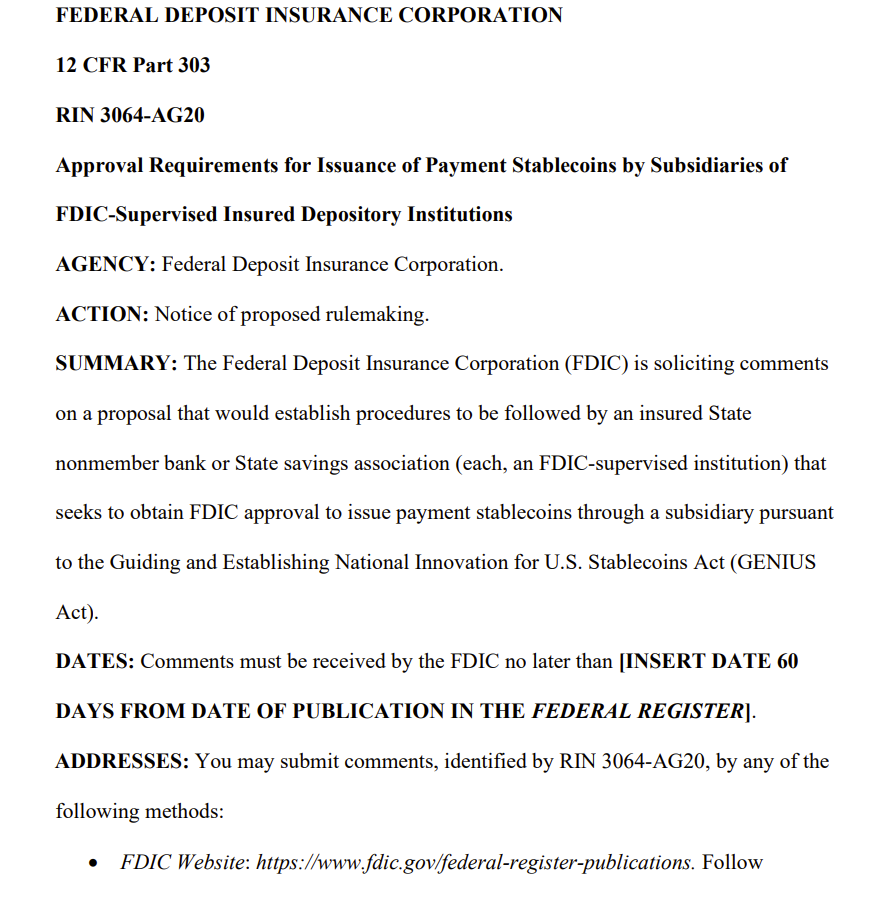
Excerpts from the FDIC’s proposal detailing the approval process for bank-issued payment stablecoins. Source: FDIC

American Bitcoin overtakes ProCap in corporate Bitcoin treasury race

American Bitcoin, the digital asset mining and holding company associated with the Trump family, entered the ranks of the top 20 corporate Bitcoin holders this week, surpassing ProCap Financial, a company founded by entrepreneur Anthony Pompliano. The shift highlights the growing competition among companies to accumulate Bitcoin.

American Bitcoin has added more than 1,000 BTC to its reserves since the beginning of December. Its total Bitcoin holdings now stand at 5,098 BTC, valued at approximately $452 million, according to industry data.

The company trades on the Nasdaq, having gone public through a reverse merger with Gryphon Digital Mining. Its shares, however, have experienced sharp volatility, reflecting the broader price swings typical of Bitcoin proxy stocks tied to the performance of Bitcoin.
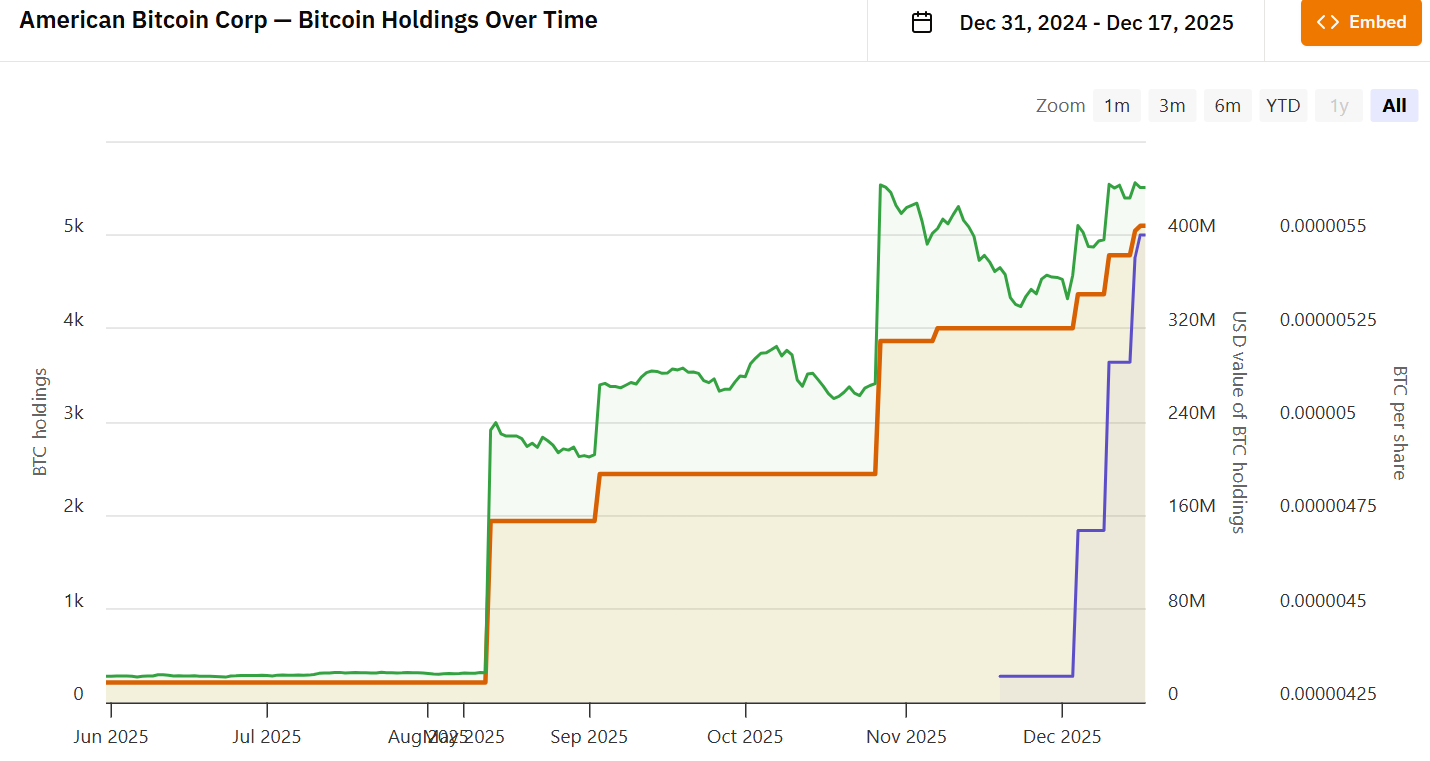
American Bitcoin’s BTC acquisitions over time. Source: BitcoinTreasuries.NET

Anchorage Digital acquires Securitize advisory unit to expand institutional offerings

Anchorage Digital has acquired Securitize’s investment adviser platform as part of a strategy to consolidate and expand its institutional investment services for registered investment advisers (RIAs).

Anchorage announced that it acquired Securitize For Advisors (SFA) for an undisclosed amount. The platform is designed to serve RIAs and had already been using Anchorage for digital asset custody. By bringing SFA in-house, Anchorage aims to integrate custody services with adviser-facing tools under a single platform.

Anchorage Digital provides institutional digital asset services and operates a federally chartered bank in the United States. In March, the company selected Cantor Fitzgerald to custody clients’ Bitcoin.

Bhutan to tap Bitcoin holdings to finance special administrative region

The Kingdom of Bhutan, one of the world’s largest state holders of Bitcoin, said it will use a portion of its digital asset reserves to help finance the Gelephu Mindfulness City (GMC), a planned special administrative region aimed at driving long-term economic growth.

The project is designed to serve as a new economic hub, focusing on sustainability and innovation, to curb Bhutan’s brain drain while creating high-quality local jobs and attracting international investment.

Bhutan currently holds more than 11,000 BTC, and officials have indicated that multiple strategies are being considered for deploying the reserves. Any use of the country’s Bitcoin, however, will be balanced against the objective of preserving its long-term value.

“Any use of Bitcoin will be guided by strong governance and prudence, with an emphasis on capital preservation, appropriate oversight, and transparency,” the government said.
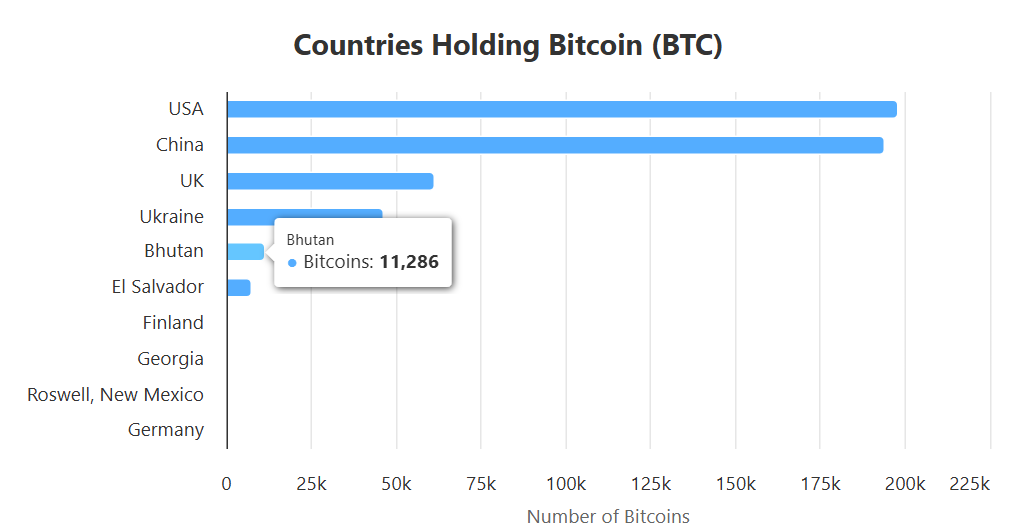
Bhutan’s ranking among countries that hold Bitcoin. Source: Bitbo

Crypto Biz is your weekly pulse on the business behind blockchain and crypto, delivered directly to your inbox every Thursday.


Domande pertinenti

QWhat is the FDIC's proposed framework for bank-issued stablecoins and what act does it relate to?

AThe FDIC has proposed a framework outlining approval requirements for how bank subsidiaries can issue payment stablecoins in accordance with the GENIUS Act. This framework requires financial institutions to apply through a subsidiary, with the FDIC evaluating both the parent company and the issuing entity, and mandates compliance with the act's provisions on issuance standards, reserve backing, and redemption policies.

QWhich company surpassed ProCap Financial in corporate Bitcoin holdings this week, and what is its current BTC reserve?

AAmerican Bitcoin surpassed ProCap Financial in corporate Bitcoin holdings. It has added over 1,000 BTC since the beginning of December, bringing its total holdings to 5,098 BTC, valued at approximately $452 million.

QWhat strategic move did Anchorage Digital make to expand its institutional offerings for registered investment advisers (RIAs)?

AAnchorage Digital acquired Securitize's investment adviser platform, Securitize For Advisors (SFA), to consolidate and expand its institutional investment services. This move integrates custody services with adviser-facing tools under a single platform.

QHow does the Kingdom of Bhutan plan to use a portion of its Bitcoin reserves, and what is the project called?

AThe Kingdom of Bhutan plans to use a portion of its Bitcoin reserves to help finance the Gelephu Mindfulness City (GMC), a special administrative region project aimed at driving long-term economic growth, focusing on sustainability and innovation.

QWhat is the primary regulatory focus of the FDIC's new proposal for stablecoins issued by banks?

AThe primary regulatory focus of the FDIC's proposal is to provide clear guidance and establish a framework for insured banks to issue payment stablecoins through subsidiaries, ensuring compliance with the GENIUS Act's standards for issuance, redemption, and reserve backing.

Letture associate

How Many Tokens Away Is Yang Zhilin from the 'Moon Chasing the Light'?

The article explores the intense competition between two leading Chinese AI companies, DeepSeek and Kimi (Moon Dark Side), and the mounting pressure on Yang Zhilin, the founder of Kimi. While DeepSeek re-emerged after 15 months of silence with its powerful V4 model—boasting 1.6 trillion parameters and low-cost, long-context capabilities—Kimi has been focusing on long-context processing and multi-agent systems with its K2.6 model. Yang faces a threefold challenge: technological rivalry, commercialization pressure, and investor expectations. Despite Kimi’s high valuation (reaching $18 billion), its revenue heavily relies on a single product with low paid conversion rates, while DeepSeek’s strategic silence and open-source influence have strengthened its market position and valuation prospects, now targeting over $20 billion. Both companies reflect broader trends in China’s AI ecosystem: Kimi aims for global influence through open-source contributions and agent-based advancements, while DeepSeek prioritizes foundational innovation and hardware independence, notably shifting to Huawei’s chips. Their competition is seen as vital for China’s AI progress, with the gap between top Chinese and U.S. models narrowing to just 2.7% on the Elo rating scale. Ultimately, the article argues that this rivalry, though anxiety-inducing for leaders like Zhilin, is essential for driving innovation and solidifying China’s role in the global AI landscape.

marsbit2 h fa

How Many Tokens Away Is Yang Zhilin from the 'Moon Chasing the Light'?

marsbit2 h fa

TechFlow Intelligence Bureau: ChatGPT Helps Amateur Mathematician Crack 60-Year-Old Problem, CFTC Sues New York Regulator Over Coinbase and Gemini

An amateur mathematician, with the assistance of ChatGPT, has solved a combinatorial mathematics puzzle originally proposed by Hungarian mathematician Paul Erdős in the 1960s. This marks another milestone in AI-aided mathematical research, demonstrating the evolving capabilities of large language models in formal reasoning. In other AI developments, OpenAI introduced a new privacy filter tool for enterprise API usage, automatically screening sensitive data. Meanwhile, the Qwen3.6-27B model achieved 100 tokens per second on a single RTX 5090 GPU using quantization, significantly lowering the cost barrier for local AI deployment. In crypto and Web3, the U.S. CFTC sued New York’s financial regulator, challenging its oversight of Coinbase and Gemini—a first-of-its-kind federal-state regulatory clash. Following a vulnerability, KelpDAO and major DeFi protocols established a recovery fund. Tether froze $344 million in assets linked to Iran’s central bank upon U.S. Treasury request, highlighting the centralized control risks in stablecoins. Separately, Litecoin underwent a 3-hour chain reorganization to undo a privacy-layer exploit. In the U.S., former President Trump invoked the Defense Production Act to address power grid bottlenecks affecting AI data centers and dismissed the entire National Science Board, raising concerns over research independence. A retail trader gained 250% on a $600k Intel options bet amid AI-related speculation. Xiaomi announced its first performance electric vehicle, targeting rivals like Tesla. Meanwhile, iPhone users reported devices automatically reinstalling a hidden app daily, suspected to be MDM-related. A Chinese securities report noted that A-share institutional crowding has reached its second-longest streak since 2007, signaling high valuations and potential style rotation. The day’s developments reflect a dual narrative: AI is enabling unprecedented individual breakthroughs, while centralized power structures—whether governmental or corporate—are becoming more assertive, underscoring that decentralization is as much a political-economic challenge as a technical one.

marsbit3 h fa

TechFlow Intelligence Bureau: ChatGPT Helps Amateur Mathematician Crack 60-Year-Old Problem, CFTC Sues New York Regulator Over Coinbase and Gemini

marsbit3 h fa

Trading

Spot
Futures

Articoli Popolari

Cosa è WL

I. Introduzione al ProgettoWorldLand è una L2 o side chain di Ethereum, progettata come una soluzione dal basso verso l'alto per migliorare l'ecosistema di Ethereum.II. Informazioni sul Token1) Informazioni di BaseNome del token: WL (WorldLand)III. Link CorrelatiSito web:https://worldland.foundation/Esploratori:https://bscscan.com/address/0x8aaB31fbc69C92fa53f600910Cf0f215531F8239Social:https://x.com/WorldLand_space Nota: L'introduzione al progetto proviene dai materiali pubblicati o forniti dal team ufficiale del progetto, che sono solo a scopo di riferimento e non costituiscono consulenza per gli investimenti. HTX non si assume alcuna responsabilità per eventuali perdite dirette o indirette risultanti.

294 Totale visualizzazioniPubblicato il 2026.03.28Aggiornato il 2026.03.28

Cosa è WL

Come comprare WL

Benvenuto in HTX.com! Abbiamo reso l'acquisto di WorldLand (WL) semplice e conveniente. Segui la nostra guida passo passo per intraprendere il tuo viaggio nel mondo delle criptovalute.Step 1: Crea il tuo Account HTXUsa la tua email o numero di telefono per registrarti il tuo account gratuito su HTX. Vivi un'esperienza facile e sblocca tutte le funzionalità,Crea il mio accountStep 2: Vai in Acquista crypto e seleziona il tuo metodo di pagamentoCarta di credito/debito: utilizza la tua Visa o Mastercard per acquistare immediatamente WorldLandWL.Bilancio: Usa i fondi dal bilancio del tuo account HTX per fare trading senza problemi.Terze parti: abbiamo aggiunto metodi di pagamento molto utilizzati come Google Pay e Apple Pay per maggiore comodità.P2P: Fai trading direttamente con altri utenti HTX.Over-the-Counter (OTC): Offriamo servizi su misura e tassi di cambio competitivi per i trader.Step 3: Conserva WorldLand (WL)Dopo aver acquistato WorldLand (WL), conserva nel tuo account HTX. In alternativa, puoi inviare tramite trasferimento blockchain o scambiare per altre criptovalute.Step 4: Scambia WorldLand (WL)Scambia facilmente WorldLand (WL) nel mercato spot di HTX. Accedi al tuo account, seleziona la tua coppia di trading, esegui le tue operazioni e monitora in tempo reale. Offriamo un'esperienza user-friendly sia per chi ha appena iniziato che per i trader più esperti.

219 Totale visualizzazioniPubblicato il 2026.03.28Aggiornato il 2026.03.28

Come comprare WL

Come comprare BASED

Benvenuto in HTX.com! Abbiamo reso l'acquisto di Based (BASED) semplice e conveniente. Segui la nostra guida passo passo per intraprendere il tuo viaggio nel mondo delle criptovalute.Step 1: Crea il tuo Account HTXUsa la tua email o numero di telefono per registrarti il tuo account gratuito su HTX. Vivi un'esperienza facile e sblocca tutte le funzionalità,Crea il mio accountStep 2: Vai in Acquista crypto e seleziona il tuo metodo di pagamentoCarta di credito/debito: utilizza la tua Visa o Mastercard per acquistare immediatamente BasedBASED.Bilancio: Usa i fondi dal bilancio del tuo account HTX per fare trading senza problemi.Terze parti: abbiamo aggiunto metodi di pagamento molto utilizzati come Google Pay e Apple Pay per maggiore comodità.P2P: Fai trading direttamente con altri utenti HTX.Over-the-Counter (OTC): Offriamo servizi su misura e tassi di cambio competitivi per i trader.Step 3: Conserva Based (BASED)Dopo aver acquistato Based (BASED), conserva nel tuo account HTX. In alternativa, puoi inviare tramite trasferimento blockchain o scambiare per altre criptovalute.Step 4: Scambia Based (BASED)Scambia facilmente Based (BASED) nel mercato spot di HTX. Accedi al tuo account, seleziona la tua coppia di trading, esegui le tue operazioni e monitora in tempo reale. Offriamo un'esperienza user-friendly sia per chi ha appena iniziato che per i trader più esperti.

457 Totale visualizzazioniPubblicato il 2026.03.30Aggiornato il 2026.03.30

Come comprare BASED

Discussioni

Benvenuto nella Community HTX. Qui puoi rimanere informato sugli ultimi sviluppi della piattaforma e accedere ad approfondimenti esperti sul mercato. Le opinioni degli utenti sul prezzo di A A sono presentate come di seguito.

活动图片













