Crypto among sectors ‘debanked’ by 9 major banks: US regulator

cointelegraphPubblicato 2025-12-11Pubblicato ultima volta 2025-12-11

Introduzione

According to preliminary findings from the U.S. Office of the Comptroller of the Currency (OCC), nine major U.S. banks restricted financial services to politically contentious industries—including cryptocurrency—between 2020 and 2023. The OCC stated that these banks made “inappropriate distinctions” among customers based on lawful business activities, either by implementing restrictive policies or requiring escalated reviews. Sectors affected were crypto, oil and gas, firearms, private prisons, and others. Crypto businesses faced limitations often tied to financial crime concerns. The OCC is continuing its review and may refer findings to the Justice Department. Critics argue the report overlooks regulatory pressure from agencies like the FDIC that contributed to debanking.

The nine largest US banks restricted financial services to politically contentious industries, including cryptocurrency, between 2020 and 2023, according to the preliminary findings of the Office of the Comptroller of the Currency (OCC).

The banking regulator said on Wednesday that its early findings show that major banks “made inappropriate distinctions among customers in the provision of financial services on the basis of their lawful business activities” across the three-year period.

The banks either implemented policies restricting access to banking or required escalated reviews and approvals before giving financial services to certain customers, the OCC said, without giving specific details.

The OCC initiated its review after President Donald Trump signed an executive order in August, directing a review of whether banks had debanked or discriminated against individuals based on their political or religious beliefs.

Crypto issuers and exchanges caught in restrictions

The OCC’s report found that in addition to crypto, the sectors that faced banking restrictions included oil and gas exploration, coal mining, firearms, private prisons, tobacco and e-cigarette manufacturers and adult entertainment.

Banks’ actions toward crypto included restrictions on “issuers, exchanges, or administrators, often attributed to financial crime considerations,” the OCC said.
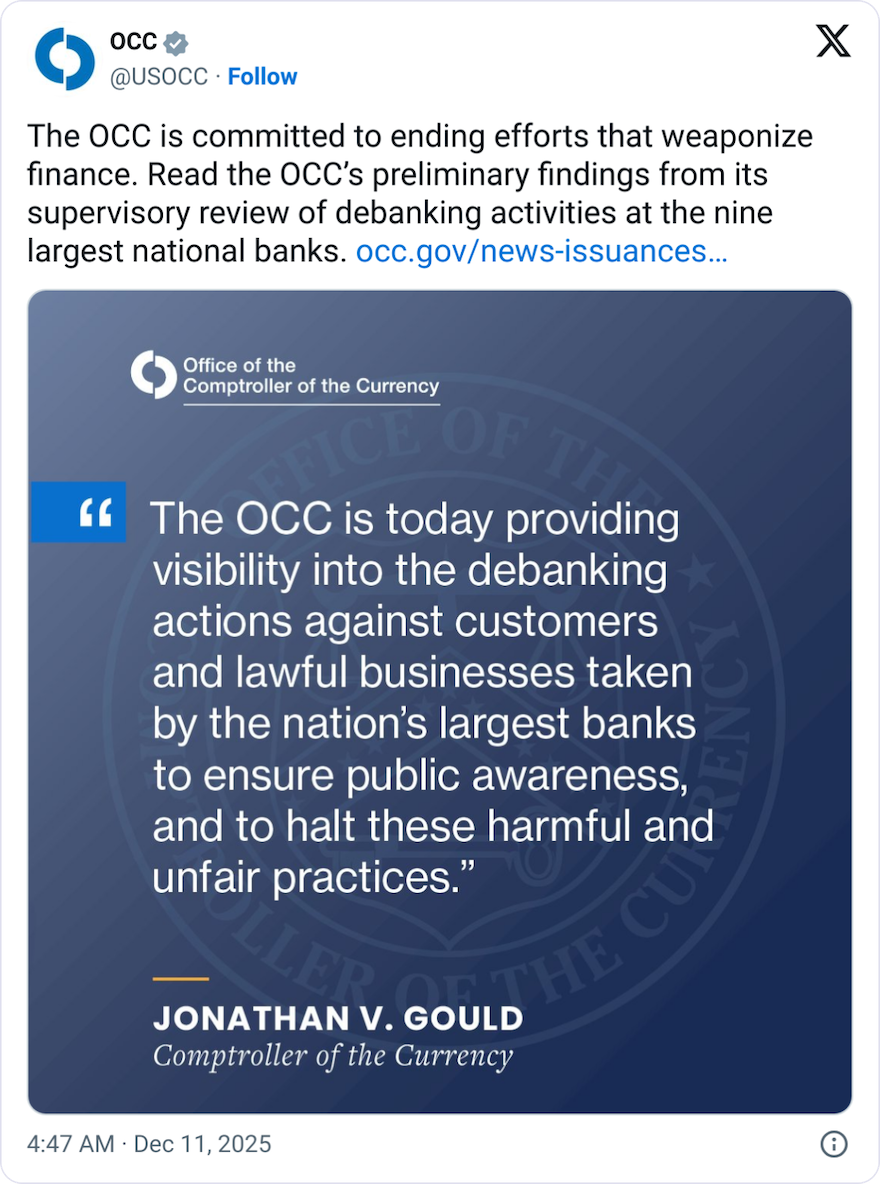
Source: OCC

“It is unfortunate that the nation’s largest banks thought these harmful debanking policies were an appropriate use of their government-granted charter and market power,” said Comptroller of the Currency Jonathan Gould.

“While many of these policies were undertaken in plain sight and even announced publicly, certain banks have continued to insist that they did not engage in debanking,” he added.

The OCC examined JPMorgan Chase, Bank of America, Citibank, Wells Fargo, US Bank, Capital One, PNC Bank, TD Bank, and BMO Bank, the largest national banks it regulates.

The OCC reported that it is continuing its investigation and could refer its findings to the Justice Department.

OCC debanking report leaves “much to be desired”

Nick Anthony, a policy analyst at the libertarian think tank Cato Institute, said in an emailed statement to Cointelegraph that the OCC’s report “leaves much to be desired” and didn’t mention “the most well-known causes of debanking.”

“The report criticizes banks for severing ties with controversial clients, but it fails to mention that regulators explicitly assess banks on their reputation,” he said.

Related: ‘Grow up... We debank Democrats, we debank Republicans:’ JPMorgan CEO

“Making matters worse, the report appears to blame banks for cutting ties with cryptocurrency companies, yet makes no mention of the fact that the [Federal Deposit Insurance Corporation] explicitly told banks to stay away from these companies,” Anthony added.

Republicans on the House Finance Committee reported earlier this month that the FDIC’s so-called “pause letters” it sent to banks under the Biden administration helped to spur “the debanking of the digital asset ecosystem.”

Caitlin Long, the founder and CEO of the crypto-focused Custodia Bank, said the “worst culprits” of crypto-related debanking under the Biden administration were the FDIC and Federal Reserve, “not OCC.”

“In OCC’s defense, this report covers large banks only. Crushing crypto wasn’t a supervisory priority for large banks like it was for small [and] mid-sized banks,” she added.

Magazine: Quitting Trump’s top crypto job wasn’t easy: Bo Hines

Crypto di tendenza

Letture associate

Embodied Intelligence 'Gaokao' is Insanely Hard, Humans Score 100, Best Model Only 12.8

Embodied AI Faces a Daunting "Everest": New Benchmark Reveals Huge Gap Between Models and Humans A comprehensive new benchmark for robotic manipulation, RoboDojo, has been released, painting a stark picture of the current state of embodied AI. It serves as a unified evaluation platform covering both simulation and real-world robot tasks. The benchmark assesses five core capabilities: Generalization (adapting to new scenes/objects), Memory, Precision manipulation, Long-Horizon multi-step tasks, and Open semantic understanding. It includes 42 simulation tasks and 18 standardized real-world tasks across three dual-arm robot platforms. The results are sobering. In simulation, the best-performing generalist robot policy achieved an average success rate of only 8.80%. Performance in the real world was slightly higher but still low, with the top model succeeding 12.8% of the time on average. In stark contrast, human experts scored 76.03% in simulation and 100% in real-world tests. The benchmark highlights significant, uneven gaps in current models' abilities. While some excel in specific areas like visual recognition or simple actions, they struggle with reliability, especially in long-horizon tasks where errors accumulate and in open-ended semantic instructions. The low scores, particularly in real-world deployment with physical uncertainties like camera noise and contact dynamics, underscore that today's models are far from being robust, general-purpose operational robots. RoboDojo is more than just a ranking; it's an infrastructure designed for fair, reproducible comparison. Its companion system, XPolicyLab, standardizes the interface for different models to be evaluated. Maintained by an academic consortium without commercial ties, it aims to provide a community-wide "altitude meter" to track genuine progress toward reliable and generalizable robot manipulation.

marsbit11 min fa

Embodied Intelligence 'Gaokao' is Insanely Hard, Humans Score 100, Best Model Only 12.8

marsbit11 min fa

Weng Li's New Blog Proposes 'Self-Evolution Should Start from Harness', DeepSeek's Cui Tianyi Endorses with Repost

Lilian Weng, former OpenAI security VP and co-founder of Thinking Machines Lab, has published a new blog post titled "Harness Engineering for Self-Improvement," proposing a pragmatic path for AI self-evolution. She argues that Recursive Self-Improvement (RSI) may practically begin at the "Harness" layer—the external runtime system governing how models use tools, manage context, and execute tasks—rather than directly from the model rewriting its own weights. The blog outlines a progression from optimizing prompts (Context Engineering) to designing workflows, and ultimately to Self-Improving Harness systems. These systems can identify their own weaknesses, propose targeted, verifiable modifications to the harness code, and validate improvements. Works like Self-Harness and Darwin Gödel Machine (DGM) demonstrate significant performance gains on benchmarks like SWE-bench through such automated harness evolution, rivaling handcrafted agents. DeepSeek researcher Tianyi Cui endorsed the view, noting harness-based self-evolution is as promising as model-based approaches. Weng emphasizes this is complementary to model training, with both reinforcing each other. However, key challenges remain: weak evaluators for subjective tasks, reward hacking, diversity collapse, managing long-term system health versus short-term success, and defining the human oversight role. The consensus is growing: the harness is a critical variable, as the same model can exhibit vastly different capabilities within different harness systems.

marsbit1 h fa

Weng Li's New Blog Proposes 'Self-Evolution Should Start from Harness', DeepSeek's Cui Tianyi Endorses with Repost

marsbit1 h fa

Trading

Spot

Articoli Popolari

Come comprare US

Benvenuto in HTX.com! Abbiamo reso l'acquisto di Talus Network (US) semplice e conveniente. Segui la nostra guida passo passo per intraprendere il tuo viaggio nel mondo delle criptovalute.Step 1: Crea il tuo Account HTXUsa la tua email o numero di telefono per registrarti il tuo account gratuito su HTX. Vivi un'esperienza facile e sblocca tutte le funzionalità,Crea il mio accountStep 2: Vai in Acquista crypto e seleziona il tuo metodo di pagamentoCarta di credito/debito: utilizza la tua Visa o Mastercard per acquistare immediatamente Talus NetworkUS.Bilancio: Usa i fondi dal bilancio del tuo account HTX per fare trading senza problemi.Terze parti: abbiamo aggiunto metodi di pagamento molto utilizzati come Google Pay e Apple Pay per maggiore comodità.P2P: Fai trading direttamente con altri utenti HTX.Over-the-Counter (OTC): Offriamo servizi su misura e tassi di cambio competitivi per i trader.Step 3: Conserva Talus Network (US)Dopo aver acquistato Talus Network (US), conserva nel tuo account HTX. In alternativa, puoi inviare tramite trasferimento blockchain o scambiare per altre criptovalute.Step 4: Scambia Talus Network (US)Scambia facilmente Talus Network (US) nel mercato spot di HTX. Accedi al tuo account, seleziona la tua coppia di trading, esegui le tue operazioni e monitora in tempo reale. Offriamo un'esperienza user-friendly sia per chi ha appena iniziato che per i trader più esperti.

413 Totale visualizzazioniPubblicato il 2025.12.11Aggiornato il 2026.06.02

Come comprare US

Discussioni

Benvenuto nella Community HTX. Qui puoi rimanere informato sugli ultimi sviluppi della piattaforma e accedere ad approfondimenti esperti sul mercato. Le opinioni degli utenti sul prezzo di US US sono presentate come di seguito.

活动图片