Crucial Week of Contention: BTC Tests Support and HYPE's Key Level Battle | Special Analysis

Odaily星球日报Pubblicato 2026-06-22Pubblicato ultima volta 2026-06-22

Introduzione

**Market Enters Critical Week: Bitcoin Pullback Test and HYPE Support Battle** The market enters a crucial phase of contention this week. The marginal shifts in Federal Reserve policy expectations continue to dictate the pricing rhythm for risk assets. Meanwhile, in the crypto market, following a period of sideways consolidation, the divergence between bulls and bears is becoming concentrated at key price levels. **Bitcoin (BTC) Analysis & Strategy** * **Technical View:** The 4-hour chart suggests BTC is in a five-wave structure since the June 5th low near $59,100. Price action shows a short-term rising channel. The recent drop below this channel's lower boundary is now being followed by a pullback attempt (wave 40-41). The outcome of this retest is critical. * **This Week's Outlook:** The core focus is whether BTC can reclaim and hold above the channel's lower boundary. * **Bullish Scenario:** A successful hold could lead to a continued rebound, potentially challenging the $69,500 - $70,500 resistance zone. * **Bearish Scenario:** Failure to hold may trigger a renewed test of the $59,000 - $60,000 core support area, with $55,000 as a deeper support level. * **Operational Strategy:** The author maintains a 20% mid-term short position initiated last week near $64,500, based on a model signaling a shift to a bearish structure. Short-term tactics involve using 30% capital for potential "spread" trades, with three contingency plans (A, B, C) outlined for react...

The market enters a critical phase of contention this week.

At the macro level, marginal changes in Fed policy expectations continue to dictate the pricing rhythm of risk assets. In the crypto market, following the previous period of volatile consolidation, the divergence between bulls and bears is becoming concentrated around key price levels.

This weekly review continues our established framework: basing analysis on multi-cycle price structure, combined with quantitative model signals, to provide a judgment on the week's market trends for both BTC and HYPE, and to formulate specific medium and short-term operational plans.

It is necessary to specifically state that all content in this article is a record of personal technical analysis, serving solely as a reference framework and review basis for my own trading decisions, and does not constitute investment advice in any form. The market is always more complex than predictions. Strict adherence to risk control and stop-loss discipline is always the first priority.

Summary of Core Trading Views for This Week:

  • Analysis of BTC's Hourly Chart Structure (Detailed in Part 1)
  • BTC Market Outlook and Medium/Short-Term Trading Strategies for This Week (Detailed in Part 2)
  • Analysis of HYPE's Hourly Chart Structure (Detailed in Part 3)
  • HYPE Market Outlook and Short-Term Trading Strategy for This Week (Detailed in Part 4)

Review of Last Week's Trading Strategies and Core Views Against the Market:

  • Verification of BTC Market Trend Forecast: Last week, we strictly followed trading discipline and decisively established a short position of approximately 20% when the market presented an entry opportunity. The medium-term trading plan outlined in the weekly review article was executed.

一、In-Depth Analysis of Bitcoin's Hourly Chart Structure

Bitcoin _4-Hour Candlestick Chart
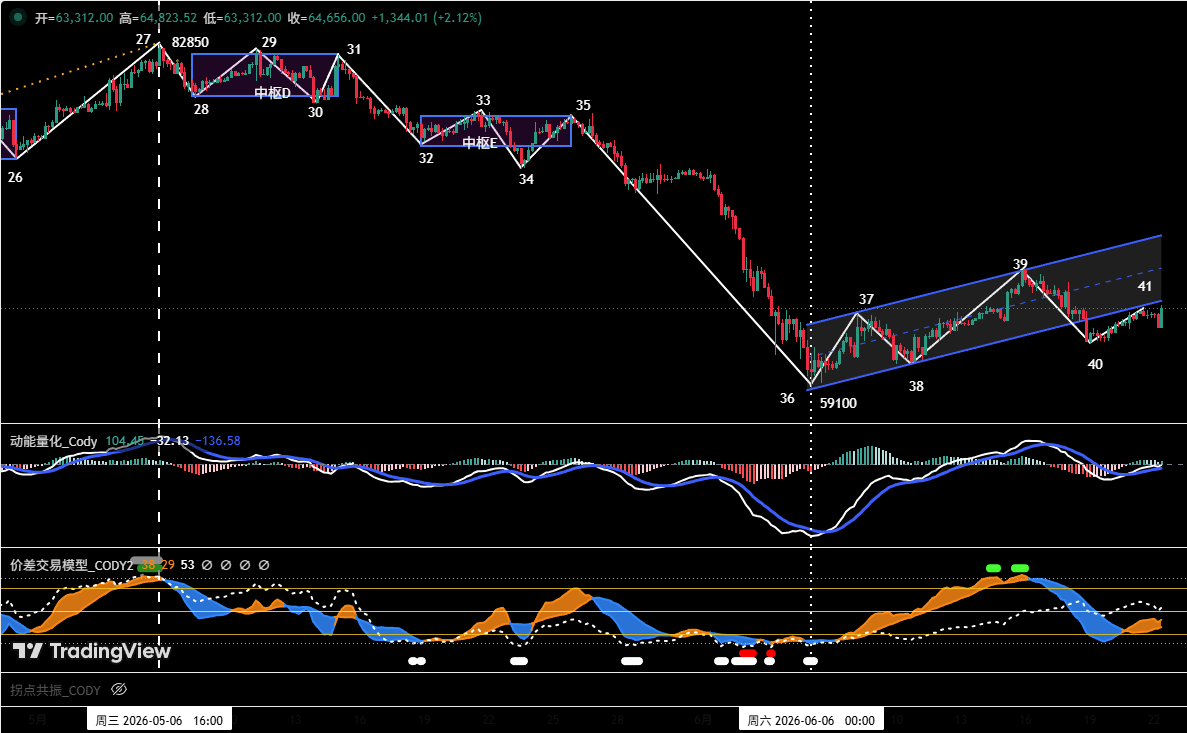
Figure 1

1 As shown in (Figure 1): From a 4-hour structural perspective, since the rebound initiated from the low of $59,100 on June 5th, the price action can be subdivided into a five-wave structure, corresponding sequentially to waves 36-37, 37-38, 38-39, 39-40, and 40-41.

2 The overall movement shows a short-term ascending channel pattern (blue channel in the chart): its upper boundary is formed by connecting the two rebound highs at (point 37) and (point 39), while the lower boundary is established by connecting the two correction lows at (point 36) and (point 38). The chart shows that the price has already broken below the channel's lower boundary at (point 40). The current rebound wave (40-41) can be seen as a stage of retesting and confirming the breakdown of the channel's lower boundary. If (point 41) cannot firmly regain a position above the channel's lower boundary, the probability of the price revisiting the previous support low of $59,100 will increase significantly.

二、Bitcoin Market Outlook and Trading Strategies for This Week

1、BTC Market Outlook for This Week:

Core View for the Week: Focus on the result of the price's retest and confirmation of the short-term channel's lower boundary.

  • If it successfully holds above this level, the price may continue its rebound along the short-term ascending channel, potentially challenging the core resistance zone of $69,500~$70,500.
  • If it breaks below effectively, the market may test the core support zone of $59,000~$60,000 once again.

2、Core Resistance Levels:

  • First Resistance Zone: $64,500~$65,000 area (near the short-term ascending channel's lower boundary)
  • Second Resistance Zone: $69,500~$70,500 area (previous high-volume consolidation area)

3、Core Support Levels:

  • First Support Level: $59,000~$60,000 area (previous important support level)
  • Second Support Level: Around $55,000 (previous significant support level)

4、Operational Strategies for This Week (Excluding the impact of unexpected news)

1 Medium-term Strategy:

Bitcoin _ Daily Candlestick Chart (Position Monitoring Model)
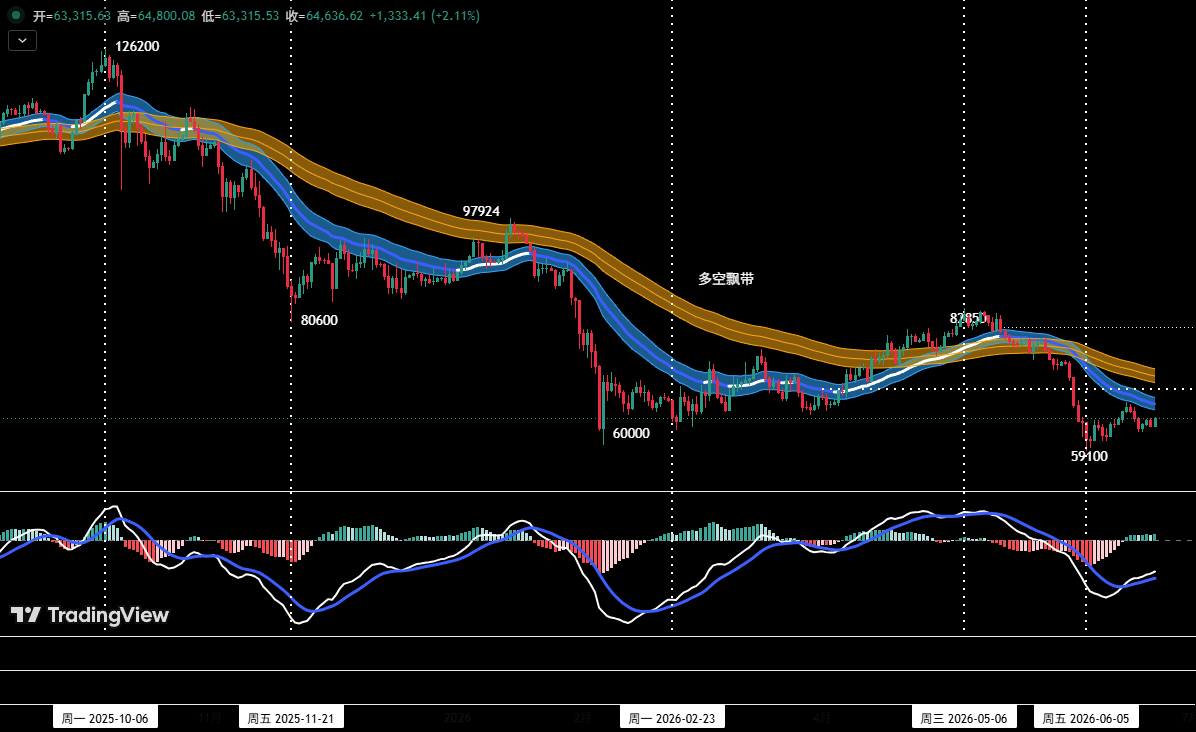
Figure 2

Position Monitoring Model: As shown in (Figure 2), the current price has effectively broken below the "Bull-Bear Channel," confirming a shift in market structure to a bear-dominated pattern. Following our established plan last week, we entered short positions near $64,500, with the initial medium-term position controlled at around 20% of total capital. We will follow stop-loss discipline going forward and await the next opportunity to add to the position.

2 Short-term Strategy: Utilize 30% of capital to seek "price differential" opportunities based on support and resistance levels, using 30-minute/60-minute cycles for operations, while setting stop-loss points.

3 In short-term operations, to dynamically respond to the market's complex evolution, we have pre-formulated three specific operational contingency plans: A/B/C.

Plan A: Tentative Positioning in Resistance Zone

  • Entry: If the price rebounds to the $64,500~$65,000 zone showing signs of stalling, combined with quantitative model top signals, an initial short position of around 15% can be established.
  • Risk Control: Set initial stop-loss.
  • Exit: Gradually close the position to take profits when the price adjusts near important support levels combined with model signals.

Plan B: Adding to Position in Strong Resistance Zone

  • Add: If the price breaks through the $65,000 resistance and continues to rebound to the $69,500~$70,500 zone, showing signs of pressure, combined with quantitative model top signals, the short position can be increased to within 30%.
  • Risk Control: Set initial stop-loss.
  • Exit: Gradually close the position to take profits when the price adjusts near important support levels combined with model signals.

Plan C: Effective Break of Support, Adding to Shorts Following the Trend

  • Add: If the price effectively breaks below the $65,000 support, continues its adjustment, and loses the $59,000~$60,000 support zone, consider adding to the short position to within 30% when price shows signs of weakness during the retest/confirmation phase.
  • Risk Control: Set initial stop-loss.
  • Exit: Gradually close the position to take profits when the price declines to important support levels combined with model signals.

三、HYPE Hourly Chart Structure Analysis

HYPE_4-Hour Candlestick Chart
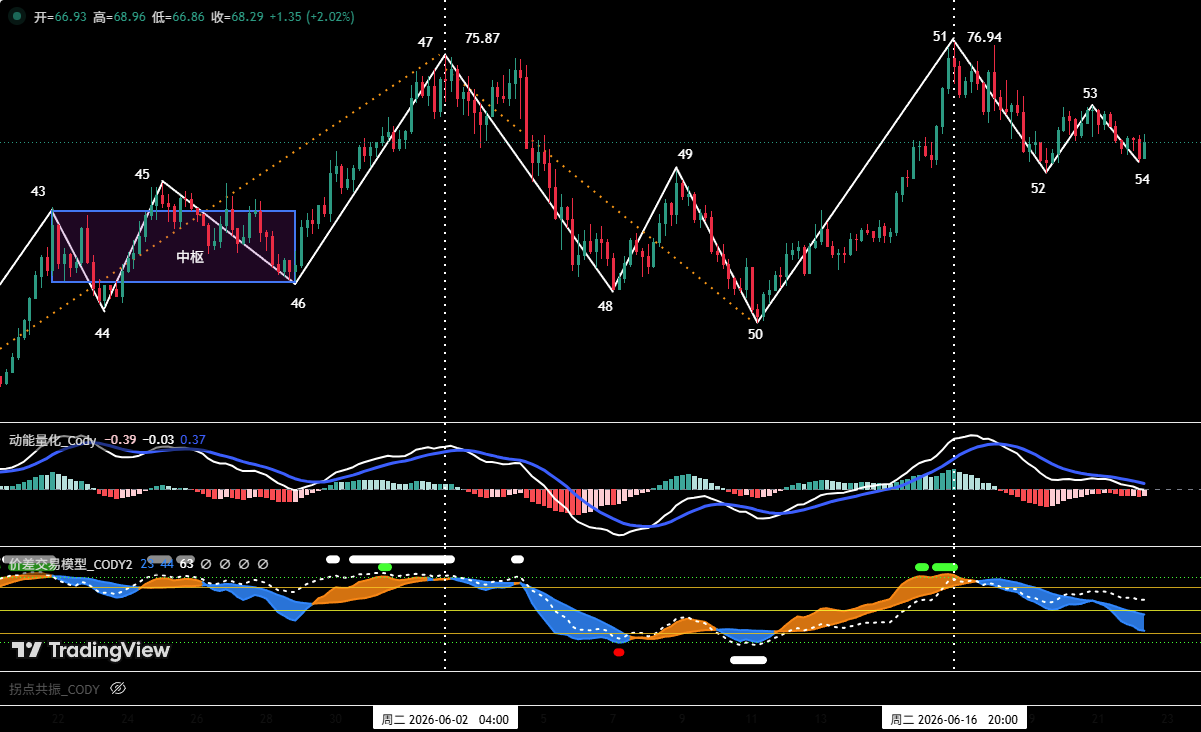
Figure 3

1 As shown in (Figure 3), on the 4-hour timeframe, HYPE started a correction from the high of $75.87 on June 2nd (point 47), explored down to around $52.62 on June 10th (point 50) where it stabilized, a correction lasting about 9 trading days. Following this, the market initiated a strong upward wave (wave 50-51), breaking the previous high in 6 trading days and setting a new high of $76.94 since the rally began in January, indicating continued strong bullish momentum.

2 The decline from the new high presents a clear three-wave corrective structure (51-52, 52-53, 53-54). The price has currently retreated again to the key support zone of $64~$66.

  • Bullish Scenario: If the price finds effective support in this zone, the uptrend since (point 50) is likely to continue, with subsequent prices continuing to challenge new highs.
  • Bearish Scenario: If this level is lost, the correction period will extend, and the price may test the core support band of $52~$54 again, which is the starting point of the previous uptrend.

四、HYPE Market Outlook and Short-Term Trading Strategy for This Week

1、HYPE Market Outlook for This Week:

1 Core Resistance Levels:

  • First Resistance: Around $77
  • Second Resistance Zone: $80~$82 area

2 Core Support Levels:

  • First Support Zone: $64~$66 area
  • Second Support Zone: $52~$54 area

Core View on HYPE for This Week:

  • Observe the outcome of the battle between bulls and bears over the $64~$66 zone.

2、HYPE Short-Term Trading Strategy for This Week (Buy on Support)

Short-term trading in HYPE this week should follow the strategy of "buying on dips, avoiding chasing rallies."

Short-term Strategy: Testing Longs on Support Zone Stabilization

When HYPE price retests and shows signs of halting decline and stabilizing in the key support zones of $64~$66 or the deeper $52~$54, combined with bottom signals triggered by the two major models, consider lightly testing long positions. Position size must be controlled below 30%, and stop-loss discipline must be strictly adhered to.

五、Special Instructions:

  1. Upon Entry: Immediately set the initial stop-loss.
  2. When Profit Reaches 1%: Move the stop-loss to the entry price (breakeven point) to ensure capital safety.
  3. When Profit Reaches 2%: Move the stop-loss to the 1% profit level.
  4. Continuous Tracking: Thereafter, for every additional 1% profit, synchronously move the stop-loss up by 1%, dynamically protecting and locking in profits.

Financial markets are constantly changing. All market analysis and trading strategies require dynamic adjustment. All views, analytical models, and operational strategies mentioned in this article originate from personal technical analysis, are for personal trading log purposes only, and do not constitute any investment advice or operational basis. The market carries risks; investment requires caution. Do not make decisions based solely on this content.


Crypto di tendenza

Domande pertinenti

QAccording to the article's analysis of the BTC 4-hour chart, what is the significance of the current price segment (points 40-41) in relation to the short-term rising channel?

AAccording to the analysis, the current price segment (40-41) represents a retest confirmation stage. It is a rebound following the price's break below the lower rail of the short-term rising channel (between points 36-38). If point 41 cannot reclaim and hold above this lower rail, the probability of the price revisiting the previous low support near $59,100 significantly increases.

QWhat are the three core scenarios (A/B/C) outlined for BTC short-term operations, and what triggers each action?

A1. Scenario A (Resistance Zone Probing): Triggers when the price rallies to the $64,500–$65,000 area and shows signs of stalling, combined with a top signal from the quantitative model. Action is to establish an initial short position (~15%). 2. Scenario B (Strong Resistance Zone Addition): Triggers if the price breaks above $65,000 and continues to rally to the $69,500–$70,500 area, showing pressure signs and a model top signal. Action is to increase the short position to within 30%. 3. Scenario C (Support Break & Trend Following): Triggers if the price effectively breaks below the $65,000 support and subsequently loses the $59,000–$60,000 support zone, showing weakness on any retest. Action is to add to the short position to within 30%.

QWhat are the two possible market scenarios for HYPE based on its price action around the $64–$66 key support area?

A1. Bullish Scenario: If the price finds effective support in the $64–$66 area, the uptrend that started from point 50 is expected to continue, with prices likely to challenge new highs. 2. Bearish Scenario: If the price loses this $64–$66 support area, the correction phase will be prolonged, and the price may retest the core support zone of $52–$54, which was the starting point of the previous major uptrend.

QWhat is the article's stated purpose and a key disclaimer regarding its content?

AThe article's stated purpose is for personal technical analysis records, serving as a reference framework and review basis for the author's own trading decisions. A key disclaimer is that it does not constitute any form of investment advice. The market is always more complex than any prediction, and maintaining strict risk control and stop-loss discipline is the top priority.

QFor HYPE's short-term trading strategy, what is the recommended approach and key condition for entering a long position?

AThe recommended short-term strategy for HYPE is 'buy on dips, avoid chasing rallies.' The key condition for entering a long position is when the price tests and shows signs of stabilizing in either the $64–$66 or the deeper $52–$54 key support areas, simultaneously accompanied by bottom signals triggered by two specific models. Any such position must be kept light, with a strict position size below 30%, and must adhere to stop-loss discipline.

Letture associate

South Korean Institutions' Crypto Race: Dual Explosion of Stablecoins and RWA

**Summary: South Korea's Institutional Crypto Race: Stablecoins and RWA Take Off** South Korea is undergoing a structural shift in its crypto ecosystem, moving beyond its historical role as a major retail trading hub. Major financial institutions and internet platforms are now building institutional-grade blockchain infrastructure, with stablecoins and Real-World Asset (RWA) tokenization as the primary drivers. The push for a regulated Korean won stablecoin market is a major policy and corporate focus. This is driven partly by an estimated $115 billion outflow into dollar stablecoins like USDC, threatening the domestic financial system. Banks (e.g., KB Financial, Hana), payment giants (e.g., Shinhan Card, BC Card), and internet super-apps (KakaoPay, NAVER Pay) are all conducting pilots. The goal is to anchor future digital finance to the Korean won and local regulations. In RWA, South Korea is advancing rapidly within regulatory sandboxes, focusing on unique domestic assets beyond typical global templates like US Treasuries. Projects involve tokenizing ships (with Hyundai Heavy Industries), defense supply chain assets, and K-pop intellectual property, alongside more conventional assets. A legal framework is set for 2027, and platforms like NXT are preparing for regulated trading. Key opportunities for crypto-native projects lie in providing the underlying technology these traditional institutions lack: global distribution channels for tokenized assets, cross-chain liquidity solutions, and enabling infrastructure tools (e.g., for asset packaging and management). Partnerships, such as Solana with Shinhan Card or LayerZero with the Korea Gold Exchange, exemplify this proactive approach. Crucially, user access is being shaped by consumer platforms. NAVER's planned acquisition of Upbit's operator Dunamu and Kakao's development of a unified wallet aim to seamlessly integrate crypto with everyday payments for tens of millions of users. The race is now about which protocols and projects will become the foundational standards as regulation solidifies and institutional adoption accelerates.

Foresight News39 min fa

South Korean Institutions' Crypto Race: Dual Explosion of Stablecoins and RWA

Foresight News39 min fa

How to Detect AI-Generated Videos? A Review of Dynamic, Traceable, and Explainable Detection Systems

**How to Detect AI-Generated Videos: A Survey on Dynamic, Traceable, and Explainable Detection Systems** With rapid advances in AI video generation (e.g., Sora, Veo), creating highly realistic, multi-minute videos is now possible, widening the gap with detection research. Current AI video detection, often limited to unreliable binary classifications, is insufficient. This survey, accepted at ACL 2026, reframes the goal as **"factual fidelity verification"**—checking if a video's content (who, when, where, what) aligns with the real world perceptually and cognitively. It categorizes AI-generated videos into three paradigms: **Local Manipulation Videos (LMV**, e.g., face swaps), **Audio-Visual Editing (AVE**, e.g., lip-syncing), and **Generative Video Synthesis (GVS**, fully synthetic videos like Sora's). Detection challenges evolve from visual artifacts in LMV to multi-modal inconsistencies in AVE and higher-level world knowledge violations in GVS. The core proposal is a **Vision-Language Dual-View framework** with four hierarchical layers: 1. **Layer 1 (Intrinsic Visual Cues):** Analyzes low-level signal statistics, noise patterns, and physiological signals. 2. **Layer 2 (Spatiotemporal Consistency):** Checks for temporal coherence in object motion and scene dynamics. 3. **Layer 3 (Cross-Modal Consistency):** Verifies alignment between video, audio, and text within the video. 4. **Layer 4 (Language-Guided World-Level Reasoning):** Uses external knowledge, facts, and physical laws to judge semantic plausibility and factual correctness. The survey traces a shift in detection focus from lower layers (1 & 2) toward higher, language-involved layers (3 & 4). It also reviews evolving evaluation metrics and datasets tailored for each video paradigm. The conclusion advocates for a **dynamic, evidence-first detection system** that moves beyond simple classification. Future trustworthy detection requires combining visual evidence (from CV) with semantic reasoning and explanation (from NLP & multimodal AI), ultimately creating traceable and explainable judgments about a video's adherence to real-world constraints.

marsbit1 h fa

How to Detect AI-Generated Videos? A Review of Dynamic, Traceable, and Explainable Detection Systems

marsbit1 h fa

It Turns Out the First Real-World Application of AI x Crypto is in Security Auditing

The article explores the surprising trend where AI's first major impact on crypto has been in security auditing, not in areas like trading or analytics. It details how AI-powered tools are dramatically lowering the barrier to finding smart contract vulnerabilities, enabling attackers to scan thousands of contracts and execute exploits within minutes. This has rendered traditional, manually-produced audit reports with their month-long validity periods increasingly obsolete, creating a critical "structural crack" in the old security model. Cases like Drift Protocol and KelpDAO show that even extensively audited protocols can be hacked through social engineering, operational flaws, or infrastructure misconfigurations beyond pure code review. Attackers are also using AI to find and exploit vulnerabilities in years-old, deployed contracts. Notably, OpenZeppelin's co-founder has expressed a grim view that "all DeFi is insecure" due to AI's asymmetric advantage. In response, the audit industry is undergoing a fundamental shift. While there's a short-term spike in defensive re-audits, the long-term business model is changing. Firms are developing AI-assisted systems and moving from one-time report deliveries towards embedded, continuous services like real-time monitoring and formal verification. Examples include AI tools uncovering critical, previously missed vulnerabilities in heavily audited protocols like Curve Finance and Zcash. The conclusion is that security must become a continuous investment, not a one-time checkbox, and audit firms must rapidly evolve their tools and service models to survive.

marsbit1 h fa

It Turns Out the First Real-World Application of AI x Crypto is in Security Auditing

marsbit1 h fa

Trading

Spot

Articoli Popolari

Come comprare HYPE

Benvenuto in HTX.com! Abbiamo reso l'acquisto di Hyperliquid (HYPE) semplice e conveniente. Segui la nostra guida passo passo per intraprendere il tuo viaggio nel mondo delle criptovalute.Step 1: Crea il tuo Account HTXUsa la tua email o numero di telefono per registrarti il tuo account gratuito su HTX. Vivi un'esperienza facile e sblocca tutte le funzionalità,Crea il mio accountStep 2: Vai in Acquista crypto e seleziona il tuo metodo di pagamentoCarta di credito/debito: utilizza la tua Visa o Mastercard per acquistare immediatamente HyperliquidHYPE.Bilancio: Usa i fondi dal bilancio del tuo account HTX per fare trading senza problemi.Terze parti: abbiamo aggiunto metodi di pagamento molto utilizzati come Google Pay e Apple Pay per maggiore comodità.P2P: Fai trading direttamente con altri utenti HTX.Over-the-Counter (OTC): Offriamo servizi su misura e tassi di cambio competitivi per i trader.Step 3: Conserva Hyperliquid (HYPE)Dopo aver acquistato Hyperliquid (HYPE), conserva nel tuo account HTX. In alternativa, puoi inviare tramite trasferimento blockchain o scambiare per altre criptovalute.Step 4: Scambia Hyperliquid (HYPE)Scambia facilmente Hyperliquid (HYPE) nel mercato spot di HTX. Accedi al tuo account, seleziona la tua coppia di trading, esegui le tue operazioni e monitora in tempo reale. Offriamo un'esperienza user-friendly sia per chi ha appena iniziato che per i trader più esperti.

297 Totale visualizzazioniPubblicato il 2024.12.11Aggiornato il 2026.06.02

Come comprare HYPE

Discussioni

Benvenuto nella Community HTX. Qui puoi rimanere informato sugli ultimi sviluppi della piattaforma e accedere ad approfondimenti esperti sul mercato. Le opinioni degli utenti sul prezzo di HYPE HYPE sono presentate come di seguito.

活动图片