Could This Be BTC's 2028 Diamond Bottom?

marsbitPubblicato 2026-02-27Pubblicato ultima volta 2026-02-27

Introduzione

The article "Is This the 2028 Diamond Bottom for BTC?" analyzes Bitcoin's sharp and unexplained price decline in early 2026, describing it as the worst start to a year since 2016. Unlike previous major crashes—such as the 2018 ICO bust or the 2022 collapse triggered by Luna and FTX—this downturn lacks a clear catalyst, deepening market fear and uncertainty. Quantitative indicators suggest the market is in a state of extreme panic, with a "fear and greed index" of 11, levels historically seen only during major bottoms like the 2018 $3K low or the 2022 $16K FTX crisis. Other metrics, however—such as MVRV, price relative to the 200-week moving average, and miner shutdown proximity—have not yet reached typical bottom signals. Despite the bearish sentiment, some positive signs exist: significant USDT outflows indicate reduced leverage, and large short-term whales are facing substantial losses, which may limit further selling pressure. The author does not definitively call a bottom but argues that extreme fear often precedes strong rebounds and that $65K may offer a relatively high margin of safety. Historically, periods of irrational pessimism have often later been viewed as diamond-bottom opportunities.

Author: Chain Research Society

Could This Be BTC's 2028 Diamond Bottom?

2026 has undoubtedly been Bitcoin's worst start to a year in the past decade.

From the opening drop on January 1st to now, BTC has fallen from $109K to $65K, a year-to-date decline of 24%. ETH has fared even worse, dropping 34%. This is BTC's worst start to a year since 2016.

But this time is different. This crash seems to have no reason.

I. An Unexplained Drop is the Deepest Fear

In 2018, it fell 73% because the ICO bubble burst, with countless shitcoins going to zero. In 2022, it fell 77% due to the Luna collapse, Three Arrows Capital, and the FTX implosion. Every crash had a clear reason.

Every time, you knew where the enemy was and how long it would take to rebuild trust. So what about 2026?

• No exchange blow-ups

• No algorithmic stablecoin collapses

• No major hacks

• No country banning BTC

It just fell. Fortune magazine said: The worst start ever, but without a clear crash catalyst.

A crash with a reason often leads to a vengeful rebound once the negative news is exhausted; but an unexplained drop is like a slow bleed. When everyone asks why it's falling but gets no answer, panic escalates exponentially.

II. Have the Bottom-Fishing Indicators Bottomed Out?

Current quantitative indicators show the market has entered an irrational selling vacuum zone.

According to the latest data on February 25th, our bottom-fishing model currently shows a signal of only 1/5, indicating it's still early for a true bottom (Data source: fuckbtc).

❌ MVRV < 1.0

❌ Price ≤ 200-week moving average

❌ Price < P25

✅ Fear & Greed Index ≤ 25 (Extreme Fear: 11)

❌ Approaching miner shutdown price (Nearly half the machines are close to shutting down)
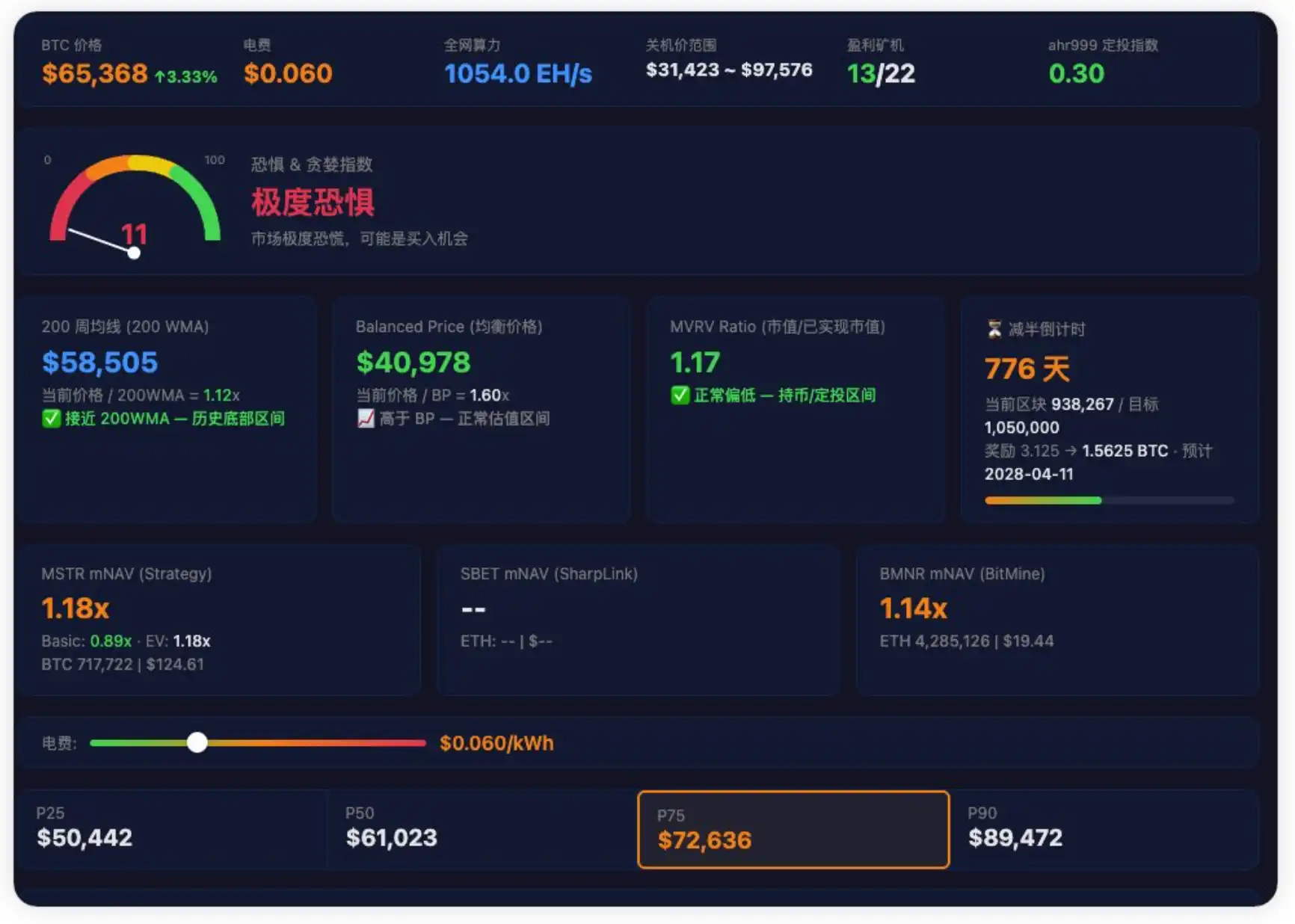
This level of extreme fear has only appeared historically at the end of 2018 at $3,000 and during the FTX crisis at $16,000. Although the price is still at $65,000, the market's psychological defense line has retreated to doomsday mode.

III. Positive Signals Under the Ice: Who's Exiting? Who's Bagholding?

Despite the freezing sentiment, there are also some positive signals:

1. USDT has seen a net outflow of $3B over 60 days. A similar scale of contraction last occurred at the end of 2022 during the FTX crash, when BTC was at $16K. BTC is now at $64K, four times higher than then.

The intensity of capital withdrawal is similar, indicating that场内杠杆 (on-exchange leverage) and weak hands have been cleaned out quite thoroughly.

2. Short-term whales have unrealized losses of $26B. Most of these players built positions between $90K-$120K and are now down 40%. The selling pressure for further significant declines should be less substantial.

Historical experience suggests that when large funds are bagholding at this depth, active selling pressure tends to dry up—because selling at a loss loses its logical meaning.

➤ My View

I am not predicting this is the bottom (it likely isn't).

But I know:

• Extreme Fear (11) has appeared.

• Historically, unexplained drops often fall deeper but also rebound more fiercely.

• At the $65K level, the margin of safety is already relatively high.

Those who called $3K the bottom in 2018 were right. Those who called $16K the bottom in 2022 were right. Those calling $64K the bottom in 2026—might be right, might be wrong.

I don't know.

But what I do know is: Panic always passes. Once trust is rebuilt, the price returns.

If you are still holding cash at this level, at least you have avoided the most violent drawdown phase. Historically, sentiment often bottoms before the price.

History repeats: After the Mt.Gox hack in 2015, people also thought trust could not be rebuilt; but looking back, every unexplained darkest hour eventually became the diamond bottom leading to the next cycle. The $64,000 of 2026 might just be the number you look back on in 2028, regretting not having bought more.


Domande pertinenti

QWhat is the current market sentiment for Bitcoin according to the Fear and Greed Index mentioned in the article?

AThe Fear and Greed Index is at 11, indicating extreme fear'.

QWhat is the author's view on whether $64,000 is the bottom price for Bitcoin in 2026?

AThe author does not predict that $64,000 is definitely the bottom, stating it 'might be right, might be wrong,' but highlights that it offers a relatively high margin of safety and could be seen as a 'diamond bottom' in hindsight by 2028.

QWhat positive signals does the article mention that are happening beneath the surface of the market panic?

AThe positive signals mentioned are: 1) USDT has seen a net outflow of $3B over 60 days, indicating leveraged and floating筹码 have been cleaned out. 2) Short-term whales are facing $26B in unrealized losses, which suggests selling pressure may be exhausted as cutting losses lacks logical sense at this depth.

QHow does the article characterize the current Bitcoin price drop compared to the crashes of 2018 and 2022?

AThe article states that unlike the 2018 crash (caused by ICO bubble burst) and the 2022 crash (caused by Luna collapse, Three Arrows Capital, and FTX implosion), the 2026 drop has no clear catalyst or reason, which creates a deeper fear as it is a form of chronic blood loss rather than a sharp event with a known enemy.

QAccording to the 'buy the dip' model cited (fuckbtc), how many of its 5 signals were triggered as of February 25th?

AOnly 1 out of the 5 signals from the 'buy the dip' model was triggered as of February 25th. The Fear and Greed index was ≤25 (it was 11), but the other four conditions (MVRV < 1.0, Price ≤ 200-week moving average, Price ≤ P25, Price接近关机价/close to mining shutdown price) were not met.

Letture associate

Uncovering the Truth About Agent Commerce, Payments, and Infrastructure

Decoding Agent Commerce, Payments, and Infrastructure: The Reality Over the past year, I've been building infrastructure for the Agent economy, engaging with major players like Stripe, Visa, Coinbase, Google, and dozens of startups. A clear conclusion emerges: true, large-scale demand does not yet exist. Startups face structural challenges. Data points illustrate this gap. Stripe's Agent commerce platform has over 1,000 merchants but only single-digit transacting agents. Visa's Agent payment token requires 9-month KYC and a $250M revenue threshold, accessible only to giants like Amazon. On-chain analysis reveals actual daily Agent transaction volume is around $17k, half of which are test transactions. The article analyzes four potential markets: **1. Agent-to-Merchant (A2M):** Current AI shopping UX is often inferior to traditional e-commerce for visual, comparison-heavy purchases (clothing, electronics). Chat interfaces are a step back. Real merchant interest is defensive "Agent Engine Optimization," fearing future obsolescence, not current demand. Potential exists in high-frequency, low-decision purchases (e.g., food delivery) or simplifying terrible UX (complex checkouts, non-native shoppers), but these require massive consumer distribution channels dominated by giants like DoorDash and Amazon. **2. Agent-to-API (A2A):** Developers already have subscriptions and billing for core APIs (compute, data). The argument for micro-payments via crypto for sub-dollar API calls is addressed by pre-paid balances today. The deeper issue is supplier resistance; major SaaS firms rely on enterprise contracts, not fractional cent pricing. Opportunity lies in the long tail of niche services, but this is a smaller market catering to developers, a historically low-paying group. **3. Agent-to-Agent (A2A):** This remains a theoretical long-term vision with near-zero current transaction volume. It involves unique challenges: discovery, trust, negotiation, dispute resolution. When it materializes, it will require a fundamentally new settlement infrastructure for high-speed, variable-value, multi-party transactions. It's a real long-term bet, but not the current market. **4. Agent-to-Finance (A2F):** This is the only category with existing, paying demand. Integrating AI into financial workflows (trading, portfolio management) is a natural evolution and enables new capabilities like autonomous rebalancing. However, competition favors incumbents with regulatory licenses, compliance infrastructure, and existing client relationships. **The Real Issue:** Why is infrastructure still being built? Incumbents can afford long-term bets, and payment companies see every problem as a nail for their payment hammer. However, payment is just one piece. The core challenge is *coordination*—orchestrating work between Agents and humans, verifying outcomes, and settling results. Payment is part of settlement, which is part of coordination. Companies that solve the coordination problem will subsume payments, not the other way around. Startups lack the infinite runway of giants and must find today's real market, which, after a year of exploration, lies outside these four categories—in an area with real, growing, and underserved activity.

marsbit42 min fa

Uncovering the Truth About Agent Commerce, Payments, and Infrastructure

marsbit42 min fa

Kalshi, MTS, and a16z's Ambition

The article "Kalshi, MTS, and a16z's Ambition" explores prediction markets as a focal point of excitement in 2025 for investors, crypto enthusiasts, and media. It traces their intellectual lineage from Friedrich Hayek's ideas on dispersed knowledge and market coordination to Robin Hanson's Logarithmic Market Scoring Rule (LMSR), which incentivizes truthful information sharing. The piece argues that a16z's significant investment in prediction market platform Kalshi (valued at $220B) transcends mere financial speculation. a16z frames prediction markets as a new form of "media" that provides "presence"—a way for individuals to actively engage with and influence world events through financial stakes, countering postmodern detachment. By wagering on outcomes, users become "super observers," and the market's aggregated probabilities gain authoritative power to define event truth and importance. The article uses media company MTS ("Monitoring The Situation") as a case study of a16z's "new media" strategy: rapidly producing high-intensity, multi-format content to "take over the timeline." However, prediction markets like Kalshi are presented as the ultimate piece in this media empire. Their real-money, crowd-sourced probabilities possess a unique "reality distortion field" and perceived objectivity, potentially swaying public opinion and granting a private company unprecedented interpretive power over reality. Ultimately, Kalshi's immense valuation is attributed not just to its exchange model, but to its role as a foundational component in a16z's envisioned new media landscape, where prediction markets define narrative and truth.

链捕手42 min fa

Kalshi, MTS, and a16z's Ambition

链捕手42 min fa

Trading

Spot
Futures
活动图片




