Consolidation and Jackson Hole: Trader Assesses Bitcoin and Ethereum Movement Scenarios

cryptonews.ruPubblicato 2026-08-17Pubblicato ultima volta 2026-08-17

Introduzione

**Analysis: Bitcoin and Ethereum Consolidation Ahead of Jackson Hole** Bitcoin (BTC) is consolidating near $63,513, with liquidity accumulating around the $62,484 support level. The primary resistance is an unfilled 4-hour Fair Value Gap (FVG) at $64,000-$65,000. Analysts outline three potential scenarios: A) a rejection from the FVG leading to a cascade down to $60,000-$61,000; B) a bullish breakout above the FVG targeting $65,373 and higher; C) (prioritized) a quick stop-loss hunt below $62,484 followed by a rapid reversal upward into the imbalance. Ethereum (ETH) is similarly stagnant, failing to test $2,000 and remaining within its own 4H FVG. Key resistance is at $1,931.50 (PWH). Scenarios include: A) a genuine breakout and hold above this level; B) a deep liquidity grab below $1,852 followed by a powerful reversal; C) a false breakout above resistance leading to a cascading dump towards $1,780-$1,800. Despite ETF inflows, ETH's price lacks momentum. The US Dollar Index (DXY) broke below key support at 99.475, opening a path toward lower FVGs near 99,000. This weakness, if sustained, could support crypto markets. Key triggers this week are FOMC meeting minutes and preliminary PMI data, with positioning ahead of the Jackson Hole symposium being crucial. The overall sentiment is cautiously positive, but the recommended strategy is to stay out of medium-term positions in major assets until a clear directional move occurs, favoring intraday trading on lower timeframes wi...

  • Bitcoin is stuck near $63,513 and is accumulating liquidity around $62,484.
  • Ethereum did not reach $2000 and remains inside the 4H FVG.
  • DXY broke through support at 99.475, opening the path to lower inefficiency zones.
  • FOMC minutes, PMI data, and positioning ahead of Jackson Hole will be the main triggers this week.

Disclaimer: This material is not financial advice or a call to action. The presented analysis is the private opinion of its author. Incrypted is not responsible for readers' investment decisions.

Market Analysis — Prolonged Consolidation, Liquidity Shortage, and Positioning Ahead of Jackson Hole

The past trading week did not bring the expected resolutions. Despite a busy macroeconomic backdrop and constant news injections regarding the Middle East, major crypto assets followed conservative sideways scenarios.

Inflation statistics predictably matched consensus forecasts and were completely ignored by market participants. We analyze the technical picture and development vectors for the main assets in detail.

Bitcoin — Pool Accumulation and Threat of Manipulation

The chart has stalled around $63,513, showing almost no movement over five days. The current structure creates extreme tension: below us, at the $62,484 level, a third series of equal lows (EQL) has formed, converging at the same point with the pWL. Liquidity continues to accumulate, and the longer the market maker leaves this pool untouched, the higher the risk of an aggressive sell-off.

Above, price dynamics are restrained by an unfilled 4H FVG ($64,000-$65,000) — it remains the main barrier of the week. Higher up are pWH ($65,373), pMH ($66,924), and the old target at $67,255. If the sideways movement breaks to the downside, price will meet pools in the 1H FVG zones ($60,000-$61,000), 4H FVG ($59,000-$60,000), and at pML ($57,758).

Current Scenarios

Scenario A — Retest of the Imbalance and Cascade Breakdown Downwards

Price enters the 4H FVG zone $64,000-$65,000, notes buyer weakness, and reverses. Then comes what the market has been expecting for several weeks: a break of the $62,484 mark without a return and a cascade drop to $60,000-$61,000 and below.

Under thin August market conditions, a fall unfolds significantly faster than a rise. Invalidation — an immediate buyback into the body of the range within one or two candles.
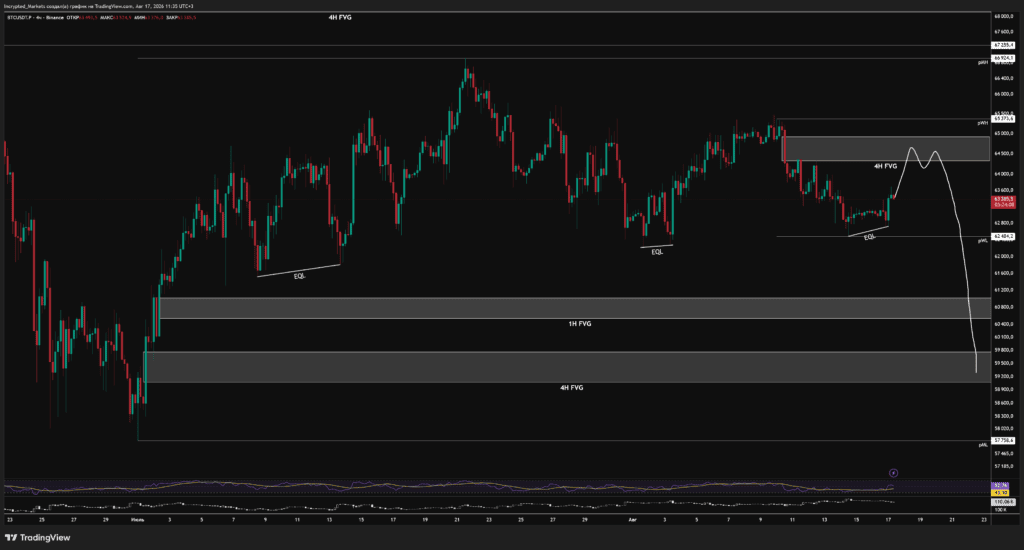
Four-hour chart of $BTC/$USDT.P. Data: TradingView.

Scenario B — Impulse Breakout and Assault on Resistances

The asset, on volume, slices through the 4H FVG, tests its upper boundary, and heads towards $65,373. Confirmed consolidation above PWH opens a direct path to $66,924 and $67,255.

The determining factor will be price behavior upon returning to the $64,000-$65,000 block — it should act as reliable support.
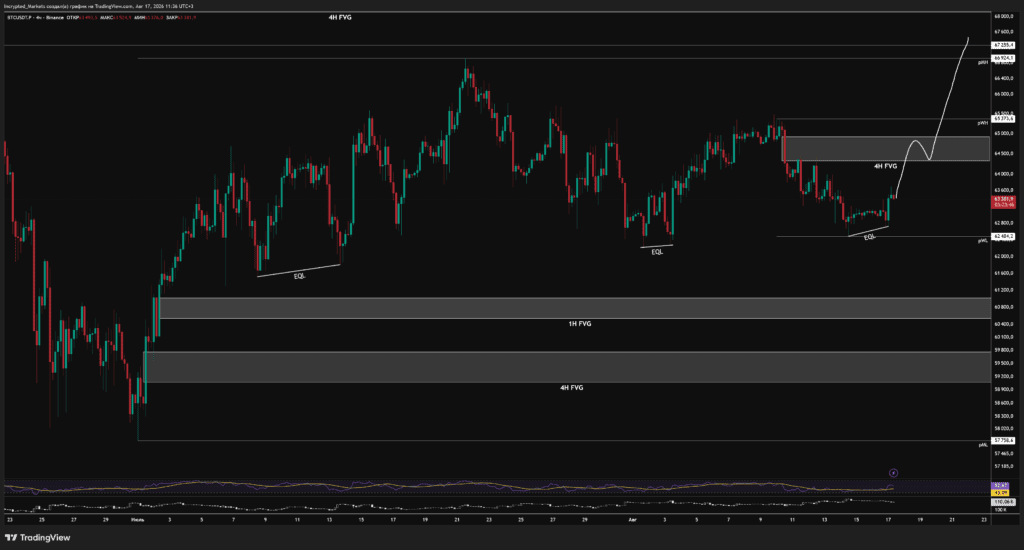
Four-hour chart of $BTC/$USDT.P. Data: TradingView.

Scenario C — Stop-Hunt and Reversal Upwards (Priority)

The most logical maneuver for large capital is a sharp break of $62,484 to take liquidity from early longs operating from the edge of the range, followed by a powerful impulse into the upper imbalance.

The key aspect is speed. A quick price return confirms buyer strength.
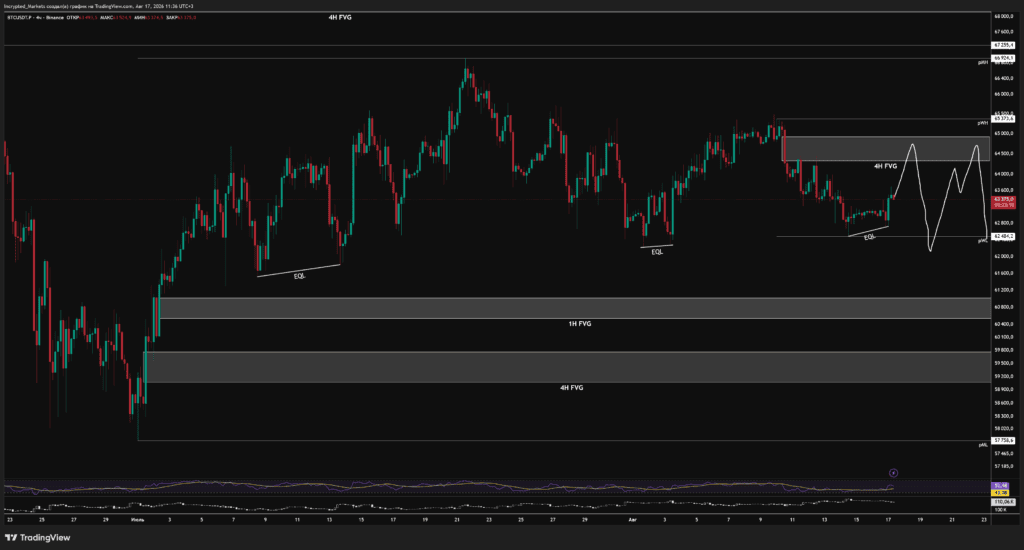
Four-hour chart of $BTC/$USDT.P. Data: TradingView.

Ethereum — Obstacle at $2000 and Divergence with ETF

The main altcoin spent the week in a similar stupor. The expected test of the round $2000 mark did not materialize. The market did not allow clean scenarios to play out: EQLs from below remained untouched, and the upward impulse choked at $1930.

The asset is literally stuck inside a 4H FVG, which currently acts as a zone of equilibrium. Pressure from above comes from resistance PWH $1931.50, behind which lies a dense cluster of liquidations 1925-1950, PMH $1982, and an hourly imbalance under $2000.

Support below is held by PWL $1852.22 and August EQLs. Below that lies a void down to the 4H FVG at $1802.46, a break of which opens the path to $1665-$1685.

Against the backdrop of chart stagnation, the relative strength of spot ETFs stands out: Ethereum funds have attracted capital for the fifth consecutive week, while Bitcoin recorded outflows of nearly $390 million last week. Meanwhile, the $ETH/$BTC pair is approaching 0.03.

However, without converting this strength into dollar value, the risk of a synchronous major dump remains.

Current Scenarios

Scenario A — Genuine Breakout and Consolidation

Accumulation within the current imbalance followed by a move through $1931.50 and entry into the short cluster $1925-$1950. The main goal is to consolidate above PWH.

Without holding this level upon retest, the move will be a false breakout.
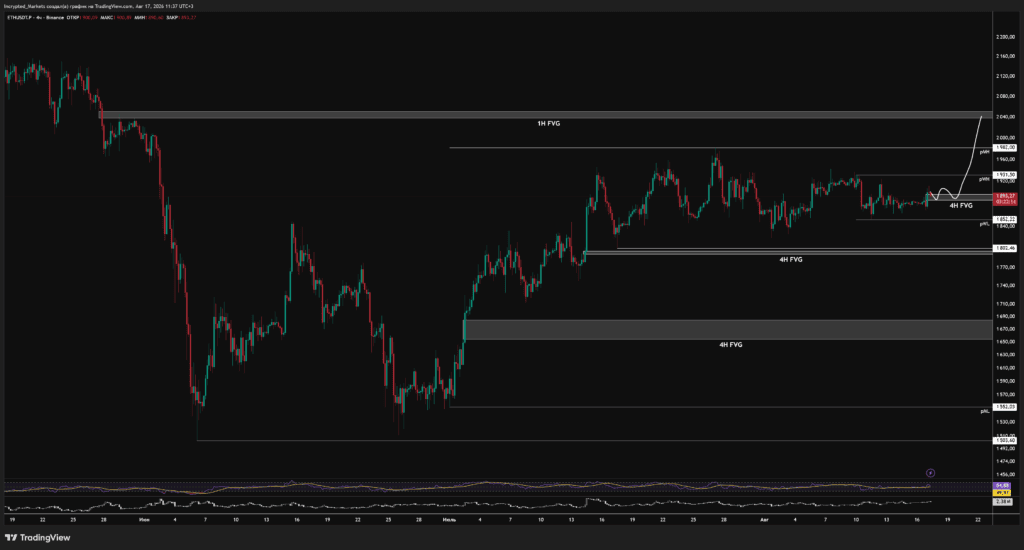
Four-hour chart of $ETH/$USDT.P. Data: TradingView.

Scenario B — Deep Liquidity Grab from Below

Break of support at $1852 and collection of equal lows along with "easy longs." A dip to $1802.46 is expected, followed by a powerful reversal upwards.

The validity of the scenario is confirmed only by a lightning-fast price return to the original range.
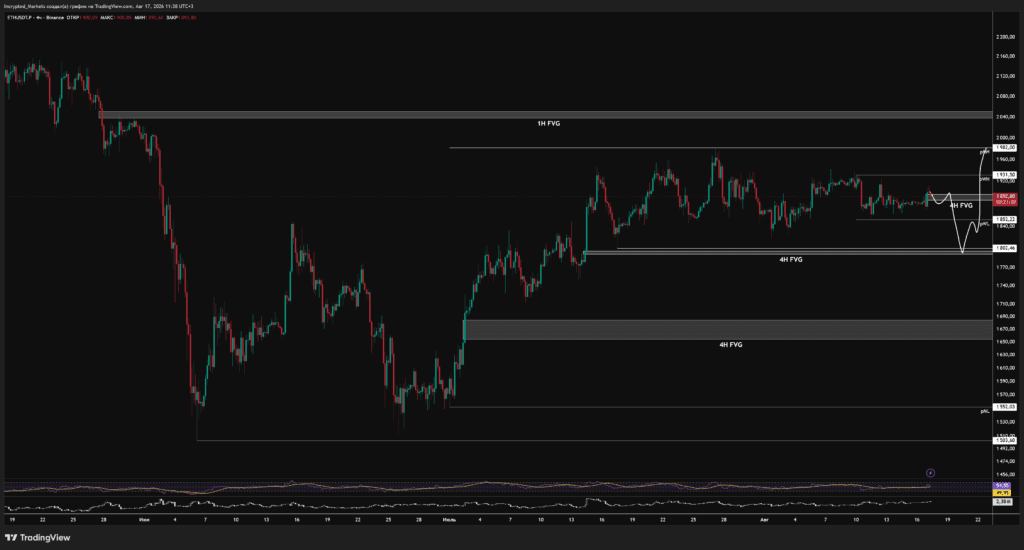
Four-hour chart of $ETH/$USDT.P. Data: TradingView.

Scenario C — False Breakout and Cascade Dump

The most painful option: the asset liquidates shorts in the $1931-$1950 zone, lures the crowd into breakout positions, then sharply reverses and cuts through the entire chart — through PWL and EQL straight to $1780-$1800.
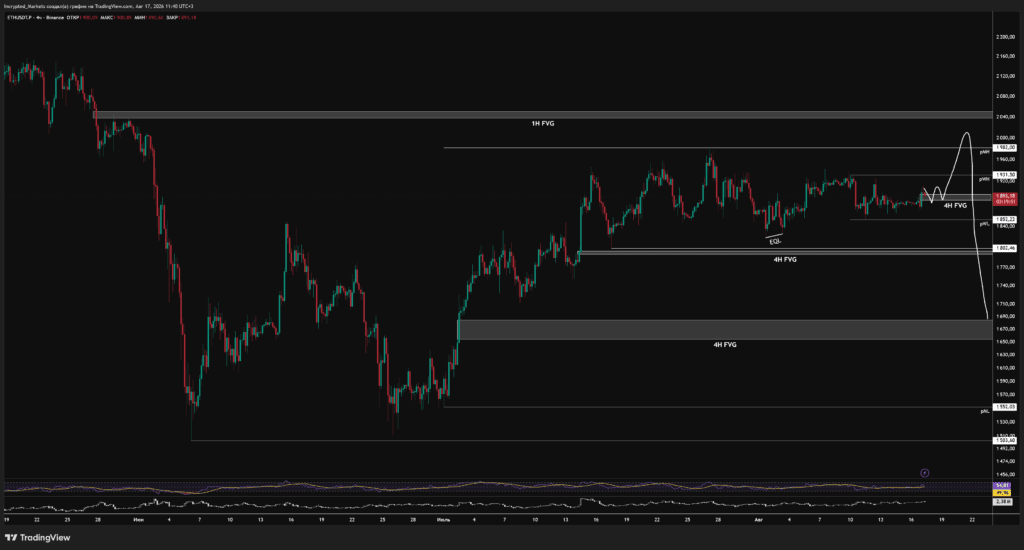
Four-hour chart of $ETH/$USDT.P. Data: TradingView.

Fundamental Triggers and Trading Plan

  • FOMC minutes on Thursday, August 20th. The document is retrospective, but any signs of a split within the committee could prompt a rapid reassessment of rate expectations;
  • Preliminary PMI indexes on Friday, August 21st. The focus is on employment and prices paid components — they will determine the balance of power at month-end;
  • Retail sector earnings season. Results from giants Home Depot, Target, Lowe’s, Walmart, and Reddit's inclusion in the S&P 500 act as an indirect channel of influence through correlation with stock indices;
  • Expectations for the Jackson Hole Symposium August 27-29. A half-empty calendar means movements will be driven not by statistics, but by capital positioning before Kevin Warsh's first speech as Fed Chair.

Summary

Paradoxically, the overall sentiment retains a positive tone. The current optimal strategy is staying out of the market for medium-term positions in heavy assets.

Under conditions where large capital is buying time, opening trades before a manipulative level break carries unjustified risk. Priority is given to intraday trading on lower timeframes in instruments with high volatility and strict risk control.

Dollar Index — Break of Key Supports, Movement Below 99.475, and Awaiting FOMC Minutes

Retrospective and Current Position

The past week dealt a serious technical blow to the positions of the American currency. While the release of expected inflation (CPI) data passed relatively calmly, the collapse in retail sales became the final trigger for sellers.

The Dollar Index (DXY) failed to hold the four-hour imbalance zone and impulsively broke through the previous support level.

Currently, DXY quotes have fallen to the 99.345 mark. The asset is trading below a key liquidity pool, opening the way to deeper inefficiency zones.

The market is transitioning into a positioning phase ahead of the Fed minutes publication and the approaching Jackson Hole symposium.

Technical Picture

The downward Order Flow received full confirmation after an aggressive consolidation below weekly lows. Key structural levels:

  • PWH 100.083 — the updated high of the past week, acting as local resistance;
  • PWL 99.475 — the previous weekly low, which was broken and now acts as the nearest mirror barrier;
  • 4H FVG zones: below, price is attracted by two large unfilled imbalances — the first with an upper boundary around 99.000, the second located deeper in the 98.700 zone.

Current Trading Scenarios

Scenario A — V-Shaped Buyback and Return Above PWL (Short Squeeze)

The index uses the current dip below 99.475 as a manipulation, i.e., a deviation, to collect liquidity. Price finds aggressive limit demand, forms a sharp reversal, and returns above the broken 99.475 level, heading to fill the imbalances above.
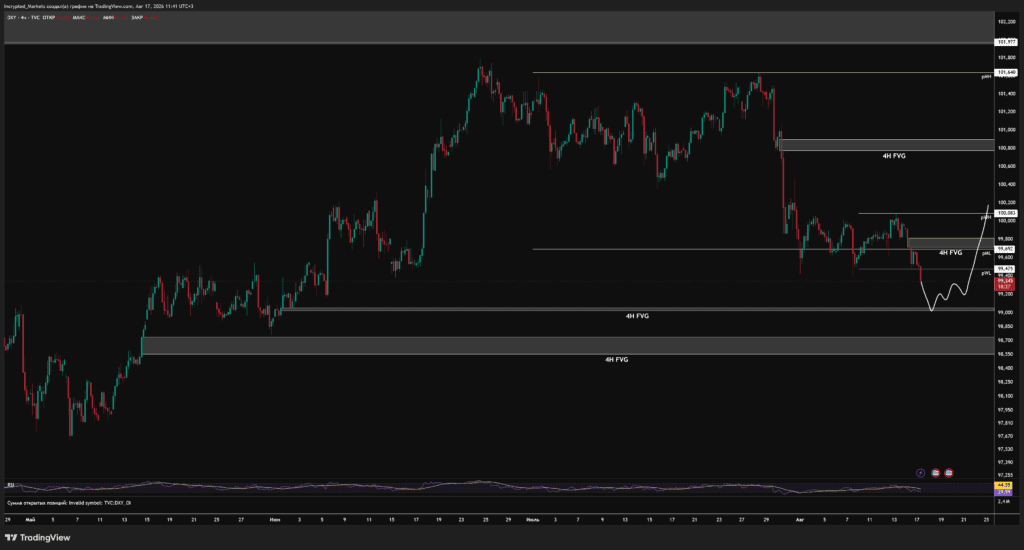
DXY index chart. Data: TradingView.

Scenario B — Pullback-Free Descent to Lower FVG (Priority Bearish)

Sellers maintain full control. The Dollar Index does not receive a bounce from current levels of 99.345 and continues a measured downward move straight to the 4H FVG zone with an upper boundary at the 99.000 level.

Further DXY weakening in this format would create ideal fundamental conditions for the crypto market to rise.
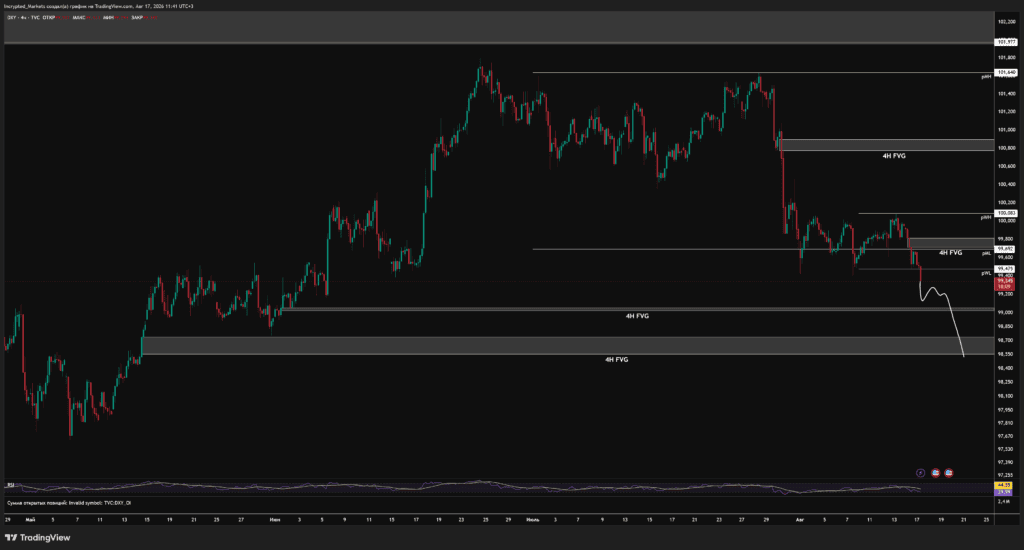
DXY index chart. Data: TradingView.

Scenario C — Retest of Resistance and Continued Decline

Price forms a local technical pullback, testing the zone of the broken PWL level 99.475 from below upwards.

Receiving a firm rejection from sellers in this area, the asset reverses and continues its decline towards the 99.000 block.
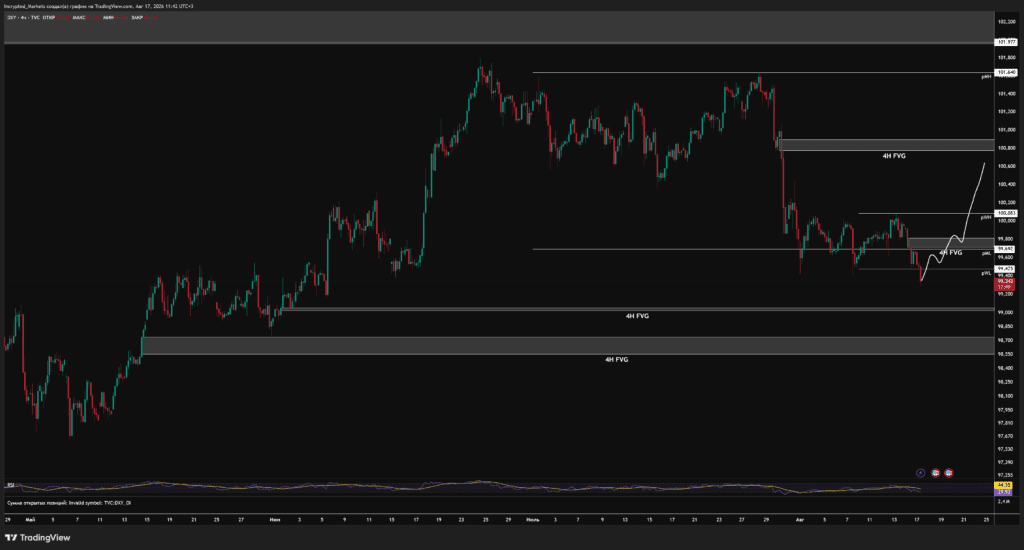
DXY index chart. Data: TradingView.

News Triggers of the Week

  • Wednesday, August 19, 17:30 — Crude oil inventories;
  • Wednesday, August 19, 21:00 — FOMC minutes release. The key event of the week, capable of providing insights into sentiments within the Fed before the September meeting;
  • Thursday, August 20, 15:30 — Philadelphia Fed Manufacturing Index for August;
  • Thursday, August 20, 15:30 — Initial jobless claims;
  • Friday, August 21, 15:30 — Preliminary Manufacturing PMI for August and Services PMI for August.

Sentiment and Tactics

The break of key support radically changes the medium-term balance of power. The market will carefully assess the details of the FOMC's backroom discussions on Wednesday evening.

Until then, chaotic manipulative movements on the thin August order book are possible.

Action plan: maintain focus on lower timeframes. For making trading decisions on crypto assets, it is critically important to see DXY's reaction — either an aggressive return above 99.475, which would be negative for risk assets, or a confident move towards pools at 99.000, which would fuel long positions.

Work systematically and control risks strictly.

Crypto di tendenza

Domande pertinenti

QWhat are the three main scenarios for Bitcoin's price movement according to the article, and which one is considered the priority?

AThe three scenarios are: A) Retest of the imbalance and a cascade breakdown downwards; B) Impulsive breakout and assault on resistances; C) Stop-loss hunt and reversal upwards. Scenario C (stop-loss hunt and reversal upwards) is considered the priority (the most logical maneuver for large capital).

QWhat key event and upcoming symposium are highlighted as major triggers for the market this week?

AThe publication of the FOMC meeting minutes and positioning ahead of the Jackson Hole symposium (scheduled for August 27-29) are highlighted as the major triggers for the market this week.

QWhat is the current technical situation for Ethereum, and what potential risk exists despite relative strength in its spot ETFs?

AEthereum is stuck within a 4H FVG (Fair Value Gap) and failed to test the $2000 level. Despite spot ETFs attracting capital for five consecutive weeks (unlike Bitcoin), the risk remains of a synchronous dump of major assets if this relative strength is not converted into dollar-denominated price appreciation.

QWhat happened to the US Dollar Index (DXY) last week, and what is the priority bearish scenario for its next move?

ALast week, the DXY impulsively broke below the previous support level at 99.475. The priority bearish scenario (Scenario B) is a non-rebounding descent directly towards the lower 4H FVG zone, with an upper boundary around 99.000.

QWhat is the recommended overall trading strategy according to the article's summary?

AThe recommended strategy is to stay out of the market for medium-term positions in heavy assets (like Bitcoin and Ethereum). The priority is given to intraday trading on lower timeframes in instruments with high volatility, coupled with strict risk control, until a manipulative level break occurs.

Letture associate

Report on the State of the Crypto Industry by 2026, Featuring Sumsub Vice President for North America, Danielle LaBarbera

The cryptocurrency industry is entering an era of regulated maturity, driven by frameworks like the CLARITY Act and the $GENIUS Act in the US. These provide clearer rules but also raise operational standards, requiring platforms to effectively demonstrate compliance. Simultaneously, fraud is evolving into sophisticated, AI-powered, lifecycle-based attacks, moving beyond simple onboarding scams. According to Daniel LaBarbera, VP of Sumsub for North America, companies must shift from one-time KYC checks to continuous, risk-based verification. This involves integrating identity, behavioral, device, and transaction data into a unified risk view. The 2026 State of Crypto Industry report highlights that while 55% of crypto firms faced fraud last year, effective strategies now combine AI-driven detection, continuous monitoring, and behavioral analytics. Key compliance challenges persist, particularly with the Travel Rule. Only 23% of companies are fully compliant, with high implementation costs, data security concerns, and regulatory fragmentation being major hurdles. Meanwhile, stablecoins are gaining traction, accounting for 36% of all crypto transactions in 2025, and evolving from trading tools into financial infrastructure for payments and settlements. The path forward lies in risk-based approaches that balance security, speed, and user experience. This includes adopting documentless verification, reusable KYC, and breaking down silos between compliance functions to create a holistic, lifecycle view of customer risk and trust.

cryptonews.ru11 min fa

Report on the State of the Crypto Industry by 2026, Featuring Sumsub Vice President for North America, Danielle LaBarbera

cryptonews.ru11 min fa

U.S. National Debt Approaches $40 Trillion in 5 Months, Bitcoin Debate Gains Momentum

The US national debt has surged to nearly $40 trillion in just five months, the fastest trillion-dollar increase on record. The debt's growth has accelerated dramatically over time, from taking 192 years to reach the first $1 trillion in 1981 to adding the latest $1 trillion in only five months. The federal budget deficit for the fiscal year is already over $1.8 trillion, exceeding last year's total, and net interest payments on the debt have surpassed $1 trillion, now exceeding defense or Medicare spending. This rapid debt accumulation is fueling arguments within the cryptocurrency industry that Bitcoin serves as a hedge against government-backed currencies and fiscal irresponsibility. Proponents, including some lawmakers and industry leaders, argue Bitcoin could act as a "hard currency" fiscal control mechanism. Legislation has even been proposed for the Treasury to acquire Bitcoin to help reduce the national debt. The International Monetary Fund has warned that global public debt could hit 100% of world GDP by 2029 if current trends continue, with the US and China as primary drivers. Some analyses suggest a sovereign debt crisis could drive capital into alternative assets like Bitcoin, similar to past regional banking crises. However, skeptics point out that both Bitcoin and gold have fallen in price at times during 2026 despite record debt, indicating the depreciation hedge theory may operate over a much longer timeframe than short-term price action.

cryptonews.ru21 min fa

U.S. National Debt Approaches $40 Trillion in 5 Months, Bitcoin Debate Gains Momentum

cryptonews.ru21 min fa

Technological Self-Reliance in China: A War from Lithography Machines to ABF Films

"China's Tech Independence: A Battle from Lithography Machines to ABF Film" In August 2026, Japan's Ajinomoto announced a 30% supply cut of ABF film to Chinese mainland clients, causing industry-wide shock and fears of price hikes and shortages in the semiconductor supply chain. That same year, Chinese company Lotus Holdings, known for its MSG business, acquired a small domestic ABF film startup for 103 million yuan, aiming to change this passive situation. ABF film is a core insulating material for advanced CPU, GPU, and AI chip packages. Ajinomoto, originally a food flavoring company, has monopolized over 95% of the global ABF film market for nearly 30 years, deriving its technology from byproducts of monosodium glutamate production. With AI chips consuming 5-10 times more ABF film than traditional chips, the supply-demand gap is widening. Ajinomoto's supply cut to China, where domestic ABF film production accounts for less than 5%, directly threatens the production of domestic high-end AI chips and their substrates. This incident highlights a crucial but often overlooked truth: the vulnerabilities in China's quest for technological self-reliance extend beyond headline areas like lithography machines to critical but seemingly minor components—insulating films, photoresists, electronic specialty gases, etc. The article frames China's tech independence as a multi-front war. While major breakthroughs have been achieved in chip design (e.g., Huawei's HiSilicon), foundry (e.g., SMIC), and memory chips (e.g., YMTC), countless smaller "Ajinomoto-style" chokepoints remain. Lotus Holdings' acquisition represents a significant shift: the battle is no longer fought only by tech giants but has become a collective, industry-wide effort involving companies from diverse backgrounds. Historically, external blockades have often spurred China's technological breakthroughs, as seen with Huawei's Kirin chips and YMTC's 3D NAND flash memory. Ajinomoto's supply cut, while a short-term challenge, may similarly catalyze domestic innovation in ABF film and other critical materials. The path to technological sovereignty is long and arduous, requiring sustained patience and investment to fill every gap in the complex supply chain. Lotus's move is not an immediate solution but a step towards that future, symbolizing a broader, relentless march toward independence.

marsbit41 min fa

Technological Self-Reliance in China: A War from Lithography Machines to ABF Films

marsbit41 min fa

Trading

Spot

Articoli Popolari

Cosa è BITCOIN

Comprendere HarryPotterObamaSonic10Inu (ERC-20) e la sua posizione nel mondo delle criptovalute Negli ultimi anni, il mercato delle criptovalute ha assistito a un aumento della popolarità delle meme coin, catturando l'interesse non solo dei trader, ma anche di coloro che cercano coinvolgimento comunitario e valore di intrattenimento. Tra questi token unici c'è HarryPotterObamaSonic10Inu (ERC-20), un progetto intrigante che mescola riferimenti culturali nel tessuto delle criptovalute. Questo articolo esplora gli aspetti chiave di HarryPotterObamaSonic10Inu, analizzando i suoi meccanismi, l'etica guidata dalla comunità e il suo coinvolgimento con il panorama crittografico più ampio. Che cos'è HarryPotterObamaSonic10Inu (ERC-20)? Come suggerisce il suo nome, HarryPotterObamaSonic10Inu è una meme coin costruita sulla blockchain di Ethereum, classificata secondo lo standard ERC-20. A differenza delle criptovalute tradizionali che possono enfatizzare l'utilità pratica o il potenziale investimento, questo token prospera grazie al valore di intrattenimento e alla forza della sua comunità. Il progetto mira a creare un ambiente in cui gli utenti coinvolti possono riunirsi, condividere idee e partecipare ad attività ispirate a diversi fenomeni culturali. Una caratteristica notevole di HarryPotterObamaSonic10Inu è la zero tassa sulle transazioni. Questo elemento allettante tende a incoraggiare il trading e il coinvolgimento della comunità, privo di costi aggiuntivi che possono scoraggiare i trader di piccole dimensioni. L'offerta totale della moneta è fissata a un miliardo di token, un numero che segna la sua intenzione di mantenere una circolazione sostanziale all'interno della comunità. Creatore di HarryPotterObamaSonic10Inu (ERC-20) Le origini di HarryPotterObamaSonic10Inu sono avvolte in un certo mistero; i dettagli sul creatore rimangono sconosciuti. Lo sviluppo di questo token non presenta un team identificabile o un piano esplicito, cosa non rara nel settore delle meme coin. Invece, il progetto è emerso organicamente, con il suo progresso fortemente dipendente dall'entusiasmo e dalla partecipazione della sua comunità. Investitori di HarryPotterObamaSonic10Inu (ERC-20) Per quanto riguarda investimenti esterni e finanziamenti, HarryPotterObamaSonic10Inu rimane ambiguo. Il token non elenca alcuna fondazione di investimento conosciuta o un sostegno organizzativo significativo. Invece, la linfa vitale del progetto è la sua comunità di base, che informa la sua crescita e sostenibilità attraverso azioni collettive e coinvolgimento nello spazio crittografico. Come funziona HarryPotterObamaSonic10Inu (ERC-20)? In quanto meme coin, HarryPotterObamaSonic10Inu opera principalmente al di fuori delle strutture tradizionali che governano spesso il valore degli asset. Ci sono diversi aspetti distintivi che definiscono il funzionamento del progetto: Transazioni senza tasse: Senza costi fiscali sulle transazioni, gli utenti possono comprare e vendere liberamente il token senza preoccuparsi di costi nascosti. Coinvolgimento della comunità: Il progetto prospera sull'interazione della comunità, sfruttando le piattaforme social per creare entusiasmo e facilitare il coinvolgimento. Discussioni, condivisione di contenuti e coinvolgimento sono elementi cruciali che aiutano ad espandere la sua portata e a favorire la lealtà tra i sostenitori. Nessuna utilità pratica: Va notato che HarryPotterObamaSonic10Inu non offre un'utilità concreta all'interno dell'ecosistema finanziario. Piuttosto, è classificato come un token principalmente per attività di intrattenimento e comunitarie. Riferimento culturale: Il token incorpora astutamente elementi della cultura pop per attirare interesse, collegandosi a appassionati di meme e seguaci delle criptovalute. HarryPotterObamaSonic10Inu esemplifica come le meme coin operino in modo diverso rispetto ai progetti di criptovalute più tradizionali, entrando nel mercato come costrutti sociali innovativi piuttosto che come asset utilitari. Cronologia di HarryPotterObamaSonic10Inu (ERC-20) La storia di HarryPotterObamaSonic10Inu è segnata da diversi traguardi notevoli: Creazione: Il token è emerso da un meme virale, catturando l'immaginazione di molti appassionati di criptovalute. Le date di creazione specifiche non sono disponibili, sottolineando la sua crescita organica. Inserimento negli scambi: HarryPotterObamaSonic10Inu ha fatto il suo ingresso in vari scambi, consentendo un accesso e un trading più facili da parte della comunità. Iniziative di coinvolgimento della comunità: Attività in corso volte a migliorare l'interazione della comunità, comprese gare, campagne sui social media e generazione di contenuti da parte di fan e sostenitori. Piani di espansione futura: La tabella di marcia del progetto include il lancio di una collezione NFT, merchandising e un sito di eCommerce relativo ai suoi temi culturali, coinvolgendo ulteriormente la comunità e cercando di aggiungere più dimensioni al suo ecosistema. Punti chiave su HarryPotterObamaSonic10Inu (ERC-20) Natura guidata dalla comunità: Il progetto dà priorità al contributo collettivo e alla creatività, garantendo che il coinvolgimento degli utenti sia al centro del suo sviluppo. Classificazione come meme coin: Rappresenta l'epitome delle criptovalute basate sull'intrattenimento, distinguendosi dai veicoli d'investimento tradizionali. Nessuna affiliazione diretta con Bitcoin: Nonostante la somiglianza nel nome del ticker, HarryPotterObamaSonic10Inu è distintivo e non ha alcuna relazione con Bitcoin o altre criptovalute consolidate. Focus sulla collaborazione: HarryPotterObamaSonic10Inu è progettato per creare uno spazio per la collaborazione e la condivisione di storie tra i suoi detentori, fornendo un canale per la creatività e il legame comunitario. Prospettive future: L'ambizione di espandersi oltre il suo presupposto iniziale verso NFT e merchandising delinea un percorso per il progetto per potenzialmente entrare in strade più mainstream all'interno della cultura digitale. Poiché le meme coin continuano a catturare l'immaginazione della comunità crittografica, HarryPotterObamaSonic10Inu (ERC-20) si distingue per i suoi legami culturali e il suo approccio centrato sulla comunità. Anche se potrebbe non adattarsi al modello tipico di un token orientato all'utilità, la sua essenza risiede nella gioia e nella camaraderia coltivate tra i suoi sostenitori, evidenziando la natura in evoluzione delle criptovalute in un'epoca sempre più digitale. Con la continuazione dello sviluppo del progetto, sarà importante osservare come le dinamiche della comunità influenzano la sua traiettoria nel panorama in continuo cambiamento della tecnologia blockchain.

2.3k Totale visualizzazioniPubblicato il 2024.04.01Aggiornato il 2024.12.03

Cosa è BITCOIN

Come comprare BTC

Benvenuto in HTX.com! Abbiamo reso l'acquisto di Bitcoin (BTC) semplice e conveniente. Segui la nostra guida passo passo per intraprendere il tuo viaggio nel mondo delle criptovalute.Step 1: Crea il tuo Account HTXUsa la tua email o numero di telefono per registrarti il tuo account gratuito su HTX. Vivi un'esperienza facile e sblocca tutte le funzionalità,Crea il mio accountStep 2: Vai in Acquista crypto e seleziona il tuo metodo di pagamentoCarta di credito/debito: utilizza la tua Visa o Mastercard per acquistare immediatamente BitcoinBTC.Bilancio: Usa i fondi dal bilancio del tuo account HTX per fare trading senza problemi.Terze parti: abbiamo aggiunto metodi di pagamento molto utilizzati come Google Pay e Apple Pay per maggiore comodità.P2P: Fai trading direttamente con altri utenti HTX.Over-the-Counter (OTC): Offriamo servizi su misura e tassi di cambio competitivi per i trader.Step 3: Conserva Bitcoin (BTC)Dopo aver acquistato Bitcoin (BTC), conserva nel tuo account HTX. In alternativa, puoi inviare tramite trasferimento blockchain o scambiare per altre criptovalute.Step 4: Scambia Bitcoin (BTC)Scambia facilmente Bitcoin (BTC) nel mercato spot di HTX. Accedi al tuo account, seleziona la tua coppia di trading, esegui le tue operazioni e monitora in tempo reale. Offriamo un'esperienza user-friendly sia per chi ha appena iniziato che per i trader più esperti.

4.8k Totale visualizzazioniPubblicato il 2024.12.12Aggiornato il 2026.06.02

Come comprare BTC

Cosa è $BITCOIN

ORO DIGITALE ($BITCOIN): Un'Analisi Completa Introduzione all'ORO DIGITALE ($BITCOIN) L'ORO DIGITALE ($BITCOIN) è un progetto basato su blockchain che opera sulla rete Solana, con l'obiettivo di combinare le caratteristiche dei metalli preziosi tradizionali con l'innovazione delle tecnologie decentralizzate. Sebbene condivida un nome con Bitcoin, spesso definito “oro digitale” a causa della sua percezione come riserva di valore, l'ORO DIGITALE è un token separato progettato per creare un ecosistema unico all'interno del panorama Web3. Il suo obiettivo è posizionarsi come un asset digitale alternativo valido, anche se i dettagli riguardanti le sue applicazioni e funzionalità sono ancora in fase di sviluppo. Cos'è l'ORO DIGITALE ($BITCOIN)? L'ORO DIGITALE ($BITCOIN) è un token di criptovaluta esplicitamente progettato per l'uso sulla blockchain di Solana. A differenza di Bitcoin, che fornisce un ruolo di stoccaggio di valore ampiamente riconosciuto, questo token sembra concentrarsi su applicazioni e caratteristiche più ampie. Aspetti notevoli includono: Infrastruttura Blockchain: Il token è costruito sulla blockchain di Solana, nota per la sua capacità di gestire transazioni ad alta velocità e a basso costo. Dinamiche di Offerta: L'ORO DIGITALE ha un'offerta massima fissata a 100 quadrilioni di token (100P $BITCOIN), sebbene i dettagli riguardanti la sua offerta circolante siano attualmente non divulgati. Utilità: Sebbene le funzionalità precise non siano esplicitamente delineate, ci sono indicazioni che il token potrebbe essere utilizzato per varie applicazioni, potenzialmente coinvolgendo applicazioni decentralizzate (dApp) o strategie di tokenizzazione degli asset. Chi è il Creatore dell'ORO DIGITALE ($BITCOIN)? Attualmente, l'identità dei creatori e del team di sviluppo dietro l'ORO DIGITALE ($BITCOIN) rimane sconosciuta. Questa situazione è tipica tra molti progetti innovativi nel settore blockchain, in particolare quelli allineati con la finanza decentralizzata e i fenomeni delle meme coin. Sebbene tale anonimato possa favorire una cultura guidata dalla comunità, intensifica le preoccupazioni riguardo alla governance e alla responsabilità. Chi sono gli Investitori dell'ORO DIGITALE ($BITCOIN)? Le informazioni disponibili indicano che l'ORO DIGITALE ($BITCOIN) non ha alcun sostenitore istituzionale noto o investimenti di venture capital prominenti. Il progetto sembra operare su un modello peer-to-peer incentrato sul supporto e sull'adozione della comunità piuttosto che su percorsi di finanziamento tradizionali. La sua attività e liquidità si trovano principalmente su exchange decentralizzati (DEX), come PumpSwap, piuttosto che su piattaforme di trading centralizzate consolidate, evidenziando ulteriormente il suo approccio di base. Come Funziona l'ORO DIGITALE ($BITCOIN) Le meccaniche operative dell'ORO DIGITALE ($BITCOIN) possono essere elaborate in base al suo design blockchain e alle caratteristiche della rete: Meccanismo di Consenso: Sfruttando il proof-of-history (PoH) unico di Solana combinato con un modello di proof-of-stake (PoS), il progetto garantisce una validazione efficiente delle transazioni contribuendo all'alta performance della rete. Tokenomics: Sebbene meccanismi deflazionistici specifici non siano stati dettagliati ampiamente, l'ampia offerta massima di token implica che potrebbe soddisfare microtransazioni o casi d'uso di nicchia che devono ancora essere definiti. Interoperabilità: Esiste il potenziale per l'integrazione con l'ecosistema più ampio di Solana, inclusi vari piattaforme di finanza decentralizzata (DeFi). Tuttavia, i dettagli riguardanti integrazioni specifiche rimangono non specificati. Cronologia degli Eventi Chiave Ecco una cronologia che evidenzia traguardi significativi riguardanti l'ORO DIGITALE ($BITCOIN): 2023: Il dispiegamento iniziale del token avviene sulla blockchain di Solana, contrassegnato dal suo indirizzo di contratto. 2024: L'ORO DIGITALE guadagna visibilità poiché diventa disponibile per il trading su exchange decentralizzati come PumpSwap, consentendo agli utenti di scambiarlo contro SOL. 2025: Il progetto assiste a un'attività di trading sporadica e a un potenziale interesse per impegni guidati dalla comunità, sebbene non siano state documentate partnership significative o avanzamenti tecnici fino ad ora. Analisi Critica Punti di Forza Scalabilità: L'infrastruttura sottostante di Solana supporta alti volumi di transazioni, il che potrebbe migliorare l'utilità di $BITCOIN in vari scenari di transazione. Accessibilità: Il potenziale basso prezzo di trading per token potrebbe attrarre investitori al dettaglio, facilitando una partecipazione più ampia grazie a opportunità di proprietà frazionata. Rischi Mancanza di Trasparenza: L'assenza di sostenitori, sviluppatori o di un processo di audit pubblicamente noti potrebbe generare scetticismo riguardo alla sostenibilità e all'affidabilità del progetto. Volatilità del Mercato: L'attività di trading è fortemente dipendente dal comportamento speculativo, il che può comportare una significativa volatilità dei prezzi e incertezze per gli investitori. Conclusione L'ORO DIGITALE ($BITCOIN) emerge come un progetto intrigante ma ambiguo all'interno dell'evolvente ecosistema di Solana. Sebbene tenti di sfruttare la narrativa dell'“oro digitale”, la sua partenza dal ruolo consolidato di Bitcoin come riserva di valore sottolinea la necessità di una chiara differenziazione della sua utilità e struttura di governance. L'accettazione e l'adozione future dipenderanno probabilmente dall'affrontare l'attuale opacità e dalla definizione più esplicita delle sue strategie operative ed economiche. Nota: Questo rapporto comprende informazioni sintetizzate disponibili a ottobre 2023, e potrebbero essersi verificati sviluppi oltre il periodo di ricerca.

522 Totale visualizzazioniPubblicato il 2025.05.13Aggiornato il 2025.05.13

Cosa è $BITCOIN

Discussioni

Benvenuto nella Community HTX. Qui puoi rimanere informato sugli ultimi sviluppi della piattaforma e accedere ad approfondimenti esperti sul mercato. Le opinioni degli utenti sul prezzo di BTC BTC sono presentate come di seguito.

活动图片