Connecticut can’t take action against Kalshi for now, judge rules

cointelegraphPubblicato 2025-12-10Pubblicato ultima volta 2025-12-10

Introduzione

A US judge has temporarily blocked Connecticut from taking enforcement action against prediction markets platform Kalshi, which received a cease and desist order from the state’s Department of Consumer Protection (DCP) for allegedly conducting unlicensed sports gambling. Kalshi sued the DCP, arguing its event contracts are legal under federal law and fall under the exclusive jurisdiction of the Commodity Futures Trading Commission. The court has paused enforcement while it reviews Kalshi’s motion for a preliminary injunction, with further legal proceedings scheduled through February. Kalshi, a CFTC-regulated platform that saw record trading volume in November, is also engaged in similar legal battles with multiple states, including New York, Massachusetts, New Jersey, Nevada, Maryland, and Ohio, over regulatory jurisdiction and gambling licensing.

A US judge has granted prediction markets platform Kalshi a temporary reprieve from enforcement after the state of Connecticut sent it a cease and desist order last week for allegedly conducting unlicensed gambling.

The Connecticut Department of Consumer Protection (DCP) sent Kalshi, along with Robinhood and Crypto.com, cease and desist orders on Dec. 2, accusing them of “conducting unlicensed online gambling, more specifically sports wagering, in Connecticut through its online sports event contracts.”

Kalshi sued the DCP a day later, arguing its event contracts “are lawful under federal law” and its platform was subject to the Commodity Futures Trading Commission’s “exclusive jurisdiction,” and filed a motion on Friday to temporarily stop the DCP’s action.
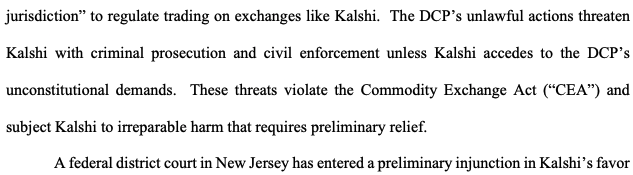
An excerpt from Kalshi’s preliminary injunction motion arguing that the DCP’s action violates federal commodities laws. Source: CourtListener

Connecticut federal court judge Vernon Oliver said in an order on Monday that the DCP must “refrain from taking enforcement action against Kalshi” as the court considers the company’s bid to temporarily stop the regulator.

The order adds that the DCP should file a response to the company by Jan. 9 and Kalshi should file further support for its motion by Jan. 30, with oral arguments for the case to be held in mid-February.

Kalshi is in a battle with multiple US states

Kalshi is a federally regulated designated contract maker under the CFTC and, in January, began offering contracts nationally that allow bets on the outcome of events such as sports and politics.

Related: How prediction markets raise insider trading and credit risks

Its platform has become hugely popular this year and saw a record $4.54 billion monthly trading volume in November, attracting billions in investments, with Kalshi closing a $1 billion funding round earlier this month at a valuation of $11 billion.

However, multiple US state regulators have taken issue with Kalshi’s offerings, which have led to the company being embroiled in lawsuits over whether it is subject to state-level gambling laws.

Kalshi sued the New York State Gaming Commission in October after the regulator sent a cease and desist order claiming it offered a platform for sports wagering without a license.

In September, Massachusetts’ state attorney general sued Kalshi in state court, which the company asked to be tossed. So far this year, Kalshi has sued state regulators in New Jersey, Nevada, Maryland and Ohio, accusing each of regulatory overreach.

Magazine: Can Robinhood or Kraken’s tokenized stocks ever be truly decentralized?

Letture associate

The Niche Consensus Among Elites: Has College Become an Expensive Waste?

**Summary:** A growing "anti-college" movement is gaining traction among elite circles in Silicon Valley, challenging the traditional value of a four-year university degree. Proponents argue that college has become an expensive, slow, and increasingly irrelevant waste of time, especially in the fast-paced tech world where opportunities pass by quickly. The movement is led by figures like billionaire Peter Thiel, who criticizes universities for high costs, ideological indoctrination, and stifling true innovation. His "Thiel Fellowship" pays young people to drop out and pursue ventures. Companies like Palantir Technologies (co-founded by Thiel) fuel this trend with programs like the "Meritocracy Fellowship," which offers high school graduates paid internships as an alternative to immediate college enrollment, promising a practical "Palantir Degree." Key drivers include: 1. **Economics:** Skyrocketing student debt versus the allure of immediate, high-paying tech jobs or startup funding. 2. **Technology:** AI and online tools lowering barriers to self-education and product development, making formal instruction seem inefficient. 3. **Culture:** A backlash against perceived "woke" ideology and DEI policies in universities, coupled with a belief that these institutions suppress meritocracy and masculine drive. The movement is notably male-dominated. Critics, like economist David Deming, warn against overgeneralizing from dropout success stories (survivorship bias). He emphasizes that genuine autodidacts are rare, corporate training is narrowly focused, and the "college wage premium" remains high for most people. University liberal arts education, he argues, builds adaptable problem-solving skills and broad perspectives. The debate highlights a deeper crisis in education. The core model of the modern university appears increasingly mismatched with the speed of the information age. The movement signals a shift in the locus of learning from institutional "education" to personal, active "learning" powered by the internet and AI. Ultimately, this may not mean the end of university, but rather a painful evolution. The future likely holds more hybrid, personalized, and lifelong learning pathways. The central question becomes: in a world changing faster than any curriculum, how do we best learn?

marsbit15 min fa

The Niche Consensus Among Elites: Has College Become an Expensive Waste?

marsbit15 min fa

From Subsidies to Token-Based Pricing to Price Cuts: Is OpenAI Sparking a Price War? Is the Inflection Point for Token Economics Nearing?

The commercialization of generative AI is facing a critical inflection point as a potential price war looms. According to The Wall Street Journal, OpenAI is considering a significant cut to its token fees to compete with rival Anthropic, signaling a shift from a growth-at-all-costs model focused on token consumption. This move comes as both companies, reportedly losing billions on compute, prepare for IPOs, and as enterprise customers face "bill shock" from switching to usage-based token billing. Reports indicate poor ROI, with one analysis finding only 18 cents of every dollar spent on AI tokens generates user-facing value. The industry's initial phases—from flat-rate subscriptions to aggressive subsidies—have given way to a reckoning with real costs. Analysts debate the future: some predict a bifurcation between premium, high-cost models for complex tasks and cheaper alternatives for routine work, while others believe overall spending will still rise as agentic AI increases tokens per task. Notably, Chinese model DeepSeek's low-cost API is gaining traction with U.S. enterprises, adding competitive pressure. The core challenge is redefining value beyond token volume ("tokenmaxxing") toward measurable productivity ("valuemaxxing"), as the entire AI value chain, from cloud providers to chipmakers, feels the ripple effects of unsustainable pricing.

marsbit20 min fa

From Subsidies to Token-Based Pricing to Price Cuts: Is OpenAI Sparking a Price War? Is the Inflection Point for Token Economics Nearing?

marsbit20 min fa

Trading

Spot
Futures

Articoli Popolari

Come comprare T

Benvenuto in HTX.com! Abbiamo reso l'acquisto di Threshold Network Token (T) semplice e conveniente. Segui la nostra guida passo passo per intraprendere il tuo viaggio nel mondo delle criptovalute.Step 1: Crea il tuo Account HTXUsa la tua email o numero di telefono per registrarti il tuo account gratuito su HTX. Vivi un'esperienza facile e sblocca tutte le funzionalità,Crea il mio accountStep 2: Vai in Acquista crypto e seleziona il tuo metodo di pagamentoCarta di credito/debito: utilizza la tua Visa o Mastercard per acquistare immediatamente Threshold Network TokenT.Bilancio: Usa i fondi dal bilancio del tuo account HTX per fare trading senza problemi.Terze parti: abbiamo aggiunto metodi di pagamento molto utilizzati come Google Pay e Apple Pay per maggiore comodità.P2P: Fai trading direttamente con altri utenti HTX.Over-the-Counter (OTC): Offriamo servizi su misura e tassi di cambio competitivi per i trader.Step 3: Conserva Threshold Network Token (T)Dopo aver acquistato Threshold Network Token (T), conserva nel tuo account HTX. In alternativa, puoi inviare tramite trasferimento blockchain o scambiare per altre criptovalute.Step 4: Scambia Threshold Network Token (T)Scambia facilmente Threshold Network Token (T) nel mercato spot di HTX. Accedi al tuo account, seleziona la tua coppia di trading, esegui le tue operazioni e monitora in tempo reale. Offriamo un'esperienza user-friendly sia per chi ha appena iniziato che per i trader più esperti.

411 Totale visualizzazioniPubblicato il 2024.12.10Aggiornato il 2026.06.02

Come comprare T

Discussioni

Benvenuto nella Community HTX. Qui puoi rimanere informato sugli ultimi sviluppi della piattaforma e accedere ad approfondimenti esperti sul mercato. Le opinioni degli utenti sul prezzo di T T sono presentate come di seguito.

活动图片













