‘Congress must pass the Clarity Act’ – U.S. Treasury Secretary’s plea decoded

ambcryptoPubblicato 2026-04-09Pubblicato ultima volta 2026-04-09

Introduzione

U.S. Treasury Secretary Scott Bessent urges Congress to pass the Digital Asset Market Clarity Act, arguing that clear federal rules are essential to prevent the relocation of crypto development to jurisdictions like Abu Dhabi and Singapore. He warns that regulatory uncertainty in the U.S. makes the risks of operating there outweigh the benefits. The call is supported by Senator Cynthia Lummis, who believes the act would serve as a "safe harbor" for innovation. However, prediction market Polymarket indicates the odds of the bill passing by 2026 have recently dropped to 57%. Despite this, key industry figures, including Coinbase's Chief Policy Officer, express confidence that legislative progress will be made.

The discussion around the CLARITY Act is intensifying day by day, and in a recent turn of events, U.S. Treasury Secretary Scott Bessent has also stepped in.

Urging Congress, Secretary Bessent has demanded the passage of the Digital Asset Market Clarity Act. Introduced in 2025, the bill is still finding common ground with both the crypto industry and the banking community, but consensus remains elusive.

Remarking on the same, Bessent said,

Congress must pass the Clarity Act. Senate floor time is scarce, and now is the time to act.

U.S. Treasury Secretary Scott Bessent’s point of argument

As reported by The Wall Street Journal, the Secretary drew comparisons with other countries, calling for clear federal rules for digital assets. This, in turn, he believes, would enable widespread developments and efficient investment, crucial for the largest economy by nominal GDP to prevail.

Comparing the U.S. with other countries, Bessent added,

A growing share of crypto development relocated to places ​with clear rules, such as Abu Dhabi and Singapore. Abroad, firms knew ​when and how to register, what standards to meet, and how to operate.

Highlighting the risks in the U.S., he summed it up best when he said,

The benefits of domiciling in the U.S. rarely outweighed the risks.

Needless to say, this isn’t the first time Bessent has stepped in to highlight the importance of clear rules in the digital assets space. Back in February, he had underlined that the bill would provide “great comfort to the market” in times of volatility.

Market conditions and others in support

Echoing similar sentiments, Senator Cynthia Lummis also noted,

We have the Administration, the momentum, and we’ve made bipartisan progress.

Lummis believes that the law is a one-pot solution for “developers, validators, and node operators.” And, once approved, the Act would work as “a safe harbor” to keep innovations anchored in the U.S.

All this comes on the heels of the crypto market fluctuating between $2 trillion and $3 trillion – thanks to increased volatility.

Polymarket odds

Meanwhile, the Polymarket odds for the passage of the CLARITY Act stood at 57% at the time of publication. However, if looked at carefully, the odds have dropped by 9% from their previous high, seen just weeks ago.
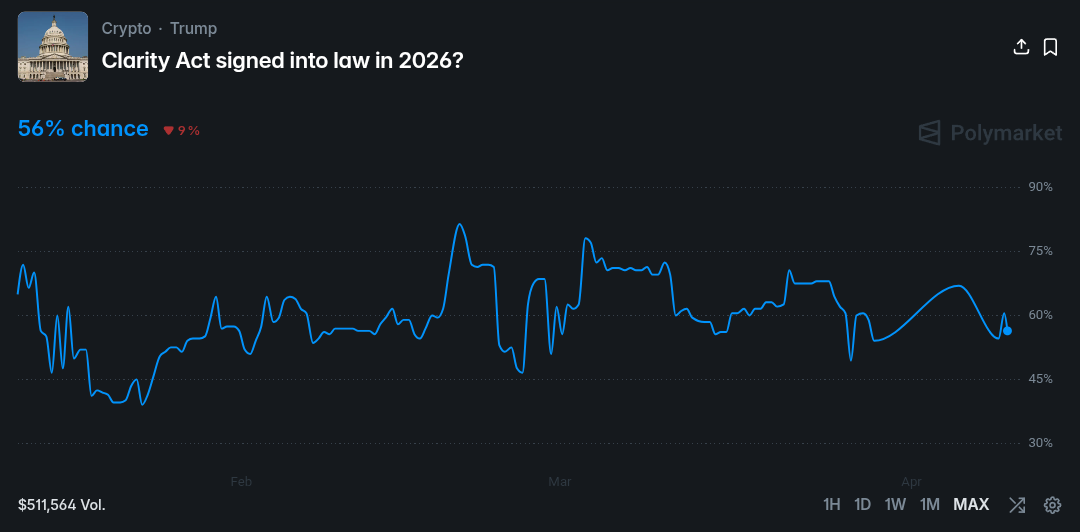
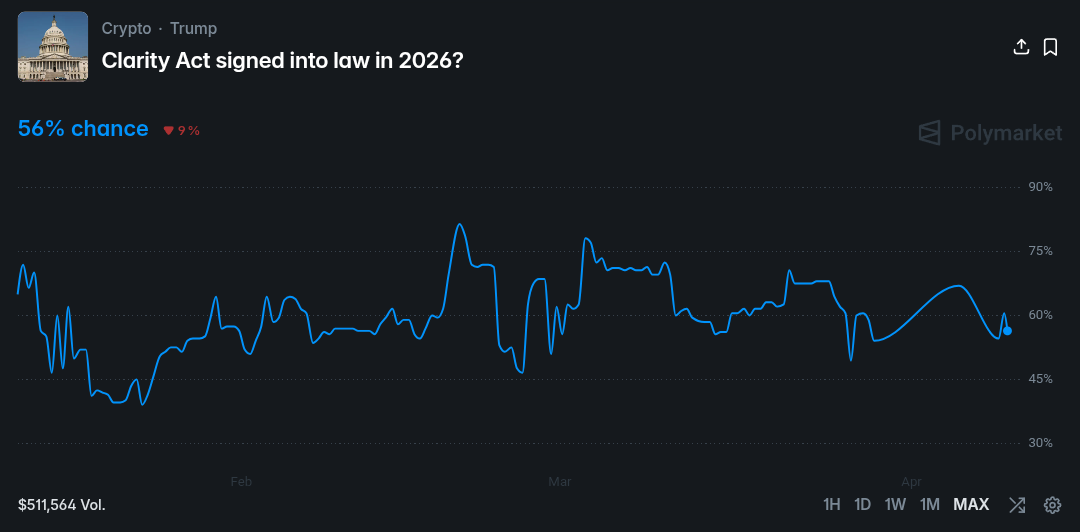
Source: Polymarket

At the same time, Coinbase’s Chief Policy Officer (CPO) also added to the ongoing demand when he noted,
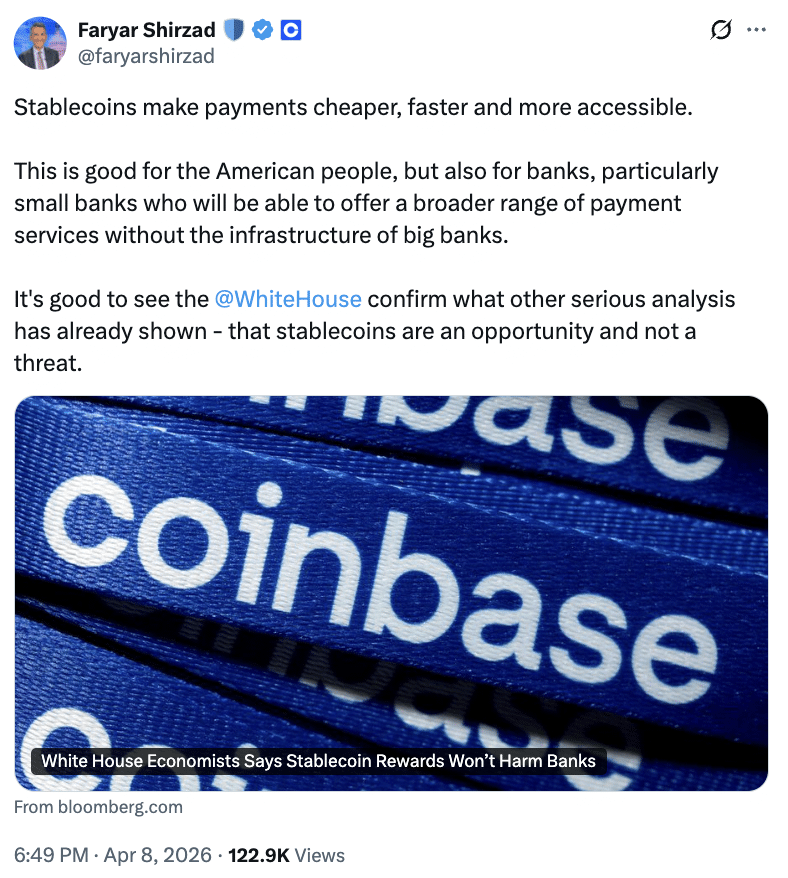
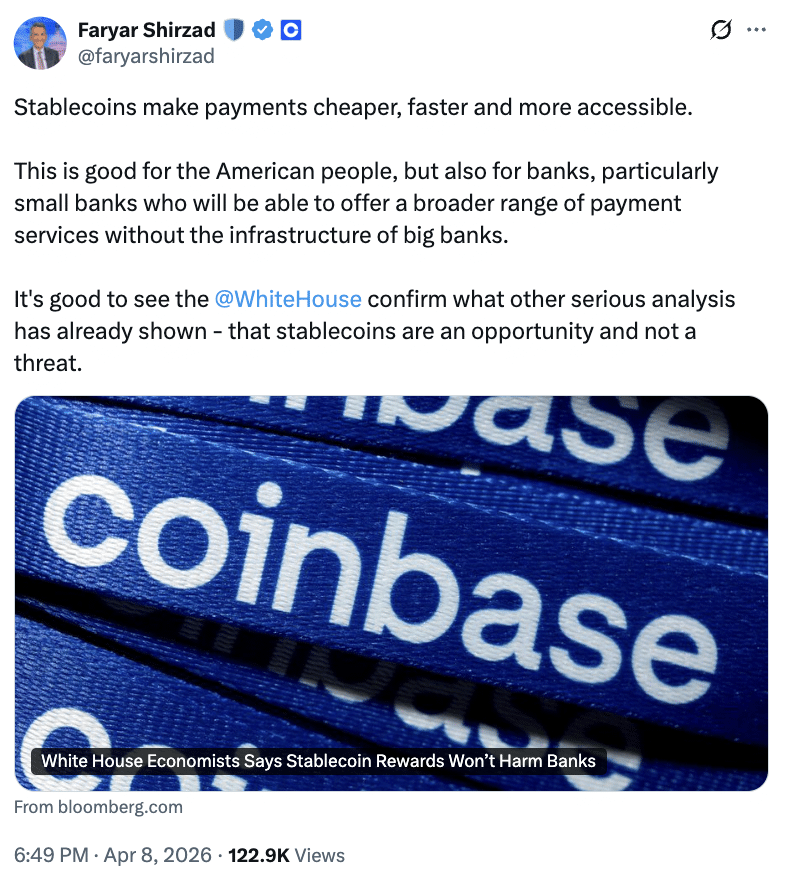
Source: X

This marks an interesting plot twist as Coinbase had recently stepped back from a recent compromise met on the CLARITY Act.

However, after the subtle threats between the White House and Coinbase, Coinbase’s CLO, Paul Grewal, turned bullish on the Act and put it best when he noted,

I’m very confident we’re going to see progress.

What’s more?

Additionally, a new report from the White House’s Council of Economic Advisers also highlighted that letting stablecoins offer yield isn’t a major threat to banks.

Thus, with so much optimism and understanding, it remains to be seen whether the CLARITY Act will be approved this year or get locked up in legislative headwinds.


Final Summary

  • The discussions around the CLARITY Act are heating up with Secretary Bessent now urging Congress to pass the Act.
  • Polymarket odds drop below 60%, adding more uncertainty to the passage of the bill by 2026.

Domande pertinenti

QWhat is the main demand made by U.S. Treasury Secretary Scott Bessent in the article?

AScott Bessent demanded that Congress pass the Digital Asset Market Clarity Act to establish clear federal rules for digital assets.

QAccording to Bessent, why are some crypto firms relocating to places like Abu Dhabi and Singapore?

ABecause these locations have clear rules, where firms know when and how to register, what standards to meet, and how to operate.

QWhat are the current Polymarket odds for the passage of the CLARITY Act, and how have they changed recently?

AThe Polymarket odds stand at 57%, which is a 9% drop from their previous high seen just weeks ago.

QWhich U.S. Senator expressed support for the CLARITY Act, and what did they call it?

ASenator Cynthia Lummis expressed support, calling the Act a 'one-pot solution' for developers, validators, and node operators, and a 'safe harbor' to keep innovations in the U.S.

QWhat was the stance of Coinbase's Chief Legal Officer, Paul Grewal, on the CLARITY Act after recent developments?

APaul Grewal turned bullish on the Act and expressed confidence, stating, 'I’m very confident we’re going to see progress.'

Letture associate

Agents Take Over Traffic Distribution Power: What Are Tencent, ByteDance, and Alibaba Competing For?

In the race to dominate the AI era's entry point, China's tech giants—Tencent, ByteDance, and Alibaba—are aggressively deploying AI Agents to control the future of traffic distribution. Alibaba is pursuing a dual-track "closed loop + openness" strategy. Its Qianwen app is evolving into a super-Agent integrated across its ecosystem (Taobao, Alipay, etc.) to handle complex tasks like travel planning. Concurrently, it is opening its platform to external brands (Luckin Coffee, KFC) and has launched a B2B Agent platform, "Wukong," targeting enterprise automation. Its other flagship, Quark, aims to be an "AI super search box" for information and tasks. ByteDance is executing an omnipresent "sprawl strategy." Its Doubao app boasts over 300 million monthly active users and is evolving into a default AI entry point for daily life, with plans for paid versions and e-commerce integration. Its core weapon is the Kouzi platform, a visual "AI assembly factory" for developers to build custom Agents. ByteDance is also pushing hardware integration, collaborating on AI phones and developing smart glasses to embed Doubao everywhere. Tencent is playing its long-held "ultimate card" by quietly embedding an AI Agent directly into WeChat. This Agent, accessible via a swipe, can understand user commands and automatically execute tasks by calling upon WeChat's millions of mini-programs (e.g., finding and ordering coffee). This leverages WeChat's unparalleled 1.4-billion-user ecosystem to position the app as an AI-powered "service operating system," a move that could dramatically reshape the competitive landscape. The core battleground is shifting from competing for "user screen time" to competing to be the "default execution layer" for user intent. The business model is evolving from an "attention economy" to an "intent economy," where the Agent that can most efficiently fulfill a user's need gains control over service access and token flow. This represents a fundamental change in how users connect with digital services, making the fight for the Agent入口 (entry point) a pivotal moment for redefining industry leadership in the AI age.

marsbit39 min fa

Agents Take Over Traffic Distribution Power: What Are Tencent, ByteDance, and Alibaba Competing For?

marsbit39 min fa

From Banning Doubao to Embracing Honor: Why Did WeChat Suddenly 'Change Its Face'?

The article explores the sudden shift in WeChat's strategy towards AI assistants from mobile phone manufacturers, transitioning from strict opposition to active collaboration. For over a year, WeChat fiercely resisted attempts by phone AI assistants (like ByteDance's Doubao in late 2025) to control its features via GUI automation ("simulated clicking"), citing security and data control concerns. This stance created a significant barrier for system-level AI integration. Now, Tencent has initiated A2A (Agent-to-Agent) partnerships with major phone brands like Honor, Xiaomi, OPPO, and vivo. This model allows a phone's system AI (e.g., Honor's YOYO) to parse a user's voice command and send a structured request directly to WeChat's own internal AI agent via secure APIs. WeChat then executes the action (e.g., sending a message) and returns the result. The article attributes Tencent's "change of face" to strategic pressure. While leading in social app usage, Tencent trails rivals like ByteDance and Alibaba in standalone AI app popularity. WeChat, with its vast mini-program ecosystem, is Tencent's key asset for an AI comeback. The upcoming WeChat AI agent aims to handle tasks like booking and payments within the app. However, phone system assistants remain the primary AI entry point for most users. The A2A collaboration allows Tencent to extend WeChat's AI reach to this crucial system layer while maintaining control over its core functions and data. For phone manufacturers, embracing A2A is a pragmatic move. The GUI route proved unviable due to WeChat's blocks. A2A offers a compliant path to integrate a vital service, enhancing their AI assistants' usefulness. It allows them to focus on developing their own AI ecosystems for other services while cooperating on WeChat access. The collaboration is framed as a mutual, strategic necessity: Tencent gains a distribution channel, and manufacturers gain a key functionality. The partnership relies on a "dual authorization" mechanism for security, requiring both user and app consent for each action. While questions about long-term data privacy practices remain, experts note A2A is more secure and compliant than GUI automation. Ultimately, this cooperation is seen as a tentative, calculated truce. Tencent's long-term goal is to make WeChat an AI-powered "service OS." Phone manufacturers aim to make their system AI the central user interface. Their paths may converge or clash in the future, but for now, the A2A deal represents the opening chapter in the battle for the AI-era user入口, driven by necessity and strategic calculus on both sides.

marsbit2 h fa

From Banning Doubao to Embracing Honor: Why Did WeChat Suddenly 'Change Its Face'?

marsbit2 h fa

Trading

Spot
Futures
活动图片





