‘Congress must pass the Clarity Act’ – U.S. Treasury Secretary’s plea decoded

ambcryptoPubblicato 2026-04-09Pubblicato ultima volta 2026-04-09

Introduzione

U.S. Treasury Secretary Scott Bessent urges Congress to pass the Digital Asset Market Clarity Act, arguing that clear federal rules are essential to prevent the relocation of crypto development to jurisdictions like Abu Dhabi and Singapore. He warns that regulatory uncertainty in the U.S. makes the risks of operating there outweigh the benefits. The call is supported by Senator Cynthia Lummis, who believes the act would serve as a "safe harbor" for innovation. However, prediction market Polymarket indicates the odds of the bill passing by 2026 have recently dropped to 57%. Despite this, key industry figures, including Coinbase's Chief Policy Officer, express confidence that legislative progress will be made.

The discussion around the CLARITY Act is intensifying day by day, and in a recent turn of events, U.S. Treasury Secretary Scott Bessent has also stepped in.

Urging Congress, Secretary Bessent has demanded the passage of the Digital Asset Market Clarity Act. Introduced in 2025, the bill is still finding common ground with both the crypto industry and the banking community, but consensus remains elusive.

Remarking on the same, Bessent said,

Congress must pass the Clarity Act. Senate floor time is scarce, and now is the time to act.

U.S. Treasury Secretary Scott Bessent’s point of argument

As reported by The Wall Street Journal, the Secretary drew comparisons with other countries, calling for clear federal rules for digital assets. This, in turn, he believes, would enable widespread developments and efficient investment, crucial for the largest economy by nominal GDP to prevail.

Comparing the U.S. with other countries, Bessent added,

A growing share of crypto development relocated to places ​with clear rules, such as Abu Dhabi and Singapore. Abroad, firms knew ​when and how to register, what standards to meet, and how to operate.

Highlighting the risks in the U.S., he summed it up best when he said,

The benefits of domiciling in the U.S. rarely outweighed the risks.

Needless to say, this isn’t the first time Bessent has stepped in to highlight the importance of clear rules in the digital assets space. Back in February, he had underlined that the bill would provide “great comfort to the market” in times of volatility.

Market conditions and others in support

Echoing similar sentiments, Senator Cynthia Lummis also noted,

We have the Administration, the momentum, and we’ve made bipartisan progress.

Lummis believes that the law is a one-pot solution for “developers, validators, and node operators.” And, once approved, the Act would work as “a safe harbor” to keep innovations anchored in the U.S.

All this comes on the heels of the crypto market fluctuating between $2 trillion and $3 trillion – thanks to increased volatility.

Polymarket odds

Meanwhile, the Polymarket odds for the passage of the CLARITY Act stood at 57% at the time of publication. However, if looked at carefully, the odds have dropped by 9% from their previous high, seen just weeks ago.
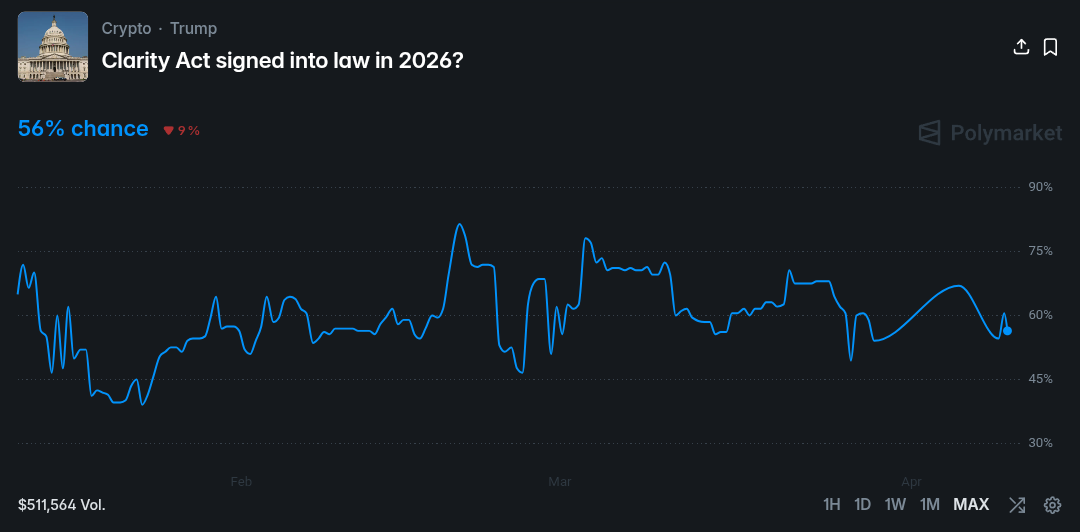
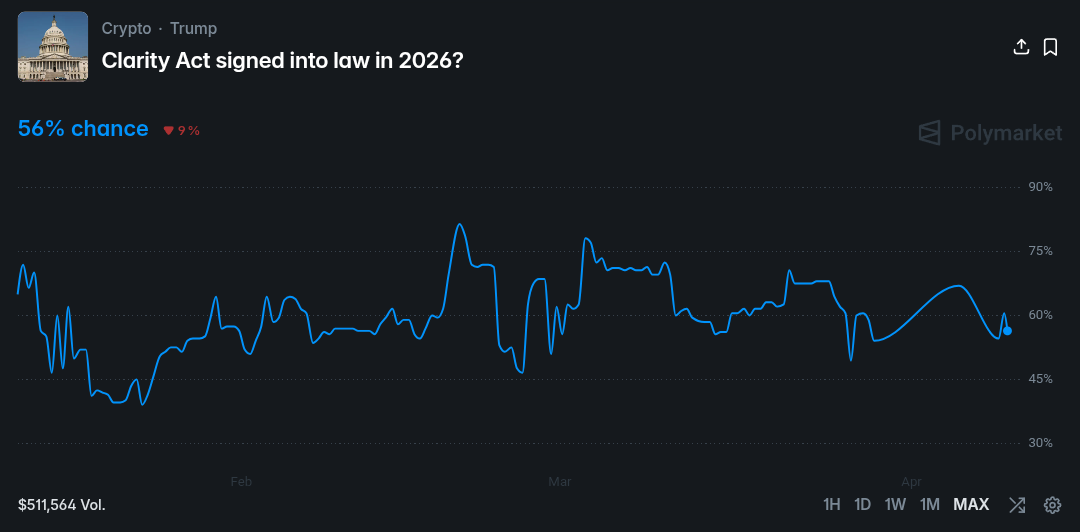
Source: Polymarket

At the same time, Coinbase’s Chief Policy Officer (CPO) also added to the ongoing demand when he noted,


Source: X

This marks an interesting plot twist as Coinbase had recently stepped back from a recent compromise met on the CLARITY Act.

However, after the subtle threats between the White House and Coinbase, Coinbase’s CLO, Paul Grewal, turned bullish on the Act and put it best when he noted,

I’m very confident we’re going to see progress.

What’s more?

Additionally, a new report from the White House’s Council of Economic Advisers also highlighted that letting stablecoins offer yield isn’t a major threat to banks.

Thus, with so much optimism and understanding, it remains to be seen whether the CLARITY Act will be approved this year or get locked up in legislative headwinds.


Final Summary

  • The discussions around the CLARITY Act are heating up with Secretary Bessent now urging Congress to pass the Act.
  • Polymarket odds drop below 60%, adding more uncertainty to the passage of the bill by 2026.

Domande pertinenti

QWhat is the main demand made by U.S. Treasury Secretary Scott Bessent in the article?

AScott Bessent demanded that Congress pass the Digital Asset Market Clarity Act to establish clear federal rules for digital assets.

QAccording to Bessent, why are some crypto firms relocating to places like Abu Dhabi and Singapore?

ABecause these locations have clear rules, where firms know when and how to register, what standards to meet, and how to operate.

QWhat are the current Polymarket odds for the passage of the CLARITY Act, and how have they changed recently?

AThe Polymarket odds stand at 57%, which is a 9% drop from their previous high seen just weeks ago.

QWhich U.S. Senator expressed support for the CLARITY Act, and what did they call it?

ASenator Cynthia Lummis expressed support, calling the Act a 'one-pot solution' for developers, validators, and node operators, and a 'safe harbor' to keep innovations in the U.S.

QWhat was the stance of Coinbase's Chief Legal Officer, Paul Grewal, on the CLARITY Act after recent developments?

APaul Grewal turned bullish on the Act and expressed confidence, stating, 'I’m very confident we’re going to see progress.'

Letture associate

Can Generative Models Finally Be Trained End-to-End? The Core Is a For Loop

This article introduces a novel training paradigm for generative models called Explorative Modeling (XM), which enables true end-to-end training. Traditionally, powerful generative models like autoregressive and diffusion models are not trained end-to-end. They are trained to predict a single small step but require iterative multi-step sampling for inference. This "exposure bias" leads to error accumulation and limits performance. The core challenge XM addresses is "mode blurring." In generative tasks, a single input (e.g., "generate a dog") corresponds to many valid outputs (multiple modes). Standard training objectives like reconstruction loss force the model to average these modes, producing unrealistic, blurry outputs. To avoid this, existing models break generation into many small, almost deterministic steps, sacrificing end-to-end training. XM tackles this by restructuring the training loop itself. Its key insight is to amplify "generative expressivity." For each training input, instead of generating one sample, the model generates K candidate outputs. Only the candidate closest to the real data is used for computing the loss and updating the model via backpropagation. This simple "best-of-K" mechanism is implemented as a short for-loop. By exploring multiple possibilities, the model learns to distribute its guesses across different modes rather than collapsing to their uninformative average. The paper demonstrates that "exploration" acts as a new, powerful scaling axis. Gains from XM increase with model size, data scale, and compute. Experiments show improvements in FID scores for image generation and significant efficiency gains, sometimes outperforming larger models without exploration. When pushed to the limit, XM enables fully single-step, end-to-end generative models. In robotics tasks, an "Explorative Policy" matched the performance of a 100-step Diffusion Policy with a single forward pass, drastically improving inference speed. While the best-of-K concept is not entirely new, the authors' contribution lies in formally understanding it as a direct method to boost generative expressivity without fragmenting the generation process. This work suggests that as models scale, enhancing exploration during training may become crucial for overcoming fundamental performance bottlenecks.

marsbit30 min fa

Can Generative Models Finally Be Trained End-to-End? The Core Is a For Loop

marsbit30 min fa

Annual Salary of Millions Competing for Electricians, Meta Rushes to Open Its Own Technical School

The AI boom is facing an unexpected bottleneck: a severe shortage of skilled construction workers and electricians. As tech giants like Meta, OpenAI, and Alphabet race to build massive data centers—such as OpenAI's $16 billion "Stargate" project—they are hitting a critical labor wall. The U.S. needs an estimated 130,000 more electricians, 240,000 construction workers, and 150,000 supervisors by 2030 for AI infrastructure alone, but tens of thousands of electrician jobs go unfilled each year. While AI companies offer high premiums, with electricians earning up to $280,000 annually, worker scarcity still causes massive losses—delays on a single project can cost $14.2 million per month. The complexity of building AI data centers, which require immense power (equivalent to powering hundreds of thousands of homes), sophisticated electrical systems, and advanced liquid cooling solutions, demands highly skilled technicians who are in short supply. To combat this, companies are investing heavily in training. Meta has committed $115 million to a free training school offering tuition, housing, and stipends, targeting 5,000 new workers. OpenAI is partnering with unions to secure skilled labor. These efforts are paying off, with a significant rise in Gen Z interest in trade schools over college. However, the power demands are staggering. AI data centers are driving a rapid surge in electricity consumption, projected to account for up to 12% of U.S. power use by 2028 and raising costs for consumers. Furthermore, the construction boom is project-based, leading to a potential future glut of trained workers once building peaks, which could depress wages industry-wide. The race for AI supremacy now depends as much on skilled hands as on advanced chips.

marsbit2 h fa

Annual Salary of Millions Competing for Electricians, Meta Rushes to Open Its Own Technical School

marsbit2 h fa

Trading

Spot
活动图片





